 Home Home | Explore the BBC |
 | ||
 | 24 April |  |
| ||
| | | | | | | |
| |||||||
| Search ON THIS DAY by date | | |   | |||
| |||||||
| |||||||
|
|
| | | | | | | | ||||||||||||
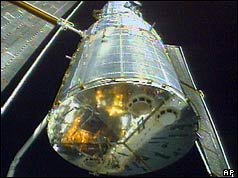
| 1990: Hubble telescope takes off for space The American space agency Nasa has successfully launched the space shuttle Discovery from Cape Canaveral in Florida on its historic mission to carry the Hubble space telescope into orbit 380 miles (611.5 km) above the Earth.
The telescope will operate from high above the atmosphere, thus avoiding the interference which limits ground-based telescopes. It will be able to see up to the edge of the known universe, taking images of objects and events which happened up to 14 billion years ago. The telescope, the size of a railway carriage, has taken 20 years to build, at a cost of $1.55 billion. It has been dogged by technical hitches, huge budget over-runs and other delays. Seven years late Its launch is seven years overdue, held up by problems in the space shuttle program, including the explosion of the Challenger shuttle in 1986. The problems continued even once it was safely in space, as the British-made solar panel arrays which provide power for the six separate instruments on board malfunctioned. However, scientists said they were expecting it to be difficult. "Deploying the solar panels is technically more challenging than the launch of a shuttle one more time," said Nasa scientist Stephen Maran. The fault was resolved, and now the telescope faces six months of testing before becoming fully operational. Test image Nasa hopes to release the first test image - of an open star cluster known as NGC 3532 - in about a week. Hubble's main instrument is a finely-polished mirror 94 inches (240 cm) across. There are also two cameras - one which can achieve image resolutions 10 times greater than that of even the largest Earth-based telescope, and a second which can detect an object 50 times fainter than anything visible from Earth. "We are going to have the ability to observe the most distant objects, among the earliest in the universe, and thus probe the secrets of creation," said Nasa's chief scientist, Leonard Fisk. The telescope will be controlled by the specially-created Space Telescope Science Institute at Baltimore. It's thought Hubble's images will provoke a drastic revision of the shapes, sizes and content of galaxies already identified by ground-based telescopes. It is also likely to find new stars and phenomena, and astronomers suggest the telescope provides the best chance yet of working out the true age of the universe.
| |
| | | Stories From 24 Apr | | ||||||||||||
| | ||||||||||||||||||
| | | | | | | |
| |||||||
| Search ON THIS DAY by date | | | | |||
| |||||||
| |||||||
 | ^^ back to top |
| Front Page | Years | Themes | Witness | |
| ©MMVIII | News Sources | Privacy & Cookies Policy |



 In Depth: The Hubble Space Telescope