
The Indian Ocean - The Spice Islands - Coral coring, Indian Ocean

Locations
The Indian Ocean - coastal waters
Location map
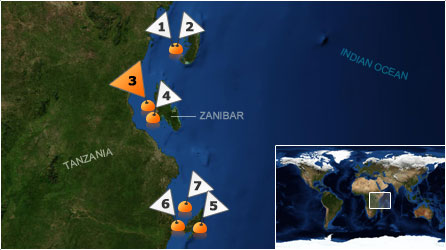
Introduction
The tropical Indian Ocean is home to the Spice Islands. Characterised by beautiful sandy beaches, fringing coral reefs and coastal mangrove forests, this is a vibrant nursery area for marine life, such as whale sharks, crabs, seahorses and a great variety of fish. The coastal areas are where humans have the most direct impact on the ocean's resources.
Coral coring, Indian Ocean
Overview
The Indian Ocean is known for its extreme weather. Warm surface water evaporates and creates spiralling winds which can trigger cyclones and devastate coastal settlements. The large and well established corals off Zanzibar contain historical data which could help protect people from catastrophic storms.
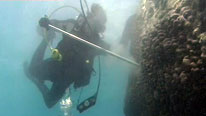
Marine geologists are undertaking research to find a way of predicting heavy rains and violent storms. They have been extracting core samples from the coral using a hydraulic drill powered by compressed air. These samples are expected to contain climate information from the last three centuries. Corals have growth bands, similar to tree rings, and a German-Dutch research group has teamed up to isolate past weather events in the sample using an ultra-violet light technique and geochemistry.
| Importance: | The technique that uses coral cores to record and study the pattern of storm events in the past may enable scientists to predict extreme weather events and save lives. |
| Dive category: | This is a scientific reef dive which involves specialist equipment. |
| Access: | The sea around Zanzibar is well established as a popular dive location. |
Interesting for
- Climate reseach in the Indian Ocean
- This website explains the joint research initiative being carried out by the Universities of Amsterdam and Cologne.
- SINDOCOM
- Paleoclimatology - corals and climate
- An introduction to the science by NOAA (US based National Oceanic and Atmospheric Administration)
- Coral Paleoclimatology: What can corals tell us about climate?
- The nature and characteristics of tropical cyclones
- Wikipedia's profile on these storm systems.
- Tropical cyclone
- Coral protection
- The World Wildlife Fund describes the conservation efforts currently focussed on the worlds coral hot spots.
- Increasing protection: coral reefs and mangrove forests.
BBC related content
Episode region
BBC iD
BBC iDBBC navigation
BBC links

BBC © 2014The BBC is not responsible for the content of external sites. Read more.
This page is best viewed in an up-to-date web browser with style sheets (CSS) enabled. While you will be able to view the content of this page in your current browser, you will not be able to get the full visual experience. Please consider upgrading your browser software or enabling style sheets (CSS) if you are able to do so.
