
The Red Sea - Human settlements, Red Sea

Locations
The Red Sea
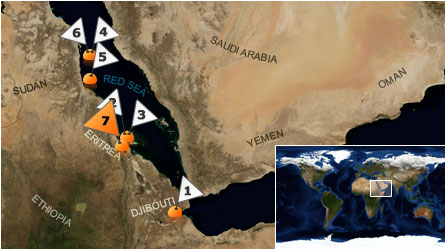
Location map
Introduction
The Red Sea is one of the youngest oceans in the world and one of the warmest. The northern region, with its diverse array of marine life, is one of the most visited dive locations on earth while the southern end remains virtually unexplored. It's a global hotspot for marine biology and an important trade route throughout human history, linking the trade goods of India and the Far East with the markets of Egypt and Europe.
Human settlements, Red Sea
Overview
Recent research suggests that the Red Sea was one of the first seas encountered by early modern humans. Along the coastline of the Red Sea in Eritrea, signs of the first coastal settlements are evident. Coral reefs, 125,000 years old, have been raised up over 10 metres by several earthquakes, which means there's little need to go diving to find these signs of early civilisation.
Buried deep within this ancient coral is evidence of early human activity. Items such as cutting tools date back to the Palaeolithic period and remains of discarded oyster shells show man's very early interactions with the sea.
| Importance: | Evidence of some of the earliest modern human settlements in the world. |
| Dive category: | This archaeological site is now above the sea level so no diving is necessary. |
| Access: | This site is in a militarised zone where access is heavily restricted. |
Interesting for
- History of paleoanthropology
- Wikipedia highlights the key points of human evolution.
- Human evolution
- Tools used by Palaeolithic man
- A summary of the oldest tools used by humans on the handprint website
- Hominid Tools
BBC related content
Episode region
BBC iD
BBC iDBBC navigation
BBC links

BBC © 2014The BBC is not responsible for the content of external sites. Read more.
This page is best viewed in an up-to-date web browser with style sheets (CSS) enabled. While you will be able to view the content of this page in your current browser, you will not be able to get the full visual experience. Please consider upgrading your browser software or enabling style sheets (CSS) if you are able to do so.
