 | 29 October 2014 |

| |
| BBC Homepage | | |
| |||
| Contact Us | | |
Local historyYou are in: Nottingham > History > Local history > Nottingham's long forgotten plaques 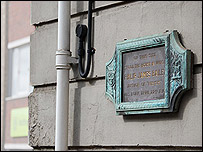 Plaque for Philip James Bailey Nottingham's long forgotten plaquesAround Nottingham there are many plaques dedicated to former residents, including ones which have been long forgotten. Around Nottingham there are many plaques, some you may never have noticed, which grace the walls of buildings. They're dedicated to people who, whilst living in Nottingham, achieved astonishing things. There's one dedicated to DH Lawrence and Lord Byron; as well as lace manufacturer Thomas Adams and Trent Bridge cricket ground founder William Clarke. There are some which have only been installed recently. For example, George Africanus, Nottingham's first black entrepreneur, was only given a plaque in 2003 - despite dying in 1834. Forgotten peopleHowever, there are also tributes to those who're less well-known. 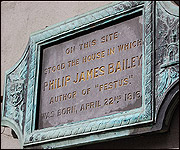 Holbrook plaque for Philip James Bailey Three old, rectangular, weathered plaques can be found dedicated to Philip James Bailey, Henry Dawson and Marshall Tallart. These 'Holbrook' plaques (named after William Holbrook who provided the money for them), only give us a tantalising morsel of what the three men did. After a bit of research... Philip James BaileyPhilip James Bailey (1816-1902) was the author of a multi-volumed poem called Festus. He spent most of life in Nottingham and wrote Festus as a young man. He never bettered the success of this lauded work. According to an entry on Wikipedia, Festus "is a vast pageant of theology and philosophy" and "an attempt to represent the relation of God to man and of man to God." Heavy stuff, but it was hugely popular in its day, and even Lord Alfred Tennyson was a fan of the work. Henry DawsonHenry Dawson (1811 - 1878) was an artist whose work is comparable with that of Turner's. 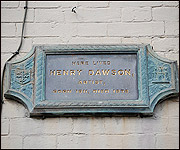 Holbrook plaque for Henry Dawson His most famous work depicted King Charles I Raising his Standard on 24th August 1642 at Nottingham Castle. His plaque is located above a hairdressers on Mansfield Road and unless you're on a double decker you probably wouldn't notice it. Ironically this says a lot about Dawson's work. Barely acknowledged in his day, it was only just before he died that he found recognition for his paintings. Marshall TallartMarshall Tallart (1652 - 1728) was a French military commander. At the Battle of Blenheim in 1704, Tallart's forces were destroyed and he was captured and then imprisoned in Nottingham. 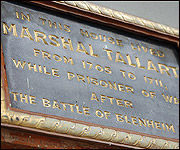 Holbrook plaque for Marshall Tallard He lived in Newdigate House, which now houses the World Service Restaurant near the Castle. He was under parole in Nottingham but endeared himself to the locals. Allegedly he taught local women to make white bread and popularised the eating of celery. Holbrook plaquesIn the early 20th Century, William Stevenson Holbrook left money in his will to have various plaques, and tributes, erected around the city which celebrated historical moments. He also left money to celebrate six poets which had lived within the city. Holbrook plaques can still be found around the city, including the three mentioned above, the others are dedicated to Charles I, Gilbert Wakefield, Lord Byron and John Leavers. Seven are missing, thought to have been stolen, these were dedicated to: Historian John Blacker, missionary William Carey, artist Edwin Ellis, mathematician George Green, engineer Thomas Hawksley and two poets Robert Millhouse and Henry Kirke White. Take a look at our plaque gallery: last updated: 27/05/2008 at 15:50 You are in: Nottingham > History > Local history > Nottingham's long forgotten plaques    |
| | About the BBC | Help | Terms of Use | Privacy & Cookies Policy |
