In an age when public houses have determinedly obscure names, the Roman Bath pub in York should be applauded. Why, in the 1970s, did the Mail Coach Inn at St Sampsons Square become the Roman Bath? Because thats exactly what was discovered deep in its bowels. The question is, do todays rowdy patrons realise their behaviour is eerily reminiscent of the legionnaires who occupied it almost 2000 years ago? What's in a bathhouse?
Bath-houses to the Romans were a cross between leisure centres and casinos. Perhaps regrettably, they have no equivalent in modern society
After completing their involved bathing regime, the soldiers of the Legio IX Hispana, for whom York was home until 122 AD, might easily have indulged in a spot of gambling or have clinched a business deal. Artefacts discovered during excavations at York's legionary bath-house include fragments resembling playing pieces used in a form of back gammon and chess. 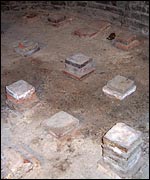 | | Floor of York's bath-house |
Dens of iniquity?
The lascivious nature of the baths is reflected in the rule adopted in bath-houses across Roman Britain that ladies bathe in the mornings and gents at other times. The rule reflected the desire to shield ladies from the wayward habits of their male counterparts. Although some might suggest the men had a hidden agenda in avoiding the reprimands of their womenfolk! The rowdy atmosphere of Roman bath-houses is delightfully described by the Roman philosopher Seneca. His account of living above a bathhouse reveals their lively, bustling nature. "Add to this the arrest of an occasional roisterer or pick-pocket, the racket of the man who always likes to hear his own voice in the bathroom, or the enthusiast who plunges into the swimming tank with unconsciable noise and splashing
Then the cake-seller with his varied cries, the sausage-man, the confectioner and all the intonations of the vendors of food hawking their wares, each with his own distinct intonation." Vigorous cleaning!
Quite apart from the social aspect of Roman bath-houses, the actual process of bathing was incredibly elaborate and involved, extravagant enough to match any modern-day spa treatment centre. 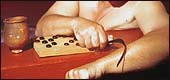 | | A stirgil in action |
First came the exercise, necessary in order for the individual to work up a healthy sweat. The next stage was the caldarium, or hot room, the remains of which are visible in the cellar of the Roman Bath pub in York. Here the sweat and dirt was scraped off the skin using an instrument known as a stirgil. In the remains at York, the stone blocks which would have supported the raised floor are visible. Underneath this floor, furnace-heated air would circulate giving the room a sauna-like temperature and humidity. As yet, other chambers of York's bath-house have not been located. After the caldarium came the frigadarium and plunge pool to close the pores. Finally the fraternising and socialising that made the bath-houses so much more than simply a place to clean oneself. So the next time there's a deal struck over a pint, a win on a fruit machine, or a little rowdy interaction at closing time, will the participants realise they're continuing a tradition that's almost 2000 years old? Bibliography Roman Towns in Britain, Guy de la Bedoyere, Tempus Publishing, 2003 Roman Britain, Keith Branigan, Reader's Digest, 1980 Seneca: Epistulae Morales, translated R Gunmere, Loeb Classical Library, 1920 The Towns of Roman Britain, John Wacher, Book Club Associates, 1976 With thanks to Keith Mulhearn of the Roman Bath Museum, York.
| 



 ROMANS