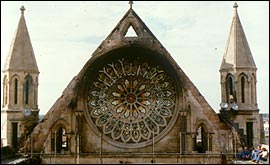
That particular Sunday evening my wife and I were standing in the back bedroom watching lightning. At around midnight the phone went and it was the Minster policeman. He said 'Bob, I've got a fire' I immediately thought, 'oh it's another false alarm on the detection system'. I asked where and he said 'South Transept'. I set off and by the time I was on Monkgate I could see the flames and a great pawl of smoke. I was stopped by one of the city police and had to leave my car there. So I went into the Minster and joined the policemen who by then had let the firemen in through the south entrance, and even at that early stage we could see flames starting come through the vaulted ceiling. Together with my assistant, Alex Simpson, I had to get keys and take firemen up to try and gain access to the fire. It was very unfortunate because the policeman had only been at the cathedral for three weeks and that was his first night on duty on his own, so he was a little overwhelmed by what was happening. We took the firemen up but the fire had occurred at the only entrance there was to the roof void so it was impossible get to the seat of the fire. 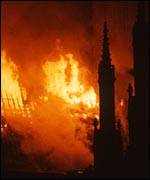 | | The Minster fire |
In what seemed a very short time the flames were bursting through the vaulted ceiling, timbers were falling and molten lead was coming down. By about four in the morning the whole of the roof collapsed. That was quite a time because I was down below with the firemen and we were trying to put out these blazing timbers as they fell. We suddenly heard this roar as the roof started to come down and we just had to run as the whole thing collapsed like a pack of cards down the centre of the South Transept. It was a comparatively short time then before the fire was out because it was there on the ground and accessible. My workmen had heard about this, there was an early broadcast on Radio York, and they started coming in to join me by about 6:00 in the morning. We decided that we'd start to clear up straight away, we had to knock off while the archaeologist came in to photograph and label the debris, then we carried on clearing up. 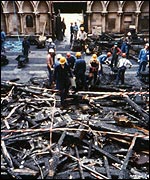 | | Rubble in the South Transept |
Here I'd to praise all the men working with me at that time. They came in and worked right until 8:00 at night and they did that night after night until we'd cleared the transept. We also had a great number of volunteers who came in and cleaned the rest of the building. Back in my office the phone was ringing the next morning with people from all over the country offering oak trees to rebuild the cathedral. I received offers of about 260 trees with some people offering a great number. The architect came the next morning, Dr Charles Brown, and we formed a little committee. Together with some structural engineers we had to put forward a case for how we thought the restoration should be done. I was for a very traditional repair, using oak timbers and more or less copying the old roof and vaulted ceiling. Certain people wanted to use steel and other materials, so we had to put forward our case to the Dean and Chapter and then let them make a decision. We waited a matter of an hour or two and the decision was made that the restoration would be done in a traditional manner using traditional materials, effectively putting back what was there. 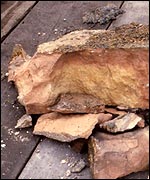 | | Calcified stone damaged by the heat of the fire |
What was more important to me at the time was that I would be put in charge of that work because of my background. Before I became Superintendent of Works I had been a joiner with the Dean and Chapter. I'd learned my trade with my grandfather and when I started he was restoring the ceiling of the North Transept so ironically I learned my trade doing that particular type of work, so that's why it was useful for me. There was a lot of stone work to do, because the archway between the south transept and the central tower had been severely burnt and the gable end had to be rebuilt above the rose window. The archway was a cause for concern because that arch supports the central tower, so it had to made safe. In the meantime I was going round the country looking at oak trees and selecting the very best. We appointed a firm of timber merchants to process the trees. One of the things I had to do was convince people that for a roof structures it's quite normal to use unseasoned timber, but for the vaulted ceiling I needed something reasonably well seasoned. So the timber used for the ceiling was sawn into 3.5" planks. We air dried them for nine months, then kiln dried them for another three months to reduce the moisture content. Then we built up the ribs and the bosses in a series of laminations. To make the 13, five tonne, roof trusses we needed a huge workshop. So I took an area in the Dean's Park and covered it with boarded floor. Then we erected over it the first temporary roof that we'd used to make the cathedral watertight. 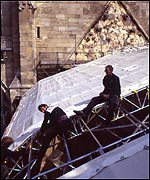 | | The temporary roof is put in place |
That was one of the many offers we had. A firm that made these domed roof structures contacted me and said they could make the building watertight as a temporary measure. It wasn't high enough to work in because of the huge pitch of the roof, but we used that until they could make a much higher structure which was in three sections running on tram lines on the walls so we could move a section to one side to drop the roof trusses into place. The reconstruction took four years and cost £2.25m. We had all sorts of offers of help - practical things like polythene sheeting to seal of the transept and beeswax to polish furniture, we also had lots of people sending in money. As soon as it was discovered the building was insured the money dried up. But we had got a considerable amount of money in and that was used later to improve the fire detection system and help make the new roof more fire resistant. I'm very proud of the work we did. From my point of view it's special to think that the Littlewood family have been involved in restoring both the north and south transept. We have a long history of working at the Minster, some 260 years. My grandfather, my father, my uncle, my mother, my son and my grandson were all there for a while and I was at the Minster for 51 years. During the restoration I remember one member of the Clergy saying to me that it was a case of the right person being there at the right time, and that meant a lot. Bob Littlewood |