 | 29 October 2014 |

| |
| BBC Homepage | | |
| |||
| Contact Us | | |
Local historyYou are in: North Yorkshire > History > Local history > Clock quiz: the answers 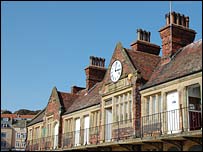 Clock quiz: the answersBy Adam Holmes Time's up - how did you do? There were 11 North Yorkshire clocks in our quiz. Did you identify them are or have you made a clock up? Here's where you find out exactly how you fared. IMAGE 1 - St Peter and St Paul's Church, PickeringI know I said it was easy, but was this one too easy? 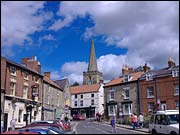 The place we are looking for is Pickering and the clock in question is the one on the tower of the parish church, St Peter and St Paul. The church is famous for its frescoes which date from the Middle Ages. During the Reformation they were painted over and forgotten about until they were uncovered in 1852 during work on the interior of the church. Although the frescoes were covered over again, a major restoration project between 1876-78 saw them put back on permanent public display. IMAGE 2 - Old Town Hall, WhitbyThis wasn't an easy clock to spot, but it is quite a landmark in Whitby. 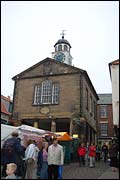 The clock is in the heart of the 'old town' and stands on top of the Old Town Hall in the Market Place. During the summer months the surrounding area is packed with tourists exploring the narrow streets and window shopping and browsing round the many gift shops. This is the part of Whitby which is synonymous with Whitby Jet - the fossilised remains of trees from the Jurassic period - which is made into jewellery. Many people walking through this area will also be making their way to or from Whitby's famous 199 steps which lead up the East Cliff to St Mary's Church and Whitby Abbey. IMAGE 3 - Station clock, Whitby railway stationThere are few places where punctuality and timekeeping is as important as a railway station! 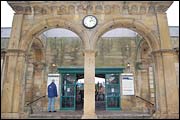 This is the clock at the entrance to Whitby railway station. If you look closely at the clock face, you can see the lettering LNER (which is partially obscured by the hands of the clock) which stands for London and North Eastern Railway, the company which built the station. At one time Whitby had a number of stations, but this is the only one which remains. It's the terminus of the Esk Valley line which connects Whitby to both Pickering (via the heritage North Yorkshire Moors Railway) and Middlesbrough. IMAGES 4 & 5 - West Pier, ScarboroughThere's not a lot on the first of these pictures to give away its location, but the second shows more of its surroundings and helps put it in context. 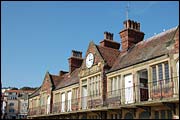 The building which the clock is part of looks out onto a small public car park. Part of the ground floor of the building is a public toilet, hence the cryptic reference in the caption to 'spending a penny.' I'm not sure how comfortable I felt taking pictures of a public loo! The West Pier is the heart of what remains of Scarborough's fishing industry. The trawlers land their catch here and it's where the Harbour Master has his office. There's a fishmongers where you can buy fresh fish and at the end of the pier there's an ice house! (It's not a house made of ice, but the place where the ice used for keeping fish fresh is made). IMAGE 6 - Stokesley Town Hall, StokesleyWe've gone north in the search for this clock, which is on the wall of Stokesley Town Hall. 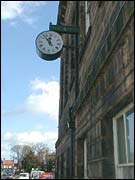 Stokesley is on the River Leven, at the foot of the Cleveland Hills. The High Street, with College Square at one end and West Green at the other, is bounded by Georgian and Regency buildings. You get some great views of the northern edge of the North York Moors from Stokesley. The High Street is bounded by Georgian and Regency buildings, which make it quite an elegant little town. The town is on the River Leven and there's a nice walk to Great Ayton, the birthplace of the famous explorer Captain Cook! Stokesley's weekly Friday markets, which are held along the wide cobbled High Street, date back to 1223 when the town was first granted a charter to hold fairs. IMAGE 7 - St Andrew's Church, RillingtonThis clock has got to be one of the most seen clocks in the whole of North Yorkshire. 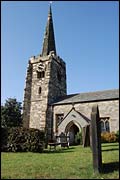 The church is next to the busy A64 and stands at the crossroads in the centre of the village of Rillington. Every day, thousands of cars, lorries, vans and busses trundle past, but how many drivers and passengers appreciate this lovely clock? The church spire - which has recently undergone extensive restoration work - has had quite an 'eventful' history. The spire was blown down in 1783 and rebuilt in 1788. It was then damaged by the Great Gale of 1839 and was repaired in 1840. In 1867, it was struck by lightening and had to be restored again - this time "with a conductor attached". IMAGE 8 - Hornes Travel Goods & Gift Shop, WhitbyThis was probably one of the easiest clocks to spot! 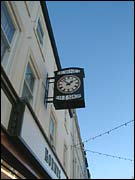 One of the most visible clues as to its whereabouts is the fact the name of the shop is clearly visible in the picture! Hornes is on Skinner Street in Whitby. Whitby is a fantastic place to wander around. There are quite a few new shops as well as the long established, traditional, businesses. If you've not been to Whitby recently, it's well worth a visit. You can watch the boats come and go in the harbour and there are some great places to eat fish and chips or an ice cream. IMAGE 9 - St Mary's Church, ScarboroughSt Martin's and Holy Apostles' church enjoys a commanding position above Scarborough's 'old town' and offers excellent views over the harbour and South Bay. It occupies one of the highest points in Scarborough and is close to the entrance to Scarborough Castle. 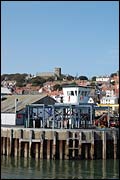 This picture of St Mary's was taken close to the lighthouse at the end of Vincent Pier in Scarborough Harbour. Although the church is quite a distance away, the clock is still clearly visible. There's been a church on this site since at least 1150. During the 1400s St Mary's was extended and was much bigger than it is today. The church was severely damaged in 1645, during the Civil War, when it caught up in a siege of the nearby castle. Anne Bronte (sister of Charlotte) was buried in St Mary's churchyard after her death in 1849. Her funeral service was held at nearby Christ Church because of restoration work being carried out at St Mary's. (Christ Church was demolished in 1979). The white building in the foreground of this picture is the port control cabin for Scarborough Harbour Master and his team. IMAGE 10 - Solberge Hall, near NorthallertonA Georgian country house better known for its food and accommodation - Solberge Hall Hotel. 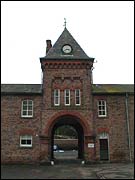 Close to the county town of North Yorkshire - Northallerton - and the headquarters of North Yorkshire Police - Newby Wiske. The clues might have led you to the rough area we were looking for, but perhaps not to the clock itself. The hotel is a Grade II listed building, which stands in nine acres of gardens and woodlands. IMAGE 11 - Scarborough railway station, ScarboroughIt can be hard to spot a clock if you can't see much of the building which it belongs to. 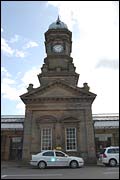 This clock, on the top of Scarborough railway station is a very impressive piece of work. The clock dominates the surrounding area, at the junction of Westborough and Northway. The railways arrived in Scarborough in 1845 via a branch of the York and North Midland Railway (which became part of the North Eastern Railway in 1854). Being on the rail network was a crucial part of Scarborough's development as a major seaside resort in the late 19th and early 20th century. Just over the road from the station is Scarborough's famous Stephen Joseph Theatre, where playwright Alan Ayckbourn premieres all his new work. IMAGE 12 - Scarborough railway station, ScarboroughIf you recognised the previous clock, this one should have been easy! 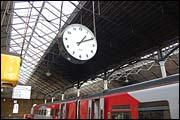 Once you've worked out the big clock was the one on top of Scarborough station, it should have soon become clear this clock is the one inside the station. Once you see the bigger picture, with the train in the background, it's fairly obvious where we were looking for! As ever, punctuality and timekeeping go hand in hand with Britain's railways. last updated: 28/03/2008 at 15:28 SEE ALSOYou are in: North Yorkshire > History > Local history > Clock quiz: the answers   |
| | About the BBC | Help | Terms of Use | Privacy & Cookies Policy |
