 | 29 October 2014 |

| |
| BBC Homepage | | |
| |||
| Contact Us | | |
Local historyYou are in: North Yorkshire > History > Local history > Times are changin' 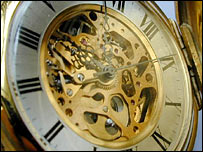 Times are changin'By Katy Wright Once upon a time, clock and watch making was seen as a viable career option and industry apprenticeships were available to all who wanted them. But with less people learning the trade, there's now more than enough work for people like Geoff Hepworth. In 1956, Geoff Hepworth left school aged fifteen, and started as an apprentice in a watch and clock shop on the Shambles in York. There were six other apprentices there at the time, although two of them couldn't stick it and left early on. The rest of them stayed and learnt what would be their trade, starting with alarm clocks, and gradually moving up to watches. Help playing audio/video Geoff's father had been out of work during the Second World War, and the impact that had on the family meant Geoff was all too aware of the importance of getting a job he could rely on. And as Geoff says, "There's always time, always going to be time, everybody needs time... And so we knew there'd always be work".
Fifty years later, Geoff's still working as a watch and clock maker and mender, despite recently attempting to retire. The reason is simple: there's plenty of work but there aren't enough people to do it. And the reason for that, explains Geoff, is that there isn't enough hands-on training available these days: "You can't afford to pay an apprentice the wages they ask for nowadays and work yourself - he's asking you things... so you don't work as much, so you lose money... That's why people don't go into it - they can't get a job" Paul Thurlby, Horology course director at the University of Central England, confirms the situation when he refers to changes in the number of people enrolling on part time courses over the last twelve years: "part time numbers, either hobbyists or apprentices have dropped significantly". 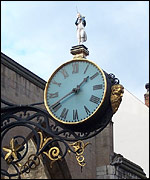 St Martin's church clock, Coney Street But for Geoff's son, Michael, it was a different story. As a young boy he'd help out in the workshop and soon began to learn the trade. Ironically, however, although he didn't lack the relevant training, he did lack something else quite vital: "He had no problem at all with it... he was very good. But after a while he said 'I can't do it dad, I can't sit there and not do anything else except that'. And he went off and did other things..." According to Geoff, it takes a certain type of person to make and mend watches and clocks. Being tidy helps a lot as there are so many tiny pieces inside a watch or clock. And being a perfectionist is a useful quality too, as is the ability to sit still for a long time and concentrate on the task in hand. Eileen, who's been married to Geoff and his clocks for forty years, isn't that type of person. She says that although you get used to the constant ticking, there's only so many clocks you can have in each room, and the best place for the rest of them is in the attic! Help playing audio/video But there are plenty of people who do love their clocks and watches, they just don't know how to look after them. And with a shortage of those who do know, people like Geoff are much sought after. Even when Geoff sold his workshop on Gillygate, with a view to retiring, people still found him... "I had a chap phone me, who's been coming to me for years. He'd been to my shop and thought I'd died. So he eventually found my number and rang me. Quite funny really." But it looks as though the time will come when horologists are either nowhere to be found or unable to do the job any longer. What the rest of us will do, who knows? As for Geoff, well he's already got plans... "It's got to be something mechanical... If I don't do clocks, it's motorbikes. So, one or the other. But motorbikes are bigger, so I can see them better." last updated: 28/03/2008 at 15:11 SEE ALSOYou are in: North Yorkshire > History > Local history > Times are changin'   |
| | About the BBC | Help | Terms of Use | Privacy & Cookies Policy |
