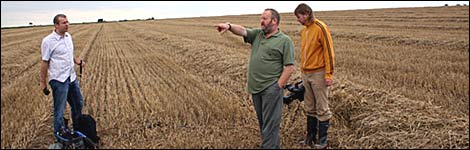
 | | Straw field at Towton |
At last I can show you all where the ecoDepot was grown. OK not the whole of the ecoDepot exactly but the walls. The straw came from this field near Towton, just south of Tadcaster. At the edge of the field is a memorial to the battle of Towton Moor. We’ve been shooting a film for York schools, which is why we came to the field. From the field you can see Ferrybridge and Drax, two temples to fossil fuel. Yorkshire produces around a fifth of the nation’s electricity and these power stations are part of that history. They are also testament to the spectacular inefficiency of the process of generating electricity from coal. 20 million tonnes of CO2 pour out of Drax every year. | "Paul Cunningham, the project manager, said to me, “You know you’re getting somewhere when you start smelling paint." | |
But in our field lies the beginings of the future. This one field contains enough straw for 20 ecoDepots, so Peter Horner, the boss at Agrifibre tells me. I’ve previously scribbled how timber framed straw cladding is simply a modern version of wattle and daub, and how this discovery of straw as the great insulator is in reality a rediscovery of what people were doing hundreds of years ago. But I wouldn’t want you to imagine that our ancestors had all the answers. Take Stonehenge. What were those guys thinking about? They may have been interested in making special pleadings to control the weather but all those huge stones hauled seventy miles or more. Presumably hauled by teams of oxen or similar, pumping huge clouds of methane into the atmosphere. Druid training courses didn’t include course work on embodied energy, clearly. 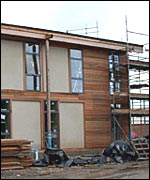 | | The scaffolding is removed to reveal the ecoDepot |
And then the building itself. It was all very well making the place a monument to solar power but they had no chance of getting grants to install any form of renewable energy in a building, without insulation or even single glazing, never mind double glazing. And with it being a historic monument and everything, it would have been a bit tricky to obtain planning permission for a small wind turbine or a spot of solar heating. I can see it now, woad covered locals standing in front of the town hut waving huge stone placards, protesting about the need for adequate ventilation in public buildings. The scaffolding is starting to come off the ecoDepot. Like a snake sloughing its skin or a butterfly emerging blinking into the sunlight, its belly rumbling from a long winter’s hibernation ... Did I say butterfly? Workmen are working around the building, finishing off the cedar cladding, attaching the guttering. Inside they’ve started painting. As he escorted me round, Paul Cunningham, the project manager, said to me, “You know you’re getting somewhere when you start smelling paint.” 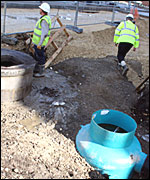 | | The bathysphere is now part of the harvest tank |
It’s amazing how bright the interior is. On the first floor, so much light is pouring in from the floor to ceiling windows and the skylights that the builders are working without artificial light. It already feels like a great place to work. Across the car park, the vehicle wash has sprung up, its metal frame reminding me of platforms at the Channel Tunnel terminal. You’ll see that what was described last blog as a bathysphere is now an integral part of the rain harvesting tank. My next task is to get the official opening onto the BBC1 6 o’clock news. My deadline is in early December. The ideas are bubbling nicely. Watch this space. Christian, Energy Champion, City of York Council, 07/10/06 |