|
The medal had been in New Zealand for the previous 70 or more years. In 1916 it had been posthumously awarded to Enniskillen born Captain Eric Norman Frankland Bell. Eric Bell's father was a quartermaster in the Royal Inniskilling Fusiliers so it was no surprise that his son followed in his father's footsteps and joined the 9th Battalion RIF. On 1st July 1916 - A date which was later to become known as the first day of the Battle of the Somme.- Captain Bell was in command of a Trench Mortar Battery at Thiepval, France. Here is the citation which accompanies this prestigious medal. Captain Eric Norman Frankland Bell | | | 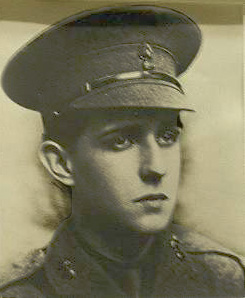 | | Captain Eric Bell VC | |
" For most conspicuous bravery. He was in command of a Trench Mortar Battery, and advanced with the infantry in the attack, when the front line was hung up by enfilading machine-gun fire. Captain Bell crept forward and shot the machine-gunner. Later, on no less than three occasions, when our bombing parties, which were clearing the enemy's trenches, were unable to advance, he crept forward alone and threw trench-mortar bombs among the enemy. When no more bombs were available, he stood on the parapet under intense fire and used a rifle with great coolness and effect on the enemy advancing to counter-attack. Finally, he was killed rallying and reorganizing infantry parties which had lost their officers. All this was outside the scope of his normal duties with his battery. He gave his life in his supreme devotion to duty. " His body was never recovered. |
Victoria Cross | | | 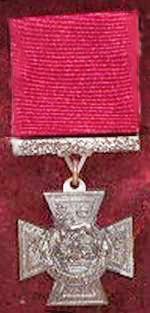 | | Capt. E.N.F.Bell's VC | |
The Medal came into the possession of Bell relatives in New Zealand who many years later generously decided it's rightful place was in the safe keeping of the Royal Inniskilling Fusiliers' Museum, in Enniskillen. And so, through intermediaries, they eventually arranged for it to be handed back to the regiment. It is now housed in the Castle Keep, Enniskillen Castle. Visitors to the museum can see this actual VC proudly displayed beside Captain Bell's portrait and citation
All told, the members of the regiment won eight VC's during World War I, several of which can be seen in the museum. |
Exhibits Of course this VC is not the only exhibit. There are hundreds of items on display and the venue is visited by many different groups and individuals, all with their own reasons to visit. Many are descendants of soldiers looking for help in tracing family history. The museum has a vast library of documents and photographs, and for family members are willing to help in this research. History | | | 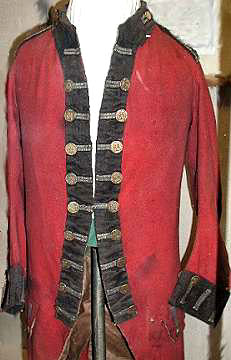 | | Irish Volunteers coat 1778 | |
Formed in 1689, the Royal Inniskilling Fusiliers regiment lost it's identity over three centuries later in 1968 when it was amalgamated with two other regiments to become the Royal Irish Rangers, which itself later joined with the Ulster Defence Regiment to become the Royal Irish Regiment. With such a long and distinguished history, it is no surprise that also among the visitors are model soldier collectors and makers who come to see the various uniforms to ensure their own copies are correct. Badge collectors find the exhibits of great interest too. This photo shows one of the oldest uniforms on display. It is a coat of the Irish Volunteers which was formed in 1778 under Captain James Armstrong. On the buttons is a drawing of Enniskillen Castle with the words "Independent Enniskilleners"
The Regimental Museum at Enniskillen Castle is open to the public. (www.inniskilling.com)
THE BBC IS NOT RESPONSIBLE FOR THE CONTENT OF EXTERNAL SITES |
|
See also: Somme hero: Robert Quigg VC 1885 - 1955 Battle of the Somme Battle of the Somme - Memorabilia The Larne Fallen An Enniskillen VC Lurgan Men in the Great War World War I: Soldiers of Down The Peake Brothers at War 1914-18 |
|
|
|



 print version























 POST A COMMENT ON THIS ARTICLE