



The online and offline activities provide opportunities for children to explore a number of cross curricular links connected to: ' The World Around Us' - (History, Geography, Science) Mathematics and Numeracy, The Arts and Language and Literacy.
'Ideas for Connecting Learning' (ICLs) themes covered are: 'Where I Live', 'Thinking Through the Past', 'Festivals and Celebrations' and Journeys.
There are seven sections within the Saint Patrick's Journey resource – an overview of each activity, suggested classroom activities and how they relate to the Northern Ireland Curriculum are broken down below.
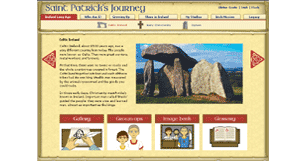
Areas covered:
Celtic Ireland | Early Christianity |Ogham
Brief Descriptor:
This section provides an introduction into what Ireland was like 1500 years ago, covering brief
descriptions of Celtic Ireland and how people lived, worshipped and communicated.
Watch:
Clip on Ogham Stones, this introduces children to the earliest form of writing found in Ireland. Ogham Stones can still be located in parts of Ireland today. Before viewing the clip ask the children to listen out to see if they can locate where the Ogham Stone has been found - they will need this information later on.
Active Learning
Opportunity:
1 OGHAM DISCUSSION and ACTIVITY: after viewing the clip have a general discussion about different forms of communication – discuss that, before writing was invented, people communicated stories from person to person and that these stories were likely to change over time.
To reinforce this play a 'Chinese Whispers' game with the class and then review stories to see how they have changed. This can be related to how stories about Saint Patrick may have changed over time.
Discuss with the children if they were able to find out from the clip where in Ireland the Ogham Stone was found. Ask the children to draw a map of Ireland and to plot the locations on a map. Divide the children into small groups and ask them to research on the internet for other Ogham Stones locations found in Ireland - see our Web Links page. These destinations should also be plotted on the map. The activity could then be extended by asking the children to research the distances between the different locations.
2. OGHAM ACTIVITY SHEET- Children have the opportunity to decipher and create their own Ogham messages. Ask the children to download the Ogham key and activity sheet from the Ogham page.
Curricular Links:
Linking to ICL: Thinking Through the Past
Cross-Curricular links: The World Around Us – History, Geography
Whole Curriculum Skills: Thinking Skills and Personal Capabilities | Communication
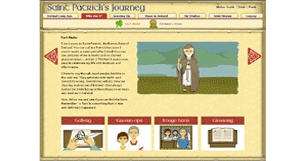
Areas Covered:
Fact Finder | Children's Views
Brief Descriptors:
FACT FINDER: the aim of this activity is for children to find out for themselves what they really know about Saint Patrick. Over the years a lot of myths have sprung up and sometimes it's hard to tell FACT from FICTION. The activity helps to dispel some of those myths and provides a springboard for classroom discussion.
CHILDREN'S VIEWS – a fun and engaging animated series of audio interviews from children aged between 7-11 who provide descriptions of how they think Saint Patrick might have looked and what he was like. This activity together with illustrations provides an introduction into the Saint Patrick topic, allows children to gain an understanding that different people will have different views and may not see things in the same way.
Watch :
CHILDREN'S VIEWS – Animated descriptions from children
Active Learning Opportunity:
1. FACT FINDER QUIZ – dispelling myths about Saint Patrick
2. CLASSROOM DISCUSSION: begin a general discussion about how children think Saint Patrick might have looked and clothes he might have worn. Invite the children to make a collage or painting. Why not submit their artwork for possible inclusion on the BBC's Saint Patrick Journey's Gallery.
This activity could be extended by asking children to think about what materials would have been available back in the 5th Century for the making of clothes, jewellery and make-up. See web link for Clothing Guide to Ancient Celts. Perhaps children could design a 5th Century piece of jewellery.
There are opportunities for children to research into the science of plants ie how colours were extracted from plants to form dyes for make-up and clothing.
Curricular Links:
Cross-Curricular Links: The Arts | The World Around Us – History, Science
Whole Curriculum Skills: Thinking Skills and Personal Capabilities
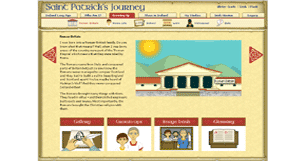
Areas Covered:
Roman Britain | Home Life | School | Latin | Animation 1: Kidnapped | Revision Quiz 1
Brief Descriptor:
In this section the children discover what life was like for Patrick living in Roman Britain 1500 years ago. They gain an insight into his home and school life and find out about Latin and its continued significance in our lives today. There follows an illustrated audio animation sequence that tells the story of Patrick being captured and taken to Ireland as a slave. The section concludes with a 'quick fire' revision quiz helping children to review and assess their progression.
Watch:
KIDNAPPED ANIMATION 1–tells the story of when Patrick first arrived in Ireland
Active Learning
1.LATIN ACTIVITY – introduces children to some basic Latin terms. Opportunities:
2.REVISION QUIZ 1
3.CLASSROOM DRAMA and DISCUSSION: print off the 'Kidnapped' script and use it in conjunction with the drama activity sheet. This offline activity provides opportunities for children to perform drama in front of a class and have a classroom debate afterwards discussing slavery and the different view points of the people involved in Patrick's kidnap: Patrick himself, his family, the kidnappers and Patrick's master.
There are also opportunities for children to create their own music to accompany the drama.
Curricular Links:
Linking to ICLs: Thinking Through the Past and Where I Live
Cross-Curricular Links: The World Around Us – History | PDMU | The Arts
Whole Curriculum Skills: Thinking Skills and Personal Capabilities | Communication
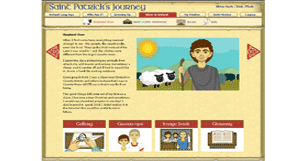
Areas Covers:
Shepherd Slave | Build a Celtic Settlement | Animation 2 – Escape | Revision Quiz 2
Brief Descriptor:
We commence Patrick's journey to Ireland by hearing how different it is to that of his life back home in Roman Britain. The countryside, the people even the language is different.
Within this unit of work the children have the opportunity to BUILD A CELTIC SETTLEMENT -they are invited to listen to a series of 12 audio descriptors – 8 are correct and 4 are wrong and then they have to decide which ones are correct and link them to the settlement. A correct choice results in the learner being rewarded with that part of the settlement gradually coming to life through colour and movement.
On successful completion of the activity the children are presented with two short video clips describing the structure for Rath and Crannog settlements.
Watch:
Active Learning Opportunities:
1. BUILD A CELTIC SETTLEMENT – insight into what Celtic life was like 1500 years ago.
2. CLASSROOM DISCUSSION - after the 'Build a Celtic Settlement' activity discuss with the children what life must have been like 1500 years ago. Use the opportunity to get children to write a brief Newspaper report looking back in time and describing what the houses and people might have been like and how they traded and farmed.
3. Revision Quiz 2
Curricular Links:
Linking to ICLs: Thinking Through the Past and Where I Live
Cross-Curricular Links: The World Around Us – History and Geography | Language and Literacy
Whole Curriculum Skills: Thinking Skills and Personal Capabilities
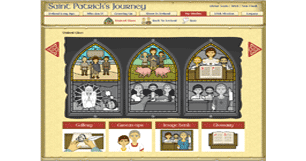
Areas Covered:
Stain Glass | Animation 3 – Back To Ireland | Revision Quiz 3
Brief Descriptor:
Within this unit we use the metaphor of a stain-glass window to illustrate that significant stories from Christianity may sometimes be represented in this way. Through a series of six greyed out panels children are invited to activate these and bring them to life. As each panel is illuminated we hear a description of Patrick's return to his homeland and how the arrival of a few pigs resulted in some sailors being converted to Christianity. We also gain an insight into Patrick's life as a scholar and introduced to Germanus one of the great religious teachers of his time.
Watch:
ANIMATION 3 – BACK TO IRELAND – Patrick has a dream in which he sees Victoricus and hears 'The Voice of the Irish' calling him back to Ireland. Patrick decides he must follow the call and leaves his family for a second time to return to Ireland.
Active Learning Opportunities:
1. STAIN GLASS ACTIVITY – the story of Patrick's arrival in his homeland and his life as a scholar.
2. REVISION QUIZ 3
3. MAKING A STAIN GLASS WINDOW – after viewing the animation ask the children to design a series of panels that reflect Patrick's dream sequence. These drawings could then be transferred to cardboard and cut out. Coloured plastic or sweet wrapping paper could be used to cover the glass panels. The completed work could be attached to the classroom window or window at home so that light can shine through.
Why not take a photograph of the work and send it into the BBC for possible inclusion in our Gallery.
Curricular Links
Linking to ICL: Thinking Through the Past
Cross-Curricular Links: The World Around Us – History | PDMU – Christianity | The Arts
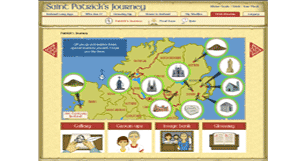
Areas Covered:
Patrick's Journey | Animation 4 – Final Days |Revision Quiz 4
Brief Descriptor:
This section takes us back to present day Ireland and the children see an animated Patrick standing on an interactive map. Patrick invites the children to journey with him to ten separate destinations. The children have to find each destination in turn. When they are successful, the map comes to life and reveals a series of either videos or audio clips associated with that location.
Watch:
Clips on:
ANIMATION 4 – FINAL DAYS – In this last animation sequence we hear about the story of the fawn and where Patrick decides to build his main church. The animation moves on to show Patrick's final days and the writing of his Confession. We hear the story of how it is said that Patrick's body was placed on a cart with oxen let loose and where the oxen rested it is said to be where Patrick's body was laid to rest.
Active Learning Opportunities:
1. PATRICK'S JOURNEY – animated map activity
2. Activity Sheet – Geography Map Activity
3. REVISION QUIZ 4
Curricular Links:
Linking to ICLs: Thinking Through the Past and Where I Live
Cross-Curricular links: The World Around Us – Geography, History |Mathematics and Numeracy
Whole Curriculum Skills: ITC
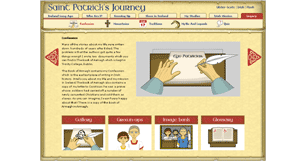
Areas covered:
Confession | Monasteries | Traditions | Myths and Legends | Revision Quiz 5
Brief Descriptor:
In this final unit we hear about Saint Patrick's Confession and his letter to Coroticus and how they are both contained in the Book of Armagh which is kept in Trinity College, Dublin. We look at some of the myths and legends associated with Saint Patrick and his legacy.
Watch:
Active Learning Opportunities
1. REVISION QUIZ 5:
2. PLACE NAMES – ask the children to research how many place names of churches and schools they can find with the name Patrick in them. Open the discussion up to other well known place names and how these names have come about. For example 'Downpatrick' comes from the Irish word 'Dun' meaning 'fort' – 'the fort of Patrick', 'Saul' comes from the Irish word 'Sabhall' meaning barn. The children could research other place names – see our Web Links page.
3. Ask the children to research on the internet for the Book of Kells – see our Web Links page and get them to print out some of the illuminated letters, use these letters as inspiration to create their own illuminated lettering and make a bookmark for themselves.
Curricular Links:
Linking to ICLs: 'Thinking Through the Past' and 'Festivals and Celebrations'
Cross-Curricular Links: The World Around Us – Geography, History, Science
Disclaimer
All sites listed are checked regularly. However, the constantly changing nature of the Internet means some sites may alter after we have visited them. The BBC is not responsible for the content of external websites.

BBC © 2014The BBC is not responsible for the content of external sites. Read more.
This page is best viewed in an up-to-date web browser with style sheets (CSS) enabled. While you will be able to view the content of this page in your current browser, you will not be able to get the full visual experience. Please consider upgrading your browser software or enabling style sheets (CSS) if you are able to do so.
