Ornamental Cherries - Part 2
6 March 2008 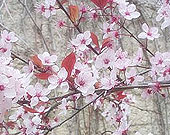 Every garden, no matter how small, should have at least one flowering cherry tree. They are deciduous, many of them with foliage that colours beautifully in autumn before falling. They mostly flower in spring with a few that produce their blossom during mild periods in late autumn and throughout the winter. Every garden, no matter how small, should have at least one flowering cherry tree. They are deciduous, many of them with foliage that colours beautifully in autumn before falling. They mostly flower in spring with a few that produce their blossom during mild periods in late autumn and throughout the winter.
Check on the ultimate height and spread of the variety as some will, within a decade become very large.
Where they are sited close to a lawn or hard surface area such as a patio or tarmac drive their roots will cause serious problems. The bigger roots stay close to the surface gradually thickening to cause raised areas on the lawn and a trip hazard where they damage the tiles or other surface.
Trees are available as bush, half standards and full standards where 5-6 ft of the trunk is straight without branches.
Larger trees are expensive but give a new garden an air of maturity. They will need to be supported with a wooden stake and tie until the roots have spread out into the surrounding soil.
Plant at the same depth as previously grown and add some well rotted farmyard manure to the base of the planting pit. Firm the soil to exclude air pockets and dish the surface to collect and retain rainwater in the root zone.
Cherries have more that their share of pests and diseases including black fly, shot hole, bacterial canker and silver leaf disease.
The black fly will attack the young, soft tips of shoots tightly curling the leaves. It does no lasting damage but the affected curling leaves may be picked off and burnt.
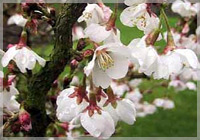 While most trees are pruned in winter cherries are best left until July when the spores of diseases such as silver leaf are dormant. While most trees are pruned in winter cherries are best left until July when the spores of diseases such as silver leaf are dormant.
Prunus incisa ‘Kojo-no-mai’ produces pale red flowers in spring and grows to 7-8 ft on height.
At the other end of the scale Prunus ‘Kanzan’ has double, deep, dusky pink flowers in late spring. The unfurling leaves are bronze turning bright green. Its eventual height and spread is 30-35 ft.
Prunus sargentii has brilliant orange-red autumn leaf colour with pale pink flowers in mid-spring.
Ornamental Cherries - Part 1...»
Disease and Pest identifier...»
«...back to John's index page
|