Ornamental Cherries
15 November 2007 Flowering cherries are the harbingers of bright, sunny days with blue skies overhead. Winter is over and the chances of a late spring frost are receding. Some species and cultivars are also part of the winter scene, when on the dullest day, they can single handedly add interest to the garden with flower and bark. 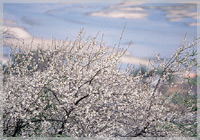 The flowers of Prunus subhirtella autumnalis and its cultivar could not be described as big, bold or brightly coloured. They are without fragrance and each flower is a disappointment. All that changes when whole branches of the tiny, semi-double, white flowers appear like pin points of light against a leaden sky. The flowers of Prunus subhirtella autumnalis and its cultivar could not be described as big, bold or brightly coloured. They are without fragrance and each flower is a disappointment. All that changes when whole branches of the tiny, semi-double, white flowers appear like pin points of light against a leaden sky.
They appear intermittently from November to late March and a mild spell of weather, even for a couple of days, sends the right message and another Milky Way of flowers appears. The cultivar P.s. ‘Autumnalis Rosea’ is similar in every way but with blush pink petals. The thin stems studded with open flowers makes a delightful centre piece for the festive table. They are usually sold as standard trees with 6 ft clear stem and a head of branches. It will have a mature height of 20-25 ft. If you get the opportunity buy a bush tree with branches from ground level or as a half standard with a 3 ft bare trunk. That way the flowers are at your level rather than above your head. The mahogany barked cherry trees make their display from the ground up. As it’s trunk thickens and matures, the shining, golden brown bark of the Manchurian cherry (Prunus maackii) starts to peel and flake. On a wet day the bark glistens and in the evening it reflects any lights that are close by. 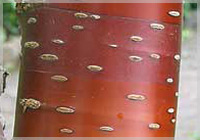 More commonly available in nurseries and garden centres is Prunus serrula from China. The bark appears to be polished and is a deep, mahogany brown colour. I am prepared to bet a wheelbarrow of farmyard manure that you too will automatically start to peel off the loose bark revealing the new shiny, smooth under layer. A mature tree in winter is a magnificent sight with the attractive bark displayed on all but the thinnest branches. More commonly available in nurseries and garden centres is Prunus serrula from China. The bark appears to be polished and is a deep, mahogany brown colour. I am prepared to bet a wheelbarrow of farmyard manure that you too will automatically start to peel off the loose bark revealing the new shiny, smooth under layer. A mature tree in winter is a magnificent sight with the attractive bark displayed on all but the thinnest branches.
back to John's index page
|