Capoeira (pronounced cap-wear-a) is a dynamic art form that originated in Brazil around 500 years ago, but is now popular throughout the world. "It's a Brazilian art form which looks like a combination between African dance, acrobatics and gymnastics. It's played as a spontaneous game that looks like martial arts – but it's just for fun," said Capoeira teacher Jim Lynch. In Norfolk, the interest in Capoeira is growing. Classes are run in Great Yarmouth and North Walsham, but it started with Grupo Senzala in Norwich. "I'd just come back from doing it for a year when abroad. Capoeira is a game between two people and there was no-one for me to play with," said founder member Rod Penn. "My friends wanted to learn, I showed them a few things and over the course of five years the group has become more settled. We're now a full group with classes for different abilities and rigorous training," he added. Playing the game  | | Grupo Senzala Norwich at The Forum |
Capoeira is characterized by its deceptive kicks and sweeps. Two players enter a circle of the other participants, known as a "roda". At the head of the roda are musicians, fellow Capoeira members, who play instruments specific to the art. There is the berimbau (musical bow), the atabaque (floor drum) and a pandeiro (Brazilian tambourine). The musicians are lead by a Mestre, or master, who through the tempo of the band, controls the type of game being played. There are five games which can be played, each with a different rhythm. Fast loud tempos dictate games where the players throw fast, powerful kicks and blows accompanied by aerial gymnastics, spins and flips. Slower tempos dictate more dance like interaction and more deception between the two players. Capoeira kids Capoeira is getting a strong following from young people in Norfolk. "The kids have seen it on Blue Peter, all over computer games and I think because the kids are much more exposed to the media, children know what Capoeira is," said Jim Lynch. "It makes it very easy to talk about to anyone who's seen BBC TV and it's all over Hollywood. There are specific Capoeira movements used in some of their fight sequences," he added. For 15-year-old Sam Tawn, Capoeira has always been part of his life. "I was born in Brazil, but when I moved over here I found out about a group in Norwich. I decided to come and from then on was hooked. I felt it was part of my culture and that I should be involved in it," he said. 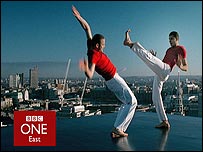 | | Capoeira as seen on BBC1 |
"I get a massive buzz from it. The energy from the crowd and the music. You should get involved as it helps your fitness and your co-ordination. It's really social as you make some good friends," he added. Good for the girls The sport might have been one for the boys in the past, but more and more ladies are now taking up the Capoeira challenge. "I was immediately addicted to it. I think because it's about fitness and the music - it's just the whole cultural experience," said Claire Bennett. "It is male dominated, but I'm up for the challenge as I'm quite competitive. I really want to get really good, kick their asses," [laughs] she added. Brazilian carnival As part of Norfolk's Black History Month celebrations, Grupo Senzala organised a night of cultural celebration at St Andrews Hall in Norwich. Nearly 1000 people took part in the event, including a number of Capoeira masters who flew in especially for the event from Brazil. |