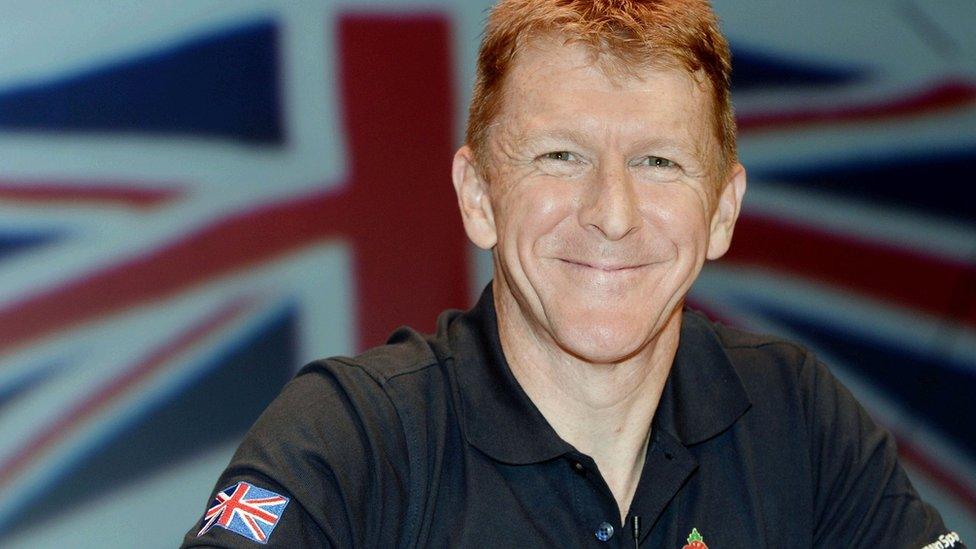
Tim Peake 'ready' for flight to International Space Station
- Published
British Astronaut Tim Peake and his crew have completed training ahead of their trip to the International Space Station
British astronaut Tim Peake says he's "definitely ready" for his first space flight, finally fulfilling a childhood ambition after two and a half years of intensive training.
The former military test-pilot has just passed his final practical exams and is due to blast off to the International Space Station on 15 December.
Along with Russian commander Yuri Malenchenko and Nasa astronaut Tim Kopra, he will spend 170 days in orbit, conducting scientific experiments and carrying out maintenance work on the vast flying laboratory.
"The launch, re-entry, the whole experience of being in weightlessness, if I get the opportunity to do a spacewalk - these are all absolute highlights of the mission," Mr Peake told the BBC at a Russian facility deep in a snowy forest on the edge of Moscow. It's where Yuri Gagarin also trained over half a century ago to be the first man in space.
Mr Peake will be the first British astronaut on the ISS, flying from the European Space Agency. Since the US space shuttle programme was ended, the Russian spacecraft has been the only way up.
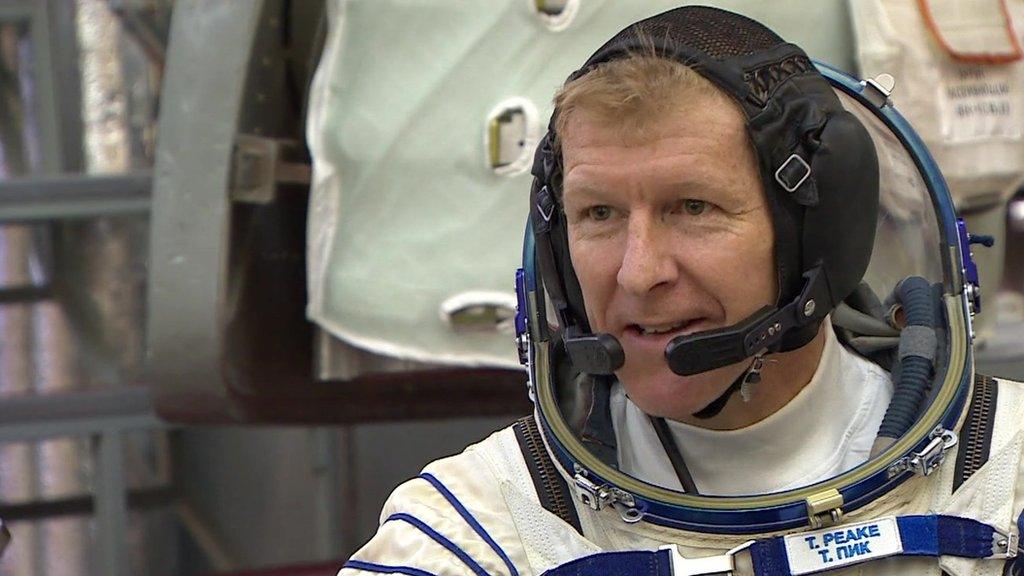
So last week, the main three-man crew and their back-up team were put through two days of gruelling practical tests, including several hours squeezed inside a replica of the Soyuz capsule they'll travel in.

Mr Peake (left) will travel alongside Russian cosmonaut Yuri Malenchenko (centre) and US astronaut Tim Kopra (right)
Fully kitted-out in their space suits, the astronauts flew a simulation of the six-hour journey, tackling multiple malfunctions on their way.
"There are emergency drills to see how to act to save themselves and the spacecraft," trainer Georgy Pirogov explained, keeping an eye on the crew via a bank of video screens in a mini mission control.
"It could be a fire, loss of pressure or an emergency landing," he said. "But in reality, most of it is automatic and ideally they should just sit and fly!"
The intense training programme has included living in a cave and deep under the sea. Yet of all things, Tim Peake says that it is learning Russian that has been "a struggle".
Now fully qualified, he says he has "no worries whatsoever" about his first ever spaceflight.
"Flown astronauts have given me lots of advice," he says, equating the experience to learning to dive or to ski.
He says there are plenty of mishaps as you adjust to a life in zero gravity, where you have to tether yourself to the wall to sleep, and to the toilet.
"After about two weeks they say you get into a pattern - how to eat, wash, use the loo - all the normal things we take for granted in our 1G [gravity] environment," he has been assured.

Mr Peake will make the journey in December
The crew will undertake a full scientific programme on the ISS, conducting more than 250 experiments over their six-month mission - many on their own bodies. They include research on the human immune system and the ageing process.
Some of the crew's baggage allowance will be taken up by that research kit. But as well as family photographs, Tim Peake says he'll be taking some personal items to be "flown in space", that he plans to give to his sons when they turn 18.
And on the advice of former astronauts, he'll also make space for one vital item: sticky-tape.
"They say if you leave anything, you turn around and it won't be there," he laughed, recalling the top tip for life 400km (248 miles) above Earth.
The final "graduation" ceremony at Star City takes place next week, attended by the astronauts' families. Then it's into the obligatory quarantine, ahead of the launch.
"The whole experience is a huge privilege," the British spaceman reflects, unruffled as ever. "But seeing that first view of planet Earth from space is probably going to be the most exciting moment."
- Published23 November 2015
- Published11 November 2015
- Published6 November 2015