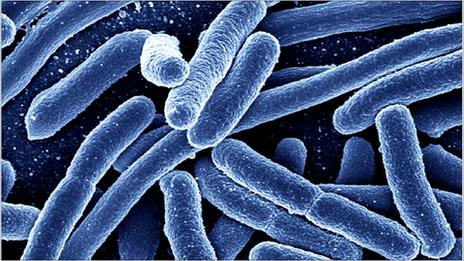
The first images released of E. coli O55 which has affected about 30 people, including 10 children in Dorset
A new test is being developed in a bid to trace the source of a potentially deadly E. coli strain found in Dorset.
Scientists are devising the new ultra-sensitive test to detect the O55 strain which had never previously been found in an outbreak in the UK.
It first broke out in July 2014, hospitalising two children with acute kidney problems and has since caused outbreaks of infectious diarrhoea.
It is hoped the test will be ready for use on animals in the new year.
Kidney failure
Despite an investigation, tests and screening, the source of the strain, which produces a toxin that can lead to fatal kidney failure, has never been traced.
To date the 055 strain has affected 30 people, 10 of them children in areas including Bournemouth, Poole, Weymouth, Blandford and Christchurch. It also affected two cats.
All 10 children and one adult were hospitalised after they developed the complication of haemolytic-uraemic syndrome (HUS) which affects the kidneys.
Noeleen McFarland, from Public Health England, told BBC's Inside Out South: "When it was confirmed we knew we had uncovered something unusual that hadn't been seen in the UK before."

Four-year-old Isaac Mortlock developed haemolytic-uraemic syndrome (HUS) after contracting the bug

Isaac who has damaged kidneys as a result of the bug is expected to need a transplant
Negative tests
Public Health England said any previous cases of the O55 strain in the UK had been associated with travel.
Following the outbreak, officers were sent out to investigate and test play parks, swimming pools and restaurants visited by those infected seven days prior to them being ill.
"Everything we investigated, tested and sampled was all negative," Mrs McFarland said.
Isaac Mortlock, aged four, from Bournemouth, was hospitalised after contracting the strain.
Isaac's mum Gabrielle Archer said: "His kidney function didn't return to normal and we've been told he will need a transplant in the future."
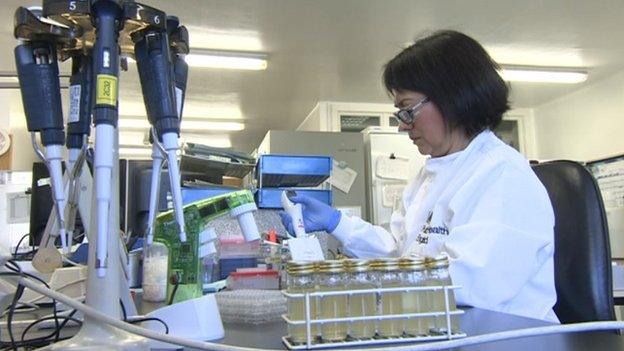
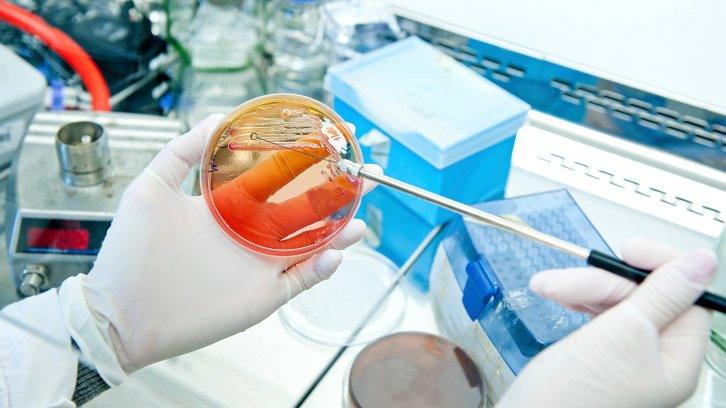
The new test is being worked on by scientists at the Animal and Plant Health Agency (APHA), based in Surrey using microscopic magnetic beads which picks out the E. coli O55.
Environmental health officers are also wearing bacteria catching socks over their boots to provide samples from areas visited by those who picked up the bug.
Public Health England said the last confirmed outbreak in the county was in mid September.
Watch BBC Inside Out on BBC One in the South at 19:30 BST for more on this story.

Avoiding E. coli infection
Wash hands thoroughly after using the toilet, before and after handling food and after handling animals
Remove any loose soil before storing vegetables and salads
Wash all vegetables and fruits that will be eaten raw
Store and prepare raw meat and unwashed vegetables away from ready-to-eat foods
Do not prepare raw vegetables with utensils that have also been used for raw meat
Cook all minced meat products, such as burgers and meat balls, thoroughly
People who have been ill should not prepare food for others for at least 48 hours after they have recovered
Source: Public Health England, external

- Published18 September 2015
- Published14 September 2015
- Published24 June 2015
- Published30 May 2015
- Published28 May 2015
- Published27 November 2014

- Published26 November 2014
- Published4 June 2011