Home Affairs Committee chairman Keith Vaz said the authorities lost "vital days" in the case of the Dawood family
The UK must "up its game" on stopping people travelling to join Islamic State in Syria, Commons Home Affairs Committee chairman Keith Vaz has said.
The British authorities need a "hotline to Istanbul" to stop people trying to cross the Turkey-Syria border, he said.
Earlier he met with two of the husbands of three Bradford sisters thought to be in Syria, whose lawyers say police were "complicit" in radicalising them., external
West Yorkshire Police said it rejected that suggestion.
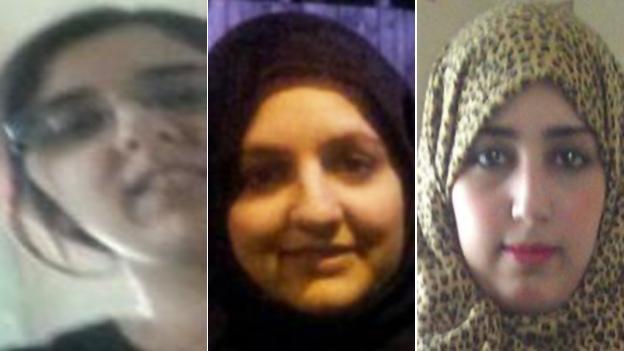
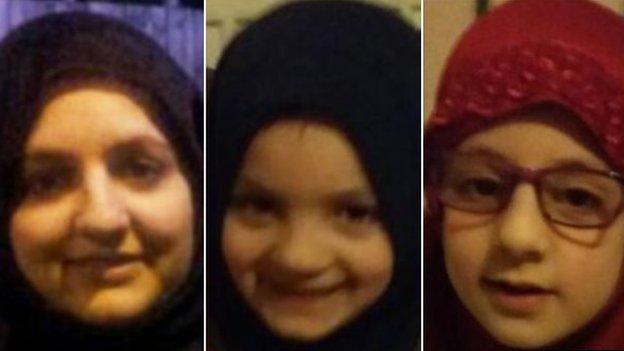
Khadija, Sugra and Zohra Dawood and their children, aged between three and 15, went missing on 9 June. An Islamic State (IS) smuggler has since told the BBC they have reached Syria.
It is claimed police encouraged them to contact their brother - thought to be fighting with extremists in Syria.

Sisters Sugra, Zohra and Khadija Dawood went missing on 9 June
In a letter to Mr Vaz, lawyers for the husbands of two of the sisters, Akhtar Iqbal and Mohammed Shoaib, also claim police have kept them in the dark about their investigation.
Speaking after the meeting in Westminster, Mr Vaz said the husbands were "heartbroken", and needed to be able to meet with police at a "very senior level" soon.
He also said the authorities had been too slow to act in what were "life-and-death situations", and must now "sharpen up" their act.
"We need to up our game as far as our contact with Istanbul is concerned," he said.
'Vital days'
"I think this is so serious, that when any parent goes into a police station and reports someone missing, there should be a hotline to Istanbul.
"In this particular case, and others, days went on before the women crossed the border. Those are vital days we need to recover."
But he said families and communities also had a responsibility to act.
"I think what we also need to do is to make sure that communities realise they should be in the driving seat on these issues," he said.
"It can't be done by Whitehall. It's got to be done by parents and communities. They are first and foremost responsible for watching and learning and listening to whatever is going on."

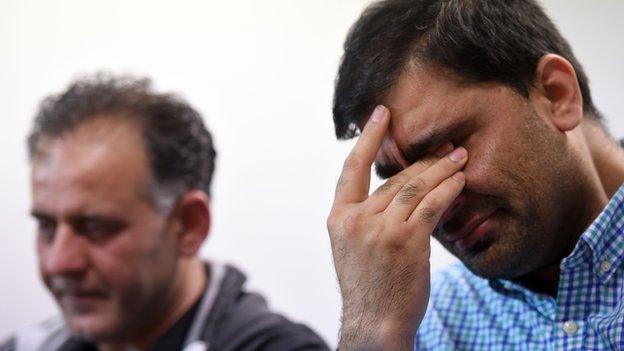
Akhtar Iqbal (left) and Mohammed Shoaib have appealed to their wives to return
He said he would be meeting with West Yorkshire Police and the North East Counter Terrorism Unit on Tuesday to discuss the allegations made by the husbands' lawyers.
In the letter to the Labour MP, external for Leicester East, solicitors said police had shown a "reckless disregard" for the consequences of their actions.
"Our clients have made repeated attempts to gain information from the police as to the progress of this investigation," said the letter. "Each request has been met by a wholesale lack of information. Instead the police have been anxious to ensure that there is no criticism of them and their tactics."
They said the home secretary and the foreign secretary would also be receiving letters complaining about the police.
Last week, West Yorkshire Police and the North East Counter Terrorism Unit published a statement which it said was from the women's "parents and family members", external. It said: "We are... very happy with the help and support we have had from the police and the way they have handled the enquiry. We as a family do not hold ourselves or the police responsible for the actions taken by the three sisters."
The Home Office said it had received the letter from the two fathers and would respond in "due course".
"Our priority is to dissuade people from travelling to areas of conflict and the Prevent strategy is working to identify and support individuals at risk of radicalisation," the Home Office said in a statement.
- Published22 June 2015
- Published19 June 2015
- Published19 June 2015
- Published17 June 2015