Duncan Kennedy reports as the Havengore recreates its journey down the Thames
A day of events has been held in London to mark the 50th anniversary of Sir Winston Churchill's funeral.
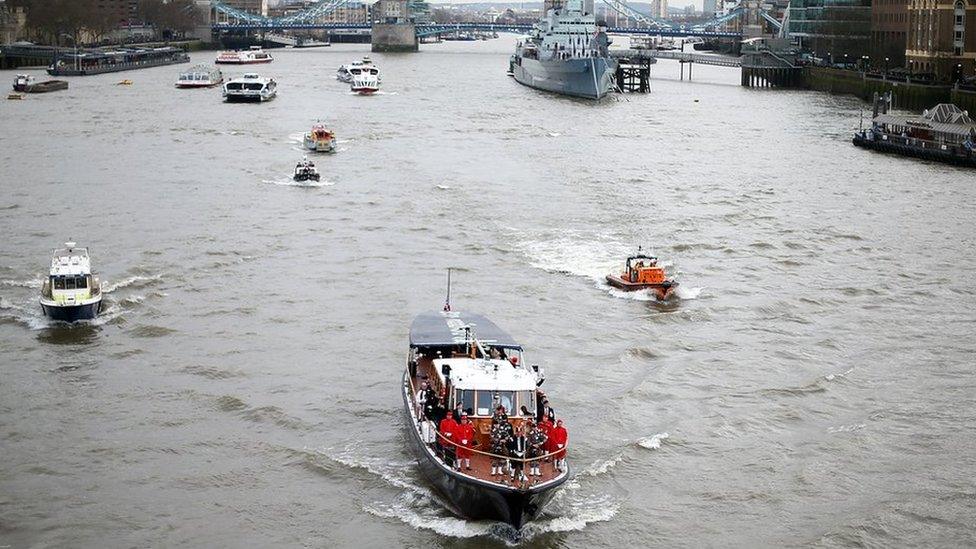
The boat that carried the former prime minister's coffin along the Thames in 1965 repeated the journey, with members of his family among those on board.
Earlier, Prime Minister David Cameron laid a wreath in memory of the World War Two leader, whom he called "a great leader and great Briton".
An evening service was held at Westminster Abbey.
David Cameron: "I admire Churchill the patriot, he knew Britain was a force in the world"
Speaking at a service in Parliament at the start of the day of commemorations, Mr Cameron said: "If there is one aspect of this man I admire more than any other - it is Churchill the patriot."
Mr Cameron said the UK needed to draw on the "courage and resolve" of Churchill to battle "every affront to freedom in this century".
A procession from the service at St Mary's Undercroft chapel ended under what has become known as Churchill Arch.
It was rebuilt at Churchill's suggestion following a direct hit from a German bomb in May 1941.

Winston Churchill's great-great grandchildren, Iona Pite, John Winston Churchill and Christabel Fraser, laid a wreath during a commemoration at Westminster Abbey

Churchill led Britain to victory in World War Two

Wreaths were laid at the statue of Churchill in the Members' Lobby of the Commons
Tower Bridge was raised as the Havengore - the boat that carried Churchill's coffin - retraced its 1965 journey from the Tower of London to Westminster.
The boat then stopped near the Palace of Westminster for a service and for wreath laying in the river.
At the Westminster Abbey service, flowers were laid at the green marble stone memorial to Churchill.
Sir Nicholas Soames said the Westminster events were a "fitting tribute" to his grandfather and a "strong reminder of all he did for his country".
Emma Soames, Churchill's granddaughter, added: "To me growing up he was a grandfather, but I came to realise at his death that he was so much more than that.
"The family are absolutely delighted that his life is being celebrated and his legacy expanded."

The Havengore travelled from the Tower of London to Westminster

The boat's route on Friday was the same one it had taken in 1965
Randolph Churchill said his great-grandfather would have been "surprised but thrilled" at the commemorations.
He and Celia Sandys, Churchill's granddaughter, laid a wreath at his statue in Parliament Square.
'Very quiet'
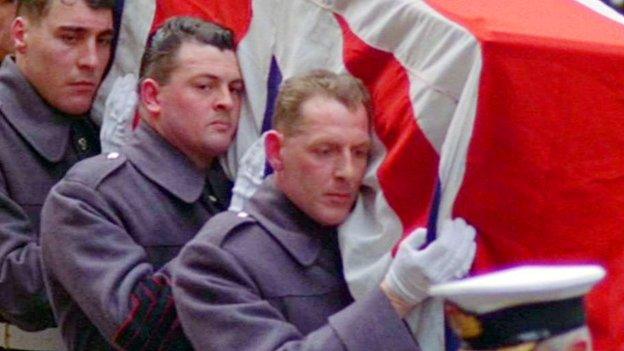
Thousands of people lined the streets of London for Churchill's funeral procession in 1965.
Journalist Martin Bell, who worked for the BBC as a junior reporter at the funeral, said: "What I remember is most of all... the sheer size of them, 10-12 deep all along the way.
"Very quiet, very dignified, almost devotional. It would be hard to imagine anybody now, however eminent, drawing that kind of crowd to his funeral.
"It was unprecedented... the entire nation was watching."

Thousands of people lined the streets of London for Churchill's funeral procession

Sir Winston Churchill (1874-1965)

1874 - Born in Blenheim Palace on 30 November
1900 - Elected to Parliament for the first time
1908 - Marries Clementine Hozier in Westminster
1915 - Forced to resign from the Cabinet in disgrace after disastrous World War One Gallipoli campaign
1940 - Appointed prime minister with Britain again at war with Germany in World War Two
1945 - Loses the General Election to Clement Attlee's Labour Party despite leading the nation to victory in the war
1951 - Returns to Downing Street again as prime minister after securing a narrow majority
1955 - Retires as prime minister due to ill health
1965 - Dies aged 90
Winston Churchill's funeral train has been reassembled at the National Railway Museum, as Ian Reeve reports
From Friday, the National Railway Museum in York will display the locomotive - named Winston Churchill - that pulled his funeral train from London to Oxfordshire before his burial.
Churchill began his career in the Army and he also worked as a journalist during the Boer War in South Africa, where he was captured and made a prisoner-of-war but managed to escape.
He served as First Lord of the Admiralty and held various senior government roles before taking over from Neville Chamberlain as prime minister in May 1940, and leading the country to eventual victory over Nazi Germany.
BBC News looks back at the day of the funeral in 1965
He lost power in the 1945 election but remained leader of the opposition, and in 1951 became prime minister again.
He resigned in 1955, but remained an MP until shortly before his death. He also wrote numerous books, and in 1953 won the Nobel Prize for Literature.
Churchill's grave is in Bladon churchyard, near his birthplace of Blenheim Palace in Oxfordshire.

Churchill was given a state funeral

Crowded streets forced people to use every vantage point to see the funeral procession

Churchill's coffin was loaded on to a train at Waterloo station

The Pullman carriage used at the funeral is going on display at the National Railway Museum
- Published30 January 2015
- Published30 January 2015
- Published30 January 2015
- Published28 January 2015
- Published24 January 2015