Science correspondent Jonathan Amos explains the science behind the "blood moon"
Skywatchers in the Americas have caught a rare celestial show caused by the Earth's shadow falling across the Moon.
The Moon changed colour from orange to blood red or brown in a total lunar eclipse.
The total lunar eclipse unfolded over three hours as the Moon moved into the Earth's shadow.
From 08:06 BST (07:06 GMT) our planet's natural satellite was fully eclipsed for more than 75 minutes and shrouded in a reddish glow.
The first eclipse of 2014 was visible across most of North America, Latin America and the Caribbean.

In California, people waited for buses to a nearby observatory to watch the eclipse

Families in Melbourne, Australia, also gathered to watch the 'blood moon'

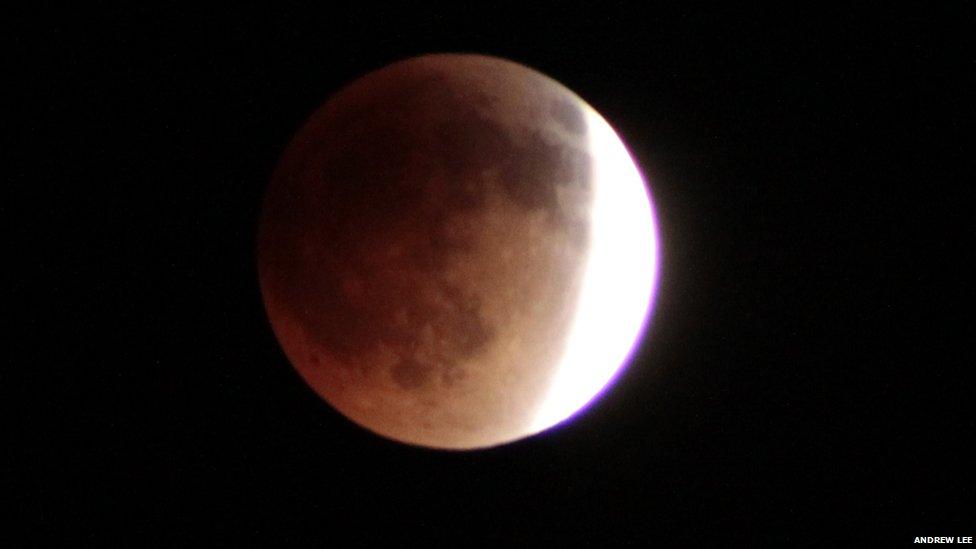
The moon appeared half red and half white mid-way through the lunar eclipse
Observers in north-west Africa and the eastern half of South America were able to see part of the eclipse, but missed some stages because they occurred after moonset.
The moment of greatest eclipse occurred at 08:45 BST (07:45 GMT).
Three further eclipses will occur during 2014: an annular solar eclipse on 29 April, a total lunar eclipse on 8 October and a partial solar eclipse on 23 October.

- Published15 April 2014