Summary

  • Germany's Covid cases hit another high with 65,371 daily cases recorded

  • Chancellor Angela Merkel has said a fourth wave of Covid is "hitting us with full force"

  • German MPs vote in favour of a new set of measures, including access to public transport only for people who have been vaccinated or tested

  • Germany's upper house of parliament, the Bundesrat, will consider the measures on Friday

  • Much of Europe is facing a spike in cases, with new measures introduced in countries including Austria and Belgium

  • The World Health Organization is warning of a "hard winter ahead" for Europe

  • Covid passes may be used over Christmas in order to keep pubs and restaurants open, the Welsh government says

  • No decision will be made on introducing the pass to the hospitality sector until early December, First Minister Mark Drakeford says

  1. Thanks for readingpublished at 17:28 GMT 18 November 2021

    We're bringing our live coverage of the coronavirus pandemic around the world to a close.

    This live page was written by Lauren Turner, Adam Durbin, Alexandra Fouche and Matt Murphy, and edited by John Hand and Emma Harrison.

    Thanks for reading and we hope you'll join us again soon.
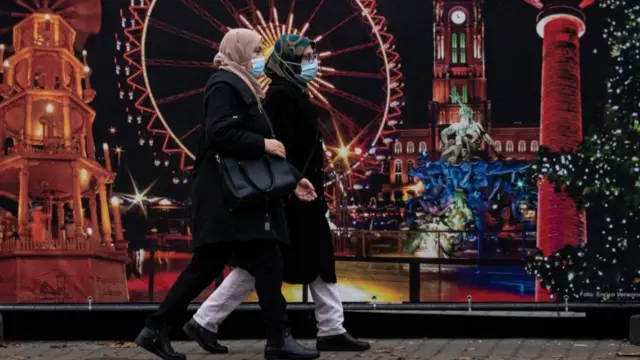
  2. What's been happening today?published at 17:16 GMT 18 November 2021

    Two women wearing masks walk in Berlin, GermanyImage source, Getty Images

    If you are just joining us here's what has been happening today:

    • In Germany Covid cases have hit a record high, with 65,371 daily cases recorded
    • The country's parliament has voted in favour of new measures, which includes limiting public transport to people who have been vaccinated or tested
    • New controls are also being put in place in Belgium, where children aged 10 and over will have to wear masks indoors and working from home will be mandatory four days a week
    • There are also high levels of infection elsewhere in Europe, with cases rising by more than 30% in the last week in Poland, while the Netherlands is considering extending the Christmas school holidays
    • In the UK, Wales is considering extending the use of Covid passes to pubs and restaurants over the Christmas period
    • Covid case rates are now highest among children aged five to nine in England, according to the latest data
    • The UK government has named 50 companies given fast-track "VIP" contracts to supply protective equipment to the NHS, following a Freedom of Information request by the Good Law Project
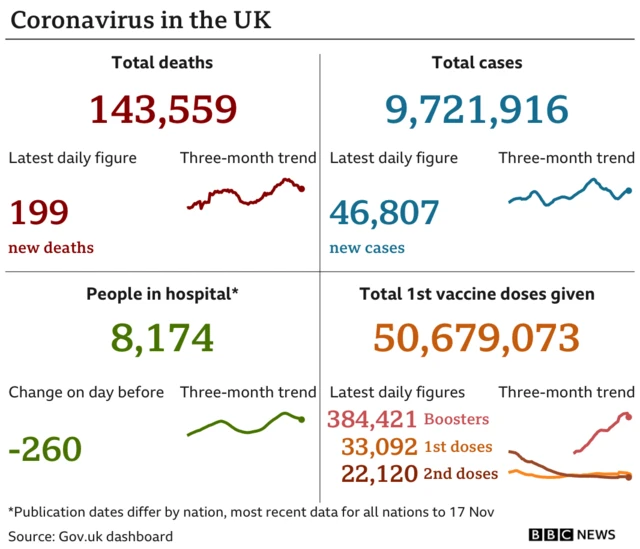
    • On Thursday the UK reported 46,807 coronavirus cases, as well as 199 deaths within 28 days of a positive test
    Covid stats graphic
  3. Lockdown for unvaccinated in Czech Republic and Slovakiapublished at 17:13 GMT 18 November 2021

    Both the Czech Republic and Slovakia have announced tighter restrictions for unvaccinated people, in a bid to encourage vaccine uptake.

    The Czech government has approved rules which allow only those who are vaccinated or have recovered from Covid in the past six months to enter restaurants, attend certain events and use various other services from Monday, the Reuters news agency reports.

    Slovakia took a similar step, in what Prime Minister Eduard Heger describes as a "lockdown for the unvaccinated" - echoing the move in Austria earlier this week.

    Both governments will also require testing at workplaces.

    "The main goal of these measures is motivation for vaccinations," Czech Health Minister Adam Vojtech says.

    With 58% of the population inoculated, the Czech vaccination rate is below the European Union average, while Slovakia has the EU's third-lowest rate, with 45% of the population inoculated.

  4. Vaccine centre for Benidorm tourists openspublished at 17:04 GMT 18 November 2021

    Tourist outside vaccine centre in BenidormImage source, Reuters

    Spanish beach resort Benidorm has opened a Covid vaccination centre specifically for tourists to combat rising case numbers in the area.

    The clinic is located near the hotel district and was drawing queues of tourists this week, while further mobile vaccination points will be set up by Valencian health authorities in areas where big crowds gather, Reuters is reporting.

    Mayor Antonio Perez tells the news agency they are extending a public service to tourists and it "sends a message of safety" to people.

    Spain requires all visitors entering the country to present either a vaccination certificate or a negative PCR test, but bars and restaurants do not require vaccine passports.

  5. How many care home workers in England have had two jabs?published at 16:54 GMT 18 November 2021

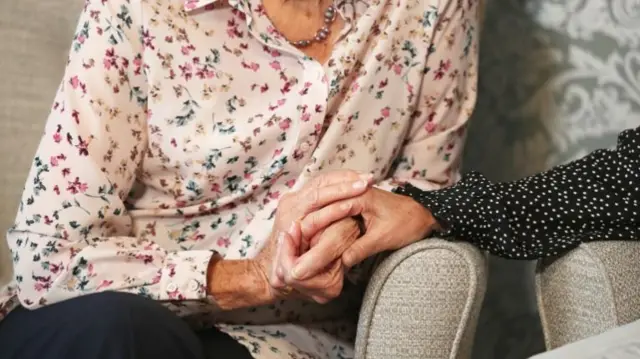
    File image of an elderly woman having her hand heldImage source, PA Media

    New figures have been released showing that 92.5% of staff in care homes for older adults in England have now had two doses of a Covid vaccine, as of 14 November. It means 7.5% of staff - 34,291 people - have not been fully vaccinated.

    They're the first figures to be released by NHS England since the 11 November deadline set by the government for all staff working in a Care Quality Commission-registered care home to be vaccinated, unless they have a medical exemption.

    The NHS figures also show 21.7% of social care staff working in independent Care Quality Commission-registered younger adult care homes and domiciliary care providers were not fully jabbed as of 14 November - that's an estimated 108,510 people.

    Our reporters spoke to care workers when the deadline passed last week - read more on what they had to say here.

  6. US buys 10m Pfizer Covid treatment pillspublished at 16:48 GMT 18 November 2021

    Paxlovid packages being processedImage source, Reuters

    The US has bought 10 million treatment courses of a Covid-19 antiviral drug, US President Joe Biden said on Thursday, external.

    The contract with pharmaceutical giant Pfizer for its Paxlovid treatment will cost the US government $5.29bn (£3.93bn at today's exchange rate), the Reuters news agency reports.

    Biden says the delivery of the pills would start by the end of 2021, if it is authorised by US regulators.

    In a statement, the president said his administration was making preparations to ensure the pills would be easily accessible and free.

    "This is positive news," he says. "This treatment could prove to be another critical tool in our arsenal that will accelerate our path out of the pandemic."

    But, he adds, vaccines remain "our strongest tool".

  7. Netherlands reports record daily infectionspublished at 16:28 GMT 18 November 2021

    The Netherlands has reported its highest number of daily Covid infections, exceeding new 20,000 cases for the third day in a row, Reuters news agency reports.

    About 23,600 people tested positive for the virus, the country's national health institute says - up from just under 21,000 a day before.

    The country has already brought in a partial lockdown.

  8. Where are cases worst in Germany?published at 16:24 GMT 18 November 2021

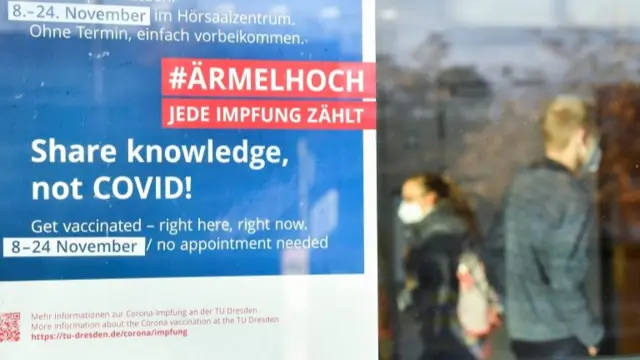
    A sign in Dresden, GermanyImage source, Reuters

    Back now to the situation in Germany. As we've been reporting today the number of Covid cases in the country has hit a record high. But where are cases worst?

    Saxony is the German region that has currently been hardest hit by the fourth wave of coronavirus.

    The state - in the east of the country, which has Dresden as its capital - has the highest infection rate as well as the lowest vaccination rate.

    Because of its status, it's considering measures like closing concerts, theatres and football games to the public and closing bars and nightclubs, Bild newspaper says.

    Daily infections there have risen 14 times in the past month, Reuters has reported.

    Infection rates are also high in Bavaria, in the south-east, and more measures are being considered there.

  9. Almost 13.9m people in UK have had booster jabpublished at 16:17 GMT 18 November 2021

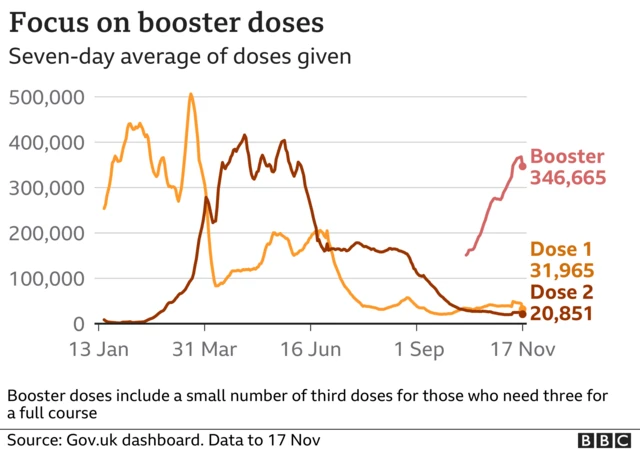
    The UK administered 384,421 doses of a booster vaccine on Wednesday, according to the latest UK government figures.

    Overall nearly 13.9m people have had a third dose of a Covid jab - about 24% of the population over 12 years old.

    More than 50.6m people - or 88.1% of the UK population over 12 - have had one jab and more than 46m people - or 80.1% of people aged 12 and over - have had two vaccine doses.

    Vaccine graph
  10. UK reports 46,807 new Covid casespublished at 16:06 GMT 18 November 2021
    Breaking

    The UK has reported 46,807 coronavirus cases in the last 24-hour period.

    There were also 199 deaths within 28 days of a positive test recorded.

  11. Companies given 'fast-track' PPE contracts namedpublished at 15:54 GMT 18 November 2021

    File image of healthcare workersImage source, PA Media

    The UK government has named 50 companies given fast-track "VIP" contracts to supply protective equipment to the NHS.

    Eighteen of them were nominated by Conservative politicians, Department of Health and Social Care data shows - with Transport Secretary Grant Shapps and former health secretary Matt Hancock involved.

    VIP contracts were introduced as the NHS struggled for masks, gloves, gowns and other safety equipment after the outbreak of coronavirus.

    The government directly awarded contracts worth billions of pounds to companies offering to supply the equipment. Contracts would usually be opened to competing bids.

    The information on the firms , externalchosen for VIP contracts follows a freedom-of-information request by the Good Law Project campaign group.

    The government said that "to save lives, we focused our efforts, resources and attention on sourcing PPE", adding it stood by efforts made to protect staff.

    Read more here.

  12. Covid cases highest in children aged five to nine in England, statistics showpublished at 15:40 GMT 18 November 2021

    Michelle Roberts
    Health editor, BBC News online

    Covid case rates are now highest among children aged five to nine, latest weekly surveillance figures for England reveal.

    The report from the UK Health Security Agency, up to 14 November, shows this younger age group has overtaken older, secondary school aged children for the first time.

    In recent months, the 10-19 age group maintained the highest rate of infections per 100,000 tested.

    It is too soon to say what is behind the change and whether it will continue.

    In recent weeks children aged 12 and over have started being offered Covid jabs.

    The data also shows confirmed Covid infections are lowest among the eldest in society - those aged 80 plus.

    This X post cannot be displayed in your browser. Please enable Javascript or try a different browser.View original content on X
    The BBC is not responsible for the content of external sites.
    Skip X post

    Allow X content?

    This article contains content provided by X. We ask for your permission before anything is loaded, as they may be using cookies and other technologies. You may want to read X’s cookie policy, external and privacy policy, external before accepting. To view this content choose ‘accept and continue’.

    The BBC is not responsible for the content of external sites.
    End of X post
  13. Answers demanded over Scottish government official's deathpublished at 15:20 GMT 18 November 2021

    The widow of a top official dealing with Scotland's pandemic response, who died after contracting Covid, believes the full details of his illness were concealed to protect a troubled hospital's reputation.

    Andrew Slorance went into Glasgow's Queen Elizabeth University Hospital for cancer treatment a year ago, where his wife Louise believes he caught the virus - as well as another life-threatening infection.

    He was the Scottish government's head of response and communication unit, in charge of its handling of the Covid pandemic.

    Andrew Slorance

    His widow tells the BBC she believes officials wanted to protect the hospital, which is already the subject of a public inquiry, as well as its reputation, "no matter what the cost".

    The hospital's health board says it had been "open and honest" and there had been no attempt to conceal any information from the family.

    You can read more on what happened here.

  14. Who can get a third jab in the UK now?published at 15:06 GMT 18 November 2021

    A woman prepares a vaccine doseImage source, Getty Images

    There have been some changes this week in the UK about who can get their booster jabs - and about teenagers' vaccinations. So what is the new guidance? Here's a recap.

    All over-40s in the UK can now have a booster jab, as long as it's been six months after their second vaccine.

    A booster is an extra dose of Covid vaccine, which helps prolong protection in the double-jabbed.

    Having three doses offers a 93% protection against symptomatic disease, according to UK Health Security Agency data, external. You can now get a third dose if you're in one of these categories:

    • You're aged 40 or over
    • You're aged 16 or over, with a health condition that puts you at high risk from Covid
    • You're a front-line health or social care worker
    • You're an adult who lives with an immunosuppressed person

    Those aged 16 and 17 can now have a second vaccine, 12 weeks after their first jab.

    And pregnant women are being urged to take up their offer of a vaccine, as they can be particularly at risk.

    The changes follow new recommendations from the government's advisers, the Joint Committee on Vaccination and Immunisation.

    All the details are here.

  15. Let visitors in to see new mums in Wales, charity sayspublished at 14:49 GMT 18 November 2021

    Media caption,

    Covid in Wales: Maternity visiting rules unfair, says mum

    Visitors should be allowed into maternity units in Wales without restrictions, a charity says.

    Since the pandemic started, some units have stopped all visiting while others have limited times parents can spend with newborns.

    The rules currently vary between health boards, with some of them including banning visits entirely, other limiting visits to a few hours and some only allowing designated partners in within certain times of the day.

    But with restrictions on movement and social distancing eased across the country, Birthrights wants hospital maternity units to also open up.

    The Welsh government says maternity services keep their rules under review and there was a "delicate balance" between protecting vulnerable individuals and allowing visiting.

    Read more here.

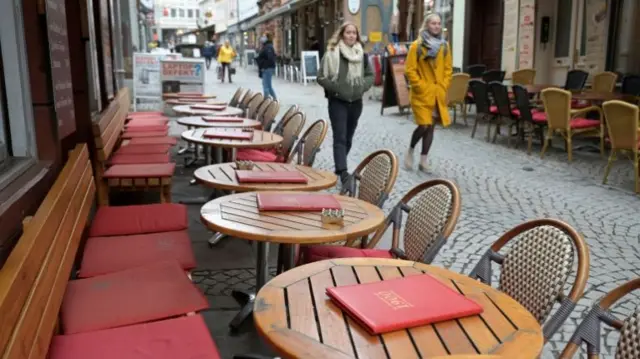
  16. Debate rages in Germany over new restrictionspublished at 14:31 GMT 18 November 2021

    Damien McGuinness
    BBC News, Berlin

    A view of a restaurant using "2G" rules, allowing only those vaccinated or recovered from the coronavirus disease (COVID-19) to enter indoor areas, in Marburg, Germany, on 17 November 2021Image source, Reuters

    The debate in Germany’s parliament today was emotional, with plenty of finger-pointing for the sharp rise in infections. The mood in the country is equally fractious, with commentators asking why politicians didn’t use the lull in infections during the summer, to prepare the booster campaign and plan for a predictably tough winter.

    Some hospitals say they are at full capacity, and worry they will be overwhelmed when the current high rates translate into more hospitalisations. These stark warnings mean that, in polls, most Germans support tougher measures.

    Until now, excluding unvaccinated people from some activities has not sparked widespread protest. In one survey, a majority supports allowing only vaccinated people to access leisure services, such as restaurants. These measures have been easy to implement. Customers have quickly become used to showing waiters proof of vaccine before ordering food.

    The newer measures decided on Thursday might be more difficult to implement. Transport trade unions say their members shouldn’t have to police the vaccine status of passengers because of potential aggression. And some employers question how they can organise daily tests for workers.

    But if the choice is between more deaths or making life more difficult for unvaccinated people, the consensus in Germany is more restrictions for people who don’t want the jab.

  17. What's been happening with Germany's case numbers?published at 14:17 GMT 18 November 2021

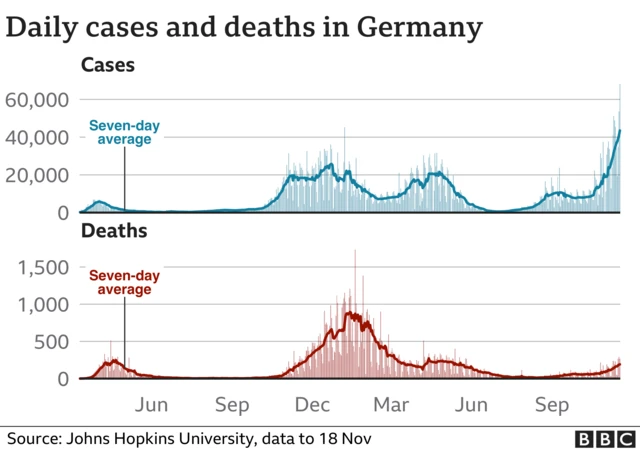
    Germany is facing its highest case numbers since the coronavirus pandemic began. We've been looking at the pattern of how case numbers have been going up and down.

    There was a small peak early in the pandemic, if you look at the seven-day averages, but the first big wave peaked at the end of December.

    There was another surge - although not as big as the one at the end of 2020 - at the end of April before a decrease. There was a rise again to a new peak in September which plateaued for a while before rapidly climbing again to the new highs we see now.

    A graph showing the cases and deaths in Germany

    There's information on the Johns Hopkins world coronavirus map , externalas well, which breaks down the figures if you're keen for more detail.

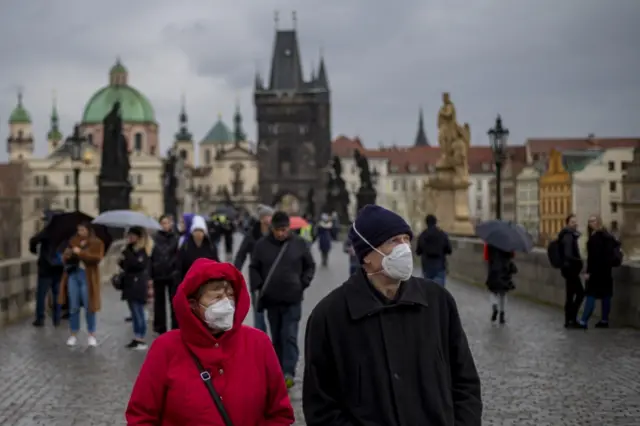
  18. WHO: Public health emergency far from overpublished at 14:00 GMT 18 November 2021

    People on Charles Bridge, Prague, wearing masksImage source, EPA

    The World Health Organization (WHO) is warning there is a "hard winter ahead" for Europe.

    Asked by the BBC if it was concerned vaccines did not appear to be preventing a surge in cases, its regional director for Europe Hans Kluge says: "Of course vaccines have been a game-changer.

    "But far too many remain unvaccinated, so we have pockets in which the virus continues to spread and cause strain on local and national health systems."

    He was speaking amid a surge in European countries, as we've been reporting on here today.

    Quote Message

    This public health emergency is far from being over, and the current rise of cases in most countries in the region, caused by the combination of insufficient vaccination coverage, the easing of preventive measures and the spread of the more transmissible Delta variant, shows that a hard winter is ahead of us."

    Dr Hans Kluge, WHO

  19. Spanish region considering extending vaccine passportspublished at 13:36 GMT 18 November 2021

    We were telling you earlier about Covid passes in Wales and Scotland - another country considering extending their use is Spain.

    The Basque Country wants to make it mandatory for people visiting bars, clubs or restaurants to show a vaccination certificate, reports Spanish newspaper El Pais.

    It would show whether they have been fully vaccinated, at least 14 days previously, if they have had Covid over the previous six months, or tested negative for the virus.

    Spanish regions are in charge of their own healthcare systems, including Covid-19 measures and vaccinations.

    Overall in Spain, 79% of the population is now fully vaccinated. The daily case rate is rising at the moment with latest 14-day figures showing 88.6 cases per 100,000 people.

  20. In quotes: Heated German debate over Covid measurespublished at 13:30 GMT 18 November 2021

    As we've been reporting, there has been some fierce debate in the German lower house of parliament over proposed new measures to curb the current spike in the country's cases.

    Here are some excerpts that give a flavour of what was said in the chamber.

    Quote Message

    More people will get infected and become ill, many of them seriously. That worries me deeply and I will say clearly: we are in an emergency situation, especially the hospitals and we must react now, resolutely and together, the government, the German states and communities. This is what today's parliamentary debate is about, as is customary in a democracy."

    Katrin Goering-Eckardt, Green Party parliamentary chairwoman

    Quote Message

    Today's debate is not about the conservatives or the [incoming] SPD, FDP and Greens government, it's about protecting our country and in order to do so, we are putting the right measures in place, ladies and gentlemen."

    Marco Buschmann, Senior FDP lawmaker

    Quote Message

    If you decide to go down that road with the majority you have here, against our and my proposals, please don't use someone else as a scapegoat every time or as a punching ball. If you want to represent the new majority here, you have to take on the responsibility. No-one can relieve you of that duty."

    Jens Spahn, Outgoing Health Minister