Summary

  • Boris Johnson has been appearing before the Commons Liaison Committee to discuss the government's coronavirus response

  • It comes as 1,564 more deaths are reported in the UK within 28 days of a positive Covid test - the highest daily figure since the start of the pandemic

  • There have now been more deaths in the second wave than the first, says Public Health England

  • Covid restrictions in Scotland around takeaway food and click-and-collect services will be tightened, First Minister Nicola Sturgeon says

  • The new measures, from Saturday, are needed because of the current "precarious" situation, she says

  • The PM says the coronavirus vaccine programme will be running 24 hours a day, seven days a week "as soon as we can"

  • School staff should be the top priority for the next phase of the vaccine rollout, says Education Secretary Gavin Williamson

  • Many hospital staff treating the sickest patients during the first wave of the pandemic were left traumatised, a study suggests

  • China's CoronaVac vaccine has been found to be 50.4% effective in Brazilian clinical trials

  • World Health Organization experts are due to arrive to China's Wuhan city to begin investigating the origins of Covid

  • Globally, there have been more than 91 million registered Covid cases and almost two million deaths, according to Johns Hopkins University

  1. Thanks for joining uspublished at 18:10 GMT 13 January 2021

    Our coverage is now drawing to a close for the day, but do join us again tomorrow.

    Updates were brought to you by Alex Therrien, Alice Evans, Claire Heald, David Gritten, Jennifer Meierhans, Joshua Nevett, Lauren Turner, Paul Seddon, Richard Morris, Vanessa Buschschluter, Vicky Baker and Yaroslav Lukov.
  2. Coronavirus headlines from the UK and around the worldpublished at 18:10 GMT 13 January 2021

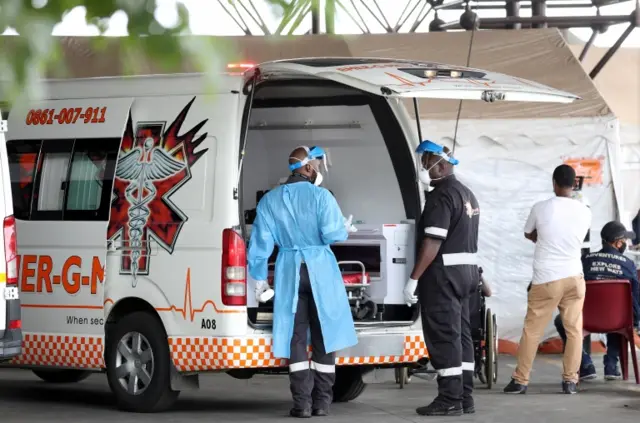
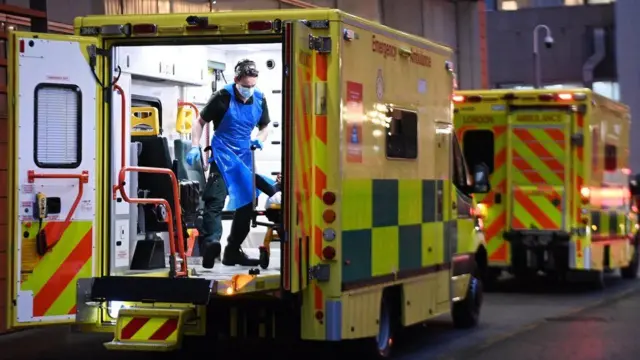
    AmbulanceImage source, European Press Photo Agency

    There's been a lot of coronavirus news around today - here are some of the main headlines:

    • The UK and Mexico have recorded their highest daily death tolls from coronavirus since the start of the pandemic
    • Today's figures show a total of 1,564 people died within 28 days of a positive test in the UK. In Mexico the total is 1,314
    • Scotland announces tighter lockdown restrictions including a ban on click and collect for non-essential purchases
    • Footballer Marcus Rashford calls for a review of free school meals after photos of meagre food parcels were shared by parents online
    • Meanwhile, Boris says 24/7 Covid vaccination hubs will open as soon as supply allows
    • The World Health Organization (WHO) says it is concerned about the spread of new coronavirus variants
    • A new coronavirus variant has been found circling in the Amazonas state of Brazil - it's also been picked up in Japan in travellers from that region of Brazil
    • Meanwhile, Tunisia has announced a four-day nationwide lockdown to stem the spread of Covid-19 infections
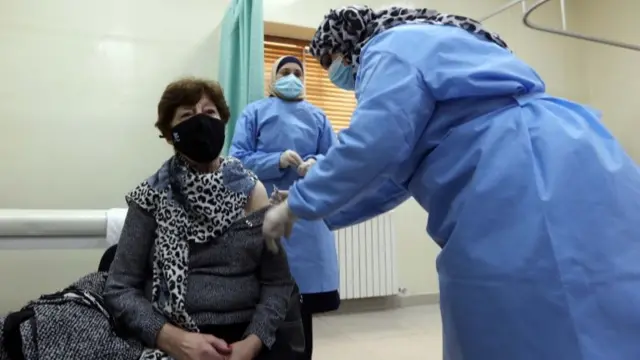
  3. Jordanians urged to register as vaccination programme beginspublished at 18:07 GMT 13 January 2021

    A woman receives a Covid-19 vaccine at a medical centre in Amman, Jordan (13 January 2021)Image source, epa

    Jordan has launched a Covid-19 vaccination programme intended to protect more than 20% of the kingdom’s 10 million population.

    The government has said the first stage will focus on people over the age of 60, those with chronic illnesses, and medical personnel. It aims to administer 5,000 shots a day at 29 centres.

    Health Minister Nazir Obeidat told the state news agency Petra, external that the first day had gone “smoothly”.

    But the head of the ministry’s epidemics and communicable diseases department, Wael Hayajneh, urged more people to register for the free vaccines, external, with only 200,000 reportedly signed up since late December.

    The government has purchased vaccines produced by Pfizer-BioNTech and China's Sinopharm. The latter was granted an “emergency licence” on Saturday.

    Jordan has seen a sharp fall in the daily number of new infections since mid-November, when restrictions that had been eased during the summer were reintroduced.

    More than 309,000 confirmed cases of Covid-19 and 4,076 deaths have been reported since the start of the pandemic.

  4. What are the rules for face masks in the UK?published at 18:03 GMT 13 January 2021

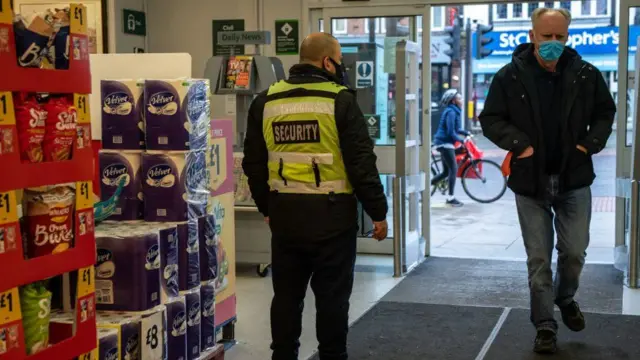
    A man wearing a face mask inside a shopImage source, Getty Images

    There's been focus this week on whether people are adhering to the rules around wearing face coverings in shops.

    Tesco, Asda and Waitrose have become the latest supermarkets to say they will deny entry to shoppers who do not wear face masks, unless they are medically exempt.

    It follows a similar move by Morrisons, while Sainsbury's says it will challenge those who flout the rules.

    So what protection do masks offer, what sort can be worn, and what are the rules across the UK?

    Read our explainer here

  5. Watch: When will schools reopen?published at 17:56 GMT 13 January 2021

    The education select committee chairman has asked the PM for the roadmap for reopening schools in England.

    Robert Halfon asked the prime minister about the mental health and social isolation effects on children being away from schools.

    Boris Johnson says the lockdown measures “have got to continue to work”, after showing “some early signs of progress”.

    But he says it was “far, far too early” to say that would lead to a relaxation next month.

    Media caption,

    Covid-19: Johnson and Halfon on lockdown effect on children

  6. Government to discuss Covid Brazil strainpublished at 17:50 GMT 13 January 2021

    Gavin Stamp
    BBC political reporter

    The UK government’s Covid O committee is expected to discuss the new variant of coronavirus that has emerged in Brazil tomorrow.

    The prime minister hinted to MPs that there could be restrictions on travel from Brazil to the UK - but a final decision has not been taken.

    Speaking to MPs he said: "We are taking steps to ensure that we do not see the import of this new variant from Brazil."

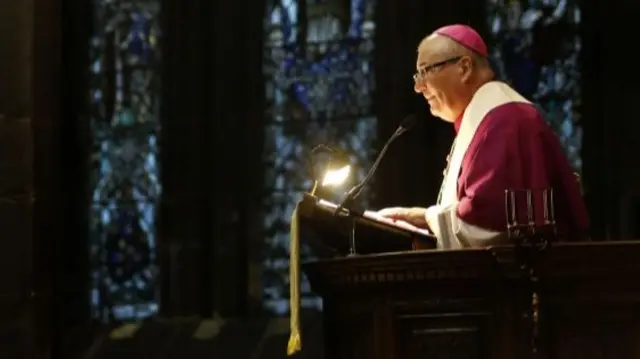
  7. Catholic Archbishop of Glasgow dies after Covid infectionpublished at 17:46 GMT 13 January 2021

    Philip TartagliaImage source, PA Wire

    The Catholic Archbishop of Glasgow has died after contracting Covid-19 shortly after Christmas.

    Philip Tartaglia, 70, was one of the most senior figures in the Catholic Church in Scotland.

    The Church said his cause of death was not yet clear.

    First Minister Nicola Sturgeon said she felt "deep sadness" to hear of Archbishop Tartaglia's death.

    She told Scottish Parliament: "I'm sure that is sadness shared by everybody across this chamber - and to send my deepest condolences to his loved ones and of course everybody in his community."

    Justice Secretary Humza Yousaf said he had "many fond memories" of conversations he had shared with the archbishop.

    Philip Tartaglia was born in Glasgow in 1951 and was appointed Archbishop of Glasgow in 2012.

    He died on 13 January, which is the Feast of St Mungo - the patron saint of Glasgow.

  8. Record daily deaths, Florida vaccination and other US headlinespublished at 17:37 GMT 13 January 2021

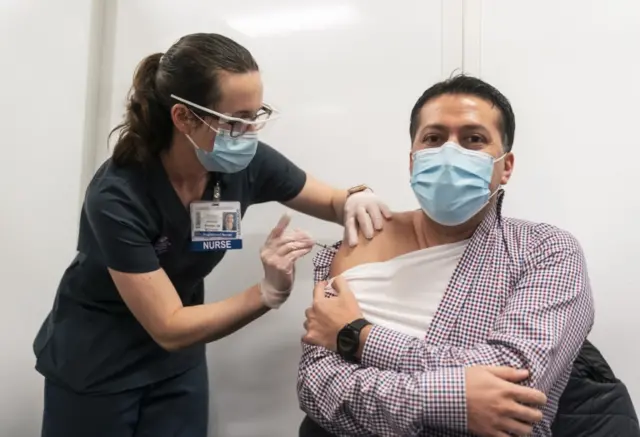
    A nurse vaccinated a fellow nurse in Seattle, Washington state. File photoImage source, EPA
    Image caption,

    More than 9.3 million of Americans have received the first shot of a Covid vaccine

    The US has been by far the world's worst-hit nation in the pandemic, with Johns Hopkins University reporting late on Tuesday a record 4,470 Covid-related deaths in the past 24 hours.

    Here are the latest key developments in America on Wednesday:

    • From 26 January, anyone arriving to the US will need to show a negative Covid test, taken within three days of departure from their place of origin
    • People from Canada, Argentina and other nations are considering travelling to Florida, amid the state's effort to vaccinate people who are 65 and older - regardless of where they live
    • US college campuses are at risk of becoming Covid super-spreaders for their entire county, a new study warns
    • More than 9.3 million Americans - or less than 3% of the country's population - have received their first shot of a vaccine

    The US has had more than 22 million confirmed infections since the start of the outbreak, according to Johns Hopkins.

    The overall Covid-related death toll has now exceeded 380,000, and is closing in fast on the number of American soldiers killed in World War Two, at about 407,000.

  9. Call for better coronavirus masks for all medical staffpublished at 17:27 GMT 13 January 2021

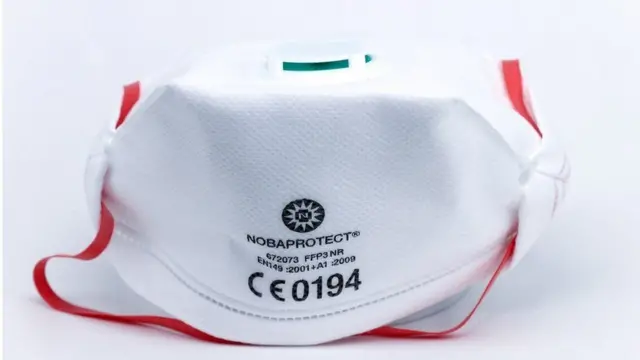
    A higher grade face maskImage source, Reuters

    Doctors' leaders have called for urgent improvements in personal protective equipment for health workers.

    The British Medical Association is appealing for a higher grade of face mask to guard against coronavirus infection.

    It says there is 'growing evidence' that the virus is being spread through the air by aerosols.

    These are tiny virus particles that can build up in stuffy rooms and they have been linked to outbreaks of Covid-19.

    This follows an open letter from more than 1,500 health professionals for staff on general wards to be given the type of high-quality masks usually only worn in intensive care units.

    Public Health England (PHE) has issued guidance on what PPE staff in different settings require. It was last updated in October 2020, external.

    And you can read our explainer here on face masks, including what protection they offer, what sort can be worn, and what the rules are across the UK.

  10. Variants could make second year of virus tougher, warns WHOpublished at 17:17 GMT 13 January 2021

    Health workers chat near an ambulance at the parking lot of the Steve Biko Academic Hospital in South AfricaImage source, Getty Images
    Image caption,

    A highly contagious strain of coronavirus first detected in South Africa has spread to 20 countries, the WHO says

    The World Health Organisation (WHO) has expressed concern about the spread of new coronavirus variants.

    A highly infectious strain, which originated in the UK, has now spread to 50 countries and territories, the WHO said.

    Since the strain was first detected late last year, it has driven a spike in coronavirus infections and deaths linked to the disease in the UK.

    A strain first identified in South Africa, meanwhile, has spread to 20 other countries, the WHO said.

    Health experts say both new variants appear to be more transmissible than previous strains but not necessarily any more dangerous. They have also played down the possibility that vaccines will not be as effective against these variants.

    Still, the increased transmission of these variants is taking its toll.

    "Going into a second year of this [pandemic] could even be tougher given some of the transmission dynamics," WHO expert Mike Ryan said during an event on social media.

    There are also concerns about a third new strain the Japanese authorities have identified in four people who are thought to have caught it in Brazil.

  11. Furlough fraud: Tax authority receives more than 21,000 tip offspublished at 17:05 GMT 13 January 2021

    BBC Radio 5 Live

    Woman with laptopImage source, Getty Images

    The Coronavirus Job Retention Scheme has been a major plank of the government's support during the pandemic.

    Under the furlough scheme, the government pays up to 80% of employees' wages up to £2,500.

    But it has been found to be open to abuse.

    New figures from HMRC given to BBC Radio 5 Live's Wake Up to Money programme show the department is handling more than 21,000 reports of suspected fraudulent use of the furlough scheme, 5,000 of which are under formal investigation.

    The money is either due to fraudulent claims, or is being paid out in error.

    The number of tip offs has spiralled since last April, from 3,000 to 21,378 reports of suspect payments by early January.

    HMRC told the BBC: "This is taxpayers' money and fraudulent claims limit our ability to support people and deprive public services of essential funding."

  12. DUP MP says donated kidneys discarded in pandemicpublished at 17:03 GMT 13 January 2021

    The DUP’s Ian Paisley has failed to trigger an emergency Commons debate on the discarding of donated kidneys during the coronavirus pandemic.

    The MP for North Antrim said he had heard some viable organs had been discarded, and called for transplant operations to continue, perhaps using private facilities.

    Deputy Speaker Eleanor Laing later told him it would be not be allowed, but said a health minister was present and listening to his request.

    Media caption,

    Covid-19: DUP MP says donated kidney discarded in pandemic

  13. Analysis: Why are the restrictions tightening in Scotland?published at 16:59 GMT 13 January 2021

    Lisa Summers
    BBC Scotland Health Correspondent

    We heard earlier from Nicola Sturgeon that restrictions in Scotland will tighten from Saturday.

    The Scottish government is acting now because of the strain on the health service.

    Its experts are warning the NHS could be overwhelmed even under a 'stay at home' scenario, external.

    We've already seen two health boards postponing all non-urgent surgical procedures as an increase in Covid cases puts growing pressure on the system.

    The action from NHS Lanarkshire and NHS Ayrshire and Arran is showing how the numbers of Covid patients in hospital is really starting to impact on wider care.

    Wards that would usually treat people recovering from hip or knee replacements for example may need to be converted into Covid wards.

    Theatres, usually busy carrying out multiple routine surgeries will become high dependency or intensive care facilities. When staff need to be redeployed to work with Covid patients, it is not safe to carry out other routine work.

    These are the difficult choices many health boards will face over the coming weeks. Action required now to deal with this health emergency will have consequences later.

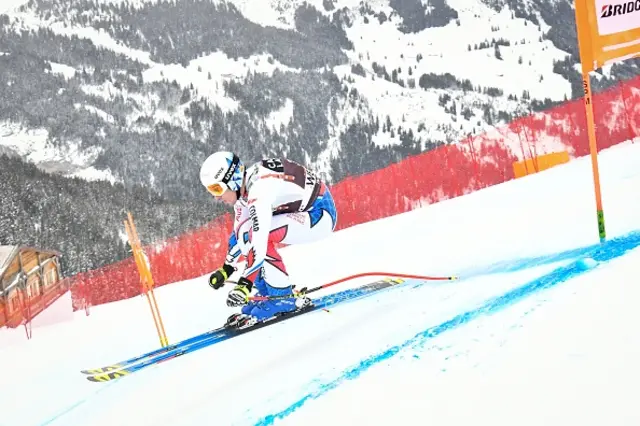
  14. Swiss ski race scrapped after outbreak linked to UK touristpublished at 16:54 GMT 13 January 2021

    Imogen Foulkes
    BBC News, Geneva

    France's Victor Muffat-Jeandet takes part in the training run for the men's downhill race of the FIS Alpine Ski World Cup in Lauberhorn, in Wengen in 2019Image source, Getty Images
    Image caption,

    The event at Wengen is one of the most prestigious at the Ski World Cup

    Switzerland’s iconic Lauberhorn ski race has been cancelled because of rising cases of Covid-19, many of them, Swiss health officials say, spread by one British tourist.

    The resort of Wengen, where the famous race is held, had recorded no cases of the virus until October, and only ten until mid-December.

    After that, cases began to shoot up, and, worryingly, sequencing revealed many of them were the new highly infectious variant first detected in the UK.

    Contact tracers found that 27 of the cases alone could be linked to one British tourist who recently stayed in a Wengen hotel.

    Wengen desperately tried to save the race, offering to close off the resort to everyone but competitors, and even closing its schools. At first Swiss health officials agreed, but when, at the start of this week yet more Covid-19 cases were recorded, they pulled the emergency brake.

    Wengen is devastated. The Lauberhorn is not just any race, but one of the top competitions on the Ski World Cup circuit. It is dearly loved by the Swiss, who have watched with delight as some of their own home-grown talent - such as Beat Feuz and Carlo Janka - triumphed there.

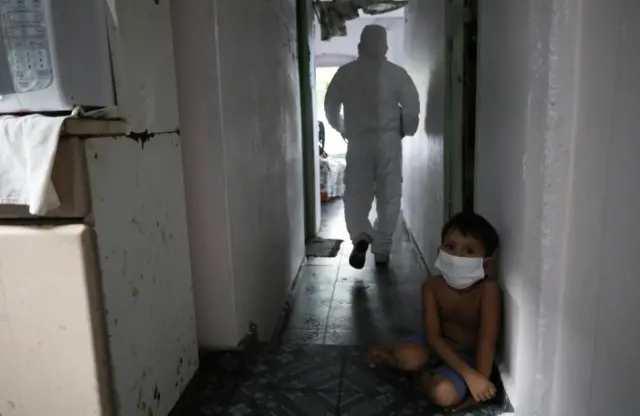
  15. Brazil's variant: Two 'spike' changes flagged uppublished at 16:50 GMT 13 January 2021

    Rachel Schraer
    BBC Health Reporter

    A boy looks as a healthcare worker inspects a house in Manaus, Amazonas state, Brazil. Photo: 11 January 2021Image source, Reuters

    As MPs have been mentioning today - a coronavirus variant has been found circulating in the Amazonas state of Brazil, and was picked up in Japan in travellers from the region.

    It’s different from the UK and South African variants, but it contains common mutations - two changes to the virus’ "spike" in particular which have been flagged as potentially making the virus more infectious.

    This is not going to be the last mutation we hear about.

    At the moment changes are mainly being picked up in areas that do lots of genetic tracking of the virus - it’s almost certain there are other mutations already circulating unseen in other parts of the world.

    And the virus will continue to mutate - it’s just a question of how, how much and how fast.

    For now there’s no evidence the virus is becoming more dangerous - but if more people catch it then, left unchecked, more will potentially become ill or die.

    But the vaccines, which target several different areas of the virus’ spike, should still work - though that’s something that scientists the world over will be monitoring very closely.

  16. More deaths in second wave than first, Public Health England sayspublished at 16:44 GMT 13 January 2021
    Breaking

    There have now been more deaths in the second wave of the pandemic than the first, Public Health England's medical director has said.

    Dr Yvonne Doyle was reacting to the new record of 1,564 deaths within 28 days of testing positive for coronavirus in the UK that have been announced this hour.

    She said: “With each passing day, more and more people are tragically losing their lives to this terrible virus, and today we have reported the highest number of deaths on a single day since the pandemic began.

    "There have now been more deaths in the second wave than the first.

    “About one-in-three people with Covid-19 don’t show symptoms, but can still pass it on to others so it is essential that we stay at home, minimise contact with other people and act as if you have the virus.”

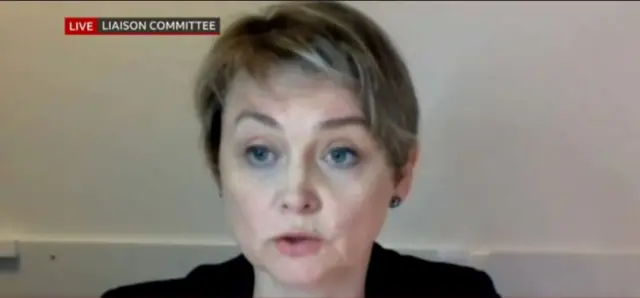
  17. Johnson questioned on Covid border securitypublished at 16:43 GMT 13 January 2021

    Yvette Cooper

    Labour's chair of the Home Affairs Committee Yvette Cooper, points out loopholes for travellers arriving home from abroad - including travelling on UK public transport when coming back from a holiday destination.

    Mr Johnson says there is a "balanced approach" from the government on the health of the nation vs the health of the economy.

    Ms Cooper says other countries brought in negative Covid tests as a requirement to travel "months ago" whereas the UK is only bringing these in from Friday.

    Mr Johnson says 3.5m passengers have been spot-checked since June 2020. He says a "great deal of work" goes into checking "passenger data forms" to check where people have come from.

    Ms Cooper says over 90% of those passenger data forms are not being checked. She says these checks "might as well be voluntary".

    Mr Johnson replies that those arriving from abroad are being screened.

    Ms Cooper asks why people from Brazil are not being checked for Covid, considering that there is a new strain in the South American country which could undermine the UK's vaccination programme.

    "We are taking steps to ensure" that the UK doesn't see the new variant in Brazil coming to the UK, replies Mr Johnson.

  18. PM quizzed on smear test wait timespublished at 16:41 GMT 13 January 2021

    Caroline Nokes, who chairs Parliament's Women and Equalities Commitee, then asks the PM about access to healthcare during the pandemic.

    She says the evidence shows it is women who are finding accessing services difficult, referring to a constituent who said her surgery was not currently doing smear tests.

    Nokes asks the PM what is an acceptable wait for a smear test?

    The PM says he sympathises with anybody who has had their treatment delayed.

    "Sadly, that's what we are seeing. We're seeing delays in cancer, we're seeing delays in smear tests and vital services that people need, and that's a result in the increase in the numbers of Covid patients and that's why we have to work flat out to get the virus under control and reduce the current wave and give people the service we need."

  19. Analysis: UK death figures - darkest days of pandemic so farpublished at 16:37 GMT 13 January 2021

    Nick Triggle
    Health Correspondent

    Perhaps the most distressing element about the latest Covid deaths is that the numbers are almost certainly going to rise from here.

    People who are dying now are likely to have been infected around three weeks ago. That was at a point when infection rates were rising quite steeply, so in the coming days and weeks we should, sadly, expect to see more deaths than this.

    Today’s figures are affected by the weekend, which sees delays reporting deaths that tend to translate into higher figures from Tuesday onwards.

    Currently around 800 to 900 people a day on average are dying once you take this into account. But the figures also provide some hope.

    For the third day, in a row the number of newly diagnosed infections are well below 50,000. There had been several days where they have exceeded 60,000.

    If that trend continues, and the number of new cases keeps coming down, that will eventually translate into the number of deaths falling. But it is going to take some weeks for that to happen. These are, as many have been saying, the darkest days of the pandemic so far.

  20. PM quizzed on protections for abuse victims in lockdownpublished at 16:36 GMT 13 January 2021

    Caroline Nokes, who chairs Parliament's Women and Equalities Committee, asks the PM what additional protections are being put in place to help victims of domestic abuse who have insecure immigration status.

    The PM says the government has done "what we can" since the start of the pandemic to encourage victims of domestic abuse to come forward, including setting up helplines and investing in independent domestic abuse advisers.

    He says lockdown rules don't apply to victims of domestic abuse.

    Nokes follows up by asking why a better job is not being done of explaining lockdown rules to vulnerable people - for example, those who rely on British Sign Language or who might have learning difficulties.

    The PM says he has been asked a couple of times about sign language in particular, and he is going to "take that away and see what we can do to increase sign language".

    He adds that campaigns the government have produced are available in accessible formats and translations.