Summary

  • Scroll down the page to find text, social media and video highlights from the last four months at the European Parliament.

  • The Parliament has now adjourned for Christmas and will return on Monday 11 January 2016.

  • Hit the 'Live Coverage' tab to watch the recent plenary debate on the December European Council summit.

  • You can also watch Jean-Claude Juncker's "state of the union" speech from September by clicking on the 'Key Video' tab.

  1. MEPs set up Volkswagen inquiry committeepublished at 16:32 GMT 22 December 2015

    17 December

    MEPs passed a resolution to set up a "committee of inquiry" into the emissions cheating scandal surrounding Volkswagen. 

    The 45-member committee will investigate whether regulators failed to prevent the car industry from cheating emissions tests designed to reduce pollution.

    The executive branch of the EU, the European Commission, which will be scrutinised as part of the probe, said it would work with the committee.

    The MEPs' inquiry, which will get underway early in 2016, could last up to a year. 
    VW carImage source, Getty Images
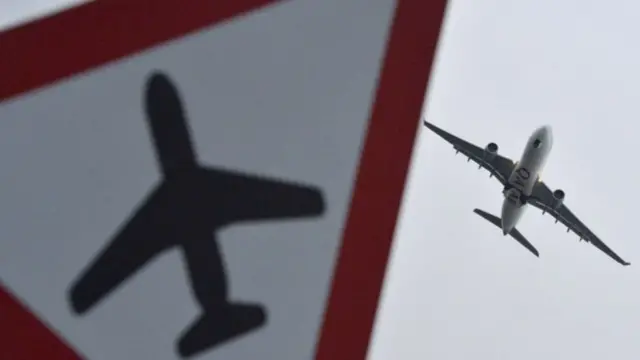
  2. MEPs give green light to airline data sharing schemepublished at 16:32 GMT 22 December 2015

    10 December

    More than two years after initially rejecting the proposals, the Parliament’s civil liberties committee backed a provisional deal, external with national governments on setting up an EU-wide scheme for sharing airline passenger data.

    It means the new scheme is likely to gain final approval at a full plenary vote in early 2016. 

    MEPs had already pledged, external to "finalise" a deal on the legislation before the end of this year, but said majority support would depend on finishing negotiations on EU data protection legislation. 

    Under the plans, airline companies would be forced to hand over so-called passenger name record or "PNR" data to the national security authorities of EU countries to help screen passengers for potential terror or serious crime suspects.

    The UK is already operating its own PNR programme, whilst a number of other EU countries, external are currently building their own systems. 

    AirplaneImage source, Reuters
  3. Raif Badawi awarded human rights prizepublished at 16:07 GMT 22 December 2015

    15 December

    During a short ceremony at the year’s final plenary sitting, President Martin Schulz awarded the Parliament’s human rights Sakharov prize to Raif Badawi, the blogger sentenced to 10 years in jail and 1,000 lashes in Saudi Arabia for "insulting Islam".

    Mr Schulz told the Parliament that Mr Badawi was simply "exercising his right to freedom of expression", and repeated his call for Saudi King Salman to release the blogger and desist from the "gruesome" sentence against him.

    Mr Badawi's wife, Ms Ensaf Haidar, came to the Strasbourg sitting to collect the award on his behalf. 

    This X post cannot be displayed in your browser. Please enable Javascript or try a different browser.View original content on X
    The BBC is not responsible for the content of external sites.
    Skip X post

    Allow X content?

    This article contains content provided by X. We ask for your permission before anything is loaded, as they may be using cookies and other technologies. You may want to read X’s cookie policy, external and privacy policy, external before accepting. To view this content choose ‘accept and continue’.

    The BBC is not responsible for the content of external sites.
    End of X post
  4. 'The momentum is on our side'published at 16:06 GMT 22 December 2015

    UKIP leader Nigel Farage says he is looking forward to next year:

    Media caption,

    EU vote could be 'tipping point' says Farage

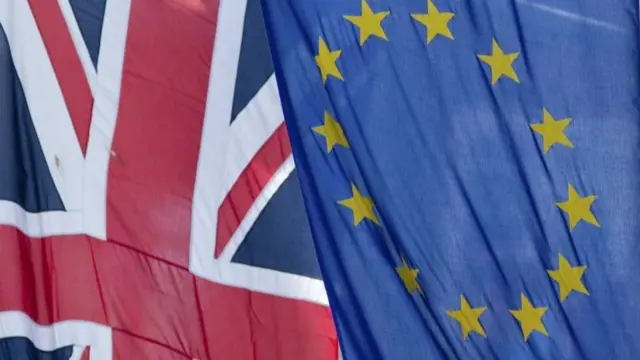
  5. MEPs debate Brexit ahead of summitpublished at 16:06 GMT 22 December 2015

    16 December

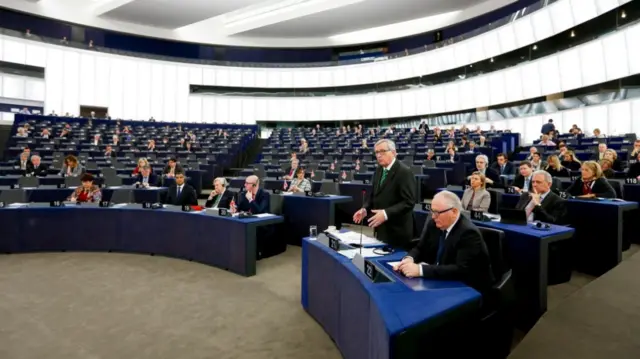
    The day before David Cameron headed to Brussels to continue to push for changes to the UK’s terms of EU membership, MEPs debated the month’s summit of EU leaders.

    The topic of Brexit was a key theme of the debate, which was also dominated by the migration crisis and the recently-announced plans for an EU border force.

    UKIP leader Nigel Farage poured scorn on the prime minister’s plans, which he said amounted to “almost nothing” and predicted the UK’s forthcoming referendum would prove a “tipping point” for the “European project”.

    Commission President Jean-Claude Juncker, however, declined to comment on the renegotiations, leaving BBC Political Correspondent Alex Forsyth disappointed: 

    This X post cannot be displayed in your browser. Please enable Javascript or try a different browser.View original content on X
    The BBC is not responsible for the content of external sites.
    Skip X post

    Allow X content?

    This article contains content provided by X. We ask for your permission before anything is loaded, as they may be using cookies and other technologies. You may want to read X’s cookie policy, external and privacy policy, external before accepting. To view this content choose ‘accept and continue’.

    The BBC is not responsible for the content of external sites.
    End of X post
    UK and EU flagsImage source, Reuters
  6. MEPs debate climate dealpublished at 16:03 GMT 22 December 2015

    15 December

    There was also a mixed reaction at the plenary to the climate deal reached in early December following marathon UN talks in Paris.

    The Paris pact, agreed between nearly 200 countries, aims to curb global warming to less than 2C (3.6F) by the end of the century.

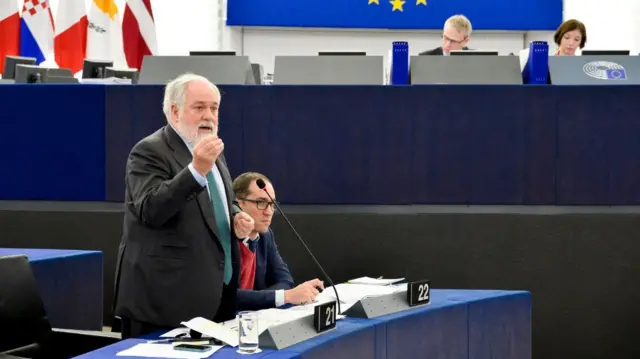
    EU climate commissioner Miguel Arias Canete had hailed the agreement, external as "the major multilateral deal of the 21st century".

    However, Green MEPs led the charge among those who were sceptical about whether the commitments made in the deal would ever come to fruition, or be enough to protect the planet. 

  7. Commission announces new border forcepublished at 16:00 GMT 22 December 2015

    15 December

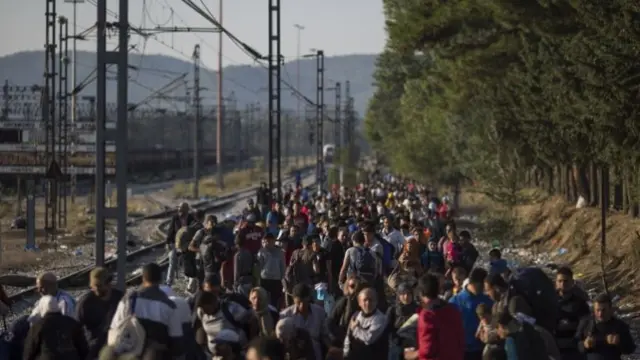
    Commission deputy chief Frans Timmermans came to the Parliament to announce the Commission’s latest response to the migration crisis – an EU Border and Coast Guard force to replace Frontex, the existing borders agency.

    The Commission has proposed that the new force should have a rapid reserve pool of 1,500 experts, to be deployed in three days if member states are overwhelmed or are deemed to be failing to safeguard the EU's external borders.

    Controversially, the new force would have the power to intervene at a national border even if the government of that country disagrees.

    As a non-Schengen state, the UK would not be bound by the immediate provisions of the new proposal.

    Mr Timmermans told MEPs that the provision was a “safety net”, which the Commission hoped “will never need to be used”.

    MEPs will now begin scrutiny of the plan, which will have to gain their approval, along with that of national governments, before it can come into force. 

    Migrants in GreeceImage source, Getty Images
    Image caption,

    The migrant crisis has put huge pressure on the EU's external borders

  8. MEPs question Nord Stream extensionpublished at 15:57 GMT 22 December 2015

    15 December

    MEPs expressed concern about plans to double the capacity, external of the Nord Stream gas pipeline running from Russia to Germany via the Baltic Sea, in a resolution vote.

    It came shortly after a number of EU countries set out their opposition to the extension in a letter to the Commission, which is due to assess whether the project complies with EU law.

    An agreement between several EU energy companies with Gazprom, the Russian state-backed energy company, would add around 55 billion cubic meters of capacity to the pipeline by 2019.

    However, critics of the project have warned it could undermine the EU’s broader strategic goal of reducing energy dependence on Russia.

    EU climate commissioner Miguel Arias Canete told MEPs that the scheme will have to "full comply" with EU law and be "in line" with the bloc's wider energy interests. 

    EU climate commissioner Miguel Arias CaneteImage source, European Parliament
  9. MEPs back EU-Liechtenstein tax agreementpublished at 15:56 GMT 22 December 2015

    2 December

    MEPs gave their support to an agreement for Liechtenstein and EU countries to automatically exchange information on the bank accounts of each other's residents from 2017.

    The information will include the names, addresses, tax identification numbers and dates of birth of account holders, as well as financial and account balance information.

    The agreement, which was signed at the end of October, comes as part of a drive to help national tax authorities detect tax avoidance and evasion.

    MEPs did not have the power to amend or formally block the agreement, but had to express their opinion on it before it is due to come into force in January 2016. 

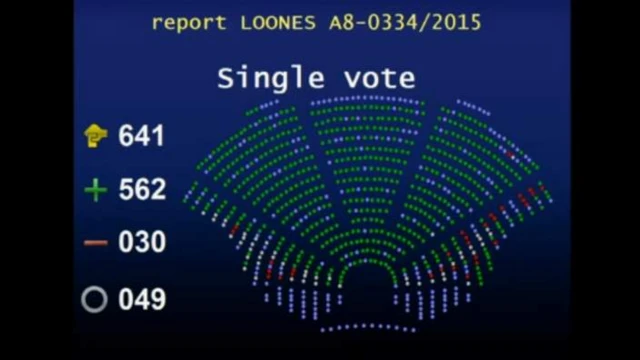
    Result of vote
  10. Commission announces new recycling measurespublished at 15:56 GMT 22 December 2015

    2 December

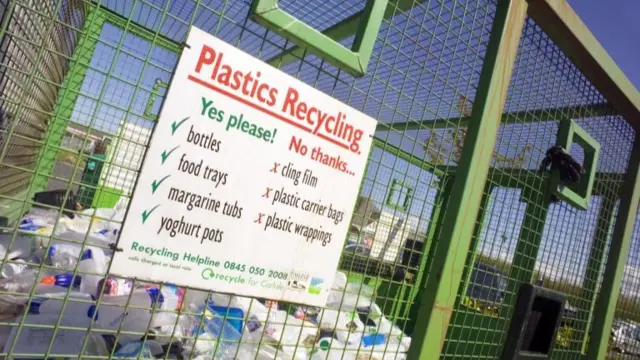
    Investment commissioner Jyrki Katainen and deputy Commission chief Frans Timmermans came to the Parliament to announce new measures to promote a “circular economy” in the EU.

    The proposals, external aim to boost recycling and reuse of resources as much as possible in the manufacturing of new products.

    Mr Timmermans told MEPs the targets in the plan contained the "most strict recycling and landfilling requirements on Earth".

    Green and left-wing MEPs, however, accused the Commission of watering down its plans from previous announcements, which had been delayed. 

    Recycling plantImage source, Science Photo Library
  11. MEPs call for Frontex complaints mechanismpublished at 15:55 GMT 22 December 2015

    2 December

    In a resolution vote, MEPs called on Frontex, the EU borders agency, to set up its own mechanism for dealing with complaints about fundamental rights.

    They rejected an amendment proposed by the anti-EU ENF group declaring that such a mechanism will "frustrate the return of illegal migrants to their country of origin". 

    The establishment of such a procedure has been resisted by Frontex, despite a 2013 inquiry, external by the European Ombudsman requesting such a change.

    Frontex has been legally obliged since 2009 to protect the “physical and mental integrity” of migrants when conducting its operations.

    However, the agency has argued that complaints about individual incidents should be handled by the national governments where they occurred.

    Migrants on boatImage source, AFP/Getty Images
    Image caption,

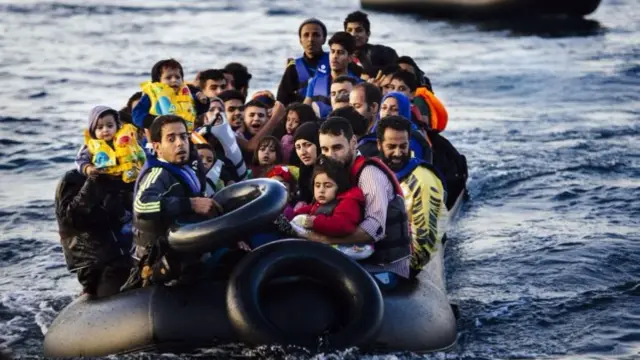
    The International Organization for Migration says around 970,000 migrants and refugees have illegally entered Europe via sea this year

  12. ...and begin anotherpublished at 15:54 GMT 22 December 2015

    2 December

    …and there was an early Christmas present for tax-minded MEPs, as group leaders decided to extend, external the tax committee’s mandate for a further six months.

    The committee, whose composition will remain the same, will also look into the Commission’s role in enforcing EU state aid rules and “aggressive tax planning” by multinational firms. 

    This X post cannot be displayed in your browser. Please enable Javascript or try a different browser.View original content on X
    The BBC is not responsible for the content of external sites.
    Skip X post

    Allow X content?

    This article contains content provided by X. We ask for your permission before anything is loaded, as they may be using cookies and other technologies. You may want to read X’s cookie policy, external and privacy policy, external before accepting. To view this content choose ‘accept and continue’.

    The BBC is not responsible for the content of external sites.
    End of X post
  13. MEPs approve tax investigation reportpublished at 15:53 GMT 22 December 2015

    25 November

    MEPs finally approved a much-delayed report on tax avoidance in the EU prepared by the Parliament’s temporary tax investigation committee.

    The main recommendation in the report compiled by the 45-member committee was for “country-by-country” reporting of where multinationals make their profits.

    It urged greater transparency relating to the amount of information national tax authorities should have to disclose both to authorities in other EU countries and the European Commission.

    Notably, it also called for renewed efforts to set up a common system for calculating corporate tax payments due by multinationals across the EU.

    However, its recommendations are only advisory and it remains to be seen whether the document has any effect on corporation tax policies, which are a matter for national governments. 

  14. A happy Commissionerpublished at 15:53 GMT 22 December 2015

    The EU’s Budget Commissioner, Kristalina Georgieva, tweeted this picture of the final vote displayed on a screen inside the chamber: 

    This X post cannot be displayed in your browser. Please enable Javascript or try a different browser.View original content on X
    The BBC is not responsible for the content of external sites.
    Skip X post

    Allow X content?

    This article contains content provided by X. We ask for your permission before anything is loaded, as they may be using cookies and other technologies. You may want to read X’s cookie policy, external and privacy policy, external before accepting. To view this content choose ‘accept and continue’.

    The BBC is not responsible for the content of external sites.
    End of X post
  15. MEPs ratify 2016 EU budgetpublished at 15:52 GMT 22 December 2015

    25 November

    On the same day, MEPs gave a final vote of approval to the provisional deal, external on the EU’s budget for 2016 they had reached with national governments earlier in the month. 

    It meant that, unlike last year, they were able to give their approval to the annual budget according to their own deadlines.

    Under the deal, external, the EU’s 2016 budget will be set at €144bn in actual spending, with €155m reserved for commitments, slightly higher than initially proposed by member states back in May, but slightly below what MEPs had initially wanted.

    Annual EU budgets are proposed by the European Commission, but must be approved by national governments and the European Parliament before they can come into force. 

  16. Schengen area declared ‘partly comatose’published at 15:51 GMT 22 December 2015

    25 November

    Jean-Claude Juncker raised political and medical eyebrows alike when he declared during a plenary debate on the EU security situation that the Schengen zone was “partly comatose”.

    His comments on the passport-free travel area, which includes 22 EU states, came after a number of governments had restored temporary border checks in response to the migration crisis.

    In defence of the zone, however, he said border-free travel within the area had been "one of the main pillars of the construction of Europe". 

    And he said a collapse of the zone would have huge economic consequences, linking its fate to that of the Euro itself.

    UKIP MEP Patrick O’Flynn, however, tweeted during the debate that the zone was “effectively over”:

    This X post cannot be displayed in your browser. Please enable Javascript or try a different browser.View original content on X
    The BBC is not responsible for the content of external sites.
    Skip X post

    Allow X content?

    This article contains content provided by X. We ask for your permission before anything is loaded, as they may be using cookies and other technologies. You may want to read X’s cookie policy, external and privacy policy, external before accepting. To view this content choose ‘accept and continue’.

    The BBC is not responsible for the content of external sites.
    End of X post
    Jean-Claude JunckerImage source, European Parliament
  17. See you in courtpublished at 15:49 GMT 22 December 2015

    20 November

    At the end of November came the news that a group of European journalists was taking the European Parliament to court in the hope of making MEPs' expenses more transparent.

    The 29 journalists say they decided to go to the ECJ in Luxembourg after the Parliament denied them access to the information on MEPs' expenses.

    They said they were particularly concerned about MEPs' general allowances, which they calculated to be almost €40m (£28m) annually.

    The group's leader, Slovenian journalist Anuska Delic, said that MEPs' allowances "should not be allowed to remain hidden from the European public". 

  18. MEPs debate steel crisispublished at 15:48 GMT 22 December 2015

    24 November

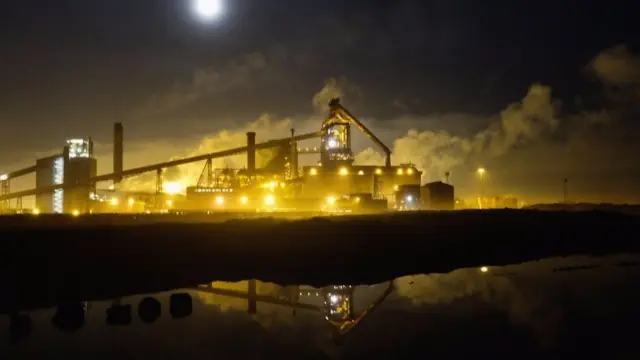
    The November plenary saw MEPs debate the crisis in the EU’s steel industry, following an emergency meeting in Brussels of industry ministers.

    British MEPs were well-represented during the debate, particularly following the announcement of thousands of job losses at a number of British plants the month before.

    Critics accused the EU institutions, as well as national governments, of not doing enough to prevent the “dumping” of state-subsidised Chinese steel imports on the EU market.

    Others also suggested that EU climate rules have made the sector uncompetitive by pushing up energy prices.

    Industry Commissioner Elżbieta Bienkowska told MEPs that she agreed with the need for a "stronger anti-dumping policy", but said the Commission was making some use of the existing tools. 

    The steel plant in RedcarImage source, Getty Images
    Image caption,

    The steel plant in Redcar is just one of many in Europe to have seen job losses in recent years

  19. EU faces biggest terror threat 'in over ten years'published at 15:47 GMT 22 December 2015

    19 November

    This X post cannot be displayed in your browser. Please enable Javascript or try a different browser.View original content on X
    The BBC is not responsible for the content of external sites.
    Skip X post

    Allow X content?

    This article contains content provided by X. We ask for your permission before anything is loaded, as they may be using cookies and other technologies. You may want to read X’s cookie policy, external and privacy policy, external before accepting. To view this content choose ‘accept and continue’.

    The BBC is not responsible for the content of external sites.
    End of X post

    Late November saw security outside the European Parliament buildings stepped up in the wake of the brutal terror attacks in Paris, in which 130 people died.

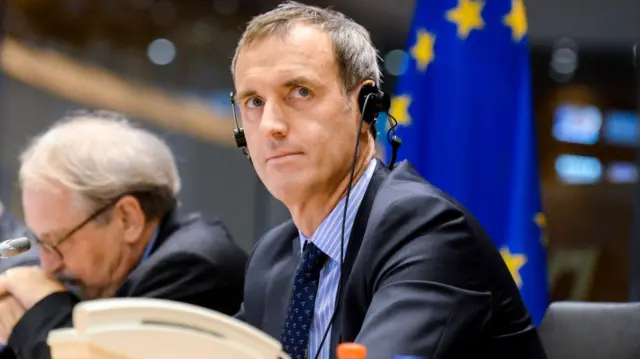
    With security in the EU rocketing to the top of the political agenda, MEPs on the Civil Liberties Committee held a special session with Europol director Rob Wainwright.

    He told them that that Europe was currently facing its most serious terrorist threat "in over ten years", and that the Paris attacks represented a "very serious escalation" of the threat facing EU countries.

    He also revealed that the EU police agency’s database tracking suspected foreign fighters travelling between Europe and Syria and Iraq had doubled in size in the past year.

    He also added that half of all the entries for the database come from only five of the EU's 28 member states, plus one international partner. 

    Rob WainwrightImage source, European Parliament
  20. Multinationals give evidence to MEPspublished at 15:41 GMT 22 December 2015

    16 November

    The Parliament’s tax investigation committee heard evidence from tax bosses representing a number of high-profile companies, including Disney, Amazon, Google and HSBC.

    The appearances, which the Parliament did not have the power to order, came as something of a surprise after members of the committee had complained about the difficulty of securing witnesses.

    The committee, set up in the wake of the “Luxleaks” tax scandal, was examining whether the tax regimes of big multinationals complies fully with EU law.

    Separately, the European Commission is conducting a number of its own probes into the tax affairs of companies to see whether they comply with EU state aid rules.