Summary

  • This morning's session began at 08.00 BST with a debate on last week's emergency EU summit on preventing the death of migrants crossing the Mediterranean.

  • This afternoon, MEPs will first debated the situation in Burundi, followed by the international response to this month's attack by the al-Shabab terror group on Garissa University College in Kenya.

  • MEPs also debated how EU institutions might be able to prevent the destruction and plundering of cultural sites in Iraq and Syria by Islamic State (IS).

  • Parliament also debated a resolution on the 13-year prison sentence recently given to Mohamed Nasheed, a former president of the Maldives.

  • In the evening, MEPs debated progress made towards EU membership by Albania and Bosnia and Herzegovina, and the the amount of money EU countries give in overseas aid.

  • The sitting closed with a debate on getting the EU to sign up to the Marrakesh Treaty.

  1. Goodnightpublished at 22:03 BST 29 April 2015

    And with that, tonight's sitting comes to a close.

    MEPs will be back in the hemicycle tomorrow morning from 07.30 BST when they will be debating the spread of the bacterial disease affecting thousands of hectares of olive trees in Italy, the performance of the European Investment Bank and a series of human rights debates.
  2. Right to bookspublished at 21:45 BST 29 April 2015

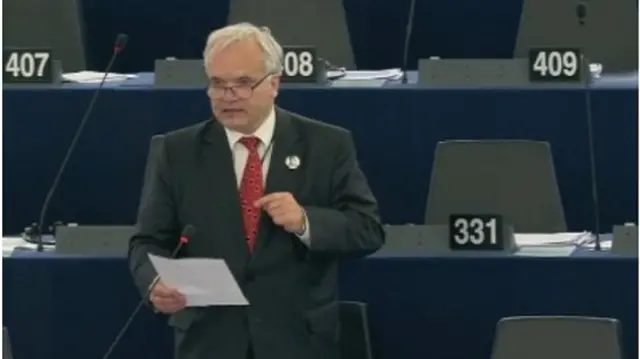
    Spanish left-wing MEP Ángela Vallina lends her support for EU ratification of the treaty, stating that access to culture is a fundamental right but that only only 1% of publications are available in a form accessible to people with visual impairments.

    Ángela Vallina
  3. Calls for EU progresspublished at 21:36 BST 29 April 2015

    Czech centre-right member MEP Pavel Svoboda says that although EU signed the Treaty in 2014, it has not yet been ratified.

    He gives a brief outline of the main purpose of the document - to enable some copyright restrictions to be dropped in order to permit "cross-border exchange" of works in accessible forms of publication, on a non-profit basis.

    He says ratification of the treaty would present a "significant improvement" for the visually impaired, and asks for an explanation of why it has not yet been ratified in the Council of Ministers.

    He adds that if there are still legal doubts about whether signing up to the treaty falls within the "competence" of the EU, then he would like to see the Council take an "active attitude" to solving the legal dispute.

    Pavel Svoboda
  4. Last debatepublished at 21:23 BST 29 April 2015

    That's the debate on overseas aid spending finished.

    The last item on tonight's agenda - after a quick break - is another oral question to the Commission and Council of Ministers - this time from Parliament's Legal Affairs Committee.

    They are asking for greater clarity on the process for getting the EU to sign up to the Marrakesh Treaty - an international agreement seeking to set limits to copyright rules in order to make it easier for visually impaired people to gain access to publications accessible to them, such as those published in Braille.

  5. Concern at aid spendingpublished at 21:05 BST 29 April 2015

    Marina Albiol Guzman, from the left-wing GUE group, says that the development money given by rich to poor countries does not match the historical debt payments going in the other direction, which she puts down to the legacy of colonisation.

    She also expresses concern about the final destination of development money, which she says often ends up "lining the pockets of the elite".

    Her scepticism is echoed by UKIP's Diane James, who says payments made in overseas aid are "notoriously prone to abuse".

  6. Development contextpublished at 20:58 BST 29 April 2015

    This of course is a big year in the world of international development - the UN and its international partners are currently debating renewal of the so-called Millennium Development Goals (MDGs), agreed in 2000, that are due to expire at the end of 2015.

    The MDGs introduced time-bound targets for poverty reduction.

    A UN report, external on progress towards achieving the current goals noted that:

    • The number of people living in "extreme poverty" has come down by 700 million since 1990

    • Over 2.3 billion people gained access to an improved source of drinking water between 1990 and 2012

    • Efforts to fight tuberculosis have saved an estimated 22 million lives worldwide since 1995

    However, the report also noted that more needs to be done if targets are to be reached for reducing child mortality, maternal mortality, and greenhouse gases.

    UN logoImage source, Getty Images
  7. Commission responsepublished at 20:43 BST 29 April 2015

    Commissioner Mimica says the Commission is still a strong supporter of the idea that countries should meet their overseas target, and adds that some improvements have been made despite turbulence in the EU economy in recent years.

    He says that, however, that although the Commission will push for states to "re-commit" to their targets, it is "ultimately up to member states to come to a consensus on this issue".

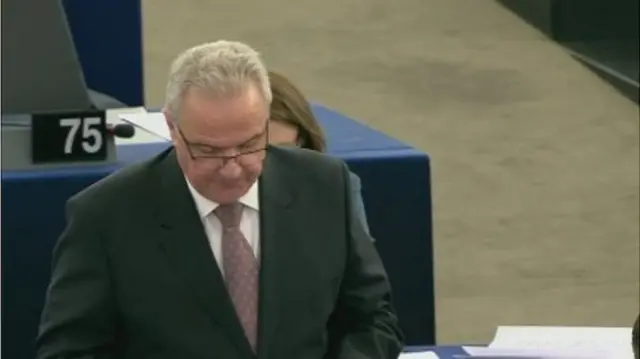
    Commissioner Mimica
  8. Calls for renewed commitmentpublished at 20:36 BST 29 April 2015

    British Labour MEP Linda McAvan, a member of the Parliament's Development Committee which has asked for this debate, says encouraging the member states to meet the 0.7% commitment is "essential to remaining credible" with regards to the bloc's overseas aid efforts.

    She says that a commitment to meet these targets will be essential to the success of an upcoming international aid conference in Addis Ababa.

    She adds it has been "no secret" that many member states have struggled with this target, but that improvements in 11 member states show that it is "not all bad news" on the development front.

    She concludes that discussions on the targets will be a "crucial issue" at a meeting of EU leaders scheduled for May 26 - and states that although she is not expecting any new commitments from EU countries, she hopes to hear renewed commitment to "what has already been agreed".

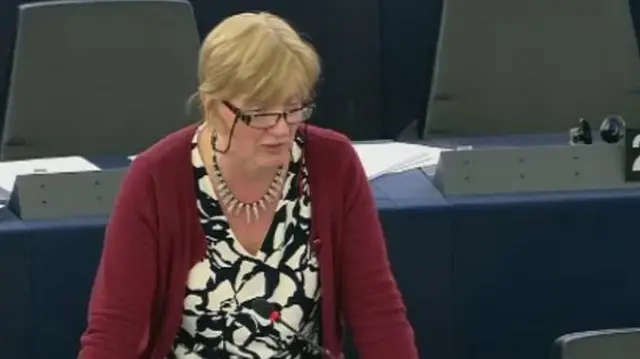
    Linda McAvan
  9. Overseas aid debatepublished at 20:27 BST 29 April 2015

    That's the debate on the EU regulation to suspend preferential trading relations with Bosnia and Herzegovina finished.

    Next up, MEPs are going to be debating the amount of money EU countries give in overseas aid as a proportion of their national income (GDP).

    Member states pledged in 2005 to raise their aid contributions - known as their Official Development Assistance (ODA) - to 0.7% of GDP by this year.

    Countries that joined the EU after 2004 have made a less ambitious commitment of giving 0.33%.

    As of 2013, only four EU countries were meeting their targets.

  10. Background on Bosnia and Herzegovinapublished at 20:21 BST 29 April 2015

    Bosnia-Herzegovina is made up of two semi-autonomous regions - the Bosniak-Croat Federation and the Bosnian Serb Republic.

    Each has its own president, government, parliament, police and other bodies.

    The country - now an independent state - is recovering from a devastating three-year war which accompanied the break-up of Yugoslavia in the early 1990s.

    The 1992-1995 conflict centred on whether Bosnia should stay in the Yugoslav Federation, or whether it should become independent.

    Its three main ethnic groups are Bosniaks (Bosnian Muslims), Croats and Serbs.

    It is considered one of the most corruption-prone states in Europe, mainly on account of the legacy of deep ethnic and political divisions left by the 1992-1995 war and by the country's complex administrative framework.

  11. Trade preferences debatepublished at 20:14 BST 29 April 2015

    Italian Socialist Goffredo Maria Bettini outlines the nature of his report, which he has produced as Parliament's "rapporteur", or lead negotiator: it is on the impending suspension of certain preferential trading conditions with Bosnia and Herzegovina on 1 January next year.

    This has been recommended by the Commission because of the country's refusal to sign up to an updated version of an EU trade agreement, which has been changed to reflect the accession of Croatia - one of its biggest trading partners - to the EU in 2013.

    Croatia's accession meant that it had to leave CEFTA, the regional agreement that facilitates trade in the Balkans - meaning it no longer enjoys duty free access to Bosnia and Herzegovina's market.

    Mr Bettini says he thinks the "punitive" part of the Commission's proposals is fair, and argues that it should not be considered a "punishment".

    He hopes the impending Stabilisation Agreement with Bosnia and Herzegovina - due to come into force in June - will provide a new opportunity to make progress on the deadlock.

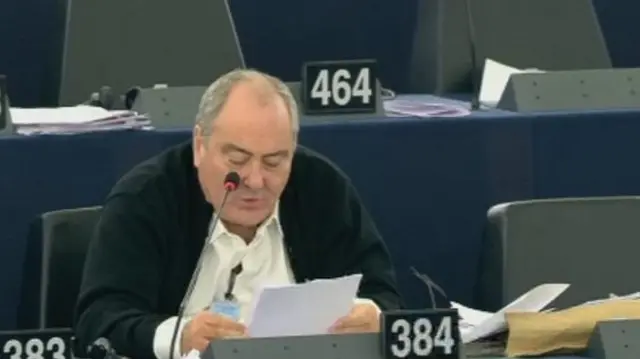
    Goffredo Maria Bettini
  12. Next debate beginspublished at 19:57 BST 29 April 2015

    That's the debate on progress towards EU membership made by Bosnia and Herzegovina finished - MEPs will be voting on their resolution on Thursday.

    However, MEPs will remain focused on the country for the time being, as they are now going to debate an EU regulation on its preferential trading preferences.

  13. Outline of 'new approach'published at 19:06 BST 29 April 2015

    Latvian EU Affairs minister Zanda Kalnina-Lukasevica says much remains to be done in the country's drive towards EU membership, and underlines that the "primary responsibility" for enacting necessary reforms lies with Bosnia and Herzegovina itself.

    She says she welcomes the EU's "new approach" agreed last December to generate fresh momentum in the country's membership and "finally move forward".

    She said the Council set out the required reforms that are necessary for talks to progress, such as moves towards a "functioning market economy".

  14. Debate on Bosnia and Herzegovina beginspublished at 18:58 BST 29 April 2015

    That's the debate on Albania's EU membership prospects finished - the Parliament's resolution will be put to the vote tomorrow.

    Next, MEPs will debate progress towards EU membership made by Bosnia and Herzegovina, the only western Balkan country that has not yet formally applied to join the EU.

    Last week, the Council of Ministers formally activated the country's EU Stabilisation and Association Agreement (SAA) - which is now expected to come into force this June.

    This SAA is supposed to provide a basis for the country to make further moves in its accession process, as well as providing sets of political and economic objectives and the gradual establishment of a free trade area.

  15. Commission closes debatepublished at 18:54 BST 29 April 2015

    Closing the debate on behalf of the Commission, Development Commissioner Neven Mimica says the country's EU accession prospects are "in its own hands", and reaffirms the Commission's commitment to assisting the country's path to membership.

    He repeats calls made by several MEPs for the accountability and independence of the Albanian judiciary to be strengthened and for the country's economy to be reformed, although ne notes that co-operation between the government and the opposition will be required to make this happen.

    Neven Mimica
  16. Parliament's resolutionpublished at 18:29 BST 29 April 2015

    MEPs' resolution, which has been drafted by German Socialist Knut Fleckenstein and will be put to the vote tomorrow, commends the "impressive" progress made towards membership by Albania.

    However, it also voices concern over ongoing political polarisation, the judiciary and corruption issues, and calls for continued political will and concrete action to pursue EU-related reforms, in particular to public administration.

  17. Call to turn page on communist pastpublished at 18:29 BST 29 April 2015

    Hungarian centre-right MEP Laszlo Tokes says that Albania must remove the "remaining remnants" of its communist past and seek to strengthen the protection of ethnic and linguistic minorities - which he says is a key ingredient in achieving political stability in the Balkans.

    He calls for these efforts to be supported by EU funding.

    Laszlo Tokes
  18. Albania's relationship with the EUpublished at 18:11 BST 29 April 2015

    Albania is not expected to join the EU until 2020 at the earliest.

    The EU has urged Albania to do more to tackle corruption and organised crime, especially crime relating to immigration and human trafficking, and drugs.

    Since 15 December 2010 Albanians with biometric passports have been able to travel visa-free to the Schengen zone, which includes most EU countries.

    Border controls are minimal under the Schengen accord, but the EU will keep a close watch on the flow of visitors from the Western Balkans.

    The EU and Albania concluded a Stabilisation and Association Agreement (SAA), seen as the first step towards membership, in June 2006.

    The negotiations took three-and-a-half years - three times longer than they took in Croatia's and Macedonia's case.

  19. No new EU members before 2019published at 18:02 BST 29 April 2015

    It's worth pointing out that, prior to taking office, current Commission chief Jean-Claude Juncker ruled out any enlargement of the EU during the term of the current executive - which is due to end in 2019.

    "It's hard to imagine that one of the candidate states with whom we are negotiating will have, in time, met all the accession criteria," he said in July.

  20. Albania debate beginspublished at 17:50 BST 29 April 2015

    First up, MEPs will debate progress made towards membership by Albania, which was granted official EU candidate status last year but has yet to start formal accession negotiations.

    The European Commission's report, external on progress made by the country during 2014 noted efforts that have been made to reform the judiciary, fight corruption and organised crime, and crack down on drug-related issues.

    However, it also said that more needs to be done to de-politicise the country's judiciary, and problems remain with enforcement of the rule of law, trafficking and human rights protection.

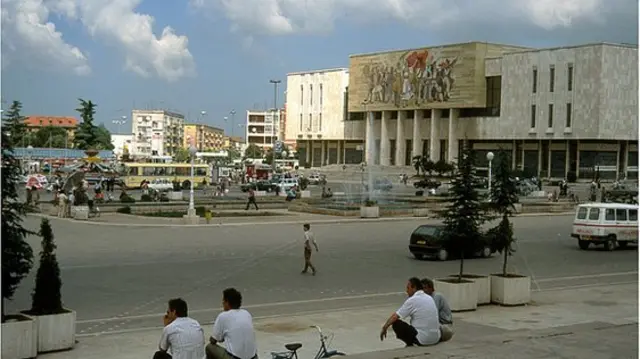
    Tirana
    Image caption,

    The central square in the Albanian capital, Tirana