Summary

  • MPs met at 11.30 GMT for questions to the Cabinet Office team; followed by prime minister's questions at 12 noon.

  • Health Secretary Jeremy Hunt made a statement on A&E waiting times following an urgent question from his Shadow Health Secretary Andy Burnham.

  • Northern Ireland Secretary Theresa Villiers announced a new bill to devolve corporation tax to northern Ireland during a statement on the Stormont House agreement.

  • The day's main business was the report stage consideration and third reading of the Counter-Terrorism and Security Bill.

  • Labour MP Nia Griffith led the adjournment debate on the regulation of the hairdressing industry.

  • Peers met at 15.00 GMT for oral questions; followed by repeats of the Commons statements on A&E waiting times and the Stormont House agreement.

  • After that, peers debated the Pension Schemes Bill in a committee of the whole House and conducted a debate on improving skills in the NHS.

  1. Goodnight from the Lordspublished at 21:46 GMT 7 January 2015

    House of Lords
    Parliament

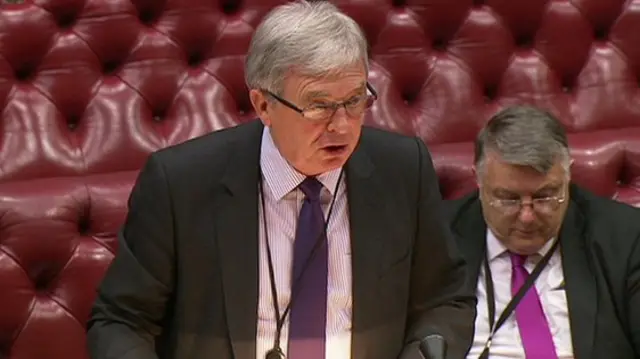
    Lord Bradley accepts the government's assurances and withdraws the amendment, which is the last one to be debated tonight.

    That concludes business in the Lords for today.

    Join us tomorrow for live coverage of Parliament from 09.30 GMT, beginning with questions to business, innovation and skills ministers in the Commons.

    The House of Lords will sit from 11.00 GMT and peers will debate topics including the future of the NHS.
  2. 'Exceptional job'published at 21:40 GMT 7 January 2015

    House of Lords
    Parliament

    Government spokesman Lord Bourne says NEST has been doing "an exceptional job" since its establishment.

    He says that research had shown that some of the restrictions on contributions and transfers were "seen as a barrier" by some would-be investors.

    However he argues that removing contribution limits was not a "proportional" response before 2017, when some restrictions are set to be relaxed.

  3. NEST schemepublished at 21:35 GMT 7 January 2015

    House of Lords
    Parliament

    Labour work and pensions spokesman Lord Bradley is introducing an amendment which would lift a cap on contributions to the National Employment Savings Trust (NEST) scheme.

    NEST is a workplace pension scheme introduced under the government's pension reforms.

    Lord Bradley also calls for an end to the ban on transfers to NEST from other schemes.

    "The effect is to discourage those employers who currently have schemes elsewhere," he argues.

    Lord Bradley
  4. Postpublished at 21:12 GMT 7 January 2015

    House of Lords
    Parliament

    Lord German welcomes the commitment from both side of House to more transparency and withdraws his amendment.

    As a matter of parliamentary convention, amendments are rarely pushed to a vote during committee stage in the Lords.

    If peers are dissatisfied with the government's position they may choose to introduce another amendment during the next stage of a bill's passage - report stage - and force a vote.

    Divisions on amendments are more common during report stage.

  5. Improved governancepublished at 21:05 GMT 7 January 2015

    House of Lords
    Parliament

    Government spokesman Lord Bourne of Aberystwyth says ministers are consulting on proposals to require trustees to improve the governance of their pensions schemes.

    He insists that the government takes the transparency of schemes seriously.

  6. Labour backingpublished at 21:01 GMT 7 January 2015

    House of Lords
    Parliament

    Lord German's amendment gains the backing of the Labour benches.

    Shadow work and pensions spokesman Lord Bradley says he supports any measure "that improves transparency for the public".

  7. Lib Dem amendmentpublished at 20:36 GMT 7 January 2015

    House of Lords
    Parliament

    The Lib Dem backbench amendment would require trustees or managers of an occupational pension scheme and the managers of a personal pension scheme to account for their investment decisions to the scheme's beneficiaries.

    "The more savers are informed the better the market will work," Lord German argues.

  8. Pension Schemes Bill debate resumespublished at 20:32 GMT 7 January 2015

    House of Lords
    Parliament

    Peers reconvene to consider further amendments to the Pension Schemes Bill at committee stage.

    Liberal Democrat Lord German is introducing an amendment which is backed by a group of Lib Dem peers.

  9. Short breakpublished at 20:27 GMT 7 January 2015

    House of Lords
    Parliament

    That's the end of the debate on skills in the NHS and the House is taking a short break before peers resume debate on the Pension Schemes Bill.

  10. Government responsepublished at 20:26 GMT 7 January 2015

    Health Minister Earl Howe tells peers that the government has asked training body Health Education England to ensure that "professional and personal development continues beyond the end of formal training" for NHS staff in England.

  11. GP training callpublished at 19:55 GMT 7 January 2015

    House of Lords
    Parliament

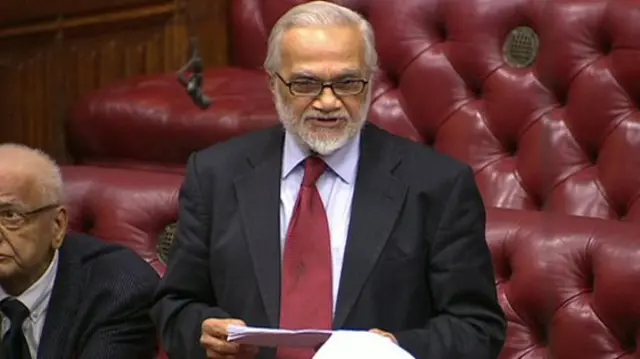
    Lord Parekh calls for increased training for GPs as part of efforts to improve medical competence.

    Lord Parekh
  12. NHS debatepublished at 19:32 GMT 7 January 2015

    House of Lords
    Parliament

    Peers are taking a break from the Pension Schemes Bill for a short debate on improving the level of medical competence and skill in the National Health Service.

    Labour peer Lord Parekh is opening the debate.

  13. Statutory instrumentspublished at 19:30 GMT 7 January 2015

    House of Lords
    Parliament

    Ministers can exercise powers conferred by an act of Parliament by using statutory instruments, which enable the government to bring parts of an act into force or alter it, without Parliament having to pass a new act.

    If the government accepts the recommendations of the Delegated Powers Committee, MPs and peers will need to approve statutory instruments in Parliament before ministers can exercise certain powers under the Pension Schemes Bill.

    An act of Parliament can be referred to as primary legislation, while statutory instruments are also known as secondary, delegated or subordinate legislation.

  14. Ministerial powerspublished at 19:19 GMT 7 January 2015

    House of Lords
    Parliament

    The Pension Schemes Bill was one of the pieces of legislation scrutinised by the House of Lords' Delegated Powers and Regulatory Reform Committee, external.

    Many laws confer powers on ministers and the committee examines such proposals.

    It has recommended that some of the powers be subject to the approval of Parliament, known as being subject to the "affirmative procedure".

    The "negative procedure" refers to statutory instruments which automatically become law unless there is an objection from either House.

  15. More on the Pension Schemes Billpublished at 18:25 GMT 7 January 2015

    House of Lords
    Parliament

    Peers are continuing their detailed scrutiny of the Pension Schemes Bill.

    As well as new provisions for private pensions, the bill gives force to measures announced in the Budget, such as giving people aged 55 and over more flexibility about how to access their defined contribution pension savings from April 2015.

    Savers will no longer be required to access their pension through a paid for annuity and will have greater choice over how they use the money in their defined contribution scheme.

    The measures are contained in the current bill and the Taxation of Pensions Bill, external, which achieved royal assent in December.

  16. End of Commons businesspublished at 18:07 GMT 7 January 2015

    House of Commons
    Parliament

    Drawing his remarks to a close, Mark Harper tells MPs that hairdressers are already to subject a number of regulations that mean the risks involved in their profession are "comprehensively dealt with".

    That brings an end to today's business in the House of Commons. MPs will be back tomorrow at 09.30 GMT with two back bench business debates.

    The first is on higher education funding and a report from the Business, Innovation and Skills Committee. This will be followed by a debate on a report from the Foreign Affairs Committee concerning Gibraltar, entitled Gibraltar: Time to get off the fence, external.

    Stay with us though as the House of Lords continues its scrutiny of the Pension Schemes Bill.

  17. Trim legislationpublished at 17:51 GMT 7 January 2015

    House of Commons
    Parliament

    Responding for the government Work and Pensions Minister Mark Harper says he is "not attracted" to Nia Griffith's suggestions, as he is unsure what problem she is trying to solve.

    Legislation should be focussed on where the risks are, not where they may appear, he argues.

  18. Cutting remarkspublished at 17:36 GMT 7 January 2015

    House of Commons
    Parliament

    Conservative MP Richard Fuller argues that hairdressing sector is working adequately at the moment and is regulated sufficiently by word of mouth. Bad hairdressers will quickly get a bad reputation and go out of business, he says.

    Heavy regulation didn't prevent unscrupulous practices in banking he argues, and warns that regulation could put off many young people, who may have not found "formal education their direct interest", from beginning their own business.

  19. Public protectionpublished at 17:18 GMT 7 January 2015

    House of Commons
    Parliament

    You do not need a qualification to become a hairdresser in the UK. Ms Griffiths argues that this leave the public unprotected from "unscrupulous" and undertrained hairdressers.

    This is especially troubling because hairdressers use sharp implements and chemicals in their work, she adds.

  20. 'Shared risk' pensionspublished at 17:17 GMT 7 January 2015

    House of Lords
    Parliament

    The Pension Schemes Bill will create a new framework with three categories of pension: defined benefit, defined contribution and shared risk.

    The current types of pension scheme are defined benefit, which include final salary schemes, and defined contribution.

    Defined benefit schemes promise to pay pensions benefits based on a fixed factor, typically salary and length of service, while defined contribution schemes pay out a sum based on the value of a member's fund on retirement.

    According to the Department for Work and Pensions, external, shared risk or "defined ambition" schemes would "offer a promise while members are saving for their pension about some of the outcome from the scheme, but not all".