Goodnightpublished at 22:23 GMT 5 November 2014
That wraps up our live coverage of Wednesday's proceedings in Westminster. Do join us tomorrow.
The Commons day began at 11.30 GMT with questions to International Development Secretary Justine Greening.
The prime minister and Labour leader Ed Miliband exchanged blows over Europe during PMQs
Labour MP Chris Williamson was granted an urgent question on Rolls Royce job cuts.
Labour MP Thomas Docherty proposed a ten minute rule bill entitled Armed Forces (Prevention of Discrimination) Bill.
The main business of the day was an opposition day debate on the top rate of income tax; and local bus services.
The adjournment debate was led by Stephen Phillips on Ebola in west Africa.
Peers began the day with a half-hour question session, which was followed by a debate on the Serious Crime Bill, which cleared the House of Lords.
The main business of the day was report-state examination of the Infrastructure Bill.
Peers also took part in a short debate on regulations that set out the fundamental standards for health and social care providers.
That wraps up our live coverage of Wednesday's proceedings in Westminster. Do join us tomorrow.
Peers have completed the list of scheduled business for today, and the House adjourns.
They'll be back tomorrow morning, at the usual time of 11.00 GMT, for an introduction ceremony and a half-hour question session with government ministers.
The main business will comprise of a series of debates, including on domestic violence and Ebola.
The debate has now turned to part four of the bill, which contains measures allowing for the creation of a community electricity right.
It would give individual residents in a community, or groups connected with the community, the right to buy a stake in a renewable electricity development, in or adjacent to the community.
Arguing against Bishop Smith's amendment, government spokesman Lord Ahmad of Wimbledon warns it could cause "significant problems".
The bishop later withdraws his amendment, and Lib Dem Lord Teverson takes to his feet to propose a change to the bill regarding planning applications. It, too, is withdrawn.
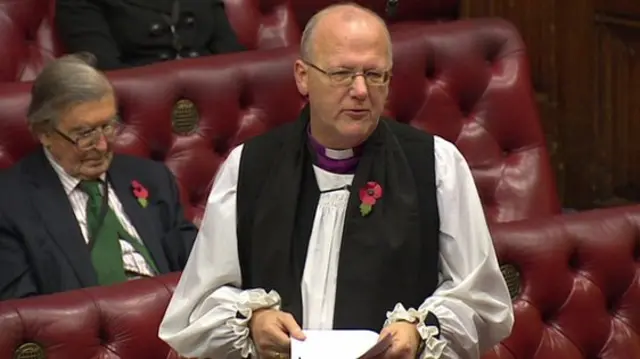
Bishop Smith makes the case for his proposed amendment to the Infrastructure Bill
The bishop says he is concerned that the proposal in the bill is "significantly lower than that agreed through cross-industry consensus", and warns that exempting small sites will cause "confusion" by creating a "two-tiered regulation system".
The Bishop of St Albans, the Rt Rev Alan Smith, is seeking a new clause on the carbon compliance standard for new homes.
The government is committed to implementing a zero carbon standard for new homes from 2016.
So-called zero carbon homes are built to comply with energy efficiency and emissions standards with any remaining emissions offset elsewhere.
Under the bill, developers will be allowed to offset carbon emissions from new houses once they have been built.
Firms would have to contribute to carbon abatement schemes if homes they build in England do not meet the required standard of sustainability.
Small sites, which are most commonly developed by small scale house builders, will be exempt.
Lord Hunt of Kings Heath agrees to withdraw his amendment, and the motion to approve the regulations is passed, bringing an end to the debate.
Report-stage scrutiny of the Infrastructure Bill resumes.
The regulations being debated in the Lords chamber introduce "fundamental standards" for health and social care providers.
They are designed to help improve the quality of care and transparency of health and social providers by ensuring that those responsible for poor care can be held to account.
They are a response to Robert Francis QC 's inquiry into the Stafford Hospital scandal.
But Lord Hunt says there are concerns about the impact of the regulations on residents in care homes, in particular that they could reduce current protections in relation to complaints systems, food and emergency procedures.
And that's it. Desmond Swayne brings the day's business in the Commons to a close.
MP will return tomorrow at 09.30 GMT when the main business will be two backbench business debates on UK foreign policy towards Iran and promotion of the living wage.
Do stay with us as the House of Lords continues, where the main business is the report stage of the Infrastructure Bill., external
A regret motion is a way of expressing criticism of certain regulations or statutory instruments, without challenging them directly, as it does not require the government to take action.
They are an invitation for the House to put on record a particular point of view, but they have no practical effect.
Peers are taking a short break from the Infrastructure Bill to debate a motion to regret regulations which set out the fundamental standards for health and social care providers.
The motion has been tabled by Labour's health spokesman in the Lords, Lord Hunt of Kings Heath.
Health Minister Earl Howe responds for the government.
International Development minister Desmond Swayne responds for the government.
Stephen Phillips is questioning whether money being given to non-governmental organisations in West Africa is being correctly spent, and whether the bodies are as efficient as possible.
He claims there is evidence that the government needs to "take a grip" of what is going on "on the ground" and make sure money is being properly directed.
The Ebola outbreak in West Africa was first reported in March 2014 and is the deadliest occurrence of the disease since its discovery in 1976.
The World Health Organisation has said that there was still a significant lack of beds in Sierra Leone and Liberia, with more than 3,000 needed.
In August, the UN health agency declared an "international public health emergency".
The disease infects humans through close contact with infected animals or spreads between between humans by direct contact with infected blood, bodily fluids or organs.
Ebola can also be spread indirectly through contact with contaminated environments.
The incubation period can be anything from two days to three weeks, and diagnosis is difficult.
Conservative MP Stephen Phillips begins today's adjournment debate on the Ebola outbreak in West Africa, a situation he says he fear "will get worse before it gets better".
Labour's second motion is defeated as well, by 278 votes to 208, a government majority of 70.
Deputy Speaker Lindsay Hoyle informs the House that in the vote on the previous income tax debate the number of backers for the motion was erroneously announced as 248, whereas the correct figure was 238. This doesn't change the outcome of vote as 287 MPs voted against the motion.
Conservative MP Charlie Elphicke then presents a petition from his constituency with 800 signatures protesting the close of Dover Medical Practice.
The Infrastructure Bill is currently being debated at report stage.
This is an opportunity to consider further amendments following committee-stage scrutiny.
Consideration of complex or wide-ranging bills at report stage can be spread over several days.
If a bill is passed at report stage, it moves on to the final stage, third reading.
Transport Minister John Hayes is now responding for the government, and he is animated.
Gesturing around the chamber he tells MPs he "pities" the opposition for their record in government on transport and, now, their motion. He congratulates the government - and his own department - on improving local bus services.
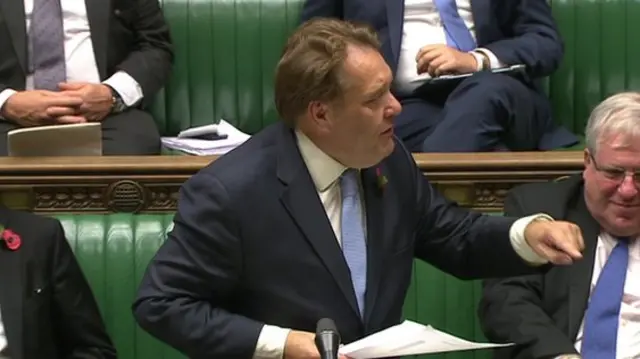
Following the wind up speeches MPs will vote on the Labour motion before turning to the today's adjournment debate at roughly 19.15 GMT.
Opposition day debates are an opportunity for the opposition to raise subjects they believe the government may be vulnerable on but, if passed, they are not binding and cannot compel the government to form policy based on the text of the motion.
