Summary

  • Wednesday's proceedings began with questions to Welsh Secretary Stephen Crabb and his team

  • Prime Minister David Cameron took questions from opposition leader Ed Miliband and backbench MPs from noon

  • Following PMQs, shadow home secretary Yvette Cooper asked an urgent question on the removal of foreign national offenders

  • MP Michael Fabricant then introduced a ten minute rule bill that proposes to overturn the law that bans the majority of homosexual men donating blood

  • The main business of the day included opposition debates called by the Democratic Unionist Party on the National Crime Agency, and the Military Covenant

  • Alliance Party MP for East Belfast Naomi Long led the day's adjournment debate, on the active inquiries investigating historic child abuse

  • The House of Lords sat from 1500 BST. Following questions, the main business of the day was examination of the Criminal Justice and Courts Bill

  • The government is defeated by one vote in the House of Lords over a Labour amendment limiting the scope of "secure colleges"

  • Peers debated how the draft conclusions of the Haass talks could be built upon to find a consensus on dealing with the past in Northern Ireland

  1. Criminal Justice round-uppublished at 23:11 BST 22 October 2014

    Although the Labour party inflicted a defeat on the government today - as its amendment preventing under-15s from being placed in "secure colleges" was passed by just one vote - the government still has several opportunities to remove parts of the bill they don't like.

    Unlike the House of Commons, amendments can be made at third reading in the House of Lords, but this is only if the issue has not been fully considered and voted on during either committee or report stage - which isn't the case here.

    What is more likely is that Ministers will try to remove the clause once the bill is sent back to the House of Commons when the bill has completed its remaining stages in the Lords. As this bill began life in the House of Commons, MPs get the final say on the bill's wording.

    Although it was a surprising victory, it will be tricky to keep the clause in the bill as it passes through Commons.
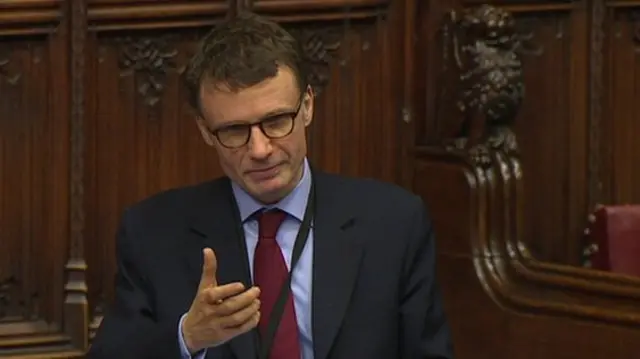
  2. End of proceedingspublished at 23:01 BST 22 October 2014

    Baroness Howe withdraws her amendment but suggests she may return to the issue at third reading, which brings an end to the day in the House of Lords

    Peers will be back at 11.00 BST on Thursday with a trio of debates on the construction industry, alternatives to university and Malawi, after the peers oral question session.

  3. Video links for childrenpublished at 22:53 BST 22 October 2014

    Crossbench peer Baroness Howe of Idlicote tables an amendment requiring a remote video link, which allows evidence to be given away from a court room, to be made available for all young witness and victims involved in criminal trials.

    A child's evidence can often be crucial in deciding the outcome of a criminal case and where in cases of sexual abuse "they are often the only witness" she tells peers.

    Despite this NSPCC has found that over half of young victims experience stress symptoms, ranging from "sleeping and eating problems and depression to bed wetting and self harm" she says

    The amendments are supported by the NSPCC, Barbados and Victim Support

  4. Amendment passedpublished at 22:27 BST 22 October 2014

    Peers have passed a government amendment, tabled by Justice Minister Lord Faulks, aimed strengthening a ban on law firms offering money and iPads as incentives to clients to bring personal injury claims that had previously been agreed to by peers.

    Peers had previously heard that firms were offering as much as £250 to pursue a personal injury claim.

    The new rule prevents regulated law firms from avoiding the ban by offering rewards through unregulated third parties and was agreed to without a division.

  5. Passage of a Billpublished at 21:34 BST 22 October 2014

    The report stage is an opportunity to consider further amendments following committee stage. Consideration of complex bills at report stage can be spread over several days - today is the second of three days of report stage on the Criminal Courts and Justice Bill for example.

    If the Bill is passed at report stage, the legislation moves on to a third reading. This is the final stage in the House of Lords - barring any parliamentary ping pong, external.

    Unlike the House of Commons, amendments can be made at third reading in the House of Lords, provided the issue has not been fully considered and voted on during either committee or report stage.

  6. Second amendmentpublished at 21:19 BST 22 October 2014

    Tabling a second amendment aimed at protecting children involved in the criminal justice system, the Earl of Listowel sets out his plans to give youths aged over 17 detained in Police custody the right to be held in Local Authority accommodation rather than a police cell.

    Children aged 16 and under already have this right, but the Earl of Listowel argues "police custody is an unsuitable and detrimental environment" for any child.

    the Earl of Listowel
  7. Amendment tabledpublished at 20:52 BST 22 October 2014

    Crossbench peer the Earl of Listowel kicks off scrutiny of the Criminal Courts and Justice Bill by tabling an amendment he says is the "solution" to problems around the anonymity children in court proceedings.

    The amendment would make anonymity "into adulthood" for children involved in court proceedings the default position, though judges will be allowed to remove it where they consider it necessary.

  8. Report stage resumespublished at 20:33 BST 22 October 2014

    Peers return their attention to the Criminal Justice and Courts Bill as the report stage gets under way once again.

  9. Haass talkspublished at 20:21 BST 22 October 2014

    US diplomat Richard Haass chaired all-party talks in Northern Ireland, which considered divisive issues such as flags, parading and dealing with the past.

    After talks ended on 31 December 2013, Dr Haass said that a final agreement was "not there" but there had been "significant progress", and that he continues to believe the final blueprint he negotiated with the Stormont parties is viable.

    Dr Haass has warned that violence could re-emerge in Northern Ireland if progress is not made in dealing with the past.

    Further talks began in Belfast on 16 October, to resolve the difficulties between the parties in the devolved government.

  10. Haass talks debatepublished at 19:36 BST 22 October 2014

    Peers now move to a debate on finding and implementing an agreement on dealing with the past in Northern Ireland - building on the draft conclusions of the Haass talks.

  11. Amendment defeatpublished at 19:35 BST 22 October 2014

    Lord Ramsbotham's amendment has been defeated by 127 votes to 90, a government majority of 37.

  12. Day ends in the Commonspublished at 19:33 BST 22 October 2014

    Home Office Minister Norman Baker concludes his speech, which brings an end to the day in the House of Commons.

    MPs will be back at 09.30 BST on Thursday, and have a variety of business to deal with, including a debate on a backbench call to scrap legislation enacting fixed-term parliaments.

    Do stay with us for now though, as the House of Lords begins a debate on Northern Ireland. That'll be followed by further scrutiny of the Criminal Justice and Courts Bill.

  13. Amendment divisionpublished at 19:27 BST 22 October 2014

    Peers have divided on an amendment to only allow the use of force on children in "secure colleges" as a last resort, or for the purposes of preventing harm to the child or others.

  14. Extra amendmentpublished at 19:16 BST 22 October 2014

    Not to be put off, Lord Ramsbotham tables another amendment aimed at unearthing the criteria for the selection of probation service contracts.

    Contracts to carry out probation services in 20 English regions and one Welsh region were tendered out to private companies and charities in 2013.

    It has been suggested that the government has been providing 10 year contracts for these services in order to lock future governments into the current penal system scheme.

  15. Government responsepublished at 19:14 BST 22 October 2014

    Norman Baker, a minister at the Home Office, is responding to the adjournment debate on behalf of the government.

  16. Close votepublished at 19:07 BST 22 October 2014

    Lord Ramsbotham's amendment falls by 191 votes to 178, a government majority of 13. Still pretty close.

  17. Another votepublished at 18:59 BST 22 October 2014

    Time for another division on the Criminal Justice and Courts Bill, on former Chief Inspector of Prisons Lord Ramsbotham's amendment to prevent "secure colleges" from being established until comprehensive rules on their operation - including on the use of force and the treatment of young offenders with mental or physical health needs - have been established.

  18. Adjournment debatepublished at 18:58 BST 22 October 2014

    The adjournment debate is now underway, led by the Alliance Party's East Belfast MP, Naomi Long. The subject is active inquiries into historical child abuse.

  19. Remaining orderspublished at 18:58 BST 22 October 2014

    The debate on the Military Covenant is over, and attention turns to the remaining orders of the day.

    Chris Skidmore, the Conservative MP for Kingswood, presents a petition on the Minor Injuries Unit at Cossham Hospital.

  20. Government defeatpublished at 18:56 BST 22 October 2014

    It's a government defeat, and there was only one vote in it.

    Labour inflicts a defeat on the government's plans for "secure colleges", as their amendment preventing under 15 year olds from being placed in the colleges is passed by 186 votes to 185.