Summary

Media caption,

Watch: Pakistan releases footage they claim shows strikes on Kabul

  1. What we know so farpublished at 06:52 GMT

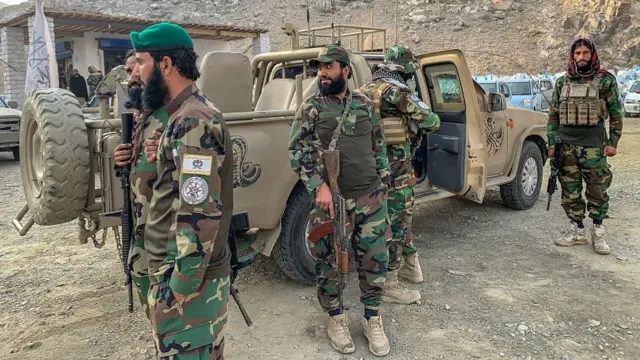
    Afghan soldiers in full battle gear standing beside a military truckImage source, Getty Images

    Pakistan's air force bombed Afghanistan's capital this morning following months of tit-for-tat fighting close to their long mountainous border. Here's what you need to know.

  2. Afghan Taliban attacks on Pakistan have stopped in some areaspublished at 06:38 GMT

    Sources are telling the BBC's Afghan service that attacks by the Taliban against Pakistan from the provinces of Kandahar and Helmand have stopped.

    Following Pakistani air strikes this morning, retaliatory strikes were launched in these areas, a spokesman for the Taliban government had earlier said.

    We have yet to confirm independently if there are casualties.

  3. The latest escalation after months of hostilitiespublished at 06:22 GMT

    Yogita Limaye
    South Asia & Afghanistan correspondent

    This is the latest escalation in violence between Pakistan and Afghanistan after months of hostilities.

    The last serious flare up was in October 2025, after which a diplomatic process had begun with Turkey and Qatar attempting to mediate between the two sides.

    A fragile ceasefire followed but negotiations failed to reach a broader agreement between the two sides for a complete ceasing of hostilities.

    Both sides blamed each other for not engaging seriously with the diplomatic process.

    Pakistan accuses Afghanistan’s Taliban government of supporting ‘anti-Pakistan terrorists’ who it blames for carrying out suicide attacks in Pakistan including the recent attack at a mosque in Islamabad. Pakistan says its strikes against Afghanistan have been targeted at militant hideouts not at civilians.

    This is a claim disputed by the Taliban government which has repeatedly said the territory of Afghanistan is not being used to threaten the security of any foreign country.

    It accuses Pakistan of carrying out unprovoked attacks in which civilians have been killed.

  4. 'We thought it was an earthquake, then we heard a loud explosion' - Kabul residentpublished at 06:08 GMT

    Mahfouz Zubaide
    News producer

    A resident of Dashti Barchi in Kabul’s District 6, which is near the area reportedly targeted by last night’s Pakistani airstrike, told me that his house shook violently due to an explosion caused by one of the strikes.

    “First, we thought it was an earthquake, because there was an earthquake in Kabul a few days ago,” he said. “Then we heard a loud explosion.”

    The resident, who is not being named for safety reasons, added that people in Dashti Barchi immediately rushed outside and stayed awake throughout the night. “No-one slept after that. Everyone was afraid."

    He said that jets were seen flying over Kabul shortly after the explosion.

    “When we saw the jets overhead, we realized they were Pakistani aircraft."

    The targeted area, was about 4 to 5 kilometres from his home, he said.

    “My wife and my parents were very scared. We were all awake the entire night.

  5. Pakistan says it carried out precision strikespublished at 05:59 GMT

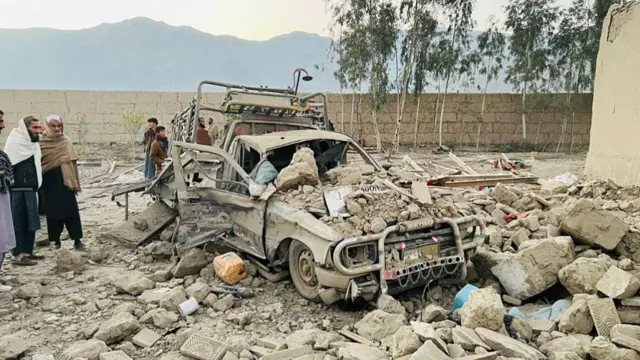
    A group of men in Afghanistan examining the ruins of a vehicle hit by Pakistani air strikesImage source, Getty Images

    We're getting more statements from officials in Islamabad, this time from Federal Minister for Information and Broadcasting Attaullah Tarar, who tells PTV that Pakistan was responding to unprovoked aggression by the Afghan Taliban.

    “Pakistan’s armed forces have once again demonstrated that any aggression or hostile designs against the country will be met with an iron hand,” he says, confirming Pakistani strikes in Kandahar province, Kabul and Paktika.

  6. Calls for de-escalation are growingpublished at 05:47 GMT

    Now, the UN Special Rapporteur for Afghanistan, Richard Bennett, is appealing for "calm and respect for international human rights & humanitarian law, in particular the protection of civilians".

    "Immediate de-escalation is essential," Bennett says on X.

    Similar calls have been made earlier by UN Secretary General Antonio Guterres and UN Human Rights chief Volker Turk.

  7. Pakistan's military releases video of strikes in Kabulpublished at 05:44 GMT

    Pakistan's armed forces says this clip is from attacks in the Afghan capital. The BBC has not been able to independently verify this footage.

    Media caption,

    Watch: Pakistan releases footage they claim shows strikes on Kabul

  8. Analysis

    How have we got here?published at 05:32 GMT

    Yogita Limaye
    South Asia & Afghanistan correspondent

    Pakistan’s leaders have released strong statements on Friday morning with the prime minister Shehbaz Sharif saying his country has the ‘full capability to crush any aggressive ambitions’ and the defence minister Khwaja Asif saying Pakistan was in an ‘open war’ with Afghanistan.

    The latest flare up began when the Taliban government declared it had launched a major offensive against Pakistani military posts near the border with Afghanistan on Thursday night. It said it was responding to Pakistani airstrikes earlier in February in which the UN says at least 13 civilians were killed.

    Pakistan had said those strikes were targeted at the hideouts of militants who it blamed for carrying out suicide attacks in Pakistani cities.

    Now Pakistan has launched a fresh series of airstrikes – this time it's targeted Kabul as well.

    While the Taliban government has confirmed the attacks, there is no information so far about what has been hit and if there are any casualties.

  9. Pakistan strikes in Nangarhar injures nine in refugee camp: Taliban officialspublished at 05:09 GMT

    Local officials of the Taliban government in Afghanistan have alleged that Pakistani tockets have been fired at a refugee camp in Nangarhar, housing Afghan citizens who had arrived in the country from Pakistan.

    The BBC Afghan service quoted the officials as saying that at least nine people were injured - seven women and two men.

    The condition of one of those injured is critical, the officials added.

  10. Iran offers to mediatepublished at 05:00 GMT
    Breaking

    Iran is ready to help "facilitate dialogue" between Pakistan and Afghanistan, its foreign minister Abbas Araghchi has said in a statement on X.

    He also urged the two countries to "resolve their differences through good neighbourliness and dialogue".

    Iran has previously offered to mediate between the two countries as border tensions were rising.

  11. UN leaders comment on Afghanistan-Pakistan clashespublished at 04:44 GMT

    United Nations Secretary General Antonio Guterres and Human Rights chief Volker Türk have both commented on the unfolding situation.

    Guterres urged both nations to adhere strictly to their obligations under international law, with a specific emphasis on international humanitarian law.

    Meanwhile, Türk appealed for dialogue between Afghanistan and Pakistan amid border clashes and deadly airstrikes,

    UN secretary general Antonio GuterresImage source, Getty Images
    Image caption,

    UN secretary general Antonio Guterres

  12. Saudi and Pakistani minister discuss regional tensionspublished at 04:34 GMT

    The foreign minister of Saudi Arabia has spoken to his Pakistani counterpart in a phone call, the Saudi foreign ministry has said in a statement.

    Saudi foreign minister Faisal bin Farhan Al Saud spoke to Pakistani foreign minister Ishaq Dar about "developments in the region" and "ways to reduce tensions", the Saudi foreign ministry said in a statement posted hours earlier on X.

    Ishaq Dar is currently in Saudi Arabia for an official visit.

  13. Analysis

    Afghan Taliban unlikely to fight a conventional war with Pakistanpublished at 04:00 GMT

    Analysts have told BBC Urdu that it would be unlikely for the Taliban to fight a conventional war with Pakistan.

    There's a significant disparity in military capability between Pakistan and the Afghan Taliban.

    Pakistan's armed forces, which are nuclear-armed, have consistently been ranked in the world's top 15 in military strength.

    The Afghan Taliban, on the other hand, lack the same military resources and face their own economic challenges.

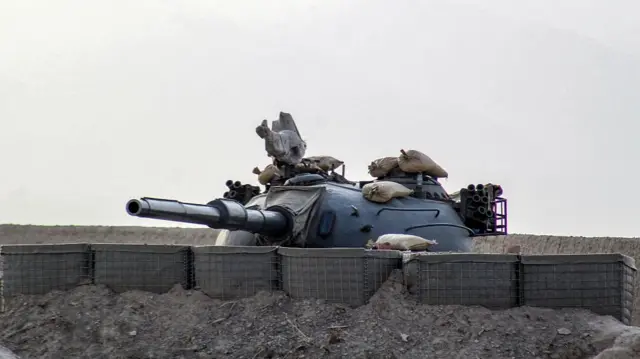
    The weapons owned by the Taliban military largely come from three sources: those left by the former Afghan army, those from foreign forces that have withdrawn, and new weapons they obtained from sources including the black market.

    Experts say videos of past border clashes suggest the Taliban forces have mostly used light weapons against Pakistani forces.

    However, the Taliban have extensive experience in guerrilla warfare, analysts say.

    An Afghan security expert has told BBC Urdu that many of the Taliban's encounters with Pakistani forces involve guerrilla tactics like surprise attacks and roadside bombs.

  14. Things have calmed down, Kabul residents saypublished at 03:51 GMT

    Hafizullah Maroof
    BBC Afghan Service

    I have spoken to a number of residents and local officials in Kabul, as well as the provinces of Kandahar and Nangarhar.

    The situation there seems to be calm now, they told me, though both sides of the border remain on high alert.

    "We will retaliate if we are attacked, but we won’t start clashes at the moment," a Taliban military spokesperson tells me.

    It's now early morning in Kabul, and residents tell me they no longer hear the sound of jets. The city seems to be calm after earlier air strikes from Pakistan.

    There are no reports of casualties so far in the strikes which carried out in Kandahar and Paktia as well.

  15. 'A terrible dynamic' - former US envoy for Afghanistanpublished at 03:22 GMT

    Zalmay Khalilzad speaking into a microphoneImage source, Getty Images

    "This is a terrible dynamic that must stop," said Zalmay Khalilzad, a diplomat who served as the US special representative for Afghanistan reconciliation from 2018 to 2021.

    He appeared to be responding to an earlier announcement from the Taliban that they had launched retaliatory operations against Pakistan.

    "Innocent Afghans and Pakistanis are getting injured or killed," he wrote on X.

    "A better option is a diplomatic agreement between the 2 countries that neither would allow its territory to be used by individuals and groups to threaten the security of the other."

    He said the implementation of such an agreement should be monitored by a third party, like Turkiye.

    Last year, Khalilzad was part of a US delegation visiting the country to meet with Taliban officials.

  16. Entire country 'stands by Pakistani armed forces' - PM Sharifpublished at 03:04 GMT

    More from Shehbaz Sharif, Pakistan's prime minister:

    "The entire nation stands by the Pakistani Armed Forces," he said, according to a series of posts on the government's X account.

    Other posts praise the military which he says "are performing their duties with national spirit".

    "The people and armed forces of Pakistan are always ready to protect the country's security, sovereignty and territorial integrity.

    "Pakistan's armed forces are determined not to allow the peace and security of the country to be compromised under any circumstances."

  17. Pakistan 'fully capable of crushing any aggressive intentions' - PM Sharifpublished at 02:43 GMT

    Shehbaz Sharif gestures while speaking into microphonesImage source, Getty Images

    Shehbaz Sharif, Pakistan's prime minister, says the country's forces "have the full capability to crush any aggressive ambitions".

    "There will be no compromise on the defense of the beloved homeland and every aggression will be met with a befitting reply," he said, according to a series of posts on the Pakistani government's X account.

  18. Which areas in Afghanistan were struck by Pakistan?published at 02:35 GMT

    Pakistan has most recently targeted the Afghan cities of Kabul, Kandahar and Paktika close to their long mountainous border that spans 2,600 km (1,615 miles).

    Map of Afghanistan and Pakistan showing their border and points where Kabul, Kandahar and Paktika are located
  19. Pakistan says it destroyed dozens of Afghan Taliban postspublished at 02:26 GMT

    Pakistani strikes have so far destroyed 27 Afghan Taliban military posts and captured nine others, according to Mosharraf Zaidi, the spokesperson for Pakistan's prime minister.

    They have also destroyed more than 80 tanks, artillery and armed personnel carriers, he said.

    "Pakistan’s immediate and effective response to aggression continues," he wrote on X.

    The Taliban defence ministry said it captured 19 Pakistani military posts and two bases on Thursday night. A total of 55 Pakistani soldiers were killed, the ministry said.

    As a reminder, it's hard to verify these figures. Throughout the recent hostilities, both sides claim to have inflicted heavy losses on the other.

  20. What we know about the casualtiespublished at 02:11 GMT

    Coffins lined on a road surrounded by menImage source, Anadolu via Getty Images

    According to Mosharraf Zaidi, spokesperson for Pakistan's prime minister, a total of 133 Afghan Taliban have been killed and more than 200 have been wounded so far by Pakistani forces.

    There were "many more casualites" from Pakistan's strikes in Afghanistan in Kabul, Paktia and Kandahar on Friday, he wrote on X.

    Zabihullah Mujahid, spokesperson for the Afghan Taliban, wrote on X that "no one was injured" in those latest Pakistani strikes.

    But an important reminder: these numbers are hard to verify.

    During these hostilities, both sides have claimed to have inflicted heavy losses on the other while suffering little damage to their own.