Summary

  1. What has Trump been saying about the Iran war today?published at 20:25 GMT

    Trump has spoken to at least three US publications over the course of today about the Iran war.

    He told CBS News "I think the war is very complete, pretty much", and said the US was "very far ahead of schedule".

    Speaking to NBC, external, he left open the prospect of acquiring Iranian oil, saying "certainly people have talked about it".

    And in an interview with the New York Post, external, he said the administration was "nowhere near" making a decision on whether to order US troops into Iran.

    We're due to hear more from Trump at 21:30 GMT (17:30 eastern time).

  2. Trump comments suggest he may be ready to declare victorypublished at 20:18 GMT

    Anthony Zurcher
    North America correspondent

    Is Donald Trump ready to declare victory in the Iran war? His comments to CBS News seem to suggest this.

    Of course, what victory means in a war whose goals were vague and frequently contradictory is not entirely clear.

    The president has said that Iran’s military has been significantly degraded. “There’s nothing left,” he told CBS.

    But if the goals were to definitively eliminate the nation’s nuclear programme or to shepherd in a more US-friendly government, the success has been much less certain.

    Trump was starting to feel the heat, however. Over the weekend, oil prices had shot up to more than $120 a barrel. American stock market futures and foreign exchanges indexes were sinking. By yesterday evening, Trump had posted on social media that higher oil was a “small price to pay” for US and global security.

    Following Trump’s assurances on Monday afternoon that an end is in sight, the US stock market rebounded and oil prices dropped precipitously.

    That may reflect a firm belief that the president is, in fact, planning to wrap up his military operation and fears of a protracted regional conflict were overstated.

    Or it could be wishful thinking. History has proven that starting war may be easy, but ending one – particularly in the Middle East – is much more challenging.

  3. Trump on how long the war could last, the Strait of Hormuz and Iran's new supreme leaderpublished at 19:59 GMT

    Donald Trump has given a phone interview to CBS News, the BBC's US media partner, in which he has signalled the war could end sooner than the administration has previously indicated.

    The US president is due to give a press conference in around ninety minutes where we may here or more. While we wait, here are his comments to CBS in full.

    On the progress of the war: "I think the war is very complete, pretty much. They have no navy, no communications, they've got no air force. Their missiles are down to a scatter. Their drones are being blown up all over the place, including their manufacturing of drones. If you look, they have nothing left. There's nothing left in a military sense."

    On original timeline for operation:"We're very far ahead of schedule... I don't know, it depends. Wrapping up is all in my mind, nobody else's."

    On Iranian missiles: "They've shot everything they have to shoot, and they better not try anything cute or it's going to be the end of that country... If they do anything bad, that would [be] the end of Iran and you'd never hear the name again."

    On the Strait of Hormuz: US is "thinking about taking it over" and could do "a lot".

    On if he has a preferred new Iranian leader in mind: "I don't want to say anything about that but yeah, I do."

    On the new supreme leader Mojtaba Khamenei: "I have no message for him. None, whatsoever."

  4. Trump says Iran war 'very complete, pretty much' and ahead of schedulepublished at 19:41 GMT
    Breaking

    Donald Trump has suggested the war against Iran could be over soon, telling the BBC’s US media partner CBS News: “I think the war is very complete, pretty much."

    He says the US is “very far ahead of schedule", adding Iran has “no navy, no communications, they've got no air force,” and claims their missiles are “down to a scatter”.

    When asked if he thinks the war could be over soon, Trump responds: “Wrapping up is all in my mind.”

    The White House has previously indicated the war, which is on its tenth day, could last for more than a month.

  5. Israel says more Iranian missiles are incomingpublished at 19:20 GMT

    Israel has issued another order telling people to take shelter after identifying a wave of missiles launched by Iran.

    There have been several similar notices throughout the day but there have not been reports of significant damage.

  6. Putin says Russia ready to help Europe with energy suppliespublished at 19:09 GMT

    Ben Tavener
    Reporting from Moscow

    Russian President Vladimir Putin says the US-Israel war with Iran has sparked a global energy crisis, but offered to help ease the situation with oil and gas supplies, including to European countries.

    Speaking in televised comments in front of officials and oil and gas bosses, he warns that oil production that depended on deliveries via the Strait of Hormuz could soon grind to a complete halt.

    "[Production] has already started to decline," he says.

    The Russian president says his country is ready to help countries with their oil and gas supplies - even European nations - as long as long contracts could be signed and politics was kept out of the equation. He hails Russian exporters as "distinguished by their stability".

    Russia is the world's second largest exporter of oil and holds the world's biggest reserves of natural gas, according to Reuters.

    Most, but not all, Europeans countries have attempted to wean themselves off Russian energy supplies after Putin ordered troops into Ukraine in February 2022.

    Putin also says Russian oil companies should take advantage of the "probably temporary" spike in oil prices to pay off some of their debts. The Russian government will also no doubt want to use the hike in oil prices to help cut the deficit in the country's public finances.

  7. Where now for Iran? Watch Panorama special on a regime at warpublished at 19:01 GMT

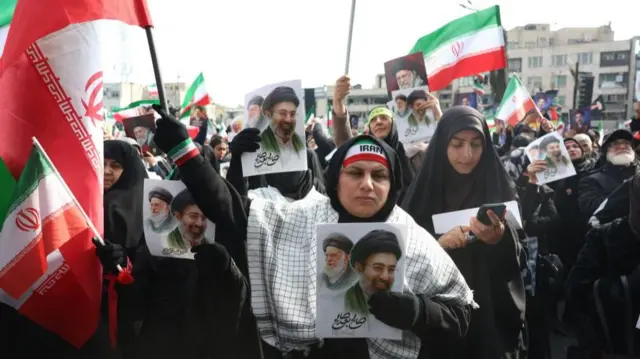
    Supporters of the Iranian government rally in TehranImage source, EPA

    On Sunday night, Iranian state media confirmed that Mojtaba Khamenei will replace his father Ali Khamenei as the country's new supreme leader, after the Ayatollah was killed on the first day of the US and Israeli strikes.

    When asked last week by BBC Panorama whether Israel would kill Khamenei’s successor if they don’t approve of them, Israel’s economy minister Nir Barkat said "as long as we see threat... from that leadership, we will take them on".

    Since the Islamic revolution put the clerics in charge, Iran has funded armed groups, fought proxy wars with its neighbours and brutally repressed its own people.

    Now under a hail of bombs and missiles, Iran is being told to change course. But can even the world’s most powerful military make that happen?

    At War: Trump, Israel and Iran is on BBC One and iPlayer from 8pm tonight.

  8. Lebanese leader calls for ceasefire and international military aidpublished at 18:52 GMT

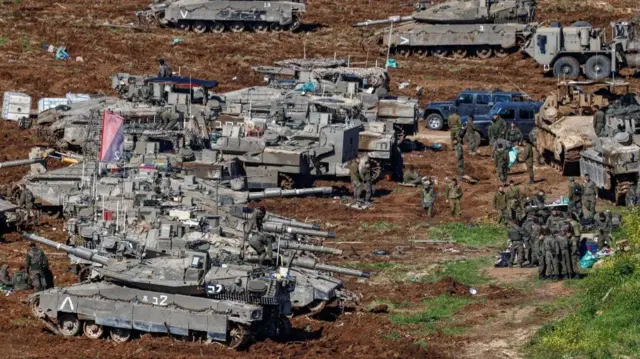
    Israeli troops and tanks on the Lebanese borderImage source, Reuters
    Image caption,

    Israeli troops and tanks have been gathering on the border with Lebanon, signalling further group operations against Hezbollah could be launched

    Lebanese President Joseph Aoun has called for a "complete ceasefire with a cessation of all Israeli land, air, and sea attacks on Lebanon".

    Israel has carried out extensive strikes against Hezbollah - which is based in Lebanon and exercises control in some areas, but is opposed by the government.

    The escalation began on 2 March when the Iranian-backed armed group launched rockets and drones at Israel to avenge the killing of Iranian leader Ali Khamenei.

    Aoun asked for international support for his country's armed forces to allow them to take control of Hezbollah-controlled areas and to disarm the group.

    He said Israel and Lebanon should begin negotiations with international oversight.

  9. What is the UK's strategic oil reserve and where is it kept?published at 18:39 GMT

    Simon Jack
    Business editor

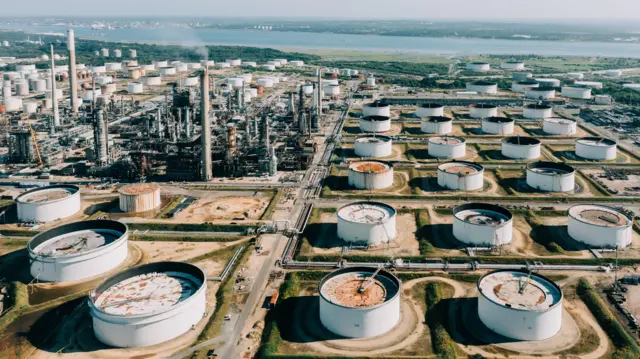
    An early morning aerial view of an oil refinery in Southampton, UKImage source, Getty Images

    All countries that are members of the International Energy Association are required to keep reserves of oil in case of disruptions to global oil supplies. The UK is a member and meets that obligation.

    The EU has a similar mechanism. Both require countries to have roughly 90 days' worth of supply in reserve for moments like this.

    The oil itself is not in a single geographic location. Oil producers like Shell and BP keep stocks at terminals and refineries around the UK and can earmark stocks held elsewhere as counting towards their reserves.

    When it's released, it doesn't mean a sudden flood of new oil starts moving. It means that producers will make more available in the market for refineries to order.

    However, energy analysts have told the BBC that given there is a shortage of refining capacity, the release is not a magic switch to increase the flow of refined products like petrol and jet fuel.

    The releasing of the reserves is more of a confidence or sentiment boosting measure to reassure markets that governments have recognised the threats and are acting in co-ordination to address them.

    In short, it may not see oil prices fall but it may stop them climbing as much as they otherwise would have done.

  10. Israelis take cover on side of road during missile attackpublished at 18:30 GMT

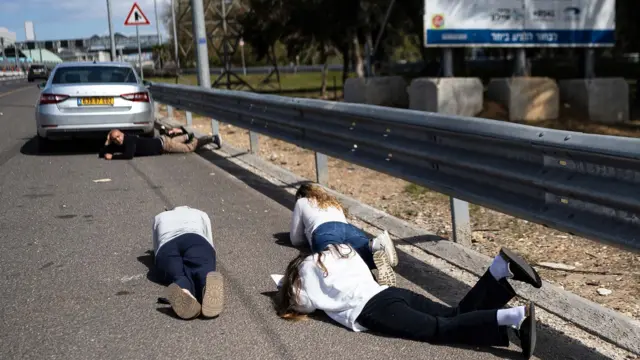
    Images taken by Reuters show Israelis lying on the side on the side of the road during an air alert earlier.

    The Israeli military reported launches from both Iran and Lebanon in quick succession a few hours ago.

    It said it had "intercepted several launches and several additional launches fell in an open area".

    Israelis lie on the road to take cover during a siren following a barrage of missiles from Iran, amid the U.S.-Israel conflict with Iran, in central Israel, March 9, 2026Image source, Reuters
    Image caption,

    Israelis lie on the road while sirens sound

  11. UK response has 'undermined our international standing'published at 18:17 GMT

    Shadow defence secretary James Cartlidge criticises the fact that a Navy warship has not yet been deployed off the coast of Cyprus, saying it would be needed for air defence operations.

    He says the UK's response so far has "completely undermined our international standing", both in the eyes of allies and "those who can exploit such weakness".

  12. UK defence secretary calls for de-escalation in Lebanonpublished at 18:12 GMT

    Healey says the government is "deeply concerned about escalation in Lebanon".

    He calls on Hezbollah to cease attacks against Israel and says "we do not want to see Israel expand this conflict further into Lebanon".

  13. British jets carrying out missions over UAE, defence secretary sayspublished at 18:04 GMT

    Healey describes the Iranian regime as "a destructive force which has slaughtered protesters", and calls on it to give up its nuclear ambitions and restart negotiations.

    He says the UK's response has been "driven at all times by military advice".

    The UK is now conducting defensive air sorties in support of the UAE, Healey says, and British forces have shot down two drones - one over Jordan, the second heading to Bahrain.

    A third Wildcat helicopter has arrived in Cyprus and RAF operations experts have been deployed to more than five countries in the region, he adds.

    The UK has eight jets in Qatar and "more jets in Cyprus than any other nation".

  14. HMS Dragon to leave for Mediterranean within dayspublished at 17:59 GMT
    Breaking

    John Healey has confirmed Navy destroyer HMS Dragon will leave Portsmouth for the Mediterranean in the "next few days".

    He says the government has also sent Typhoon and F35 fighter jets, counter-drone teams and radars to the region.

    The defence secretary says the government's response, which is coordinated with the US, Nato and Gulf allies, is underpinned by assuring there is a "legal basis for our decisions".

  15. Drone that hit UK base came from Lebanon or Iraq, Healey sayspublished at 17:53 GMT
    Breaking

    The drone which hit RAF Akrotiri last week was fired from Lebanon or Iraq, the UK defence secretary says.

    The Ministry of Defence previously confirmed the drone - which caused minimal damage at the British military base - was not launched from Iran, but has not previously said where it originated from.

    • For context: A drone hit the British base last Sunday, causing "minimal damage" and no casualties. The next day, two further drones headed for Akrotiri were intercepted, a Cypriot government spokesperson said. The MoD said it would move family members to alternative accommodation as a precautionary measure.
  16. Defence secretary making Iran statement in Commonspublished at 17:47 GMT

    UK Defence Secretary John Healey is now giving an update on the situation in the Middle East.

    You can watch live at the top of this page and we will bring you the key details here.

  17. BBC Verify

    Is the UK down to two days of gas supply?published at 17:39 GMT

    By Anthony Reuben

    The slowdown of oil and gas making it out of the Middle East and rising energy prices has led some to question the UK’s energy security.

    Among them is Reform UK’s deputy leader Richard Tice, who posted on X: “The Net Stupid Zero political class are to blame: UK has just 2 days’ worth of Gas stored.”

    According to the latest figures from National Gas - which builds and manages the country's gas infrastructure - the UK has 7,254GWh (gigawatt hours) of gas in storage, and the expected demand today is about 2,600 GWh .

    But expressing the amount of gas stored as the number of days of supply would be putting it into “extremely simple and unrealistic terms”, analysts at energy consultants Wood Mackenzie tell BBC Verify.

    They say the UK has the ability to produce its own gas, has five pipelines to import it from continental Europe, as well as three terminals for liquified natural gas, adding: “All of these would have to be inoperable for storage to be the sole source of supply, which is not going to happen.”

    National Gas says it has no concerns about storage levels, which are broadly what they would expect at this time of year.

  18. Trump to hold unscheduled news conference laterpublished at 17:25 GMT

    Bernd Debusmann Jr
    Travelling with the president

    Donald Trump has just announced an unexpected news conference at 17:30 local time (21:30 GMT) in Doral, the Miami suburb where he has spent the weekend.

    It will follow a Republican event in which Trump will meet House Speaker Mike Johnson and other Republican members of the House of Representatives.

    The US President has been making a handful of phone calls to journalists regarding Iran, and we spoke to him on Air Force One on Saturday.

    However, this would mark the first time that he has had a formal press conference since hostilities began. His last press conference, in the White House briefing room, took place on 20 February.

    While Trump’s event in Florida is focused on domestic politics, the US-Israeli operation in Iran continues to be the focus of the country’s media.

    Trump is likely to be asked about rising petrol prices, as well as his thoughts on Iran’s new leadership and how he views the potential “end game” in the country.

  19. Israeli military says it has targeted Iranian drone sitepublished at 17:17 GMT

    The Israel Defense Forces (IDF) says it has has targeted the Islamic Revolutionary Guard Corps' drone headquarters in its latest wave of strikes.

    The attacks continue "to deepen damage" to Iran's military capacity, with strikes against "dozens of infrastructure sites" also carried out today.

  20. European stocks recover slightly after early lossespublished at 17:13 GMT

    Archie Mitchell
    Business reporter

    Away from the House of Commons in London, European stocks closed lower on Monday but pulled back sharp losses seen earlier in the day.

    London’s FTSE 100 index recovered to end the day down just 0.3%, having initially fallen by as much as 1.86% to its lowest level for nearly two months.

    The wider FTSE 250 index, however, closed around 1.6% lower after struggling to regain earlier losses.

    Oil giants were among the biggest risers in London, with Shell’s shares climbing by 2.4% on Monday and BP’s gaining 1.9%.

    Elsewhere, Germany’s benchmark DAX index fell by 0.7% on Monday, while France’s CAC 40 ended the day 0.9% lower.