Summary

  • MSPs have voted to put a six-month prognosis requirement on people seeking help with assisted dying

  • They are debating amendments to the assisted dying bill as it reaches its final stage of consideration at Holyrood

  • The Assisted Dying for Terminally Ill Adults (Scotland) Bill would allow terminally-ill, mentally competent adults to seek medical help to end their lives

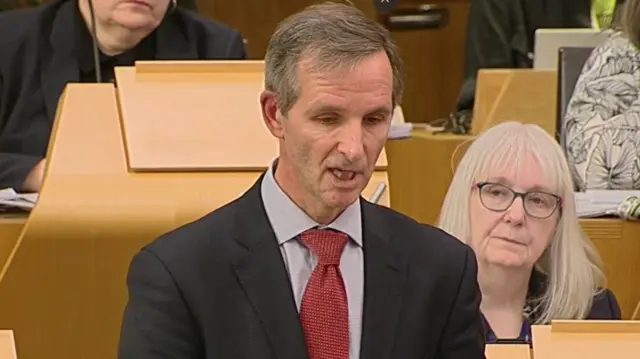
  • The proposals, tabled by Liberal Democrat MSP Liam McArthur, are being scrutinised by MSPs after they passed a vote on its general principle

  • You can watch the first of three full days of proceedings here with us by clicking on the Watch live icon.

  1. Assisted dying bill: The headlinespublished at 22:09 GMT 10 March

    The first marathon session on the assisted dying bill has been wound up. You'll be able to join us here again tomorrow for Day 2.

    In the meantime, here are the headlines so far:

    • MSPs added an additional safeguard to the assisted dying legislation
    • It means anyone who is terminally ill would be reasonably expected to die within six months in order to be eligible
    • The Scottish Parliament is due to sit late most nights this week as MSPs consider more than 300 amendments to the assisted dying legislation and we are already way behind schedule
    • The assisted dying bill would allow terminally-ill, mentally competent adults to seek medical help to end their lives
    • There has been some questioning of whether the six-months eligibility just offered the appearance of a safeguard and was in fact just guesswork
    • Debate on the amendments relating to coercion was long and passionate
    • A final vote on whether the bill should become law will take place next week, and you can watch the proceedings with us
  2. After more than seven hours, today's proceedings are brought to a closepublished at 22:07 GMT 10 March

    Holyrood's chamber

    Presiding Officer Alison Johnstone brings today's session to a close.

    But there will be little respite for MSPs - they still have two days' worth of amendments to talk through and are running well behind schedule.

    The parliament's business bureau will need to meet tomorrow to consider what to do to catch up.

  3. Analysis

    We could now be running two hours behind schedulepublished at 21:59 GMT 10 March

    Andrew Kerr
    BBC Scotland political correspondent

    MSPs voted to extend timelines to allow more debating time for these amendments.

    The deputy presiding officer offered the extension and MSPs were rather duty-bound to accept it.

    It was a vote of acclamation but the slightly tired voices didn't sound particularly enthusiastic.

    There's one estimate that we are now running two hours behind schedule.

    Talk is now turning of this running into Friday - a day that parliament never sits.

    MSPs are under considerable time pressure with this parliament finishing up in two-and-a-half weeks ahead of the Holyrood election.

    There's certainly a measure of concern that one of the most significant pieces of legislation is being squeezed into these late-night sittings.

  4. 'It just goes on and on and on'published at 21:57 GMT 10 March

    SNP MSP Kenneth Gibson
    Image caption,

    A disgruntled SNP MSP Kenneth Gibson says he's nearly had enough

    SNP MSP Kenneth Gibson intervenes to say he's exhausted and says "we've seen endless speeches, we've not even had votes for a number of hours.

    "It just goes on and on and on."

    He thinks it's "frankly unacceptable" that the finishing time for tonight's session could be pushed back beyond 22:00.

    The deputy presiding officer says she is only extending the overall timeline, not calling on MSPs to sit later tonight.

    So we should be done for the evening shortly.

  5. Analysis

    Coercion proves to be a key issue for MSPs on both sidespublished at 21:45 GMT 10 March

    Andrew Kerr
    BBC Scotland political correspondent

    Coercion. It's one of the biggest sticking points for MSPs who are expressing concern about this bill.

    MSPs spoke about their worries over people being coerced into the process of assisted dying.

    Labour's Michael Marra indicated it was one of the fundamental reasons for his opposition, as did the Conservative Edward Mountain.

    However, the former Green co-leader Lorna Slater spoke out that coercion could go the other way - with people being persuaded not to begin the process.

    The bill's proposer Liam McArthur attempted to reassure colleagues that doctors will carefully assess patients' wishes.

    However, Marra withdrew his amendment on a declaration of consent before it went to a vote, stating that he couldn't believe the process could indeed be properly safeguarded.

    That may be a little concerning for McArthur - that swithering MSPs may be more cautious with a lack of an additional safeguard.

  6. 'There must be a robust national framework for under-25s'published at 21:35 GMT 10 March

    Jackie BaillieImage source, Scottish Parliament TV

    Labour MSP Jackie Baillie says young people under the age of 25 face unique complexities when it comes to the issue of assisted dying.

    Speaking on amendments on behalf of CHAS (the Children's Hospice Association Scotland), Baillie calls for tailored safeguards and says assessment of younger adults can be harder to determine.

    She says there must be a robust national framework.

    Her amendment states training, qualifications and experience are required where the terminally-ill adult requesting assistance is under the age of 25, and has a disease, illness or condition of a fluctuating nature and with an unpredictable prognosis.

  7. This evening's sitting extended by 30 minutespublished at 21:23 GMT 10 March

    MSPs now move on to Group 5 amendments which focus on training, qualifications and experience of health professionals.

    Deputy Presiding Officer Annabelle Ewing extends the time limit of this session by 30 minutes.

    We can expect proceedings to continue until 22:30.

  8. Could there be an even later finish at Holyrood tonight?published at 21:16 GMT 10 March

    Kirsten Campbell
    BBC Scotland political correspondent

    MSPs are running well behind schedule now.

    They should have completed their debate on the group of amendments about coercion, pressure and undue influence by 7:30pm.

    But the Presiding Officers extended the time allocated to previous groupings to ensure that all points of view were heard.

    At some point they’ll need to decide whether to stay beyond their planned finish time of 10pm this evening, or whether to delay consideration of amendments about training, qualifications and advance care directives until tomorrow.

  9. MSPs continue to debate amendments to safeguard against coercionpublished at 21:11 GMT 10 March

    Edward Mountain, the Tory MSP, says the debate on amendments to the assisted dying bill shows the parliament in its best light, but reiterates his concerns about the proposed legislation.

    SNP MSP Christine Grahame says she supports this bill but she wants it to be as robust as possible.

    "This is fairly robust, it's robust stuff and its laying the onus on the practitioner to get it right."

    Michael Matheson, her SNP colleague, does not agree and argues it is dangerous to give the impression that coercion does not take place in assisted suicide, just because there is no evidence from other international jurisdictions.

    The former justice secretary insists coercion remains a risk with this bill.

  10. 'Disabled peoples' experience of coercion and abuse goes undetected'published at 20:50 GMT 10 March

    Pam Duncan-Glancy

    Pam Duncan-Glancy says social workers have contacted her to say they are "worried deeply about the bill as it stands".

    The independent MSP insists: "We should listen to them when they raise concerns."

    She points out disabled women are twice as likely to be abused as other women.

    The former Labour MSP adds: "Disabled peoples' experience of coercion and abuse goes undetected."

    She says if you are told your life is of less value you learn to believe it and many people internalise the negative attitudes directed against them.

    "I remain deeply concerned that no set of procedural safeguards can fully eliminate the risk of coercion in legislation of this kind."

  11. Where do the party leaders stand?published at 20:41 GMT 10 March

    Finance Secretary Shona Robison with First Minister John Swinney (left) and Ivan McKeeImage source, PA
    Image caption,

    Finance Secretary Shona Robison with First Minister John Swinney (left) and Ivan McKee

    Last year, the first minister said that he would not support the Bill before the stage one vote.

    John Swinney said he was concerned "vulnerable people in our society" may come to feel like a "burden" and "feel under pressure to end their lives prematurely".

    Scottish Labour leader Anas Sarwar has also said he will vote against it.

    And on Monday, Scottish Conservative leader Russell Findlay confirmed he would not vote for the Bill, after supporting it at Stage One.

  12. Analysis

    Highly-sensitive debate could lead to a tight votepublished at 20:32 GMT 10 March

    Glenn Campbell
    BBC Scotland Political Editor

    Both sides in this highly sensitive debate seem reasonably confident of success.

    My sense is that supporters of assisted dying are going to have to work extraordinarily hard to hold together the coalition of support the bill secured when it was approved in principle last year.

    The reality is that a significant number of those who voted "yes" at that stage still have serious concerns. A couple have already switched sides and others seem minded to do the same.

    One MSP who supported the bill last year told me they are now in a "very sceptical position". Another that they are more towards "voting against than in favour". A third said they are "nowhere near decided".

    The key issue for many seems to be ensuring the legislation is sufficiently robust to guard against the risk of anyone being coerced into assisted dying.

    Another concern is about the level of protection for medics who conscientiously object. That goes beyond Holyrood's powers and would need to be resolved by UK ministers if the bill goes through.

    My calculations suggest that as few as four MSPs could tip the balance on this issue.

    Expect a week of intense and at times emotionally-charged debate beforethe final decision next Tuesday.

  13. Assisted dying bill: The headlinespublished at 20:22 GMT 10 March

    The debate about the assisted dying bill at the Scottish Parliament continues, with MSPs considering amendments intended to introduce safeguards against coercion.

    Here are the key lines that have emerged so far today:

    • MSPs have added an additional safeguard to the assisted dying legislation
    • It means anyone who is terminally ill would be reasonably expected to die within six months in order to be eligible
    • The Scottish Parliament is due to sit late most nights this week as MSPs consider more than 300 amendments to the assisted dying legislation
    • The bill would allow terminally-ill, mentally competent adults to seek medical help to end their lives
    • There has been some questioning of whether the six-months eligibility just offered the appearance of a safeguard and was in fact just guesswork
    • A final vote on whether the bill should become law will take place next week, and you can watch the proceedings with us
  14. The debate on coercion amendments continues in the chamberpublished at 20:12 GMT 10 March

    Lib Dem MSP Liam McArthur
    Image caption,

    Lib Dem MSP Liam McArthur tries to address concerns about coercion

    Ruth Maguire tells the chamber: "Those intending to vote for this bill should be very, very clear about what level of risk they're willing to accept to meet the aim of legislating to allow some to end their life early."

    The SNP MSP says she's not confident that coercion can be prevented even if all the amendments in this group are passed.

    Liam McArthur says he understands the concerns but adds there are safeguards that can be explored further.

    The Lib Dem MSP insists: "Doctors are well trained and capable of making capacity and coercion assessments."

    The process already requires two doctors to make these assessments independently of each other, he explains

  15. SNP MSP says there is no international evidence of coercion in assisted dyingpublished at 19:59 GMT 10 March

    SNP MSP Rona Mackay tells the chamber there is no international evidence of coercion being involved in assisted dying.

    Her colleague Bob Doris disagrees and says safeguards against coercion must be put in place.

    Despite planning to vote against the bill, he has a swathe of amendments relating to coercion.

    Tory MSP Brian Whittle points out there is potential for coercion to take part in a case of assisted dying and coercion not to take part.

    Jeremy Balfour, who is now an independent MSP, says assisted dying must come about solely as a consequence of a person's terminal illness and not for any other reason.

    He relates the personal story of his father who had terminal cancer and whose greatest fear was "becoming a burden".

  16. Concerns about coercion raised by MSPspublished at 19:36 GMT 10 March

    Labour MSP Michael Marra speaks to his amendment relating to coercion and he points out domestic abuse has increased by 44% in the last two years.

    He highlights concerns that assisted dying could open a new route for coercive men to end the lives of the women they abuse.

    His colleague Paul O'Kane says addressing coercion is the hole in this legislation.

    O'Kane says there must be robust enough safeguards to protect the most vulnerable in society.

    There are a large number of amendments relating to coercion in this group and there will be much debate on them.

  17. Assisted dying bill proceedings resumepublished at 19:18 GMT 10 March

    MSPs have just had a short break, but they have now returned to the chamber to consider more Stage 3 amendments to the assisted dying bill.

    They are now focusing on amendments around the prevention of coercion, pressure and undue influence of terminally-ill adults.

    These have been among the key issues surrounding this proposed legislation.

  18. MSPs take a short breakpublished at 18:58 GMT 10 March

    Presiding Officer Alison Johnstone brings proceedings to a temporary halt as she signals a short break.

    MSPs have been told to be back in the chamber shortly after 19:15.

    We will resume our coverage then.

  19. Analysis

    A moment of light relief as staunch unionist Ross uses independence analogypublished at 18:42 GMT 10 March

    Andrew Kerr
    BBC Scotland political correspondent

    Douglas RossImage source, Scottish Parliament TV
    Image caption,

    Douglas Ross brought a lighter moment to Parliamentary proceedings

    There was a moment of unusual levity during proceedings.

    The former Conservative leader Douglas Ross was speaking on behalf of his neighbouring MSP, Fergus Ewing, about the principle of conscientious objection.

    Ewing has been described as SNP "royalty" in the past but now sits as an independent.

    As has been highlighted, the issue of conscientious objection starts to stray into UK regulations and is beyond the scope of this parliament.

    Ross had to quote Ewing - saying the idea of civil servants in England making decisions about what the Scottish Parliament was doing would be "unacceptable" for those who believe in the principles of Scottish self-government or independence.

    There was much laughter with those words coming out the mouth of the staunch unionist.

    The constitution has played its part in this, as it would in any Holyrood debate, with another independent MSP John Mason saying "Westminster wants to keep us in our place".

    The former Conservative MSP Jeremy Balfour said he disagreed.

  20. MSPs will be allowed a free vote on the issuepublished at 18:32 GMT 10 March

    As MSPs make their way through discussing more than 300 amendments, it's worth remembering that several changes to the legislation have already been made since it was initially proposed.

    In the chamber earlier, MSPs voted to put a six-month prognosis requirement on people seeking help with assisted dying.

    Also, the minimum age at which people can seek to end their life has been raised from 16 to 18.

    And eligible people must be resident in Scotland for at least 12 months and registered with a Scottish GP.

    These are all highly personal and moral issues and for that reason MSPs will be allowed a free vote on the issue, meaning they will not be whipped by their parties.

    That vote is still a week away and there is a huge amount to be debated in the chamber between now and then.