Summary

  1. US has hit more than 1,700 targets in Iran so far, officials saypublished at 18:12 GMT

    The US says it has hit more than 1,700 targets in Iran since it began its military operations in the country on Saturday, according to an update from the US Central Command (Centcom).

    The targets hit include missile sites, navy ships, submarines and control centres, it says.

    Centcom adds that the US used aircraft - including multiple fighter jets - as well as missile systems and ships to carry out the attacks.

    The update, which provides information of the first 72 hours of the operation, adds that Centcom is prioritising "locations that pose an imminent threat".

  2. BBC Verify

    Building linked to Iran leadership watchdog destroyed in attackpublished at 18:04 GMT

    By Shayan Sardarizadeh

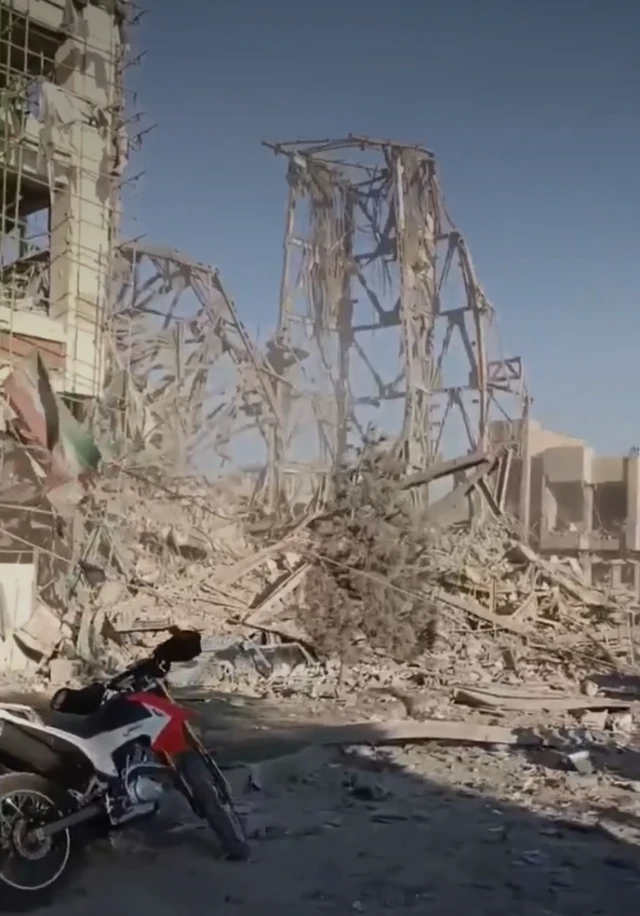
    Two videos filmed in the city of Qom today show the aftermath of a strike on the secretariat building of the Assembly of Experts, Iran’s main leadership watchdog.

    The clips, which BBC Verify has confirmed were filmed near Qom’s Basij Square, show the secretariat building has been almost completely destroyed. A building nearby was also heavily damaged in the attack.

    According to Iran’s constitution, the Assembly of Experts is made up of 88 senior clerics and is tasked with appointing the next supreme leader following the killing of Ayatollah Ali Khamenei on Saturday.

    Iran’s semi-official Mehr news agency reports the building was old and not being used for the assembly’s sessions. State broadcaster IRIB says “these buildings had been evacuated beforehand” and no casualties had been reported.

    The remains of a building, rubble is strewn everywhereImage source, Telegram/VahidONline
  3. Trump criticises allies as he discusses Iran's futurepublished at 17:58 GMT

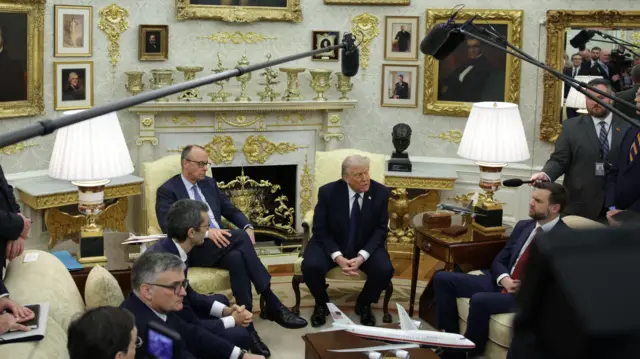
    A wide shot of Donald Trump's briefing in the White HouseImage source, EPA/Shutterstock

    US President Donald Trump and German Chancellor Friedrich Merz's White House news conference has now finished. But here are some of the key lines we heard:

    • The US president says he believed Iran was "going to attack first" after negotiations with the US failed to reach agreement on its nuclear programme
    • "Just about everything's been knocked out in Iran," Trump also says
    • After eliminating the country's Supreme Leader Ayatollah Ali Khamenei, Trump says the worst case scenario in Iran is that "somebody takes over who's as bad as the previous person". This leaves questions unanswered about future leadership, our White House correspondent writes
    • Reza Pahlavi, the exiled son of Iran's last shah, is one option but Trump said the best case scenario is that "somebody already there" takes over

    Trump also heavily criticised two US allies, accusing the United Kingdom and Spain of being "very uncooperative" since the US launched strikes on Iran.

  4. No official response from Downing Street after Trump's scathing remarkspublished at 17:44 GMT

    Chris Mason
    Political editor

    Downing Street are resisting the temptation to offer an on the record response to President Trump’s broadside.

    Instead, senior folk I talk to are repeating the thrust of the argument we heard from Keir Starmer in Parliament yesterday, when he said he was a British prime minister acting in the British national interest, with a sense of where British public opinion is.

    A poll by YouGov suggests substantially more people in Britain are opposed to America’s military action than they are in favour of it.

  5. Why oil prices are a political complication for Trumppublished at 17:38 GMT

    Bernd Debusmann Jr
    Reporting from the White House

    Earlier in the Oval Office meeting, Trump suggested that oil prices will soon drop - an important message for his administration domestically.

    Polls show that high prices remain a concern for many Americans and if people believe they are paying more at the petrol pump as a result of the conflict, it's likely to complicate matters for the US president.

    Already, oil prices have inched up since the war began, and economists have warned they are likely to continue to do so if the conflict grinds on.

    In the coming days and weeks, we're likely to see the administration address these concerns, which, together with fears of another messy regime-change exercise overseas could lead to backlash among the Trump's Maga base.

  6. UK and Spain have been 'very uncooperative' - Trumppublished at 17:32 GMT

    For the second time during this news conference, Trump is speaking about the US's relationship with the United Kingdom.

    He says Spain has been "very uncooperative", and so has the United Kingdom, he says.

    "Now the second one is shocking, but this is not the age of Churchill," he says, referring to UK Prime Minister Keir Starmer.

    Referring to the Chagos Islands, again, Trump calls this a "stupid island... that they [the UK] gave away".

    The UK "took a hundred year lease, having to do with perhaps indigenous people claiming the island, that never even saw the island before. What's that all about? They ruined relationships; it's a shame".

    He says he "loves" the UK, but criticises UK energy and immigration policy, which he calls "horrible".

    The press conference has now ended. Stick with us for the latest updates and analysis.

    Media caption,

    'UK very, very uncooperative over that stupid island' - Trump on Chagos Islands

  7. Trump raises memory of Iran's role in Iraq warpublished at 17:29 GMT

    Bernd Debusmann Jr
    Reporting from the White House

    Trump has - not for the first time - directly blamed Iran for the deaths and wounding of American service members.

    This is a theme that the White House has been pursuing for several days now, raising the memory of incidents that go back to bombings and kidnappings that took place as early as Lebanon's civil war in the 1980s.

    In this instance, Trump seemed to be referring to a more recent conflict: the US war in Iraq that began in 2003.

    During that conflict, Iran supplied a type of roadside bomb known as explosively formed penetrators, or EFPs, to proxy militia groups operating against US forces.

    While he claims that these accounted for 95% of US casualties, this appears to be an exaggeration. Later studies suggested they killed at least 196 US troops and wounded nearly 900, out of nearly 4,500 troops killed.

    These weapons, however, were highly lethal and often led to amputations among US troops that were hit.

    Typically, they consisted a metal cylinders filled with explosives and concave metal that turned into a high speed "slug" that could penetrate even heavily armoured vehicles.

  8. Iranian community in US 'happy with what we did' - Trumppublished at 17:27 GMT

    Trump next says that the Iranian community in America is really pleased with the US operation against Iran.

    "So many people said thank you, thank you, thank you. You see it in the streets of Los Angeles," he says.

    Celebrations have been seen in Los Angeles, which is home to a large Iranian-American community, in recent days.

    "The fact is that people are happy with what we did," he says.

    He says that people in the city have pictures of him at rallies: "I see my picture; I say - oh no, it's another protest. And then I started saying - boy, they were very friendly people."

  9. Trump says oil prices may be high 'for a little while'published at 17:24 GMT

    Donald Trump has just been addressing rising oil prices amid the US strikes on Iran.

    "People felt it's something that had to be done," he tells reporters as he justifies taking action.

    "So if we have a little high oil prices for a little while... as soon as this ends those prices are going to drop," he says, before adding "I believe lower than even before".

  10. Analysis

    Trump chooses Merz meeting for strongest comments on Iran yetpublished at 17:23 GMT

    Daniel Bush
    Washington correspondent

    US President Donald Trump has turned an Oval Office meeting with German Chancellor Friedrich Merz into his most substantive live remarks yet on the war in Iran.

    The strategy is in keeping with Trump’s approach since he launched the military campaign against Iran over the weekend.

    Trump has foregone a major prime-time speech, something past presidents often did from behind the Resolute Desk in the Oval Office to explain their rationale for going to war.

    Trump is seated just steps away from that desk. But instead of an address to the nation, Trump is talking at length to reporters while Merz, who is seated beside him, looks on.

    The White House hasn’t signalled any plans for a formal speech by the president on Iran. For now, it appears Trump is content with a more free-wheeling approach focused on social media posts and comments to the press.

  11. Why is Trump annoyed at Starmer?published at 17:20 GMT

    Rachel Flynn
    Live reporter

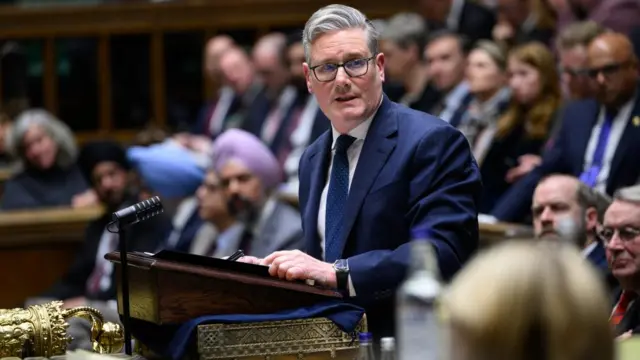
    Starmer speaking in the CommonsImage source, PA Media

    President Trump has just reiterated his frustration with UK Prime Minister Keir Starmer, after he did not permit the use of UK bases for the initial wave of US attacks on Iran.

    The United States had sought the use of the Diego Garcia base in the Indian Ocean, and RAF Fairford in Gloucestershire, for those strikes but Starmer refused. He told MPs his decision was informed by history, saying "we all remember the mistakes of Iraq".

    "President Trump has expressed his disagreement with our decision not to get involved in the initial strikes, but it is my duty to judge what is in Britain's national interest," he told MPs.

    However, the situation changed on Sunday when Iran's "outrageous" response became "a threat to our people, our interests and our allies", the PM said.

    Iran's retaliation to the US and Israeli attacks had threatened British people across the Middle East, prompting the decision to allow the bases to be used to hit Tehran's missile infrastructure, he said.

  12. Trump questions feasibility of exiled son of last shah to lead Iranpublished at 17:16 GMT

    Bernd Debusmann Jr
    Reporting from the White House

    Just a few moments ago, Trump was asked whether he sees Reza Pahlavi, the exiled son of Iran's last shah, as a feasible option to run Iran in the future.

    In response, the president was cordial, saying that while "some people like him", he believes a best-case scenario would be that "somebody already there" take over.

    This is far from the first time that Trump has expressed skepticism about Pahlavi.

    In an interview with Reuters in January, Trump said that he was unsure "how he'd play within his own country."

    "I don't know whether or not his country would accept his leadership," he added. "Certainly if they would, that would be fine with me."

    Trump's comments will likely raise alarm bells among Iranians hoping to restore the Pahlavi dynasty to the throne, nearly 47 years after it was overthrown by in the Iranian Revolution of 1979.

    Other experts, however, have echoed Trump's assessment and questioned whether Pahlavi - who has been exiled since the revolution - could effectively take control and govern a country he has not seen in decades.

  13. The most barbed comment from Trump about Starmer to datepublished at 17:11 GMT

    Chris Mason
    Political editor

    President Trump has said his most barbed thing yet about Sir Keir Starmer.

    “This is not Winston Churchill we're dealing with,” the president said in a news conference alongside the chancellor of Germany.

    President Trump said he was “not happy with the UK” because of the initial refusal from London to let Washington use the British base at Diego Garcia in the Indian Ocean during its first strikes on Iran.

    I am getting in touch with Downing Street for their reaction.

  14. 'This is not Winston Churchill that we're dealing with,' Trump says of Starmerpublished at 17:09 GMT
    Breaking

    Trump is next asked about the response from other allies of the US.

    He points out that he is particularly unhappy with the United Kingdom and Spain.

    Referring to the UK's Chagos Islands deal, he says: "That island that you read about, the lease, for whatever reason, he made a lease of the island, somebody came and took it away from him.

    "And it's taken three, four days for us to work out where we can land, it would have been much more convenient landing there as opposed to flying many extra hours.

    "So we are very surprised. This is not Winston Churchill that we're dealing with," he says of UK Prime Minister Keir Starmer.

    As a reminder, the Chagos Islands - officially known as the British Indian Ocean Territory - are located in the Indian Ocean and Britain has controlled them since the early 19th century.

    Despite previously expressing support for it, Trump recently urged PM Starmer to scrap a deal that would see the UK cede sovereignty of the territory to Mauritius, and pay an average cost of £101m a year to lease back a joint UK-US military base on the largest island.

  15. Analysis

    Trump leaves questions on Iran's future leadership unansweredpublished at 17:07 GMT

    Bernd Debusmann Jr
    Reporting from the White House

    At his meeting with Friedrich Merz, Trump has again reiterated the administration's view that Iran was going to strike preemptively.

    This has become, largely, the administration's primary justification for the start of hostilities.

    Notably, Trump also seems to be of the opinion that Iran's retaliatory strikes on "somewhat friendly" countries in the Gulf appears to be backfiring and turning them against the government in Tehran.

    Trump has so far provided no details on who he believes is governing Iran now, or who could next - appearing to confirm earlier reporting that "new leadership" was targeted today.

    The US president is clearly convinced that from a military standpoint, the operation is going well.

    But he seemed to acknowledge concerns that a new Iranian leader could be more hard-line than Ayatollah Khamenei and his supporters.

    And - as far as a best case scenario - Trump seems to be suggesting that what happened in Venezuela can be replicated. There existing government structures remained in place after the capture of the country's leader, Nicolas Maduro.

  16. Trump's asked what the worst case scenario is in Iranpublished at 17:06 GMT

    Trump's next asked what the worst case scenario that the US has planned for is.

    He answers that the worst case is that "we do this and somebody takes over who's as bad as the previous person".

    Trump goes on to say that they had some people in mind who might lead the country, but they are now dead.

    "Pretty soon we're not going to know anybody," he adds.

  17. Trump says he 'might have forced Israel's hand' over Iranpublished at 17:01 GMT

    The first question Trump's asked about the Middle East is if Israel forced his hand.

    "No, I might have forced their hand," he responds.

    Referring to Iran, Trump says: "We were having negotiations with these lunatics, and it was my opinion they were going to attack first."

    "I didn't want that to happen," the US president says. "So, if anything, I might have forced Israel's hand."

  18. 'Just about everything's been knocked out' in Iran, Trump sayspublished at 16:54 GMT

    Donald Trump begins the briefing by describing his relationship with Germany, which he says shares a "great affinity" with the US.

    He's then quickly on to Iran, which he says now has no navy, no air force or air detection.

    "Just about everything's been knocked out," Trump says.

    He adds that the pair will also be talking about trade deals.

  19. Trump and Merz begin media briefingpublished at 16:50 GMT
    Breaking

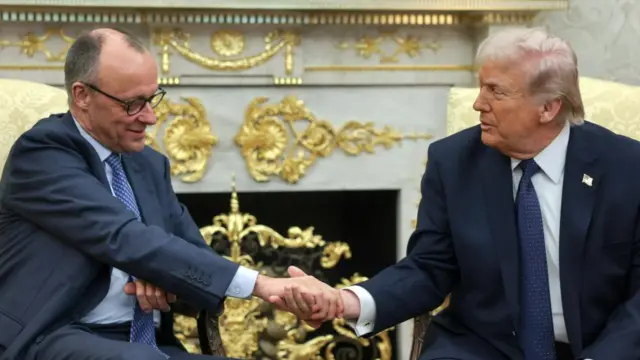
    U.S. President Trump and German Chancellor Merz meet at the White House in WashingtonImage source, Reuters

    US President Donald Trump and German Chancellor Friedrich Merz are now in front of reporters in the White House and are beginning their media briefing.

    Watch live at the top of the page and we'll also bring you the key comments here.

  20. US embassy in Beirut 'closed until further notice'published at 16:42 GMT

    The United States embassy in Lebanon's capital, Beirut, says it "will be closed until further notice".

    "All other regular and emergency consular appointments have been cancelled," it says, adding that it will give an update when the embassy reopens.

    Beirut, and parts of southern Lebanon, have been hit by Israeli strikes in recent days. Israel says this is in response to attacks from the Lebanon-based, Iran-backed militant group, Hezbollah.

    The announcement follows the US closing its embassy in Kuwait until further notice and its diplomatic mission in Riyadh, Saudi Arabia, after it was hit by a drone. The US also evacuated the Jordanian embassy yesterday after explosions were heard nearby.

    The US embassy in Muscat, Oman, had put out a "shelter in place" order, but it has since partially lifted.