Summary

  • The US has seized a Russian-flagged vessel in the North Atlantic linked to Venezuelan oil

  • It also says it apprehended a second tanker in the Caribbean in the "back-to-back" boarding of two "ghost fleet" ships

  • The UK military supported the US operation to seize the tanker in the Atlantic, the Marinera, with air surveillance and a navy ship, the Ministry of Defence says

  • White House Press Secretary Karoline Leavitt says the Marinera's crew will be brought to the US for prosecution "if necessary" - Russia's foreign ministry earlier said the US must not hamper their return

  • Leavitt says the vessel, which US authorities are calling the Bella 1, was "deemed stateless after flying a false flag"

  • Moscow says the tanker was only temporarily flagged to Russia, and that "no state has the right to use force against vessels properly registered in other countries' jurisdictions"

  • The ship is accused of breaking US sanctions and shipping Iranian oil - it's historically transported Venezuelan crude oil but reports say it's empty at the moment

Media caption,

Tracking the oil tankers seized by the US

  1. US seizes Russian-flagged tanker in North Atlanticpublished at 20:32 GMT 7 January
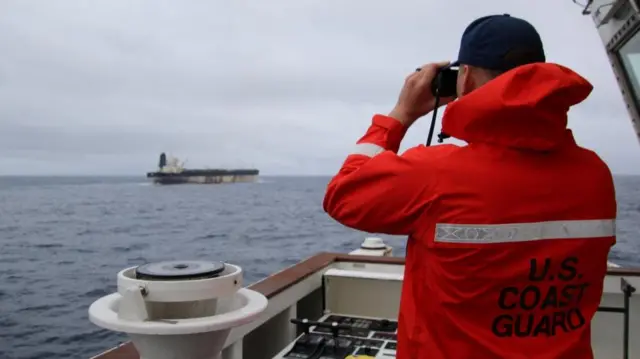
    A US Coast Guard looking at Marinera thorough binocularsImage source, Reuters

    The US has seized an oil tanker sailing under the Russian flag that it has accused of breaking American sanctions and shipping Iranian oil.

    The Marinera, formerly the Bella 1, was intercepted in the North Atlantic by US forces after they attempted to board it in the Caribbean last month.

    The White House said the ship was "deemed stateless after flying a false flag", but Russia has said that the vessel had been granted "temporary permission to sail under the State Flag of the Russian Federation" on Christmas Eve.

    "No state has the right to use force against vessels properly registered in other countries' jurisdictions," the Russian transport ministry said after the seizure.

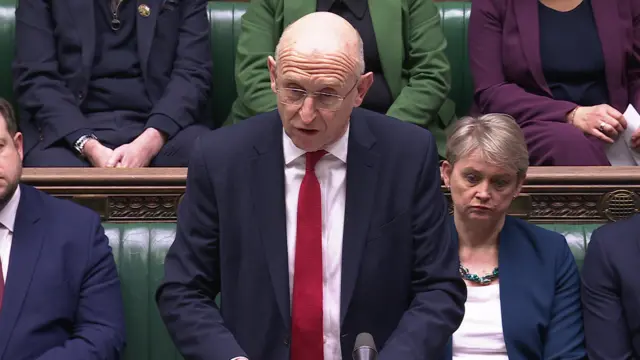
    UK forces supported the US operation, but they were not involved in boarding the vessel, UK Defence Secretary John Healey told MPs.

    We are ending our live coverage now, but you can read more in our news story.

  2. BBC Verify

    Two US videos show seizure of Sophia oil tanker in Caribbeanpublished at 20:21 GMT 7 January

    by Paul Brown and Richard Irvine-Brown

    A screenshot from the video of the tankerImage source, @Sec_Noem

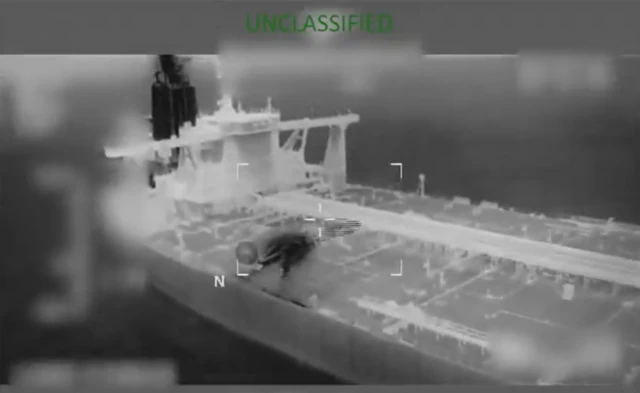
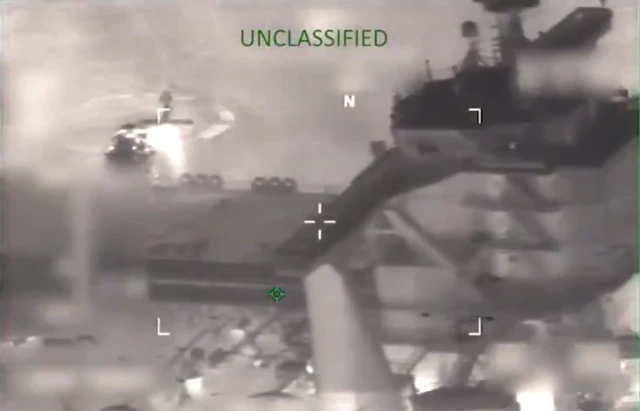
    US authorities have released two videos filmed by the military following the seizure of the Sophia and Marinera oil tankers.

    Both US Homeland Security Secretary Kristi Noem and the US Southern Command posted the clips on X, which show helicopters approaching large tankers from different angles and people landing on the deck. In the video released by Noem, we see the people approach the bridge.

    BBC Verify analysis found both videos show a ship with a bridge and support structures consistent with the Sophia, not the Marinera. The north compass point visible in both videos is also on the starboard side of the ships, indicating it is the same vessel.

    A screenshot from the video of the tankerImage source, @Southcom

    According to Noem, the ship was seized in “international waters near the Caribbean Sea”. The Sophia’s most recent location data showed it was off the coast of Cameroon on 24 July and it has not transmitted its position since.

    It is possible for ships to falsify their location data to hide their position, which is known as spoofing.

  3. What is the shadow fleet?published at 20:07 GMT 7 January

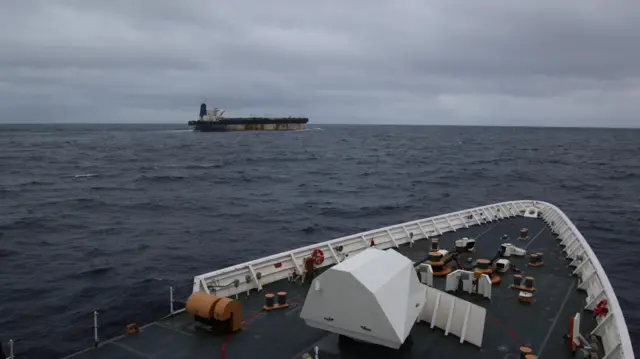
    A rusty tanker can be seen in the distance from the deck of a US military shipImage source, US EUROPEAN COMMAND via X
    Image caption,

    The ship Marinera (formerly the Bella 1) seen in the distance

    We've talked a lot about the shadow fleet today, but what is it?

    Shadow fleets, or ghost fleets, are becoming increasingly common with Venezuela, Iran and Russia all accused of using them to avoid sanctions on oil.

    False flags and obscure insurance are among the methods used by these shadow vessels - which are often ageing tankers. Some are suspected of undersea sabotage, illicit drone launches or "spoofing" their location data.

    Financial intelligence firm S&P Global estimates that one in five oil tankers worldwide are used to smuggle oil from sanctioned countries.

    Of these, estimates suggest 10% carry only Venezuelan oil, 20% carry Iranian oil, while 50% are exclusively dedicated to Russian oil. The remaining 20% are not tied to any particular country and can transport oil from more than one of these nations.

    Earlier in the Commons UK Defence Secretary John Healey said the Marinera - or Bella 1 - was a sanctioned, stateless vessel with a long history of "nefarious activity" linked to Russia and Iran.

    He said there was an "increasing web of shadow shipping" that undermines global trade and threatens the UK's security, with some 544 vessels sanctioned by the UK and its allies.

  4. US attorney general says crew will be investigated for fleeing Coast Guardpublished at 19:52 GMT 7 January

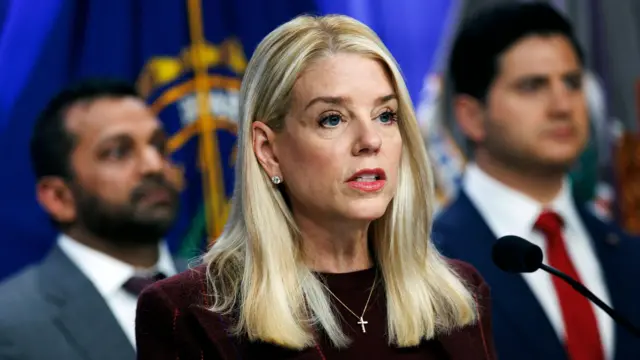
    US Attorney General Pam Bondi during a press conferenceImage source, EPA/Shutterstock

    Attorney General Pamela Bondi says despite "frantic efforts to avoid apprehension", including fleeing the US Coast Guard, the Bella 1, also known as the Marinera, was "safely apprehended" this morning.

    In a statement on X, Bondi says as a consequence of failing to obey the Coast Guard’s orders, members of the vessel are under full investigation and "criminal charges will be pursued against all culpable actors".

    "The Department of Justice is monitoring several other vessels for similar enforcement action - anyone on any vessel who fails to obey instructions of the Coast Guard or other federal officials will be investigated and prosecuted to the fullest extent of the law," she adds.

  5. Marinera has 'long history of nefarious activity', says Healeypublished at 19:25 GMT 7 January

    Defence Secretary John Healey speaking in the House of CommonsImage source, House of Commons

    UK Defence Secretary John Healey is delivering his update for MPs.

    He describes the Marinera as "falsely flagged" and having "refused to comply" with the US.

    "This is a sanctioned, stateless vessel which carries a long history of nefarious activity and shares close links with both Iran and Russia," he says.

    Healey adds that he allowed the use of UK bases and the deployment of RAF and Navy assets to assist the US.

    He adds that no UK personnel took part in the boarding of the ship, which is now under the control of US forces.

    He says that the UK supported the action to help enforce counter-Iran sanctions, to counter the threat of "shadowy maritime activity" and to reinforce British defence and security.

  6. Defence Secretary John Healey speaking in the Commonspublished at 19:15 GMT 7 January

    UK Defence Secretary John Healey has just started making a statement in the House of Commons.

    It is billed as being on Ukraine and a "wider operational update", and we are expecting to hear him address the UK's support of the US efforts to seize the Marinera earlier today.

    We will bring you any key lines from the statement, and you can watch live at the top of this page.

  7. Trump says he will control Venezuelan oil moneypublished at 19:14 GMT 7 January

    Donald Trump says that, as US president, he will control the money raised from 30 to 50 million barrels of oil that Venezuela's interim authorities have agreed to hand over to the US.

    In a new post on Truth Social, Trump says the "high quality, sanctioned oil" will be sold at market value and the money will be "controlled by me, as President of the United States of America, to ensure it is used to benefit the people of Venezuela and the United States".

    He adds the oil will be taken by storage ships and brought directly to unloading docks in the US.

  8. The Marinera's journey before being seizedpublished at 18:59 GMT 7 January

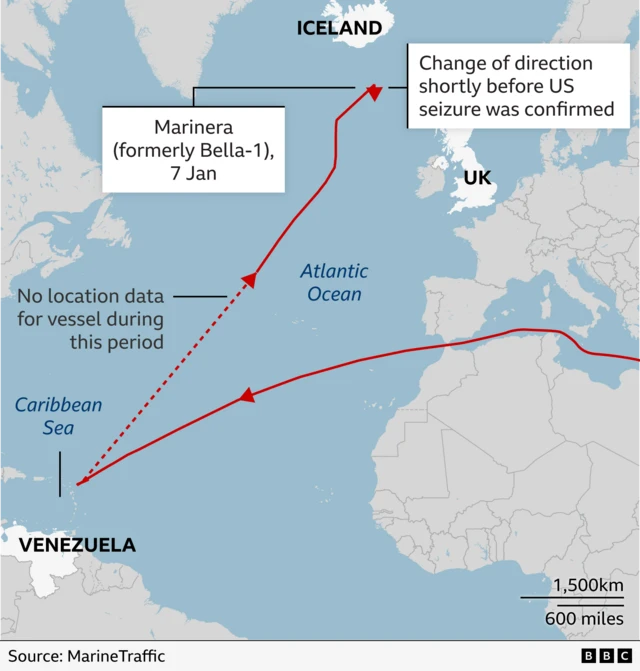
    The Marinera was seized in the Atlantic Ocean between the British Isles and Iceland, shortly after a new shift in direction.

    When the US Coast Guard tried to board it last month, it had been in the Caribbean and headed in the direction of Venezuela.

    It then dramatically changed its course towards the north, changed its name and re-registered as a Russian vessel.

    Just before the US seized the vessel, it's course had shifted northward again.

    There was a period during the journey when no location-tracking data was available.

    Map of the Atlantic Ocean showing the tracked route of the vessel Marinera (formerly Bella-1) as of 7 January. A red line traces its journey from near Venezuela in the Caribbean Sea, across the Atlantic, and north toward the UK and Iceland. A dashed section indicates a period with no location data. Near the North Atlantic, an arrow marks a change of direction shortly before the vessel was confirmed seized by the US. Labels identify Iceland, the UK, Venezuela, the Caribbean Sea, and the Atlantic Ocean, with a distance scale and source noted as MarineTraffic (BBC graphic).
  9. BBC Verify

    Why is the US still referring to the Marinera tanker as the Bella 1?published at 18:12 GMT 7 January

    by Kayleen Devlin

    When US Homeland Security Secretary Kristi Noem announced the US Coast Guard had boarded two vessels, she referred to the oil tankers as the Sophia and the Bella 1.

    Bella 1, now renamed Marinera, was falsely flying the flag of Guyana last month, which made it stateless. The Russian transport ministry said earlier today that it granted the Marinera "temporary permission" to sail under the Russian flag on 24 December.

    The vessel is currently listed in Russia’s maritime registry, with the port of registration recorded as Sochi, but does not state the start date. MarineTraffic showed the ship's flag status - which is manually entered by the crew - changed to Russia on 4 January.

    So why has the US called the tanker the Bella 1 instead of its new name?

    Experts told BBC Verify that under UN international maritime law, a stateless vessel can be boarded by authorities. A ship also cannot change its flag during a voyage unless there is a real transfer of ownership or change of registry.

    Dimitris Ampatzidis, a maritime analyst at intelligence firm Kpler said that “if the transfer [to a new flag] is unclear, rushed, or inconsistent, the vessel risks being treated as improperly flagged or effectively ‘stateless’.”

    The fact that the Marinera changed mid-voyage “implies they may not have done due dilligence”, Richard Meade from shipping firm Lloyd’s List added. "It’s generally accepted as best practice that if you are changing flags you will want to do inspections and administration.”

    David Tannenbaum, director of intelligence firm Blackstone Compliance, told BBC Verify: “Russia appears to be testing the letter of this law by claiming the vessel has a change of registry, however the boarding of the Bella 1 shows the US has taken the position that this change is not legitimate."

  10. White House claims Bella 1 was 'stateless'published at 18:04 GMT 7 January

    Bernd Debusmann Jr
    Reporting from the White House

    The White House's account of the seizure of the Bella 1, aso known as the Marinera, seems to run contrary to what we've already heard from Russia about the vessel.

    During the press briefing a short time ago, Press Secretary Karoline Leavitt claimed that the vessel was "a Venezuelan shadow-fleet vessel that has transported sanctioned oil" and "deemed stateless after flying a false flag".

    Marine Traffic showed the ship's AIS flag status - which is not a legal registry but manually entered by the operator or crew - changed to Russian on 4 January.

    When we asked for clarification, the White House said it does not have more to say beyond Leavitt's comments.

  11. What is the US saying about Venezuela and the tanker seizures?published at 17:50 GMT 7 January

    We've just reported on two briefings from senior Trump administration officials. Here's what we've learned:

    • White House press secretary Karoline Leavitt said oil from Venezuela will arriving in the US "very soon" and will be used to "benefit both the American people and the Venezuelan people"
    • Leavitt added there is a "long term plan" in Venezula and recent events are the "first action you are all seeing"
    • Asked about the seizure of the two tankers, Leavitt said they were linked to sanctions evasions and part of a "shadow fleet"
    • She said the Marinera, previously called the Bella-1, was subject to a warrant when the US seized it in the North Atlantic
    • She told reporters the warrant applies to the crew on board, who may be prosecuted when they arrive in the US
    • In the case of the Sophia captured in the Caribbean, she said it was currently being escorted to the US by Coast Guard vessels
    • In a separate media briefing on Capitol Hill, Secretary of State Marco Rubio said the US has "a lot of leverage" over Venezuela's oil and the US will ensure access for US and other oil companies to the market
    • Rubio told reporters that the US will sell Venezuelan oil "on the marketplace at market rates" and "control how it is dispersed in a way that benefits the Venezuelan people"
    • He said the US will ensure "amnesties" for Venezuelan opposition leaders and rejected criticism the Trump administration was "winging it"
  12. Seized vessel Sophia was carrying out 'illicit activities' - White Housepublished at 17:33 GMT 7 January

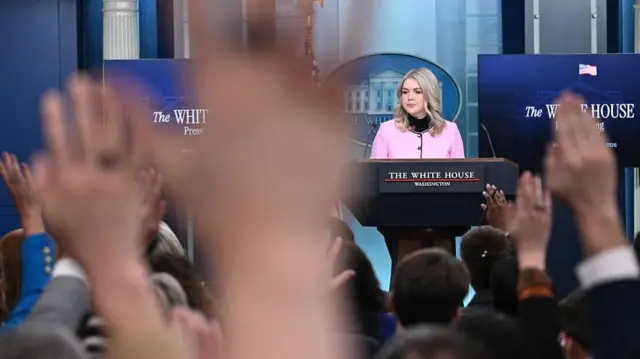
    Karoline Leavitt takes White House reporters' questionsImage source, Getty Images

    Leavitt is asked about the second vessel seized today, the Sophia, which was boarded in the Caribbean Sea.

    She describes it as a "stateless, sanctioned dark fleet" vessel and says it was boarded by US personnel "without incident".

    Leavitt does not offer any extra details on why the Sophia was seized, only repeating what an official statement said earlier - that it was "conducting illicit activities".

    She says the operation was carried out under an existing military operation in the region, and that the US Coast Guard is escorting the vessel to the US for "final disposition".

  13. White House says US committed to enforcing embargopublished at 17:33 GMT 7 January

    Leavitt is asked about whether there will be increased tensions with Russia after the tanker seizures.

    In response, the White House press secretary says Trump has a "very open, honest and good" relationship with Russian President Vladimir Putin, as well as with Chinese President Xi Jinping.

    She adds that this is going to continue but that Trump is "going to enforce our policy that is best for the United States".

    That means enforcing embargo against all "shadow fleet" vessels illegally transporting oil, Leavitt adds.

    "He's not afraid to implement it", she concludes.

  14. US court ordered seizure of 'shadow fleet' vessel - WHpublished at 17:13 GMT 7 January

    Media caption,

    White House: Crew of seized Marinera oil tanker could face prosecution in US

    Turning to this morning's seizure of a vessel in the North Atlantic, Leavitt says the Marinera - previously known as the Bella 1 - was linked to violations of US sanctions and its capture was authorised by a US court order.

    She repeats the administration's position that its sanctions policies will be "fully enforced", and describes the vessel as being part of a "Venezuelan shadow fleet" which transported sanctioned oil.

    Leavitt adds that the court order authorising the seizure of the vessel also covers its crew, meaning they can be brought to the US and prosecuted.

  15. US has a 'long-term plan' in Venezuelapublished at 17:10 GMT 7 January

    White House Press Secretary Karoline Leavitt says there is "a long term plan here" for the US's actions in Venezuela, and the 30 to 50 million barrels of oil are the "first action you are all seeing".

    Asked about how the US will reassure workers they will be safe in Venezuela, Leavitt says Trump reserves the right to use the military if necessary, and will do what is in the best interest of the American people.

    She adds that the US tried to engage with Maduro diplomatically, but he was an "illegitimate dictator" and is now sitting in a prison cell in New York.

  16. Oil arriving in the US 'very soon' - Leavittpublished at 17:10 GMT 7 January

    Karoline Leavitt describes an oil deal "made by the President and his team with the Venezuelan interim authorities" and says it "will benefit both the American people and the Venezuelan people".

    She says oil will be released to the United States and will be "arriving here at home very soon".

    She also says that the "funds will be dispersed for the benefit of the American people and the Venezuelan people" at the discretion of the US.

  17. White House says US in close contact with Venezuela 'interim authorities'published at 17:04 GMT 7 January

    The briefing has now moved on from domestic issues and the first question is about Trump's claims that the US is in charge of Venezuela.

    Leavitt says the Trump administration is in close correspondence with Caracas, and the US has "maximum leverage".

    "We are continuing to be in close coordination with the interim authorities and their decisions, are going to continue to be dictated by the United States of America," she says.

  18. US is not 'winging it' in Venezuela - Rubiopublished at 16:43 GMT 7 January

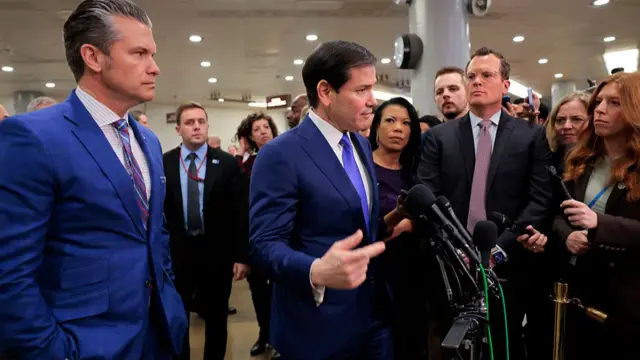
    Marco Rubio and Pete HegsethImage source, Getty Images

    Rubio describes the second phase of the US's strategy in Venezuela as "recovery", which will include amnesties for opposition leaders", and then a "transition", without giving further details.

    The Venezuelans "understand the only way they can move oil and generate revenue, and not have economic collapse, is if they cooperate and work with the United States", Rubio adds.

    He rejects criticism from Senators that the US is "winging it" in Venezuela, and says the regime can no longer move oil and generate revenue unless the US allows, giving Washington "tremendous leverage" and "control".

    Marco Rubio says the US tried repeatedly to reach an outcome that did not involve going in and grabbing Maduro. "Those were unsuccessful unfortunately," he says.

    It is within a president's right to act if there is a threat to the nation, Rubio says.

  19. US has 'lot of leverage' over Venezuelan oil - Rubiopublished at 16:39 GMT 7 January

    We can now bring you comments from US Secretary of State Marco Rubio, who has been speaking with reporters on Capitol Hill.

    He says that the US will sell oil that is in Venezuela and "sell it in the marketplace at market rates". The money raised from that oil will be handled so the US will "control how it is dispersed in a way that benefits the Venezuelan people".

    "We have a lot of leverage to move on the stabilisation front," he adds.

    He also says that they will ensure that "American, western and other companies have access to the Venezuelan market in a way that's fair".

  20. Tankers absent from start of White House briefingpublished at 16:37 GMT 7 January

    Bernd Debusmann Jr
    Reporting from the White House

    Karoline LeavittImage source, Reuters

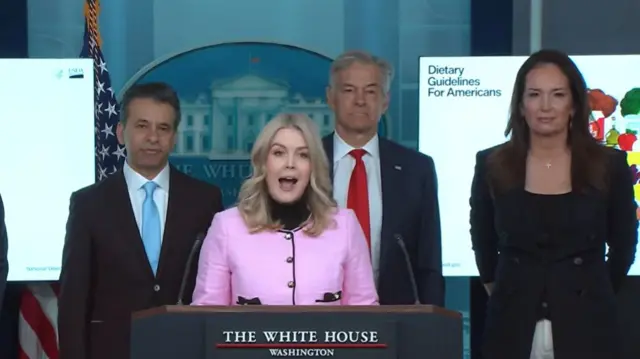
    We're about 10 minutes into the White House briefing, and still no mention of the seizure of the ship seizures, nor of Venezuela.

    The outset of this briefing has been dominated by domestic policy - specifically the "Make America Healthy Again" policies of this administration, and food.

    In some ways, this is no surprise. The White House clearly sees "MAHA" as a winning topic, popular with much of the President's base.

    Much of the White House press corps, however, will be pressing for answers on the tankers, as well as broader questions on Venezuela.

    Notably, the two cabinet members most involved in those issues - Secretary of State Marco Rubio and Secretary of Defence Pete Hegseth - are currently on Capitol Hill - my colleagues will bring you their comments in just a moment.