Summary

Media caption,

'Will we lose? Of course not' - Zelensky speaks to BBC about war with Russia

  1. Civilians to soldiers: How the war has changed ordinary Ukrainianspublished at 15:14 GMT

    Laura Gozzi
    Europe reporter

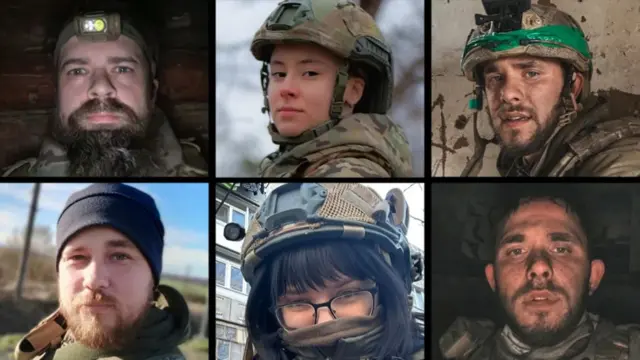
    Individual photos of six Ukrainian soldiers on a grid, all of which are wearing a uniform and/or protective equipment

    When Russian bombs began falling on Ukraine on 24 February 2022, many who had never held a weapon before rushed to take up arms.

    Not long ago, Olena worked as a nightclub administrator in Prague. "It felt like everything was ahead of me - and there was plenty of time," she says.

    In December 2024, she returned to Ukraine, joined the army and became a pilot.

    "I look at the 'before' photo and see myself calmer," Olena says. "More naive. Everything became different. I became different."

    While the fighting continues, she can't imagine another life: "My place is here as long as the enemy is in my house."

    Like the majority of Ukrainians, on 24 February 2022 Oleh, a publishing graduate, says was "confused, and scared".

    "I am not a military man, I have never seen myself like that," he says. But the next month, Oleh joined the army.

    As a soldier, he says, "you are constantly in a small room in your head, the space of which is getting smaller every time. Outside the window, others are living… while there is no handle on the door on your side to get out."

    These are just two stories of the Ukrainians I spoke to, four years since they became soldiers overnight. You can read on here.


  2. Analysis

    Four years into this war, the unspeakable is being normalisedpublished at 15:03 GMT

    Vitaliy Shevchenko
    Chief analyst, BBC Monitoring

    In Ukraine, civilians continue to be killed practically every day. Russian bombs and drones have left a million people without heating, light and water.

    The past year added an element of the bizarre to what was clearly abnormal. As civilian casualties soared in Ukraine, Trump accused Zelensky of starting the war and said Putin was keen to end it.

    US-led talks between Russia and Ukraine generated numerous official proclamations of progress but little else - the fighting continues, and they haven't changed Russia's maximalist position.

    This is hardly surprising, given that after cutting almost all of its aid, the US put most of the pressure on Kyiv, giving Putin little reason to stop.

    Instead, the talks are normalising the idea that Russia has legitimate interests in Ukraine that deserve to be discussed at the negotiating table.

    What negotiators from Russia, Ukraine and the US have been discussing, however, was until recently considered non-negotiable under international law: the sovereign right of states to choose their own alliances and foreign policy, and prohibitions on the use of force against the territorial integrity or political independence of any state and on the legal recognition of territorial acquisitions resulting from the use of force.

    All wars end at some point, but after four long years there is no sign this one will end any time soon.

  3. France uses humour to respond to Russia's unsubstantiated claims on nuclear bombpublished at 14:54 GMT

    Marianne Baisnée
    Reporting from Paris

    When asked about a statement by Russia’s Foreign Intelligence Service (SVR) accusing the UK and France of plotting to arm Ukraine with a nuclear weapon or a “dirty bomb,” a French government source respond by pointing to the X account French Response.

    The account was launched by the French Foreign Ministry last September to counter fake news and disinformation from France’s adversaries in the information war by using humour and irony to push back.

    In a series of six posts, reposting messages from accounts relaying the SVR accusation, French Response replied with lines such as: “Five years into its ‘three-day war’, Russia would really prefer you to focus on French and British nukes,” or “Year 5 of the ‘3-day war.’ Russian narrative: ‘FR-UK deterrence is the threat.’”

  4. Russia's wounded or killed now outnumbering recruitspublished at 14:35 GMT

    Jonathan Beale
    Defence correspondent

    Western officials say that over the past three months Russia has lost more men than they were able to recruit.

    An official, who asked not to be named, said that was "really significant" and would likely impact Russia's ability to generate enough forces for an offensive later this year.

    Russia has been recruiting between 30 to 35,000 soldiers a month. Over the past three months it's been suffering higher casualties - wounded or killed. The Western official said it was the first time such losses - with more injured or killed than recruited - had been sustained over a period of three months.

    UK Armed Forces Minister, Al Carns, has called the Russian manpower deficit "really important". Speaking on the fourth anniversary of Russia's full scale invasion, Carns said "the cost on Russia has been almost unimaginable".

    He said the UK Ministry of Defence estimated that Russia had suffered 1.25 million casualties overall. He said that was probably an under-estimate - and was higher than all US casualties suffered during World War Two.

  5. Zelensky calls for more air defence systemspublished at 14:19 GMT

    Abdujalil Abdurasulov
    Reporting from Kyiv

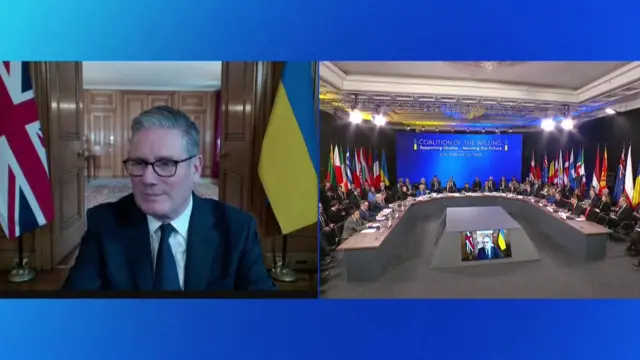
    Both Prime Minister Keir Starmer and President Volodymyr Zelensky spoke about the importance of supporting Ukraine’s air defence system during the meeting of the 'coalition of the willing' today.

    President Zelensky says that they need PAC-2 and PAC-3 missiles from the US.

    These are interceptors used by American-made Patriot air defence launchers.

    Crucially PAC-3 can intercept Russian ballistic missiles, which makes it an incredibly valuable weapon to have.

    Russia’s aerial attacks in January and February this year appears to have depleted Ukraine’s stock of those missiles.

    In January, President Zelensky complained about having empty Patriot divisions during aerial attacks.

    Without these interceptors, Ukraine’s energy infrastructure as well as other strategic facilities will be effectively defenceless against Russian ballistic missiles.

  6. Putin warns UK and France over unsubstantiated nuclear bomb plotpublished at 14:04 GMT

    Laura Gozzi
    Europe reporter

    Speaking at a board meeting of the FSB - Russia's security service - Russian President Vladimir Putin today made no substantial reference to the war he launched on Ukraine four years ago.

    Instead he referred to the unsubstantiated claims made by Russia's foreign intelligence service that the UK and France were plotting to arm Ukraine with a nuclear bomb. "[The UK and France] probably understand how any attack on Russia using a nuclear element could end," Putin warned.

    He also accused Kyiv of being behind what he called a "terrorist attack" near Savyolovsky station in Moscow on Monday, which killed a traffic police officer and injured two others. Putin said a person was "recruited" over the internet then made to carry an explosive device which was detonated remotely. (Russian officials had previously said the blast was a suicide attack.)

    Putin urged FSB officers to "intensify the fight against terrorism" and stated that Kyiv had placed its bet on "terrorism" as it had not been able to "defeat Russia on the battlefield".

    The Russian president also warned - without sharing evidence - that sabotage attempts on pipelines in the Black Sea were forthcoming, and accused Kyiv's Western partners of preventing a settlement between Kyiv and Moscow from being reached during peace talks.

  7. How many casualties in four years of war?published at 13:36 GMT

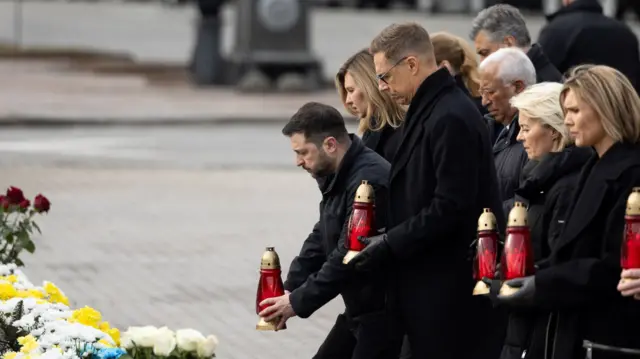
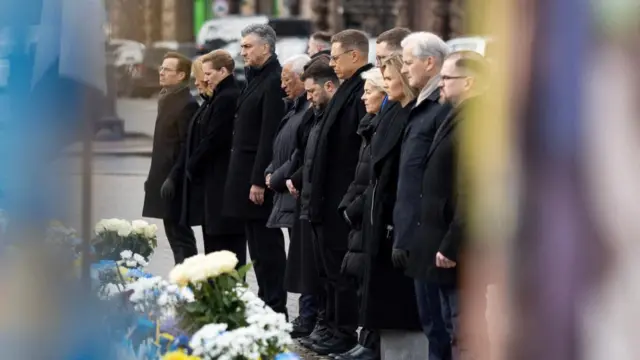
    Zelensky, his wife and European allies visit a makeshift memorial to fallen Ukrainian defenders at the Independent Square on the fourth anniversary of Russia's full-scale invasionImage source, Reuters
    Image caption,

    Zelensky and European allies visit a makeshift memorial on the fourth anniversary of Russia's full-scale invasion

    Four years of war have brought significant casualties on both sides - but verifying the exact figures can be challenging.

    Last month, President Volodymyr Zelensky told French broadcaster France 2 that "officially" 55,000 Ukrainians had been killed on the battlefield. In addition, a "large number of people" are considered officially missing, he said, though he did not give an exact figure.

    Based on estimates from sources including the UA Losses website, which the BBC has cross-referenced, the number of Ukrainians killed could be as high as 200,000.

    On the Russian side, the BBC has now identified the names of over 186,000 Russian soldiers killed in the war. The true death toll is generally accepted to be much higher, as many deaths on the battlefield are not recorded.

    Military experts believe this analysis might represent 45-65% of the total, putting the potential number of Russian deaths at between 243,000 and 352,000.

  8. Entering the fifth year of war - where are we now?published at 13:31 GMT

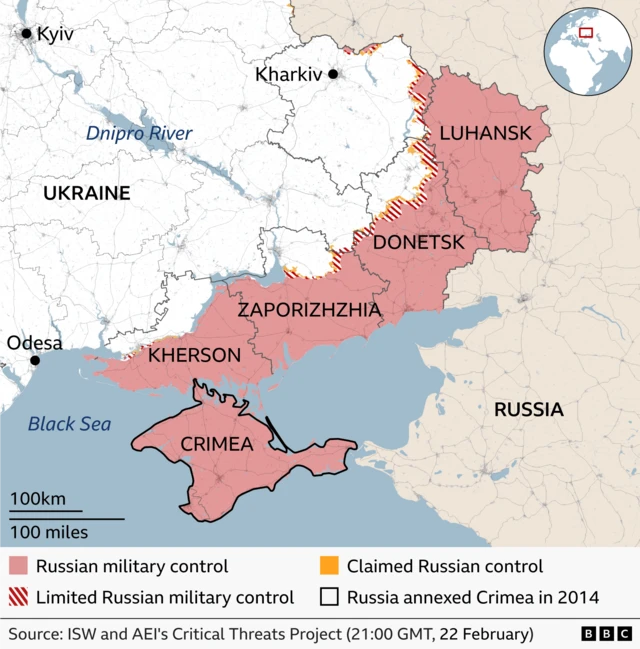
    Map of Ukraine showing regions under Russian military control shaded red, limited control in red stripes, and claimed control shaded yellow as of 18 February. The regions of Luhansk, Donetsk, Zaporizhzhia, Kherson – with almost all of Luhansk shaded red and much of the other three provinces also under Russian control. Crimea which was annexed by Russia in 2014 is also are marked as under Russian control. Major cities labelled include Kyiv, Kharkiv, and Odesa. Source: ISW
    Image caption,

    Russia has been trying to gain full control of the Donbas region (Luhansk and Donetsk), as well as Zaporizhzhia and Kherson

    Let's take a closer look at where the land lies as we enter the fifth year of war between Russia and Ukraine.

    Territory

    • Russia took about 4,700 sq km (1,800 sq miles) of territory in 2025 - an area about twice the size of the city of Moscow - according to analysts at the US-based Institute for the Study of War (ISW)
    • Russian forces have been moving mile by mile through the Donbas region, trying to gain full control of the area along with two other regions, Zaporizhzhia and Kherson
    • But it has never had these regions under full control - and in some front line areas, Russian forces appear to have been forced to retreat
    • It has also come at significant cost in terms of casualties - more on that in our next post

    Peace negotiations

    • Despite multiple rounds of peace talks, there are still key hurdles to overcome
    • An agreement on territory remains elusive, with Russia still seeking full control of the eastern Donbas, a non-starter for Ukraine
    • US President Trump has been driving the talks but has previously been accused of being too aligned with Russia
    • The most recent round of negotiations in Geneva concluded without a breakthrough on 18 February
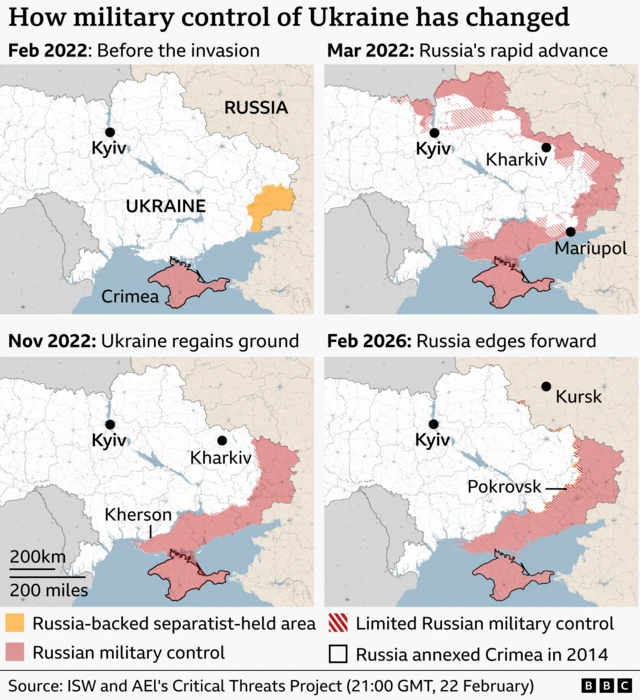
    Series of four maps showing changes in Russian military control in Ukraine from February 2022 to August 2025. Feb 2022: No Russian military control (except in Crimea which was annexed in 2014) but there is a patch to the east shown in yellow as being held by Russia-backed separatists. Mar 2022: Rapid Russian advance with areas in red (control) and red stripes (limited control). Nov 2022: Ukraine regains territory; Russian-controlled areas reduced. Feb 2026: Russia edges forward; controlled areas increase again. The maps highlight cities including Kyiv, Kharkiv, Mariupol, Kherson, Kursk, and Pokrovsk. Source: ISW
    Image caption,

    Russia failed to take Kyiv in the first year of the war, and was expelled from the city of Kherson. Since then, the battle has mostly been in the east

  9. Analysis

    Ukrainians don't want war, but no-one is telling me they should sue for peace eitherpublished at 13:17 GMT

    Jeremy Bowen
    International editor, reporting from Kyiv

    It has been a long, hard and deadly four years. Ukraine is under pressure from Trump’s America to give up strategic land that Russia has failed to capture despite sacrificing thousands of its troops.

    President Zelensky told me at the weekend that he would not be giving up land. President Putin shows no sign of dropping his maximalist demands. Putin has made clear his belief that Ukraine should be under Russia’s control.

    The foreman of the men salvaging steel from the ruins of a destroyed Ukrainian power station told me Russia was attacking sources of power, heat and light for civilians to bring Ukraine to its knees. His tone strongly suggested that he was not prepared to accept that, like so many others here.

    I’ve found no-one telling me that Ukraine needs to sue for peace. Their history with Russia is long and bloody and they don’t want to return to Moscow’s control.

    That doesn’t mean they want more war. But they don’t believe that a sacrifice of land for a ceasefire would satisfy Putin’s territorial ambitions.

    The Russia-Ukraine war has upended assumptions about European security and the safety of the future. The full-scale invasion was an early warning that the world was changing. Nothing in the last four years has suggested it is any safer, and the war here and its global consequences are a central reason for that.

  10. Analysis

    Four years on, Ukraine shows leaders were wrong to doubt its militarypublished at 13:09 GMT

    Jeremy Bowen
    International editor, reporting from Kyiv

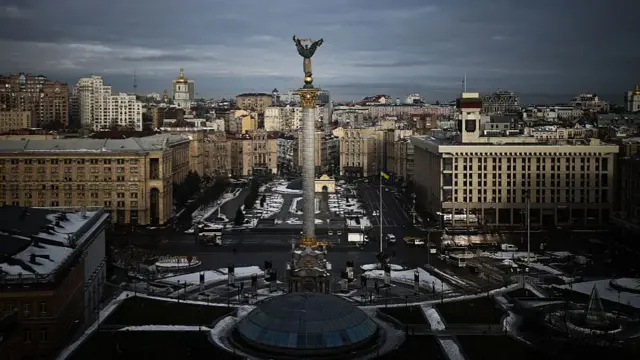
    An aerial view of Independence SquareImage source, AFP via Getty Images
    Image caption,

    The scene in Kyiv's Independence Square this morning, four years on from the start of Russia's full-scale invasion

    Today Ukraine and its President Volodymyr Zelensky are being showered with support by European allies in the 'coalition of the willing'. It’s a big change from the first day of the full scale invasion, four years ago exactly. Then, they expressed outrage that President Putin had ordered his men to invade - but their military analysis was that Ukraine would lose within a few weeks. That was Putin’s assumption too.

    They were, of course, wrong.

    I was in Kyiv during the time when Russian forces were at the edge of the city. At the height of a civilian exodus 50,000 people a day were boarding trains at the main railway station to head west, away from the Russians.

    I had read many assessments of Russian strength and Ukraine’s relative weakness, and every morning I was expecting some kind of Russian breakthrough. Tank obstacles and sandbagged strongpoints were erected at road junctions and checkpoints with every expectation that they would be needed.

    It took a few weeks to realise that not only were the Russians being held, they were losing the battle for Kyiv. On 29 March 2022, Russia announced it was pulling its forces back from Kyiv.

    After that, Ukraine was taken much more seriously by its Western allies.

  11. 'We need to keep fighting,' Ukrainians tell BBC as Europe reflects on four years of conflictpublished at 13:00 GMT

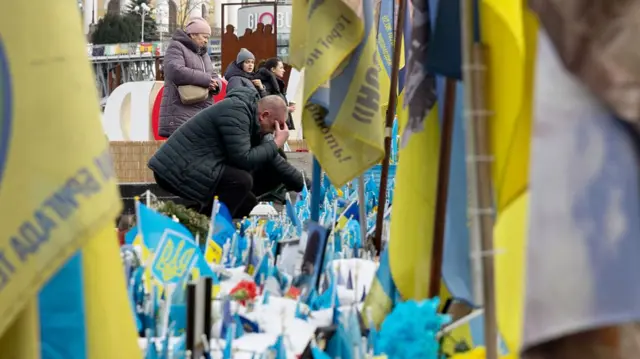
    A man visits a makeshift memorial for Ukrainian soldiers in Kyiv. He has his head in his hands as he crouches down to the flags on the ground.Image source, AFP via Getty Images

    If you’re just joining us, we’ve been following tributes from Ukrainians and European allies that are marking the fourth anniversary of Russia’s invasion of Ukraine.

    We’ve heard from Ukraine’s President Volodymyr Zelensky, who’s urged Donald Trump to “stay on our side”, and called for more support from the EU to restore key infrastructure. Zelensky also pushed for a date to join the EU, warning that without one Russia would seek to block the move.

    European leaders are in the Ukrainian capital Kyiv, attending memorial events and visiting a power plant badly damaged by Russian air strikes. They then joined UK PM Keir Starmer and French PM Emmanuel Macron, who virtually hosted a meeting of the 'coalition of the willing'.

    That came after Starmer announced the UK's largest package of sanctions against Russia since the early months of the war in 2022.

    But Kremlin spokesperson Dmitry Peskov said the“full goals” of the war had not yet been achieved. Moscow is demanding that eastern regions of Ukraine - the Donbas - are handed over, an unacceptable condition for Kyiv.

    Our diplomatic correspondent Paul Adams has been speaking to those paying tribute across Ukraine, including hearing from a Ukrainian father whose son died in the conflict in 2023 and who says “we need to keep fighting”.

    We'll hear more about the impact on the ground at 16:30 GMT, in the BBC's special programme, War in Ukraine: What Happens Next?

    European leaders visit a makeshift memorial in Ukraine. We can see pictured: Ukraine's President Volodymyr Zelenskiy and his wife Olena, Finland's President Alexander Stubb, Estonia’s Prime Minister Kristen Michal, Croatia's Prime Minister Andrej Plenkovic, Denmark's Prime Minister Mette Frederiksen, Iceland's Prime Minister Kristrun Mjoll Frostadottir, Latvia's Prime Minister Evika Silina, Norway's Prime Minister Jonas Gahr Store, Sweden's Prime Minister Ulf Kristersson, Lithuanian Minister of National Defence Robertas Kaunas, President of the European Commission Ursula von der Leyen and European Council President Antonio CostaImage source, Reuters
    Image caption,

    Zelensky and European allies visit a makeshift memorial on the fourth anniversary of Russia's full-scale invasion

  12. 'No truth' to Russian claims that Britain plans to supply a nuclear bomb says Downing Streetpublished at 12:46 GMT

    Since the publication of our previous post on Russian claims that Britain and France are planning to arm Ukraine with a nuclear weapon, we have heard a rebuttal from Downing Street.

    The PM's official spokesperson describes the claims as "a clear attempt by Vladimir Putin to distract" from Russia's actions in Ukraine and there are "no truth" to them.

    He adds that the "package of action on military, humanitarian, reconstruction fronts" announced today shows where the UK's support for Ukraine lies.

  13. Russia shares unfounded claims over 'plot to arm Kyiv with nuclear bomb'published at 12:24 GMT

    Laura Gozzi
    Europe reporter

    Earlier today Russia's Foreign Intelligence Service (SVR) released an entirely unsubstantiated statement accusing the UK and France of plotting to arm Ukraine with a nuclear weapon or a "dirty bomb".

    The SVR said Paris and London realised that the current situation in Ukraine "leaves no chance of achieving their much-desired victory over Russia at the hands of the Ukrainian army", and that they were therefore facilitating Kyiv's acquisition of nuclear weapons.

    Earlier today Kremlin spokesman Dmitry Peskov said Russia would "take into account" the claims during future negotiations on a Ukraine peace settlement.

    The SVR's accusations are completely unfounded, and the agency has provided no documents or leaks to support it. Russian government-affiliated agencies have a history of sharing wild claims of this ilk. Neither the UK nor France have commented.

  14. Meanwhile, Russian state TV channels make no mention of the significant datepublished at 12:02 GMT

    BBC Monitoring

    Russian state TV channels made no mention on 24 February of the fourth anniversary of Moscow’s full-scale invasion of Ukraine. Prime time news bulletins the previous evening were also silent on the date.

    Instead, coverage focused on reported battlefield advances and events marking Defender of the Fatherland Day, which commemorates Russian military achievements.

    In one broadcast, Channel One honoured what it called the “heroes of the special military operation”.

    Some officials addressed the human cost online. Belgorod Governor Vyacheslav Gladkov said, external “hundreds of civilians” had been killed in the border region over four years, adding that the local economy had adapted to “constant shelling and threats”.

    Prominent pro-war bloggers, meanwhile, struck a defiant tone, portraying the conflict as an existential struggle and urging continued unity and support for the armed forces.

  15. Watch: How Russian newspapers are covering the anniversarypublished at 11:47 GMT

    Steve Rosenberg
    Russia editor

    Media caption,

    Russia editor Steve Rosenberg looks at the coverage four years into the war

  16. In Bucha, people gather under grey skies to commemorate the fallenpublished at 11:29 GMT

    Paul Adams
    Diplomatic correspondent reporting from Bucha

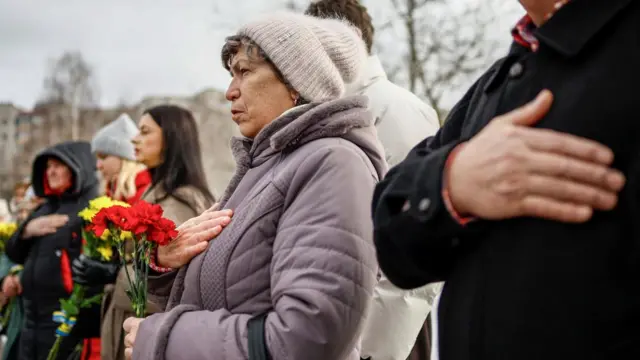
    A row of people hold flowers and place a hand on their chests during a memorial service in Bucha, Ukraine.Image source, Reuters
    Image caption,

    In the Ukrainian town of Bucha, people gather on the fourth anniversary of the Russian invasion to pay tribute to those who have died

    In his video address this morning, President Volodymyr Zelensky listed the names of places associated with the horrors of the past four years. Top of the list was Bucha.

    This is where the brutality of Russia’s all-out invasion was first, shockingly, revealed.

    Captured in the first days of the invasion, after Russian airborne troops landed at nearby airport, Bucha was occupied for several weeks, before being pushed back in late March.

    Evidence of atrocities quickly emerged. The bodies of civilians lying where they were shot in the streets. A mass grave containing the bodies of scores of people, unearthed in front of the world’s cameras.

    Suddenly Bucha was notorious.

    This morning, under grey skies and recent winter snow melting all around, people gathered at a military cemetery to commemorate the fallen; not only those who died in those early weeks but a host of others who have been killed since, in front-line battles hundreds of miles away.

    Orthodox priests led prayers and Ukraine’s national anthem rang out, but it was a mostly silent affair, as relatives laid flowers, stood in quiet contemplation and left.

    Serhii Zavadsky, 49, was here to pay respects to his oldest son, Oleksiy, who died in 2023 during the siege of Bakhmut, weeks before he was due to be married.

    “We need to keep fighting,” Serhii told us. “We don’t have any choice."

    “I believe in our victory, because truth is on our side. If I could, I would wipe Russia from the face of the earth.”

  17. Starmer says allies need to 'shift the narrative' on the warpublished at 11:28 GMT

    Keir Starmer says Ukraine's allies need to "shift the narrative" away from the perception that Russia is winning the conflict.

    “We’ve got to shift the narrative. Whatever Putin tells himself and his people, Russia is not winning, and we must shift the narrative into that place with greater force and determination," he says.

    During his call with Zelensky and European leaders, Starmer says that Russia has suffered "half a million casualties in the last year, to gain and occupy less than 1% extra of Ukrainian territory".

    The Russian economy is also suffering, he says. But he adds that allies need to "increase pressure on Russia and its war economy", before referencing the new sanctions announced by the UK today.

  18. Watch live: Starmer speaks to Zelensky at 'coalition of the willing' meetingpublished at 11:11 GMT

    Keir Starmer speaks to coalition of the willing

    We're now seeing footage of a "coalition of the willing" meeting, where Prime Minister Keir Starmer is speaking to Ukraine's Volodymyr Zelensky - as well as other leaders - via video.

    We'll bring you the key lines as we get them, and you can watch live at the top of the page.

  19. Russians have 'changed considerably' in four years of war, Kremlin tells BBCpublished at 11:01 GMT

    Ben Tavener
    Reporting from Moscow

    The Kremlin has told the BBC that both Russia and Russians have “changed considerably” in the four years since Vladimir Putin launched his “special military operation”.

    “It’s been a very important four years in the history of our country: it will remain forever in people’s memories,” Kremlin spokesman Dmitry Peskov said on the day the war entered its fifth year.

    He said he believed the war had triggered a “phenomenal consolidation” in Russian society, particularly around the president, and that Russians now better understood their roots.

    Although few people in Russia publicly criticise the war or President Putin, a growing weariness with the consequences of the war and its effect on people’s lives, including high inflation, is palpable in the country.

    Peskov did not answer whether the Kremlin believed Russia would still be fighting in Ukraine four years on. Nor could he confirm when or where the next round of trilateral Russia-Ukraine-US talks would take place.

    He once again accused the UK of interfering in attempts at a peace deal between Russia and Ukraine at an early stage in the war, and said the war had grown into a far bigger conflict due to the “direct involvement of countries in western Europe and the United States”.

  20. The 'full goals' of the war have not yet been achieved, Kremlin spokesman sayspublished at 10:55 GMT

    Laura Gozzi
    Europe reporter

    Kremlin spokesman Dmitry Peskov says the "full goals of the special operation" not yet been achieved, which is why the conflict continues.

    Peskov made the comments during a regular scheduled call with journalists, during which he referenced Moscow's main talking points around the war, including that Russia was open to resolving the conflict diplomatically.

    Moscow is demanding eastern regions of Ukraine - known as the Donbas - are handed over, an unacceptable condition for Kyiv. Multiple rounds of US-brokered talks over the last few months seem to have reached a stalemate largely due this demand.

    Peskov also said that the past four years had been "very important" for Russia, and they would "forever remain in people's memories".

    Since 2022 millions of Russian lives have been lost or upended by the war and its sprawling consequences - from high inflation to mass emigration.