Summary

  • A Russian fake news network has been targeting Ukraine at the Winter Olympics with a disinformation campaign on social media

  • The operation has been spreading fake versions of news reports to discredit Ukrainian athletes and fans, including using AI voiceovers to impersonate trusted figures

  • BBC Verify has analysed more than 40 examples of fake reports, which experts say are intended to "overwhelm" news organisations and influence people's opinion against Ukraine

  • We use open-source intelligence, satellite imagery, fact-checking and data analysis to help report complex stories

  • This feed is where we post our work throughout the day

  • Get in touch with us by following this link

  1. US military build-up intensifies and fake news targeting the Winter Olympicspublished at 17:25 GMT 18 February

    Thomas Copeland
    BBC Verify Live journalist

    Today’s BBC Verify Live page has focused on three main stories, so here’s a recap of what we’ve covered.

    A major Russian disinformation operation is targeting Ukrainian athletes and fans at the Winter Olympics. We’ve talked you through their fake news stories and AI impersonations, as well as broken down what we know about the goals and tactics of the operation.

    As Washington DC exerts more pressure on Iran, we’re continuing to track the build-up of US military assets in the Middle East. Here’s what we know about the location of the USS Gerald R Ford aircraft carrier and what flight tracking data tells us about US air power in and around the region.

    We’ve also been looking at videos emerging from Iran which appear to show people being shot at while mourning protesters killed in recent anti-government protests. Keep an eye out on the BBC News app and website for our report when it’s published.

    And here in the UK, the team has looked into a claims by Reform UK’s Robert Jenrick about energy prices and the Office for Budget Responsibility.

    Join us tomorrow for more from BBC Verify Live.

    BBC Verify Live banner
  2. US bolsters air power in the Middle East, plane-tracking data showspublished at 17:10 GMT 18 February

    Tom Gould
    BBC Verify journalist

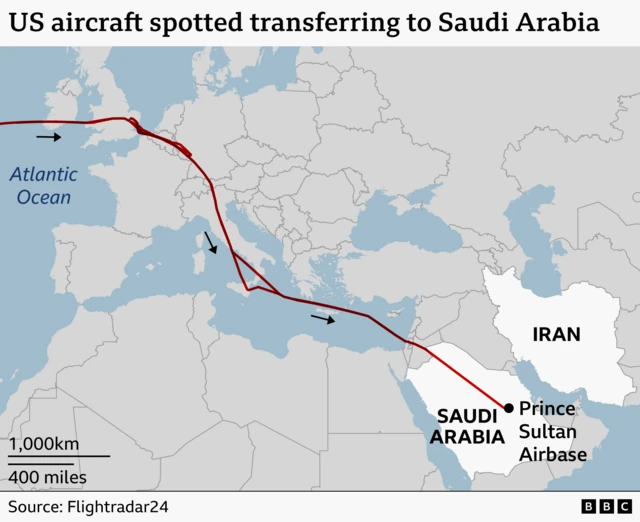
    Open-source data shows the US military is continuing to deploy aircraft in and around the Middle East, as tensions with Iran remain heightened as talks between officials continue over Tehran’s nuclear programme.

    Among the newly deployed assets are E-3 Sentry airborne warning and control system (Awacs) aircraft and F-22 Raptor fighter jets, according to flight tracking websites ADS-B Exchange and Flightradar24.

    Some of these aircraft were tracked heading to Prince Sultan Airbase in Saudi Arabia.

    Flight path map from the UK to Saudi Arabia

    Sam Wise, an aviation analyst at intelligence firm Janes, says there has been a “higher than normal amount of movement” in recent days. The US has deployed as much as a third of its total operational E-3 Sentry fleet, he says, which it uses to conduct large-scale air operations.

    The F-22 is one of the most advanced fighters operated by the US and it’s uncommon for them to be sent to the Middle East, Wise adds.

    Justin Bronk, a senior research fellow at the Royal United Services Institute, agrees the movement of F-22s is “unusual”.

    The scale of US military activity is reminiscent of the preparations for Operation Midnight Hammer in June 2025, when the US attacked Iranian nuclear sites, according to Arun Dawson, a researcher at the Freeman Air and Space Institute.

  3. New video from Iran shows person in armoured vehicle appearing to fire at mournerspublished at 16:17 GMT 18 February

    Ghoncheh Habibiazad and Jake Horton
    BBC Persian and BBC Verify

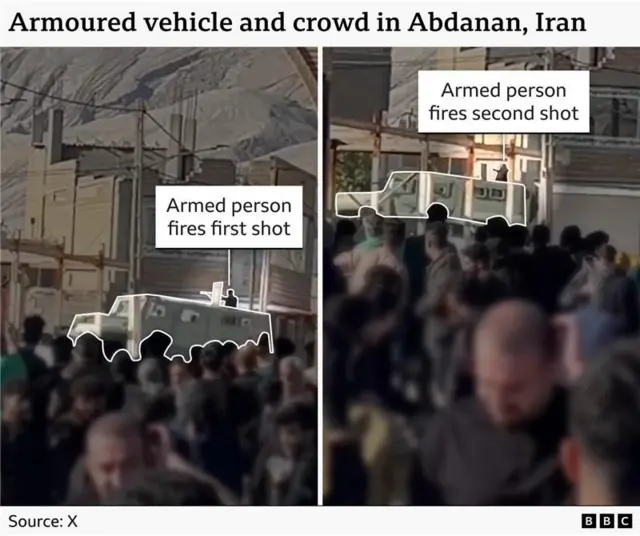
    Verified video from a cemetery in western Iran shows a person in an armoured vehicle appearing to shoot at a crowd of mourners on Tuesday.

    The group in the city of Abdanan can be heard chanting “death to Khamenei”, Iran’s Supreme Leader.

    The person points the gun away from the camera when the first shot is fired, before directing the weapon towards the crowd when a second shot can be heard. A puff of smoke near the gun is visible after each shot.

    Two screengrabs from a video showing a crowd in the foreground and a armoured vehicle with a man on top pointing a gun

    Another verified video from the cemetery shows smoke in the distance as people run away from the scene and several gunshots can be heard.

    Iranians usually hold commemoration ceremonies on the 40th day after someone dies. These events have been held over the last few days in several cities to mourn people killed on 8 and 9 January, during the deadliest nights of anti-government protests.

    Activists have said more than 7,000 people were killed as a result of the crackdown on the demonstrators last month.

    A billboard in the background of one of the videos shows a picture of Alireza Seydi, a teenager from Abdanan who is understood to have been killed in Tehran last month. He appears to be one of those commemorated during the ceremony.

    We’ve also verified videos from different parts of Iran including Tehran and Isfahan showing ceremonies for the protesters killed in Iran’s recent anti-establishment protests.

  4. US aircraft carrier briefly broadcasts location off coast of Moroccopublished at 15:19 GMT 18 February

    Alex Murray
    BBC Verify journalist

    The Gerald R Ford in the Caribbean in December 2025Image source, Reuters
    Image caption,

    The Gerald R Ford in the Caribbean in December 2025

    We’ve been tracking the movement of US military warships and aircraft in recent days, as Washington continues to apply pressure on the Iranian government over its nuclear programme.

    The aircraft carrier USS Gerald R Ford, one of the largest and most advanced warships in the world, briefly broadcast its location off the coast of Morocco.

    USS Gerald R Ford switched on ship-tracking AIS (automatic identification system) for the first time in 2026 at 12:30 GMT today.

    The carrier transmitted its location until 13:18 and appears to be navigating at full speed towards the Gibraltar Strait between Spain and Morocco, which connects the Atlantic to the Mediterranean.

    At its current speed, USS Gerald R Ford would arrive in the eastern Mediterranean in about three to five days, according to our estimate.

    BBC Verify has asked the US military to confirm if the location data of the ship is accurate.

  5. What the names of a Russian disinformation operation say about its tacticspublished at 14:46 GMT 18 February

    Thomas Copeland
    BBC Verify Live journalist

    The disinformation operation we’re reporting on today is known by some analysts as Matryoshka, a reference to a Russian nesting doll because of the impersonation tactics it uses.

    Matryoshka operates by posting large amounts of fake content which is shared in a coordinated manner via a network of fake social media accounts. Experts say that the goal of the campaign is to get some of it shared on by real accounts or covered by news outlets.

    “Matryoshka is also referred to as ‘Operation Overload’ because its original goal was to overwhelm newsrooms with requests to fact-check the fake stories, making it hard for newsrooms to distinguish legitimate requests from malicious ones and stretching their resources thin,” says Pablo Maristany de las Casas from the Institute of Strategic Dialogue (ISD).

    It first gained widespread attention during the Paris Olympics in 2024, but it’s been in operation since at least September 2023, according to a French government report.

    “Its goal is to influence public opinion in the EU and the US about Russia’s invasion of Ukraine, undermine trust in democratic institutions, polarise public opinion on sensitive issues, and tarnish the image of Ukrainians,” says Maristany de las Casas.

    As we told you earlier, almost nothing is known about where Matryoshka operates, who runs it, or whether it has links to the Kremlin.

  6. How does the OBR rank as a financial forecaster?published at 14:08 GMT 18 February

    Ben Chu
    BBC Verify policy and analysis correspondent

    In his speech on the economy earlier, Reform UK’s new Treasury spokesman Robert Jenrick said a future Reform government would retain the Office for Budget Responsibility (OBR).

    This is despite Reform’s leader Nigel Farage previously saying he “questioned the need” for the official fiscal forecaster and Treasury watchdog.

    Jenrick also criticised the OBR’s performance as “far from perfect” and noted it had been ranked “near the bottom” of a recent league table of UK economic forecasters compiled by the Times newspaper, external.

    The Times’ league table examined forecasts from groups like banks and economics consultancies on measures including GDP growth, inflation and unemployment.

    The newspaper compared their forecasts made before 2025 to the outturn of data in the calendar year and created its own ranking of their relative performance.

    The OBR did come second from bottom on the Times’ ranking.

    However, the newspaper itself noted the OBR had a disadvantage in the comparison process, because it only produces two forecasts a year, as part of a government’s Spring Statement and Autumn Budget. Other groups can produce them more regularly and take account of more timely indicators of the likely performance of the economy.

    The Times reported the UK’s economic outlook clearly deteriorated shortly after the OBR’s forecasts for 2025 were made alongside the October 2024 Budget.

    A 2023 OBR evaluation, external found that, since 2010, its growth and borrowing forecasts had been more accurate than those made historically by the Treasury when it was responsible for producing official forecasts before the OBR was created.

  7. Russian disinformation network uses AI voiceovers to impersonate ‘trusted figures’published at 13:31 GMT 18 February

    Thomas Copeland
    BBC Verify Live journalist

    We’re reporting today on a Russian disinformation network which is using fake news stories to target Ukrainian athletes and fans at the Winter Olympics.

    “What truly sets Matryoshka apart is the use of AI voiceovers to impersonate the voices of trusted figures,” says Pablo Maristany de las Casas from the Institute of Strategic Dialogue (ISD) think tank.

    “They take a real video of a real person but part-way through they switch to stock footage overlaid with a deepfake narration that sounds just like the real person so that they can insert absurd lies that appear more authentic,” explains Darren Linvill, a media forensics expert at Clemson University.

    Watch the video below, which has been linked to the network.

    At the beginning it shows a real press conference by Olympics chief Kirsty Coventry on Euronews, but after a few seconds an AI version of Coventry’s voice takes over.

    It claims she said she was shocked that the Ukrainians have come to Milan “for crazy political PR”, that the athletes are behaving aggressively and that she has “never encountered people this irritating, I swear.”

    But, footage from the real press conference shows that Coventry said none of these words.

    BBC Verify has seen this same tactic used to create a deepfake of an American commentator at the Winter Olympics and the Canadian broadcaster CBC has debunked an AI video of one of their journalists too., external

    The individual impact and reach of the fake videos has been limited, but together they reveal the methods being used to undermine support for Ukraine.

    We’ve also previously investigated how a British 999 call handler's voice was cloned using AI by the same operation last year.

    “The operators of Matryoshka know that its content is more credible when its delivered, seemingly, by a trusted person,” says ISD’s Maristany de las Casas.

  8. UK industrial energy prices high, but not that highpublished at 12:56 GMT 18 February

    Anthony Reuben
    BBC Verify senior journalist

    Robert Jenrick has given his first speech as Reform UK’s Treasury spokesman today, laying out the party’s priorities for the economy.

    In his remarks, he said: “We can't allow a situation where industrial energy bills are five or six times higher here than in the United States.”

    We looked at this comparison last week when billionaire Manchester United co-owner Sir Jim Ratcliffe made a similar claim, but he said it was three or four times higher.

    We asked the International Energy Agency (IEA) for figures for the two countries and they gave us prices covering October to December 2025.

    For industrial electricity, the price in the UK was 3.7 times the US figure. For industrial natural gas, the UK price was 4.5 times higher.

    It is certainly the case that the UK has relatively high prices for industrial energy, but not quite as high as Jenrick suggested.

  9. Watch: Ros Atkins looks at unanswered Andrew questionspublished at 11:35 GMT 18 February

    Since the US Department of Justice released a vast tranche of files about the convicted sex offender Jeffrey Epstein, there have been a series of new allegations about the extent of the relationship between the billionaire financier and Andrew Mountbatten-Windsor.

    And questions have also been mounting over the way Buckingham Palace has responded to the various accusations against the King's brother. The BBC's Analysis Editor Ros Atkins has taken a look, watch below:

    Media caption,

    Ros Atkins on...unanswered Andrew questions

  10. Fake news stories part of Winter Olympics disinformation campaignpublished at 10:56 GMT 18 February

    Thomas Copeland
    BBC Verify Live journalist

    BBC Verify has analysed 43 examples of fake news stories shared with us by US-based researchers called dTeam and analysts at Clemson University. The disinformation campaign is often called Matryoshka.

    One hallmark of its output is fabricated news stories that impersonate legitimate news sources, research organisations, government bodies and security agencies.

    Take a look at these screenshots from videos about the Winter Olympics circulating on platforms like X and Telegram, which feature near-identical branding to real news outlets like Deutsche Welle and E! News.

    Six screengrabs from fake news videos with various false claims, including: “The granddaughter of a Ukrainian billionaire has booked all the suites in three Italian hotels for the duration of the Olympic Games”, “FRENCH POLICE HAVE ARRESTED A GROUP OF UKRAINIAN REFUGEES WHO WERE SELLING COUNTERFEIT TICKETS TO OLYMPIC EVENTS”, “Protesters called for the Ukrainian team to be barred from participating in the Olympic Games”, “A Ukrainian performance artist covered the walls of the Paris-Milan flight's airplane lavatory with faeces”, “ITALIAN POLICE HAVE STEPPED UP SURVEILLANCE OF UKRAINIAN REFUGEES AHEAD OF THE OLYMPICS” and "Snoop Dogg refused to take a photo with the Ukrainian Olympic team in Milan"

    BBC Sport has also been impersonated in at least one fake video claiming that Ukrainian athletes have been shunned by other European teams.

    “Russia wants Ukrainians to appear, frankly, unlikeable,” says Linvill, a media forensics expert at Clemson University. “To the right audience these videos have the potential to be very convincing.”

  11. Russian disinformation network targets Ukrainians at Winter Olympicspublished at 10:35 GMT 18 February

    Thomas Copeland
    BBC Verify Live journalist

    A major, longstanding Russian disinformation operation is using the Winter Olympics to make Ukrainian athletes and fans appear aggressive, corrupt and unlikeable, experts have told BBC Verify.

    We have analysed 43 examples of fake news stories since 30 January shared with us by independent researchers. The individual impact of the fakes has been limited, but together they reveal the methods being used to undermine support for Ukraine.

    “They have been using tactics like this to turn Western opinion against Ukraine for years, and the Olympics are an opportunity to target new audiences,” according to Darren Linvill, a media forensics expert at Clemson University.

    BBC Verify has been tracking the operation for several years. One of the many names it goes by is Matryoshka, a reference to a Russian nesting doll because of the impersonation tactics it uses.

    The operation’s latest campaign about the Winter Olympics has been reported by NewsGuard, Agence France-Press and Euronews.

    Almost nothing is known about where Matryoshka operates, who runs it and whether it has links to the Kremlin. But, we’ll bring you more details on how the operation works over the course of our coverage today.

  12. Russian disinformation campaign targets Ukraine at Winter Olympicspublished at 10:11 GMT 18 February

    Adam Durbin
    BBC Verify Live senior journalist

    Good morning.

    We’re launching BBC Verify Live’s coverage today with details about a Russian fake news network which has targeted the Winter Olympics in recent weeks. The operation, which BBC Verify has been tracking for some time, is now seeking to discredit Ukrainian fans and athletes at the games in Italy by spreading fabricated and manipulated versions of legitimate news reports.

    We’ve spoken to experts about the tactics used by the disinformation network, which at times has focused on deepfaking the voices of trusted figures to turn public opinion against Ukraine.

    Plus, we’re continuing to monitor the major US military build-up near the Middle East, as Washington ramps up pressure on Iran over its nuclear programme. The team are tracking the movements of fighter jets, strategic aircraft and warships in the region, as negotiations between both nations continue in Switzerland.

    BBC Verify Banner