Our live updates have endedpublished at 17:15 GMT
Our live coverage has come to an end.
You can continue to read more about today's proceedings here.
The public inquiry into the Nottingham attacks is continuing to hear evidence into the killings of Barnaby Webber, Grace O'Malley-Kumar and Ian Coates by Valdo Calocane on 13 June 2023
Experienced firearms officer PC Jonathan Speeden has finished giving evidence to the inquiry
Earlier on Wednesday, the senior officer who oversaw the police investigation into the killings - retired Det Supt Leigh Sanders, of Nottinghamshire Police - is giving evidence to the Nottingham Inquiry, which is being held at Mary Ward House in London
Sanders told the inquiry that some police officers believe Calocane - who was sentenced for manslaughter on the basis of diminished responsibility - had committed murder
The victims' families looked visibly upset as Sanders described a CCTV image of Calocane as "nondescript", with the senior investigating officer suspecting stories about the case were being leaked to the press
Our live coverage has come to an end.
You can continue to read more about today's proceedings here.
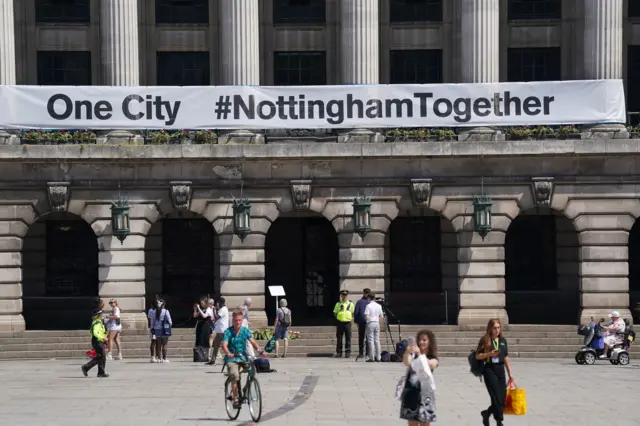 Image source, PA Media
Today's proceedings in London have come to a conclusion, with PC Jonathan Speeden ending his evidence.
Footage - shown to the inquiry previously - shows Valdo Calocane being taken from a police van in handcuffs before unexpectedly kicking an officer.
Retired Det Supt Leigh Sanders had said during the morning session he felt police officers were undoubtedly at risk during Calocane's arrest.
Speeden said there were no further firearms officers coming on shift until 07:00 on the morning of the attacks on 13 June 2023.
But he did say firearms support could have also been requested from neighbouring forces.
He added firearms brought a defined structure to leading an operation.
Speeden said: "The firearms world is very professional in the way that we know that when we're deployed, we do things in a certain way, and they're very methodical."
Speeden said the fact a stranger was believed to have been behind the attacks was "strange" at the time.
He said: "It's not an everyday occurrence.
"I thought it was very strange for something to have happened to what I saw as two young individuals.
"And just the nature of it - if it's happened there, why couldn't it happen somewhere else?"
Under cross-examination, talking about the debriefing after the attacks, Speeden explained there had been a disagreement over whether firearms should have been deployed.
It had been argued that handing the searches to firearms teams might have reduced the number of unarmed officers able to search for Valdo Calocane.
Speeden said a "stay safe" message would have been given not to approach Calocane should an unarmed officer be the first to locate him and to alert authorised firearms officers (AFOs).
He said: "I wouldn't want any one colleague putting themselves in harm's way when we've got the equipment to deal with somebody that is dangerous."
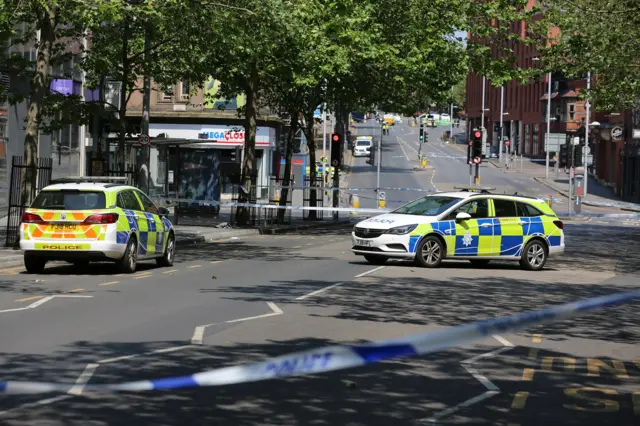 Image source, Nottinghamshire Police
Speeden said he was unsure the search for Calocane was the sole callout for them at the time, with only three armed response vehicles available and a whole county to cover.
He explained there were further pressures, including medical equipment needing to be replenished, and firearms officers who were attending to the casualties at the scene.
Speeden said he would not change how he responded, but said: "I think three armed response vehicles to cover any county is a very low number and to be able to perform to the best of our abilities, you would need more firearms officers."
Asked if he felt he had enough information, Speeden said: "I believe that was the only information that was available at that time."
Speeden said as it was not a firearms-led search, he was unaware of who was in charge of coordinating it or how many officers were involved.
"I would have had control of the search and it would have been run on a single channel, and I would have requested that other officers/teams would have been patched in to our talk group.
"It's very hard to cover off an urban area completely unless you've got hundreds of officers.
"The biggest asset for me with doing an area search as well as CCTV would have been the National Police Air Service.
"I know hours have been cut down, some forces only pay for it between certain times. It is still possible to get a helicopter or a fixed winged aircraft if they're available and whatever monetary cost can be sorted out later down the line."
Learning there had been two victims, Speeden said he was concerned about further attacks.
Speeden said: "My thought at that time was 'has he gone in an alleyway, into a building, or is he simply hiding?'
"All those people [at the scene] for me were just another potential target for that individual.
"There is somebody that is dangerous and they've got to be in possession of something that is lethal."
A further call asking if a suspect had been identified by Speeden was played.
Audio of calls made by Speeden at 04:11 and 04:20 were played out to the hearing.
A statement by Speeden showed he had asked "several times" while travelling to the scene in Ilkeston Road on the day of the attacks - where Barnaby and Grace were killed - if armed firearms officers (AFOs) would be deployed.
He argued for their use to protect those at the scene should Calocane return, and once medical staff had taken over so that an armed search could be started.
"I'd been told and rightly so that the victims' medical aid was the priority, I don't disagree with that at all, and from my recollection at the scene my AFOs were still heavily committed with medical treatment," he told the inquiry.
Speeden, a police officer since 2001 and firearms officer for a decade, is outlining his experience and training, including a firearms instructors course.
Among "many incidents" while working for Dorset Police, he said he was called to a stabbing in an urban environment which lasted for seven hours including searching for a suspect.
"We always carry a sidearm," he said. "But when it comes to firearms deployment it's not something I would want to do unless the necessity is there to do it."
After a round of cross-examination over a range of points made earlier, retired Det Supt Leigh Sanders has concluded giving evidence to the inquiry.
"Mistakes were made on this occasion," Sanders said as the examination of how the next of kin were informed concluded this section of the hearing.
PC Jonathan Speeden, who was the operational firearms commander on the day of the attacks, is due to give evidence next.
The inquiry has heard how Calocane had a list of names in his backpack on the day of the attacks.
The names were of former flatmates and neighbours of Calocane, including those who have previously given evidence to the inquiry.
The inquiry previously heard how Calocane had assaulted two former flatmates on separate occasions and also caused a woman to flee from a first-floor window, resulting in her fracturing her spine.
Sophie Cartwright KC, representing the survivors, asked Sanders if he "appreciated the significance" of where Calocane was the morning of the attacks and how the route he took "linked to all those previous incidents".
Sanders replied: "I think he was obviously in the area that he was familiar with within Nottingham and obviously that area was also relevant in terms of some of the previous history."
However, he added he did not consider the names on the piece of paper in his investigation, although statements were taken from those people.
The inquiry has heard how text messages and a voicemail from an acquaintance of Valdo Calocane to him were seen and heard by police.
The man, known as Mr Monteiro, had spoken to Calocane via text, in Portuguese.
Sanders had recorded that those messages offered "nothing significant regarding the investigation" and showed they were "actions of a loner and a man evicted from a property who was looking or a place to stay".
In a voicemail to Calocane, Mr Monteiro was heard trying to get in touch with him over concerns about Calocane taking his house key and getting "in trouble" with a neighbour.
In the voicemail, he said: "If this turns into a police case bro, I'm going to hand you over. I won't lie to you.
"I trusted you at my home man, I trusted you at my home and you took my key and left with it."
Sanders admitted Mr Monteiro was never asked what the call was about.
Sanders is being probed about an early decision to charge Calocane, under supposed pressure from plans to run a story by the press about a warrant being outstanding for him.
"I didn't want anything to prejudice the investigation," Sanders said.
"There would be reporting in the national press whilst our investigation is going on which would cause issues to the investigation.
"That rush was in order for me to protect my organisation."
Sanders had written in his log that the media were planning "a fake embellished news report" that would "undermine public confidence in local policing".
Moloney KC suggested that a warrant being outstanding for nine months and the number of dealings by police with Calocane would cause "reputational damage" to the force.
Sanders said "there were a number of stories" and a decision was made to charge to protect the investigation.
He denied charging to shut down stories of "police failings".
The day before Valdo Calocane was first on the radar of Nottinghamshire Police for breaking down a neighbour's door in May 2020, an East Midlands Ambulance Service log shows Calocane was taken to hospital.
It recorded he had "acute behavioural disturbance" as well as chest pains and "hearing mumbling".
He told medics he had mental health issues in the past but would not disclose further details.
Sanders said that he did not believe he had seen the document.
Police records showed someone had contacted the force to say while they were a student at a college in Pembrokeshire, Wales, there had been an incident of "violence against an animal" by Valdo Calocane.
The log said Calocane was believed to have been a cleaner at a college at the time and was living in student accommodation.
The person claimed Calocane had mental health issues "since at least 2013".
Asked why the person did not have a statement taken from them, Sanders said he did not believe it would "add any more value" to the information obtained by medical records in relation to his more recent health.
Sanders told the family's legal representative that no exploration of Calocane's history prior to 2019 took place.
"From an operational perspective, I'm not sure even if there were medical records going back that far, what I would gain from going further back," he said.
"From my perspective, I didn't see how the relevance of that was going to progress my homicide investigation at that time.
"We have what we need for the issues in the case."
Retired Det Supt Leigh Sanders has told the inquiry there were "a lot of officers who genuinely believed that this was an instance of murder".
Calocane admitted manslaughter on the grounds of diminished responsibility, and attempted murder in relation to the survivors.
Moloney KC said: "Did your team want there to be a trial to see whether the charge of murder was approved?"
Sanders said: "The difficulty you've got in the opinion being expressed by police officers, is based on being an operational police officer, key lines that we pursue give us observational views."
However, officers "simply don't have the expertise" to understand what might be going on in a person's head.
"There were officers who believed he had committed murder," Sanders said.
