Summary

  • Top officials from US immigration enforcement agencies have faced questions from lawmakers about Trump's immigration policies

  • Questions were asked about the deaths of Alex Pretti and Renee Good, US citizens who were shot and killed by federal agents in Minneapolis

  • The heads of Immigration and Customs Enforcement (ICE), and the head of US Customs and Border Protection (CBP) also spoke about how training has changed for agents and how many agents are wearing body cams

  • Agents from those federal agencies have been deployed to US cities as part of the Trump administration's crackdown on immigration

  • These deployments have been met with wide-scale protests and criticism

  1. Analysis

    A return to partisan trenchespublished at 19:27 GMT 10 February

    Anthony Zurcher
    North America correspondent

    If Republicans in Congress are still harbouring concerns about how federal officers have enforced immigration law in Minneapolis and elsewhere in recent weeks, there has been little evidence of it during today’s hearings at the House Homeland Security Committee.

    Many Democrats on the committee have pressed Todd Lyons, acting director of Immigration and Customs Enforcement, and Rodney Scott, commissioner of Customs and Border Protection, during these hearings on clashes with protesters, including the shooting deaths of two American citizens. Some, like LaMonica McIver of New Jersey and Eric Swalwell of California, have done so in fiery terms.

    The Republicans on the committee, however, have largely defended federal actions, highlighted threats against enforcement officers and condemned Democrats for disregarding what they say are the threats that undocumented migrants present to Americans.

    It’s a return to the partisan trenches after it appeared, for a brief moment, that public outcry following the shooting of Alex Pretti might prompt greater congressional scrutiny of the Trump administration’s activities in Minneapolis and elsewhere.

    We're ending our live coverage now, but you can read more about today's hearing here: Immigration bosses defend Trump's enforcement agenda in Congress
  2. What we heard from immigration officials before Congresspublished at 18:50 GMT 10 February

    And that wraps up the testimony from US immigration enforcement agency officials.

    Here are some of the key things we heard:

    • Todd Lyons, the acting director of Immigration and Customs Enforcement (ICE), told Congress that ICE agents are being unfairly compared to the gestapo and are working in the "deadliest operating environment" in the agency's history
    • Lyons told the hearing he could not confirm if any ICE agents have been fired for misconduct, and he could not give details on any possible internal investigations
    • The hearing was told about 3,000 out of 13,000 ICE agents in the field have body cameras, and about 10,000 out of 20,000 border patrol agents have body cameras
    • The agency heads say training has not been decreased because of the hiring surge under the Trump administration, but that the timeline for agent training has been condensed
    • Things got heated when lawmaker Dan Goldman, a Democrat, suggested ICE tactics were fascist, telling Lyons: "If you don't want to be called a fascist regime or secret police, stop acting like one"
    • Republican Sheri Biggs highlighted the increase in threats received by ICE agents, to which Lyons said it has never been like this under any other administration
    • Another fiery exchange occurred when New Jersey Democrat LaMonica McIver asked Lyons if he thinks he is "going to hell", before she was cut off by the committee's chairman. A White House social media account called the question "messed up"
  3. Hearing concludespublished at 18:29 GMT 10 February

    The last lawmaker to question the witnesses is Democrat Al Green.

    He asks them if they would testify on a case before an investigation, to which they all agree they would not.

    Green then says Homeland Security Secretary Kristi Noem violated that principle by accusing Alex Pretti of brandishing a firearm when he was shot by border patrol agents, which does not match videos from the scene.

    She should be held accountable, Green says.

    With that, the hearing ends.

  4. Lawmaker says approach of agents contrasts previous administrationspublished at 18:20 GMT 10 February

    Representative Troy Carter from Louisiana is pushing back on some of the points made by Republicans at the hearing.

    On the point that there were less immigration-related protests and riots during previous presidential administrations, Carter says it's because federal agents took a different approach.

    Under other presidents, agents were better at de-escalation, he says, adding that Democrats do want criminals locked up and no one dying in the street.

    Carter asks Lyons what an undocumented person looks like and how agents target people.

    Lyons said no one is targeted for the colour of their skin.

  5. ICE head says five-year-old not used as 'bait' as Democrats claimpublished at 18:05 GMT 10 February

    The subject of five-year-old Liam Ramos is raised again.

    Republican Congressman Brad Knott asks Lyons if agents really used the child as "bait", as Democratic lawmakers have said.

    Lyons says no, that ICE agents took care of the child, playing his favourite music and taking him to McDonalds after he was detained.

    For context: Liam Ramos was detained with his father in Minnesota and was sent to a detention centre in Texas. The two stayed there for nearly two weeks before being released on 1 February.

  6. Will ICE be deployed to the 2026 FIFA World Cup?published at 17:58 GMT 10 February

    Democrat Nellie Pou, from New Jersey, says her district will host "hundreds of thousands" of visitors during the upcoming 2026 FIFA World Cup.

    She asks Lyons if ICE will commit to pausing its operations and raids at FIFA matches and events.

    Lyons says ICE and Homeland Security are a key part of the "overall security apparatus" of the World Cup.

    He says ICE are dedicated to ensuring that everyone visiting World Cup events will be "safe and secure".

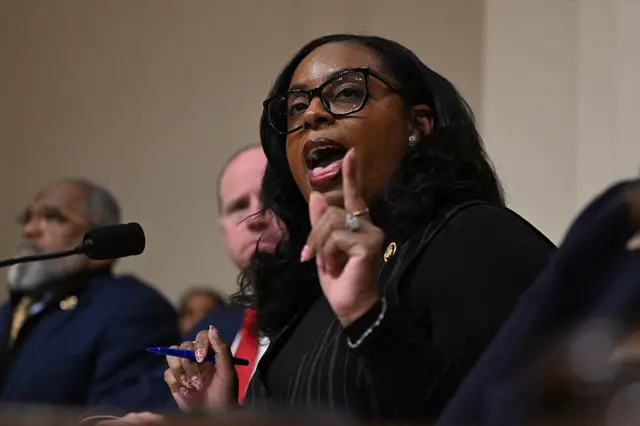
  7. Fiery moment as Democrat asks Lyons about 'Judgement Day'published at 17:47 GMT 10 February

    A woman with long hair, black-rimmed glasses and a dark suit gestures with one hand holds a blue pen with her other handImage source, Getty Images

    We've just seen perhaps the most firey moment of the hearing so far.

    New Jersey Congresswoman LaMonica McIver, a Democrat, asks ICE boss Todd Lyons if he considers himself a religious man, to which he says yes.

    "How do you think Judgement Day will work for you with so much blood on your hands?" McIver asks.

    "I'm not going to entertain that question," Lyons said.

    McIver presses further, asking: "Do you think you're going to hell, Mr Lyons?"

    He refuses to answer, and McIver was then cut off by the committee's chairman.

    A White House account on social media has since responded to the moment, saying McIver "steps completely out of line" with her question.

    "This is seriously messed up," the account wrote.

  8. Questions are few and far betweenpublished at 17:35 GMT 10 February

    As the hearing continues, the lawmakers are using most of their allotted five minutes to make their own political statements.

    We're two and a half hours into the hearing, and at this stage the witnesses are not being asked a lot of pertinent questions.

    Those that do arise are mostly partisan. Republicans are talking about negative rhetoric against ICE agents, Democrats are talking about violent incidents involving federal agents.

  9. Lyons says rhetoric against ICE has never been like thispublished at 17:30 GMT 10 February

    Sheri Biggs, a Republican from South Carolina, says the rhetoric put forward by "radical leftists" branding ICE agents as the gestapo and secret police "has consequences".

    She says between 2024 and 2025 there was a more than 16,000% increase in threats of assault towards immigration officers, in addition to an 8,000% increase in death threats.

    "Just think about that, if you were going to work every day and had to deal with that."

    Lyons responds that there is "unfortunately so much rhetoric out there" against the work that ICE is doing.

    He says it has never been like this under any other administration.

  10. Republican emphasises ICE's role in law and orderpublished at 17:22 GMT 10 February

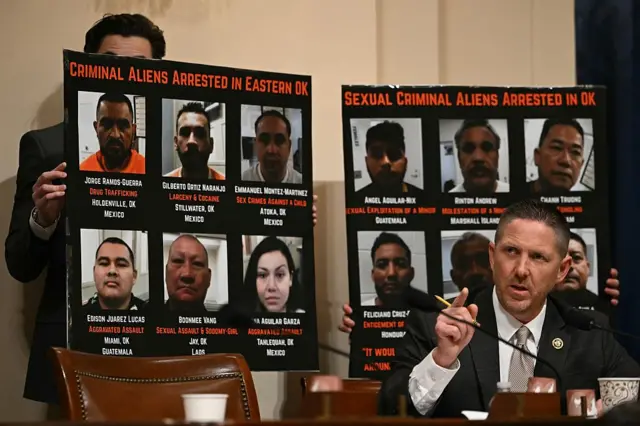
    Republican Congressman Josh Brecheen starts his time by holding up posters of people he says are "criminal illegal aliens" arrested by ICE in his district in eastern Oklahoma.

    He lists some of their crimes, which allegedly include sexually abusing minors, and says the Trump administration's immigration enforcement brings "law and order" to the US.

    In his response, ICE boss Todd Lyons also speaks a bit about the threats and danger he says faces his agents. He says "agitators" use apps to find and target agents.

    A man in a suit and tie gestures in front of two posters showing multiple mug shots of "criminal aliens arrested in eastern OK"Image source, Getty Images
  11. ICE head clashes with lawmaker over 'fascist' labelpublished at 17:07 GMT 10 February

    Dan Goldman, a Democrat member from New York, asks Lyons about the "numerous documented instances" of US citizens being asked to prove their citizenship by federal agents.

    "Do you know what other regimes in the 20th Century required similar proof of citizenship?" Goldman asks.

    Lyons says there are "very nefarious regimes" that have done this, including Nazi Germany.

    Things then get heated, with the pair speaking over each other and Lyons stating this is the "wrong type of questioning".

    Goldman demands more time, and presses Lyons on his previous statements that ICE agents being compared to the gestapo or secret police encourages threats against them.

    He says the problem is that Lyons "has it backwards" and that people are instead making valid observations about ICE tactics which are "un-American and outright fascist".

    "If you don't want to be called a fascist regime or secret police, stop acting like one."

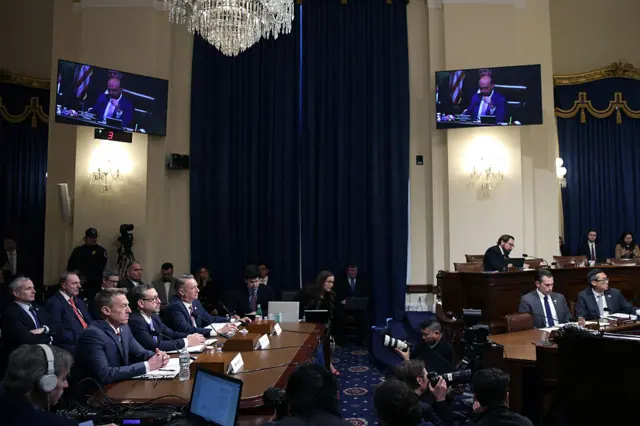
    People sit in a committee room with a high ceiling, chandelier and TV screens on the wallsImage source, Getty Images
  12. Border patrol head says examples of pepper spraying not proper procedurepublished at 16:56 GMT 10 February

    Border patrol commissioner Rodney Scott is shown a video from a CBS News package, which appears to show federal agents deploying pepper spray into the car of a US citizen, whose small child was in the back seat.

    Asked if this was an example of proper procedure for agents, Scott says "it's not".

    A second video is shown to the hearing - this time of an agent spraying pepper spray into the face of a person who is already pinned to the ground.

    Scott says he cannot comment on that incident and will get back to the committee on if that agent is being investigated.

  13. White House official hits out at Democratspublished at 16:50 GMT 10 February

    Bernd Debusmann Jr
    Reporting from the White House

    We've not really heard much from the White House yet on today's hearing - although that is likely to change when Karoline Leavitt briefs the media here early this afternoon.

    But even as the hearing goes on, White House Communications Director Steven Cheung has been posting both about the hearing and about broader immigration issues.

    In one post, Cheung said that California Democrat Eric Swalwell was "fact-checked for peddling an outright lie" during an earlier exchange with Todd Lyons.

    In another post, Cheung re-tweeted a video showing a car crash involving an undocumented migrant, which he said "could have been prevented" had Biden properly secured the border.

    "That's why the Trump administration is working so hard to protect Americans from outcomes like this," he added.

    We're very likely to hear a similarly combative tone from Leavitt in today's briefing. The administration often digs in on the topic of immigration and notes that it is among the primary reasons that a majority of Americans cast their ballots for Trump in 2024.

  14. What's the difference between ICE and CBP?published at 16:41 GMT 10 February

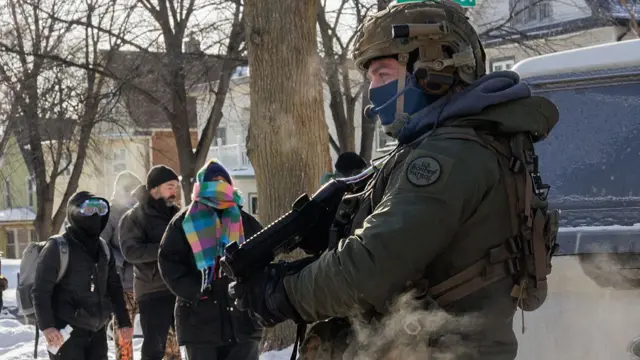
    A Border Patrol agent standing in camo gear with a helmet, mask, and gun as pedestrians walk past on residential streetImage source, Anadolu via Getty Images

    As the committee returns from a brief break, here's a refresher on the difference between two of the most prominent parts of the Department of Homeland Security (DHS) during the Trump administration immigration enforcement crackdown.

    ICE stands for the US Immigration and Customs Enforcement agency and CBP is the Customs and Border Protection agency.

    Both agencies are part of the DHS, but there are some key differences between the two.

    What is ICE?

    • A federal agencywhich enforces immigration laws and conducts investigations into undocumented immigration
    • It also plays a role in removing undocumented immigrants from the US
    • Typically, ICE operates inside the US, with some staffing abroad. It was formed as part of the Homeland Security Act of 2002, a response to the terror attacks on 11 September 2001

    What is CBP?

    • The US Customs and Border Protection agency is tasked with patrolling the US borders and enforcing immigration laws at and between ports of entry
    • It also sometimes takes part in immigration raids with ICE

    However, these roles have become increasingly blurred as the Trump administration pulled agents from a range of federal law enforcement agencies to participate in immigration enforcement.

  15. Democrat says officials better hope for pardons from Trumppublished at 16:38 GMT 10 February

    Next up is Shri Thanedar, a Democrat member from Michigan, who asks Scott and Lyons if they hope to get a pardons from Trump before he leaves office.

    Scott says he is "protecting America", is very proud of the service he provides and "doesn't need a pardon from anybody".

    Thanedar replies: "Well you better hope you get pardoned because you will be held accountable for the absolute disregard of the law your agencies have shown."

    He adds that he will introduce a bill in the US Congress to abolish ICE and also says he has also co-sponsored a bill to impeach Secretary Noem.

    "ICE must be abolished," he says.

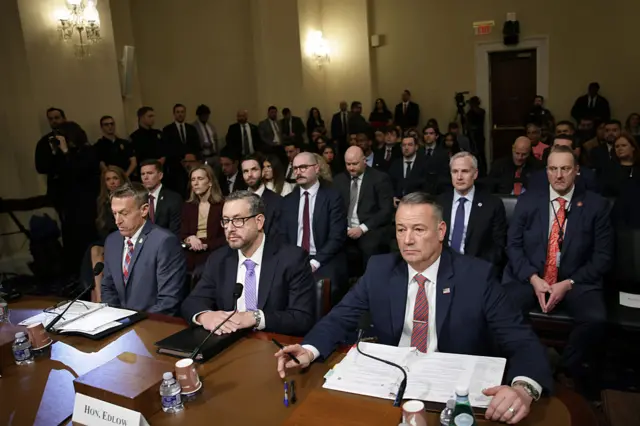
    Three men in suits sit behind a desk with microphones, paper and water bottles in front of themImage source, Getty Images
  16. Are American citizens being detained by ICE?published at 16:25 GMT 10 February

    Lou Correa, a Democrat representative from Southern California, asks Lyons about US citizens being detained by ICE.

    Lyons pushes back, saying no American citizens are being targeted by immigration agents, but Correa insists they have.

    When Lyons says he has not heard an instance of that happening, Correa says he will provide him a list.

  17. How many ICE agents have been fired for their conduct?published at 16:19 GMT 10 February

    Democrat Eric Swalwell then asks Lyons how many ICE agents have been fired for their conduct under his leadership.

    "I can get you that data, I'll get back to you," answers Lyons.

    Swalwell asks if "at least one" has been fired, to which Lyons says he will not speak on the actions of his agents.

    "But two people have been killed so far, is that right? A nurse named Pretti and a mom named Good," Swalwell adds.

    He asks if Lyons will apologise to the families of Good after she was called a "domestic terrorist" by members of the Trump administration.

    Lyons says no, he will not.

    "I welcome the opportunity to speak to the family in private but I'm not going to comment on the investigation," he adds.

  18. Americans divided on Trump's immigration effortspublished at 16:16 GMT 10 February

    Bernd Debusmann Jr
    Reporting from the White House

    As one might expect, this is so far a highly partisan hearing - which is itself reflective of divides in US society over Donald Trump's immigration policies.

    Polls clearly illustrate how deep that divide is.

    One poll released by CBS - the BBC's US news partner - in January found that just over half, or 52%, feel ICE is making US communities less safe.

    About 46% of respondents said they approve of Trump's deportation drive, down slightly from 51% in December.

    Notably, there is a stark divide among Democrats and Republicans. The pound found that 90% of Republicans approve of the plan to deport undocumented migrants, compared to only 10% of Democrats.

    Of course, different constituencies around the country experience the issue differently - a fact which we will clearly see in today's hearing.

  19. How many ICE agents have body cameras?published at 16:07 GMT 10 February

    Lyons is asked by Thompson how many ICE officer agents in the field have body cameras.

    He says that number stands at about 3,000 out of 13,000 agents in the field.

    Scott also answers, saying about 10,000 out of 20,000 border patrol agents also have body cameras.

    Thompson, who is the committee's top Democrat, then asks about the length of training for those seeking to become ICE officers.

    Lyons says it varies.

    The total time for someone with no law enforcement experience is three month, while someone with experience (like a former Capitol police officer, he says) would have a shortened training time of 47 days.

    He says people who join ICE are trained on immigration law.

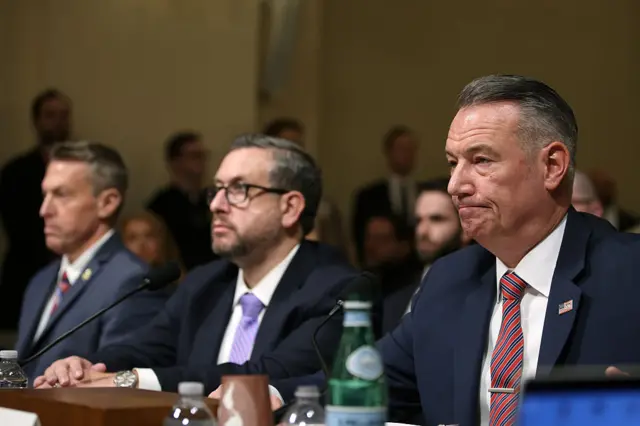
    Three men in suits and ties sit at a desk behind microphonesImage source, Getty Images
    Image caption,

    Todd Lyons, right, gives testimony to the House Homeland Security committee

  20. Has training changed for ICE recruits?published at 16:02 GMT 10 February

    Chairman Garabino now asks Lyons and Scott if their agents are taught the difference between protected protest and unlawfully impeding law enforcement.

    Both say yes, their officers are trained in this distinction.

    Asked about the surge in new recruits for ICE, and if their training remained the same, Lyons says the "meat of the training was never removed" - it is just completed quicker.

    Scott says there has been "no change in the training" of Border Patrol agents, who all must go through a 117-day programme at the department's academy.

    Asked about the use of Tasers and the use of less-lethal force, Lyons says agents are trained in "secondary weapons" which include Tasers, OC spray (commonly known as pepper spray) and the baton, which are made available to all agents.

    Scott says CBP agents are also trained to use these tools.