Summary

  1. Iran warns of imminent 'devastating offensive'published at 02:29 GMT
    Breaking

    We've just got a statement from the Islamic Revolutionary Guard Corps, warning they will attack US bases and Israel.

    "The most devastating offensive operation in the history of the Islamic Republic of Iran's armed forces will begin toward the occupied territories and American terrorist bases in just moments," it says.


  2. Iran state TV: Khamenei was killed in his officepublished at 02:28 GMT

    Ghoncheh Habibiazad
    Senior reporter, BBC Persian

    More details from that statement read out by presenters on state TV channels earlier.

    Iran's Supreme National Security Council said Ayatollah Khamenei was killed early Saturday morning at his office “while he was carrying out tasks”.

    Using satellite imagery, BBC Verify earlier confirmed significant damage to parts of the Leadership House compound, which is Khamenei's office in Tehran.

    The Islamic Revolutionary Guard Corps (IRGC)-affiliated Tasnim News Agency has said that Khamenei’s death at his office is proof that reports that he was hiding out were the “enemy’s psychological warfare”.

  3. How might Khamenei’s successor be chosen?published at 02:21 GMT

    Behrang Tajdin
    BBC Persian

    According to the constitution, Khamenei's successor must be selected by the same body that chose him: the Assembly of Leadership Experts.

    This is a body of 88 clerics that - on paper - are voted in by people once every eight years, but in reality only the clerics most loyal to the Islamic Republic are allowed to stand for it. This is why the majority of the current Assembly members are clerics as hardline as Ayatollah Khamenei.

    The constitution says these clerics must select the new Supreme Leader as soon as possible - but quickly assembling everyone, while Iran is under attack by the United States and Israel, may prove difficult for safety reasons.

    In the meantime, the president, the head of judiciary and a cleric member of the powerful Guardian Council would usually assume the leader's responsibilities.

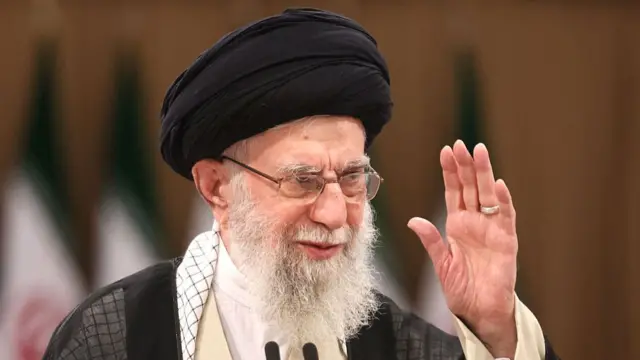
  4. Khamenei, the hard-line cleric in charge of Iran for 37 yearspublished at 02:13 GMT

    Iran's Ayatollah Ali KhameneiImage source, Getty Images

    Born in the north-eastern city of Mashhad in 1939, the son of a religious scholar, Ali Khamenei joined the religious opposition movement of Ayatollah Khomeini in 1962.

    After the Islamic Revolution in 1979, Ali Khamenei became deputy defence minister and helped organise the Islamic Revolution Guard Corps (IRGC).

    When Khomeini died in June 1989, the Assembly of Experts - a council of clerics - chose Ali Khamenei to be the new supreme leader, changing the constitution to allow him to take charge even though he had not achieved the required rank among Shia clerics.

    Ayatollah Khamenei has maintained a firm grip on Iran's politics and its armed forces ever since, suppressing challenges to the ruling system, sometimes violently.

    He also consistently taken hard-line stances on external matters, including the ongoing confrontation with the United States, of whom he remained suspicious. He had also repeatedly called for the elimination of the State of Israel - publicly questioning whether the Holocaust occurred.

    There have been seven presidents of Iran to serve during the rule of Khamenei, who has six children.

  5. Iran state TV: Khamenei's death start of 'uprising in the fight against the oppressors'published at 02:01 GMT

    Ghoncheh Habibiazad
    Senior reporter, BBC Persian

    As we just reported, Iran's state TV has announced 40 days of public mourning and seven days of public holiday over the death of Ali Khamenei, Iran's Supreme Leader.

    At the moment, Iran's state TV news channel IRINN is showing photos of Khamenei with recital of Quran in the background, with a black banner on the top left corner.

    The presenter previously read a statement by Iran's Supreme National Security Council (SNSC) officially confirming the death of Khamenei, blaming the US and Israel for his death. The statement said that Khamenei's "martyrdom" will be the beginning of "an uprising in the fight against the oppressors".

  6. Khamenei's relatives killed in the attacks toopublished at 01:59 GMT

    Earlier, state media said that Khamenei's daughter, son-in-law and grandchild were also killed in the attacks.

    According to the Fars News Agency, which is affiliated with the Islamic Revolutionary Guard Corps, there are reports that one of Khamenei's daughters-in-law has been killed as well.

  7. No mention of successor in announcementpublished at 01:57 GMT

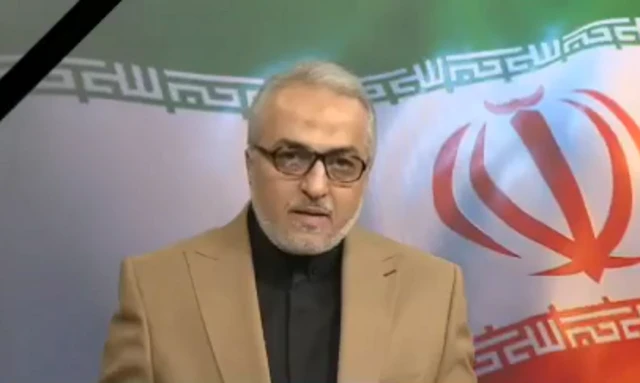
    A man in a tan suit with an Iranian flag in the backgroundImage source, IRINN
    Image caption,

    Several state media announced Khamenei's death at the same time

    With a statement from Iran's Supreme National Security Council, several state media outlets in Iran have confirmed Ayatollah Khamenei's death.

    US President Donald Trump hours earlier said the Supreme Leader had been killed during a joint attack with Israel on several locations across Iran.

    In the statement, there was no mention of how the 86-year-old died, nor of who might take over as leader.

    Our colleagues are working on translating and bringing you the top lines of that address.

  8. Forty days of mourning announced in Iranpublished at 01:42 GMT

    In a tearful address, one state TV presenter announcing Khamenei's death said the country will enter 40 days of mourning.

  9. Iran's Supreme Leader Ali Khamenei has been killed, state TV reportspublished at 01:32 GMT
    Breaking

    Iranian state TV has just confirmed Ayatollah Ali Khamenei is dead.

    We'll bring you more information as it comes.

  10. China envoy to UN warns 'red line' cannot be crossed in strikespublished at 01:17 GMT

    More from the UN Security Council's emergency meeting earlier.

    China's envoy Fu Cong said the country is deeply concerned by strikes on Iran by the US and Israel, expressing concern about reports of civilian casualties.

    He called for an immediate cessation of military action in the region to prevent further escalation.

    "At all times, the red line for protecting civilians in armed conflict must not be crossed, and the indiscriminate use of force is unacceptable," he said, calling on all parties to fulfill their obligations under international law and humanitarian law.

    China is ready to work with the international community to unite efforts to promote peace and stability in the Middle East as soon as possible, he added.

  11. Trump says a diplomatic solution is 'easily' achievablepublished at 01:02 GMT

    Bernd Debusmann Jr
    Traveling with the President

    While the traveling press pool has not seen Donald Trump today, the US President has been busy calling various American networks throughout the course of the day.

    In a call with Bob Costa of CBS - the BBC's US partner - Trump said that the US is "doing well" so far in the strikes, and that a diplomatic solution remains "easily" within reach.

    "Much easier now than it was a day ago, obviously, because they are getting beaten up badly," he added.

    The US has been pressuring Iran to agree to conditions on its nuclear programme, threatening military action when the latest round of talks ended this week without a deal.

    Trump says Iran's Supreme Leader Ali Khamenei has been killed in the attack - though Iranian officials are yet to confirm this. On the call, Trump declined to comment on who he believes is leading Iran.

    However, he said he has "good candidates" in mind he would like to see in charge.

  12. CBS reports 40 Iranian officials killed in strikespublished at 00:38 GMT

    An intelligence source and a military source have told the BBC's media partner, CBS News, that around 40 Iranian officials were killed in the strikes.

    It is unclear if the officials were in one location or multiple.

    They claimed that Iran's supreme leader, Ali Khamenei, was among the dead, as well as the Islamic Revolutionary Guard Corps commander and the defence minister. Iran is yet to confirm widespread reports of Khamenei's death.

  13. Khamenei's daughter and grandchild killed in attacks, state media sayspublished at 00:32 GMT

    Ghoncheh Habibiazad
    Senior reporter, BBC Persian

    Iran Supreme Leader Ali Khamenei's daughter, son-in-law and grandchild have been killed in the attacks, the Fars News Agency - which is affiliated with the Islamic Revolutionary Guard Corps - has said in a report, quoting "informed sources" in the Supreme Leader's office.

    Fars has also reported that "it has been said that one of Khamenei's daughters-in-law has been killed" in the attacks too.

    There had been some reports circulating earlier on the death of Khamenei's daughter-in-law and son-in-law, which were later denied.

    Iranian officials are yet to confirm the death of Iran's Supreme Leader himself.

  14. IDF says it has completed 'another wave of strikes'published at 00:26 GMT

    The Israel Defense Forces (IDF) say they have thwarted dozens of missile launches aimed at Israel and have completed another wave of strikes on ballistic missile and air defence systems in Iran.

    The strikes were aimed at targets in western and central Iran and included several launch sites which had not yet been struck, the IDF said in a statement to the BBC.

    "The completed strikes improve the Israeli Air Force’s freedom of action and prevent numerous launches and missiles that posed a threat to the citizens of the State of Israel and the broader Middle East."

    "[The IDF] continues to degrade the missile array and air defense systems of the Iranian terror regime."

  15. Iran's UN envoy says civilian deaths are a 'war crime'published at 00:06 GMT

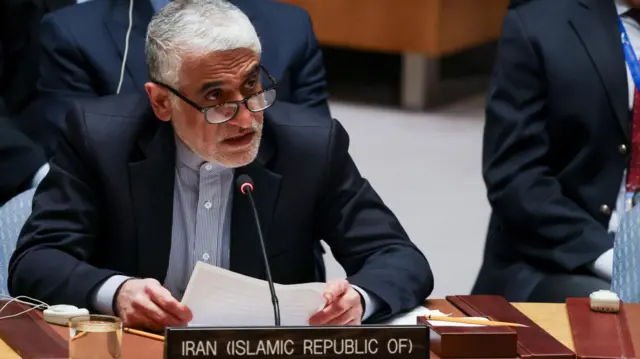
    Iran's Ambassador to the United Nations, Amir-Saeid Iravani holds a paper he is reading from in front of a microphone at a United Nations Security Council meeting after the US and Israel launched strikes on Iran.Image source, Reuters

    Amir Saeid Iravani, Iran's ambassador to the United Nations, says hundreds of people have been killed or injured in the US and Israel's “unprovoked and premeditated aggression against Iran".

    Speaking at the UN's Security Council emergency meeting, he says that includes more than 100 children killed in an explosion at a school in Minab, southern Iran.

    "The number of innocent civilians continues to rise. This is not only an act of aggression, it is a war crime and a crime against humanity," Iravani says.

    There has been no confirmation by the two Western countries of the attack on the school - located near a base of Iran's Revolutionary Guard Corps, which has been the target of the strikes.

  16. Trump to attend Republican fundraiser tonightpublished at 23:41 GMT 28 February

    Bernd Debusmann Jr
    Reporting from West Palm Beach

    The White House travelling press pool, which today includes the BBC, has been told that we won't see or hear from President Trump this evening.

    But that doesn't mean that he is done for the day.

    Just a short while ago, we were informed by White House Press Secretary Karoline Leavitt that Trump still intends to attend a fundraiser being held this evening at Mar-a-Lago for the Republican Party.

    This party, Leavitt added, "is more important than ever".

    We have been pressing the White House for more details on Trump's plans for tomorrow, but have yet to receive any word.

  17. UAE condemns Iranian attackpublished at 23:32 GMT 28 February

    The United Arab Emirates has condemned Iran's attacks on its territory, calling it a "violation of national sovereignty and international law".

    In a post on X, the UAE calls Iran's retaliatory strikes a dangerous escalation and "cowardly act" that threatens the safety of civilians and undermines stability.

    Its defence ministry says it is on "high alert" and ready to deal with any threats.

    It adds that its defence forces have intercepted 137 ballistic missiles and 209 drones launched toward the country. Fourteen of the drones that fell within the country's territories and waters caused "some collateral damage", it says.

  18. Iranian officials have yet to confirm Khamenei's deathpublished at 23:08 GMT 28 February

    Lyse Doucet
    Chief international correspondent

    There has been a swirl of reports on the status of Iran's supreme leader since this morning, when it was clear that his residence had been targeted in the first strikes.

    Satellite images showed significant damage to his compound. The first response from Iran was that he had been taken to a safe place. Then came a report that the 86-year-old cleric was to speak on state television, but nothing materialised.

    By early evening, the Israeli Prime Minister Benjamin Netanyahu in a televised address used an expression that the supreme leader was "gone" - but he didn't say Khamenei was "dead".

    But a series of reports on Israeli and US media, quoting unnamed officials, left no doubt about his fate.

    All the while, Iranian officials have continued to deny it. One presenter on Iranian state television, without mentioning Khamenei's name, told the Iranian people to ignore the "enemy’s psychological propaganda". It is hard to ignore this latest social media post from Donald Trump.

    It may be that Iranian officials are preparing to make an announcement with a certain amount of ceremony. It may be that Iran's Assembly of Experts is already meeting or preparing to do so - they are charged with the responsibility of choosing a new supreme leader.

    These are absolutely defining moments in the turbulent history of the Islamic Republic of Iran, and its hostile relationship with Israel and the US.

  19. Many unanswered questions after Trump's postpublished at 22:52 GMT 28 February

    Bernd Debusmann Jr
    Reporting from West Palm Beach

    Trump's Truth Social post announcing the Ayatollah's death suggests he already sees this as a victory - and perhaps the start of what would be a relatively quick campaign.

    Although he left open the possibility of a lengthier campaign, the week's worth of strikes he mentioned would be shorter than the 12 days of Israeli airstrikes in Iran last year, and far shorter than previous US air campaigns in Iraq in 1991 or Kosovo in 1999.

    There are, however, many unanswered questions.

    For one, Trump has now suggested - more than once - that he sees this as an opportunity for the Iranian people to "take back" the country.

    But he hasn't made clear who exactly he sees running the country if the Islamic Republic in its current form were to fall.

    Trump has previously questioned whether the exiled Crown Prince, Reza Pahlavi, has the support needed to govern.

    For the administration, any long and protracted conflict is likely to have important domestic reverberations, particularly as the president campaigned on a promise of ending long, drawn-out conflicts abroad.

    In the coming days and week, we're likely to hear him and his political allies make the case that this is something different - an example of what he often terms "peace through strength".

  20. Rubio trip to Israel cancelled, state department sayspublished at 22:42 GMT 28 February

    US Secretary of State Marco Rubio will no longer travel to Israel on Monday "due to current circumstances", his office says.

    The state department said yesterday Rubio's was heading to Israel to discuss a range of topics, including Iran.

    "Due to current circumstances, Secretary Rubio will no longer travel to Israel on March 2," a spokesperson says.