Summary

  1. Bank of England holds interest rates while warning Iran war could push inflation to 3.5%published at 14:53 GMT

    Archie Mitchell
    Business reporter

    The Bank of England held interest rates at 3.75% today, confirming that the conflict in Iran had put paid to a previously expected cut.

    The Bank says a “shock to the economy” sparked by the US-Israeli action in the Middle East could push inflation as high as 3.5% this summer, with rate-setters deciding a pause will give them time to consider the scale of the fallout.

    The Bank’s governor, Andrew Bailey, says reopening the Strait of Hormuz is key to bringing stability back to energy prices.

    And he cautions those now predicting interest rate rises against “reaching any strong conclusions”. “The right place to be is on hold,” he tells the BBC’s economics editor Faisal Islam.

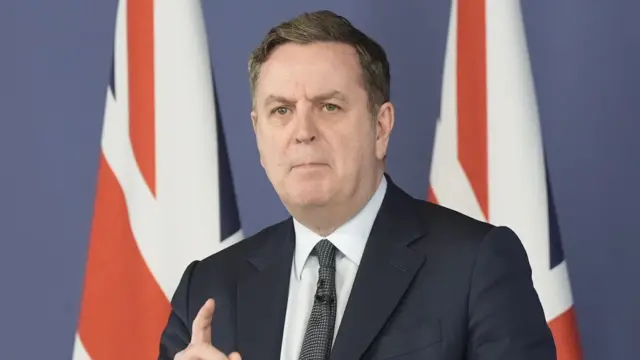
    We are yet to hear from Chancellor Rachel Reeves, but shadow chancellor Sir Mel Stride says the government has left the country exposed to the energy price rises sparked by the war.

    The BBC’s cost of living correspondent Kevin Peachey writes the decision could be good news for savers, but that any gains could be wiped out elsewhere by rising bills and mortgage costs.

    We're ending our live coverage, read the full story here.
  2. BoE deputy would have voted for cut had Iran war not eruptedpublished at 14:20 GMT

    Archie Mitchell
    Business reporter

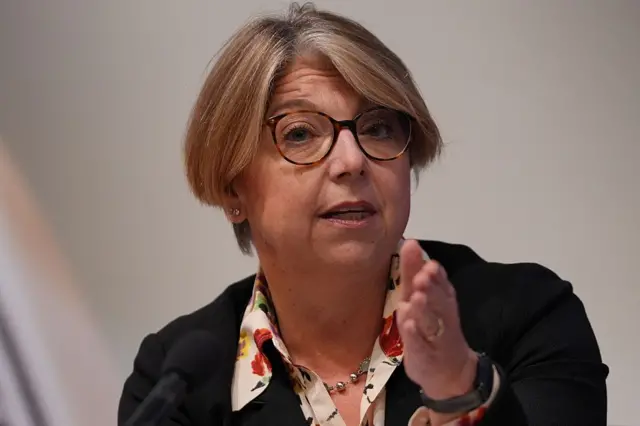
    Sarah Breeden (woman in her 50s, short blonde hair) mid-speech. She's gesturing with her left hand, wearing a black blazer and floral shirtImage source, AFP via Getty Images

    Bank of England deputy governor Sarah Breeden said in Thursday’s meeting that, had the US-Israeli war in Iran not erupted, she "would have expected to vote for a cut again in March”.

    In the end, she voted to keep rates on hold, warning that the conflict will “have a significant, though at this point highly uncertain, impact on inflation”.

    Another deputy governor at the Bank, Dave Ramsden, also said he was planning to vote for a cut before the war broke out.

    Ramsden said the “damaging economic shock resulting from the Middle East conflict has caused me to revisit my policy position”.

    Catherine Mann, who sits on the Bank’s monetary policy committee, went further. She warned that the inflationary shock of the war could be long-lasting.

    Mann added that the balance, in her view, has now shifted away from a potential further cut “towards considering a longer hold, or even a hike at some point to lean against inflation persistence”.

  3. Savers may be scratching their headspublished at 14:01 GMT

    Kevin Peachey
    Cost of living correspondent

    Anyone with savings – especially those who rely on returns as an income – faces a tricky balancing act during these uncertain times.

    On one hand, there is the prospect of the Bank of England’s base rate increasing later this year. That is good news for savers, as it should mean banks and building societies will pay more in interest.

    On the other, the rate of rising prices is expected to accelerate too. So, household bills are likely to be higher, and the spending power of savings already held will be diluted.

    Many savers are also borrowers too. So, individual circumstances will ultimately dictate how they respond.

  4. Analysis

    Bailey cautions 'against reaching any strong conclusions about raising interest rates'published at 13:43 GMT

    Faisal Islam
    Economics editor

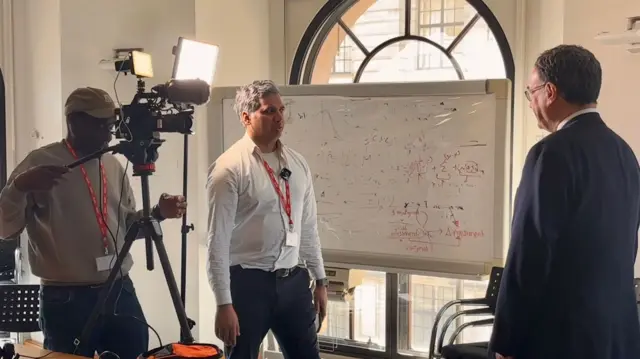
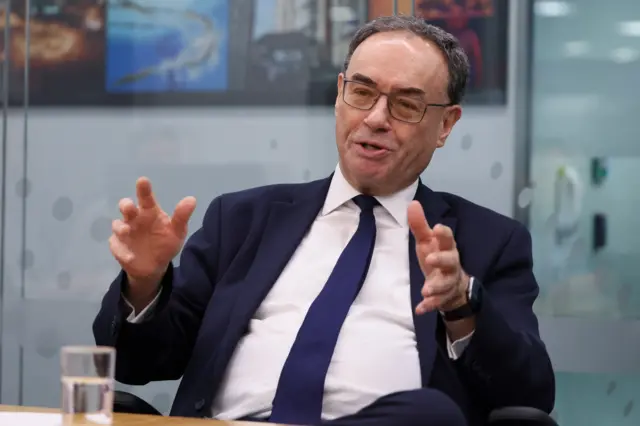
    Media crew, including the BBC's Faisal Islam (C) interviews BoE governor Andrew Bailery (R) in a room inside the bank's building

    I have just been inside the Bank Of England to interview the governor on behalf of broadcasters.

    He made some very interesting comments on the energy shock and impact on interest rates, as well as the row over replacing historical figures on banknotes.

    More detail in a moment, but the bottom line is he suggested that markets were “getting ahead” of themselves in assuming multiple rate rises this year. “I would caution against reaching any strong conclusions about raising interest rates… today we’ve given a very clear message.

    "The right place to be is on hold."

    Bailey said they would look at the extent and severity of the conflict “carefully, continuously”. He also tried to reassure the public that this was not a repeat of the energy shock of 2022 when Russia invaded Ukraine.

    He said rates were already high, and suggested that although inflation would be higher than expected, it would not be as high as the double digit shock suffered four years ago.

  5. The Bank has left interest rates unchanged, so why are mortgage rates rising?published at 13:33 GMT

    Kevin Peachey
    Cost of living correspondent

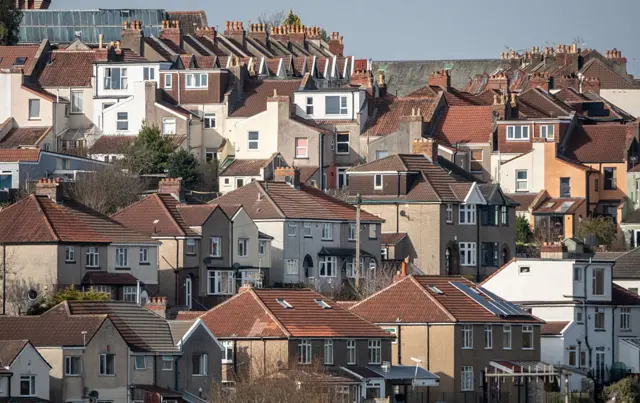
    Wide shot of a residential area of Bristol, several homes with red tile roofing in the foregroundImage source, Getty Images

    It may seem strange that the Bank has held interest rates, but mortgage rates have been rising sharply.

    The reason is that markets, and in turn lenders, think ahead of the game. They price their fixed rate deals based on expectations for the base rate.

    Lenders’ decisions are also influenced by their own funding costs.

    There had been a widespread expectation of cuts to the base rate this year. That is no longer the case. In fact, many analysts are now predicting rate rises this year.

    Hence, the response from lenders is these rather sudden increases to new fixed mortgage rates, hitting those looking to remortgage or buy a home.

  6. How other central banks responded to the Iran crisispublished at 13:21 GMT

    Archie Mitchell
    Business reporter

    The Bank of England is far from alone in proceeding with caution as uncertainty surrounds the US-Israeli war in Iran.

    US Federal Reserve chairman Jerome Powell on Wednesday said it was "too soon" to say how the Iran war would affect the outlook, leaving borrowing rates in the 3.5% to 3.75% range.

    The Bank of Canada also maintained its interest rate at 2.25%, blaming “increased volatility” caused by the war in the Middle East”.

    The Bank of Japan held interest rates at 0.75% earlier today, while in the last few minutes, the European Central Bank confirmed it would hold the rate at 2%.

  7. Why has the Bank of England held interest rates?published at 13:04 GMT

    Archie Mitchell
    Business reporter

    Global energy prices: The Bank says a “significant increase” in global energy and other commodity prices could push up costs for consumers in the UK, prompting it to press pause on any further rate cuts.

    "Second-round effects": On top of this, the summary of its decision warns of “second-round effects” on inflation, through businesses pushing up prices and wages, which also prompted it to proceed with caution.

    Uncertainty over US-Israeli strikes on Iran: Also driving the Bank’s caution is the lack of certainty over how long the US-Israeli war in Iran will last. Even if it is resolved quickly, it will take time for energy supply to return to normal, the Bank says, while the conflict itself may prompt countries to take a more guarded approach to energy supply in future - sustaining higher prices.

    A wait and see approach: Members of the Bank’s rate-setting committee have also wanted to take a wait and see approach to the conflict, agreeing that they would have more information about how the conflict will play out at its next meeting in April.

  8. BoE highlights impact of Strait of Hormuz impasse on interest rates decisionpublished at 12:48 GMT

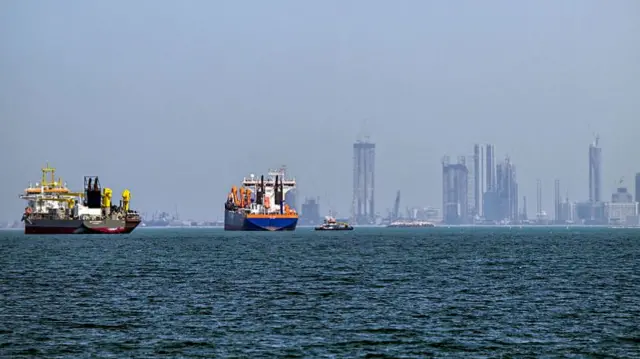
    Tankers in the Strait of HormuzImage source, AFP via Getty Images

    We've been reporting how the war in the Middle East affected the decision made by the Bank of England's Monetary Policy Committee to hold interest rates.

    In the summary of its decision, the Bank highlights the impact of the shipping crisis in the Strait of Hormuz, which Iran has effectively blocked to anyone but its allies.

    Shipping through the Strait, the Bank says, "through which around one-fifth of global oil and liquefied natural gas supply flowed, had almost ground to a halt following some Iranian attacks on vessels attempting transit".

    This has led to a "sharp rise in both the level and volatility of energy prices", as well as upwards pressure on other prices including fertiliser.

    The Bank says this upwards trend has only been "partially offset" by the decision to release oil reserves.

    Instead, the Bank's governor Andrew Bailey says resolving the rise in energy prices "depends on action taken at its source to restore the safe passage of shipping through the Strait of Hormuz."

  9. Lib Dems blame ‘Trump-flation’ for rate holdpublished at 12:37 GMT

    Archie Mitchell
    Business reporter

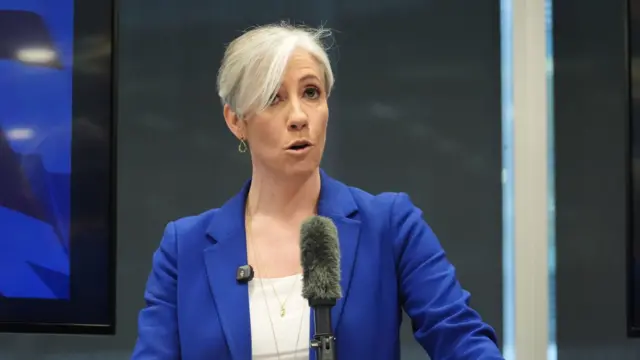
    Lib Dems treasury spokesperson Daisy Cooper (woman in her 40s with short cropped grey hair) speaks on stage, wearing a blue blazer and white shirtImage source, PA Media

    The Liberal Democrats blamed “Trump-flation” for today's interest rate decision, arguing the US president had forced the Bank of England’s hand.

    The party’s Treasury spokesperson, Daisy Cooper, also hit out at Donald Trump’s “cheerleaders” in the UK, saying Kemi Badenoch and Nigel Farage are also to blame.

    “Today, we’re getting more of the same damaging rates that have forced people to shell out for ever higher mortgages,” Cooper says.

    She adds: “People across the country will be tightening their belts as Trump-flation forces the Bank of England into a corner.”

  10. Conflict could push inflation to 3.5%, Bank sayspublished at 12:28 GMT

    Archie Mitchell
    Business reporter

    The conflict in Iran could push inflation as high as 3.5% in July, the Bank of England has said.

    That would be well above the central bank’s 2% target for the rate - which measures how fast prices are rising.

    But it would be nowhere near the 11.1% inflation figure seen in October 2022, when Russia’s full-scale invasion of Ukraine sparked a surge in energy prices.

    Consumers are currently protected by regulator Ofgem’s energy price cap, but when this rises in July, combined with firms passing on their own cost increases, inflation could be pushed to 3.5%, from 3% in January.

  11. Conservatives: ‘Labour has left us vulnerable to shocks’published at 12:23 GMT

    Archie Mitchell
    Business reporter

    Shadow chancellor Mel Stride mid-speech, two UK flags behind himImage source, PA Media

    Reacting to the BoE's interest rates announcement, the Conservatives say the government has left the country vulnerable to shocks such as the conflict in the Middle East.

    Shadow chancellor Sir Mel Stride says that "instead of fixing the roof while the sun is shining, Labour have hiked taxes to a record high and fuelled inflation with reckless spending and borrowing”.

    “Britain is paying the price for Rachel Reeves’ irresponsible choices,” he adds.

  12. BoE govenor says restoring safe shipping in Gulf key to addressing energy pricespublished at 12:18 GMT

    Lucy Hooker
    Business reporter

    BoE governor Andrew Bailey mid-speech whilst sitting on a chair at a wooden table wearing a dark blue suitImage source, Reuters

    The Bank of England “stands ready to act” to keep interest rates at a level that will keep inflation under control, Governor Andrew Bailey says, after the conflict in the Middle East prompted a sea-change in the debate over borrowing costs.

    His comments come as the Bank announced it was leaving rates unchanged in March at 3.75%.

    Unusually, the vote among the nine members of the policy committee that sets rates was unanimous, with all backing the decision to wait and “assess how events unfold”, and touched on the next move being a rise in rates.

    The Bank says prices would rise more quickly as a result of the conflict. It now expects CPI inflation to be close to 3.5% in March.

    “War in the Middle East has pushed up energy prices. You can already see that at the petrol pump and, if it lasts, it will feed into higher household energy bills later in the year,” Bailey says.

    “Monetary policy cannot reverse this shock to supply. Its resolution depends on action taken at its source to restore the safe passage of shipping through the Strait of Hormuz."

  13. Unanimous decision to 'wait and see' amid fears of inflationary spiralpublished at 12:11 GMT

    Faisal Islam
    Economics editor

    Interest rates are on hold, as expected in recent days. The cut which had been expected before the war with Iran is firmly off amid fears of an inflationary spiral.

    It was a unanimous decision to “wait and see” how long and how severe the conflict will be. The evidence of this morning is at the most concerning end of expectations, with exchanges of fire on key pieces of energy infrastructure and a rapid increase in key prices for oil, gas and fuels.

    Some members are acknowledging that they would have argued for a cut before oil and gas prices spiked.

    There was a discussion about whether a protracted price shock could require rate rises in the future.

    The Bank's economists have calculated that inflation could now hit 3.5% in the next few months, having previously expected it to hit the 2% target. That was before this morning's movements which might be more consistent with 4% inflation.

    The next six weeks before the next rate decision at the end of April should help clarify the scale and likely duration of the conflict. In the meantime rates for long term government borrowing and for fixed rate mortgages are already going up.

    Will the next movement be up? It was discussed. It is an active possibility. But it really depends on events in the Gulf. It isn't just wait and see, it’s wait and see if you can see what on earth is happening with this major conflagration conducted via drones, missiles, and social media diplomacy.

  14. Iran conflict will push up inflation, Bank of England warnspublished at 12:07 GMT

    Archie Mitchell
    Business reporter

    Explaining today’s interest rate decision, the Bank of England says the conflict in Iran will cause a “shock to the economy” that will push up inflation in the near term.

    “Conflict in the Middle East has caused a significant increase in global energy and other commodity prices, which will affect households’ fuel and utility prices and have indirect effects via businesses’ costs,” it says.

    It also warned of “second-round effects”, which could be caused by firms hiking prices in response to the war.

  15. What an interest rate hold means for your financespublished at 12:03 GMT

    Kevin Peachey
    Cost of living correspondent

    Rate-setters at the Bank of England have adopted a wait and see approach with a hold in the benchmark rate. Many people may take the same approach with their own finances.

    Before the Iran war, analysts had expected the Bank rate to have been cut this time. The economic impact of the war has changed all that.

    So, borrowing money is not now getting cheaper for individuals. In terms of mortgages, rates on news fixed deals have been rising as lenders reassess the situation and their own funding costs go up.

    For savers, a few better deals have emerged. But, ultimately, caution dominates, so there is not much competition.

    With millions facing the prospect of higher energy prices this summer, experts say it is ever more important to seek guidance, be clear about your own budget, and to make considered decisions.

  16. Bank of England holds interest rates at 3.75%published at 12:00 GMT
    Breaking

    Archie Mitchell
    Business reporter

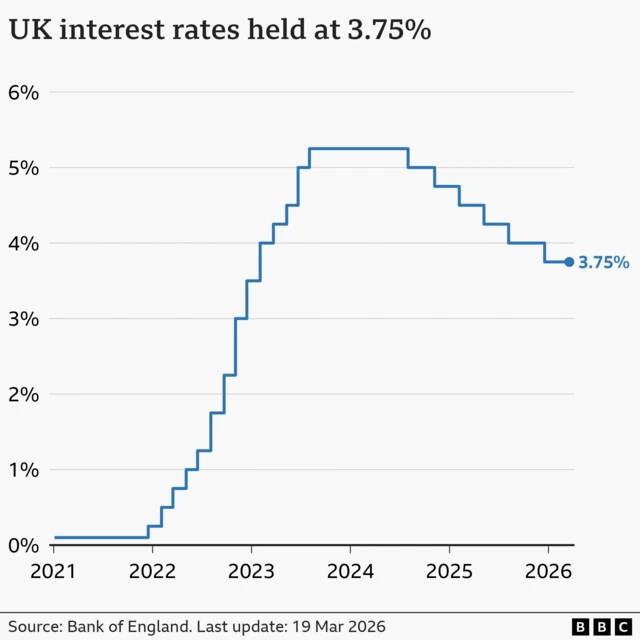
    The Bank of England has voted to hold interest rates at 3.75%.

    This decision was widely expected since war broke out in Iran.

    As recently as February, economists had widely expected further cuts to interest rates this year amid falling inflation.

    But fears the conflict will drive a renewed period of higher inflation in the UK prompted the Bank to put any further cuts on hold.

    A Line chart showing interest rates in the UK from January 2021 to March 2026. At the start of January 2021, rates were at 0.1%. From late-2021, they gradually climbed to a high of 5.25% in August 2023, before being cut to 5% in August 2024, 4.75% in November, 4.5% in February 2025, 4.25% in May, 4% in August, and 3.75% in December. At the Bank of England's latest meeting on 19 March 2026, rates were held at 3.75%.
  17. Interest rates due to be announced shortlypublished at 11:58 GMT

    The Bank of England’s latest interest rate decision is due to be announced in a few moments at 12:00 GMT.

    It is expected the Bank will hold the rate at 3.75%.

    Once we have the announcement, we’ll be bringing you the latest reaction. Our correspondents are also on hand to explain what this means for your money.

  18. Pay grows at slowest rate in more than five yearspublished at 11:55 GMT

    Nick Edser
    Business reporter

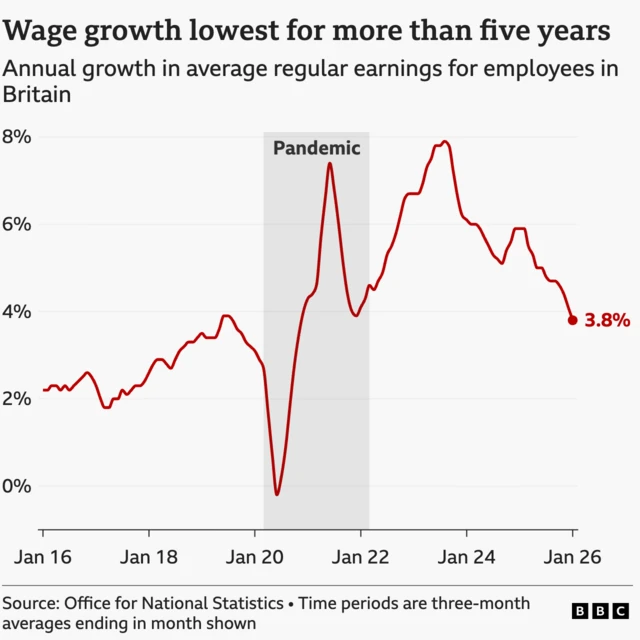
    Before we hear the Bank of England's decision on interest rates at noon, newly-released Office for National Statistics (ONS) figures show pay has grown at its slowest rate in more than five years.

    It's after earnings - excluding bonuses - grew at an annual rate of 3.8% in the November to January period,down from the previous figure of 4.1%.

    The unemployment rate remained unchanged at a near five-year high of 5.2%, the ONS says, but there was a rise in the number of workers on payrolls last month.

    Despite the slowdown in pay growth, wages were still rising faster than the rate of price increases, after inflation fell to 3% in January.

    Other findings from the ONS report showed that the average earnings growth was 5.9% for the public sector and 3.3% for the private sector in the three months to January.

    Meanwhile the number of payrolled employees in February rose by about 20,000 from the previous month, to 30.3 million.

    A line chart titled "Wage growth lowest for more than five years", showing annual growth in average regular earnings for employees in Britain from November to January 2016 to 2026. The rate started at 2.2%, hit a low of -0.2% in mid-2020 in the wake of the Covid-19 pandemic, before rising to 7.4% in mid-2021. It fell again before peaking at 7.9% in August 2023. It then started to gradually fall, reaching 3.8% in November to January 2026, the lowest since September to November 2020. The source is the Office for National Statistics.
  19. Traders predicting Bank of England could raise rates later this yearpublished at 11:49 GMT

    Nick Edser
    Business reporter

    Traders are now predicting the Bank of England could raise rates later this year to 4% from the current level of 3.75%, with September being seen as the most likely month for the move.

    Until a few weeks ago, the Bank was widely expected to cut interest rates twice this year, with the first either at its meeting today or at its next gathering in April.

    However, the outbreak of the US-Israeli war with Iran has upended all of this.

    The jump seen in oil and gas prices since the conflict broke out has raised fears that inflation – which had been easing – will start to pick up again.

    Many analysts think any chance of a rate cut this year has gone, although the weakness of the UK’s jobs market and sluggish economic growth means a rate rise is by no means certain.

    Matt Swannell of the EY Item Club said the bar for raising rates “remains very high”, while Thomas Pugh, chief economist at RSM UK, said he thought “the rate hike now priced in for second half of this year is unlikely, unless inflation goes substantially higher”.

  20. 'People are panic buying mortgages'published at 11:41 GMT

    Adam Woods
    Economics producer

    Mortgage advisor Mark Doughty sitting at a wooden desk with a laptop in front of him. He's looking to his left towards the camera, his hands in front of him with his fingers intertwined. He's in a dark blue shirt, sitting on a black cushioned chair

    Mortgage advisor Mark Doughty says he's been particularly busy over the last few weeks as people scramble to secure a deal.

    "Certainly people are panic buying mortgages," he says from his office in Lincoln.

    "It's causing some uncertainty and understandably we have quite a number of concerned clients who we're now helping through what can be a quite stressful process."

    Mark says lenders are increasing their rates to cope with demand - and in expectation that the Bank of England will hold their main base rate today due to the uncertain situation in the Middle East.

    "We noticed last week that the lender offering the most competitive two-year fixed rate was at 3.9%. Within 24 hours, because demand was exceeding their expectations, that rate went up to 4.2%. A further 24 hours later, demand was still exceeding expectations, and that same lender is now doing a two-year fixed rate at 4.6%."

    But Mark suggests the period of increased mortgage costs will be short-lived.

    "The general consensus is that we are probably going to reach the spike of rates quicker than we did last time. I personally believe that fixed rate deals will peak within the next couple of weeks and then we should move back in a more competitive market and cheaper deals."