Summary

  1. Thank you for joining uspublished at 19:58 GMT 19 March
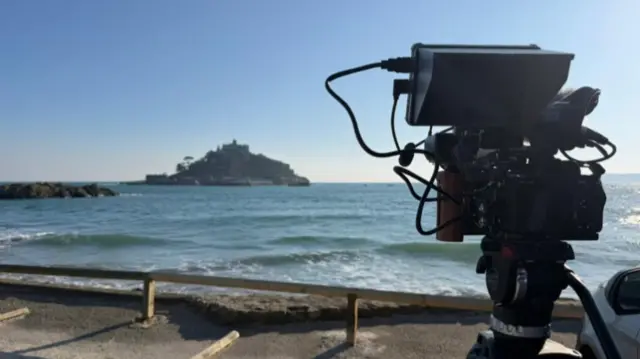
    St Michael's Mount in the distance with a camera on the right.

    We're ending our live BBC South West weather day coverage. We've been speaking to experts and the communities affected by the extreme weather in recent months.

    While some people are starting to rebuild their lives, others are still dealing with the aftermath of the devastating damage.

    Thank you for all of your questions and stay safe.
  2. Pub feels 'hopeful' after storm-hit village damage classed as 'emergency'published at 19:55 GMT 19 March

    Zhara Simpson
    BBC South West

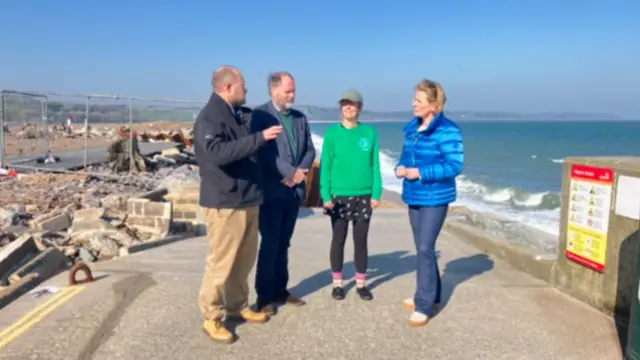
    Three people stood together being interviewed by Victoria Graham.

    Gail Stubbs, from the Start Bay Inn, in Torcross, says she is feeling hopeful now the storm-hit village is being treated as an "emergency".

    "A few weeks ago, we were feeling hopeless," she said.

    "It felt a little bit swept aside earlier on in the year, but we're feeling a little more hopeful."

    She hopes people will see what has happened in Torcross, and it will encourage other authorities and communities to look at mitigations such as planning for the worst rather than "waiting for a disaster to happen".

    She said all buildings around the inn were seriously damaged during the storms in January, but luckily, the pub only suffered damage to its roof, as well as some flooding.

    "We're just crossing our fingers that we'll be able to trade next winter when it'll be our 50th anniversary," Stubbs added.

  3. Your Voice: Your weather questions answeredpublished at 19:51 GMT 19 March

    Yachting weather

    David Braine
    Weather Forecaster

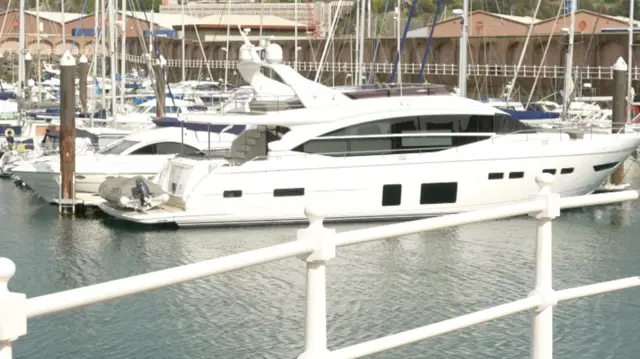
    Yachts moored up at a marina

    Hilary Whitelock, from Devon, asks:

    Quote Message

    We very much appreciate David Braine's input into our local weather forecasts. We have a small sailing yacht and often notice that, most of the time, the wind is much less strong at night. Why is this? Is it because of less convection at night?

    Answer:

    Hi Hilary, there are two things that can reduce wind speed at night, one you have already highlighted whereby the lack of convection (the process whereby the sun warms the land and sea and that warmer air rises), and something called thermal decoupling of the wind.

    This is where the wind speed and behaviour near the ground (surface wind) become separated or "decoupled" from the wind speeds in the atmosphere just above it.

    This occurs when stable, layered air restricts vertical mixing, often leading to very calm conditions near the surface while stronger winds exist higher up.

  4. House 'might not survive another winter' as sea causes it to 'shake for hours'published at 19:42 GMT 19 March

    George Thorpe
    South West

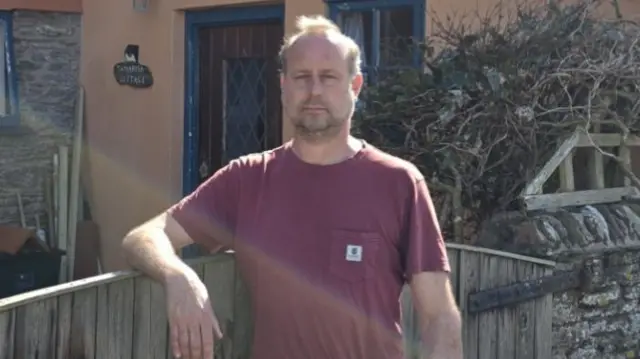
    Matt Searle outside his house in Torcross

    A man who lives in Torcross, Devon, says he fears homes there will not survive another stormy winter unless action is taken soon.

    Matt Searle, whose family have lived in the same house since they built it in 1975, says the building constantly shakes after shingle from in front of the seawall washed away.

    He tells BBC Radio Devon: “Even on a day like today where there’s a light easterly wind, my house will be shaking for five to six hours in the morning either side of high tide.”

    Searle says a solution like installing rock armour in front of the seawall is needed quickly.

    “We want to see the village survive, but unfortunately, unless we find a solution to the problem we’ve got which is a substitute for the shingle that’s gone, then these houses won’t survive," he says.

    “They might not even survive another winter if we have storms like we had this winter.”

    The beach at Torcross

    The Environment Agency says it is urgently progressing work to reduce the risk of waves overtopping.

    It says the obvious technical solution is to install rock armour in front to mitigate the beach loss.

    A spokesperson says: "Although beach lowering has caused significant impact to properties, the sea defences at Torcross are structurally sound.

    "We do appreciate, however, the concern and disruption which property owners have deciding whether to do repairs or wait for defence works.”

  5. Your Voice: Your weather questions answeredpublished at 19:36 GMT 19 March

    Wind gusts

    David Braine
    Weather Forecaster

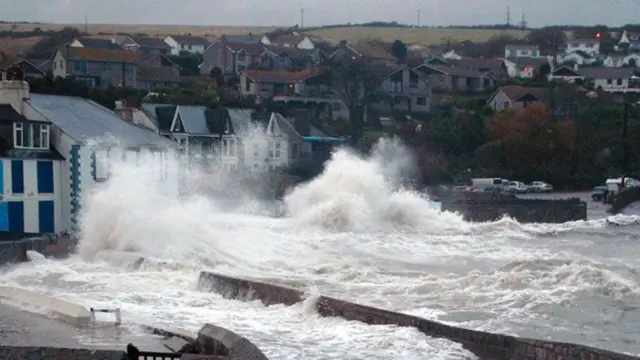
    Waves breaking over the sea wall in Portmellon, CornwallImage source, PA Media

    Hazel Morgan, from Cornwall, asks:

    Quote Message

    What causes wind to gust? Sometimes, lying in bed at night, you can hear a bit of wind but, suddenly, there is a huge gust that you can actually hear approaching, and then it has gone past and you just have the original wind again.

    Answer:

    Hi Hazel, there are a variety and causes of wind gusts in the UK and can be broadly defined into two categories, stronger winds from higher up in the atmosphere being brought down to the surface briefly and the effects of the topography of the land (the surface over which the wind is blowing).

    In the first category, winds higher up above the surface of the ground tend to be stronger than those at the surface. When there is lots of vertical movement of air on weather fronts or in thunderstorms then these stronger winds can be dragged down to the surface briefly by this turbulence.

    In the second category the shape of the land can cause the wind to vary, when it hits a hill it can both accelerate and form an invisible wave in the sky, so often to the lee of high ground, such as Dartmoor, the wind is forced to rise up and over the moor and then coming down the other side it accelerates into a gust.

  6. Storm-hit businesses have shown 'resilience'published at 19:34 GMT 19 March

    George Thorpe
    South West

    Devon County Council leader Julian Brazil

    Devon County Council's leader says it is likely real progress on the A379 repairs between Slapton and Torcross will not be made until next year.

    Speaking to John Acres at Breakfast on BBC Radio Devon, Julian Brazil says businesses in the area had shown "resilience".

    He says the council is sending detailed costings for the road and its repair work, and we will have to wait and see what comes back,.

    Brazil adds: “For things to start moving now, we’re talking about at least 2027, so we’ve got a period of time now where we’ve all just got to work together to make sure we support the businesses in that particular area.”

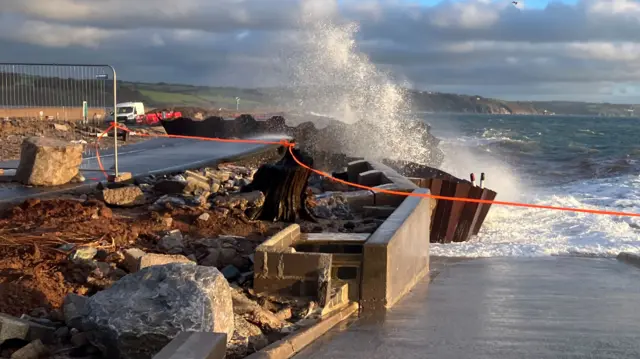
    A wave crashes in from the sea on the partially collapsed A379 in Torcross

    The government says it is providing hundreds of millions of pounds worth of funding for road maintenance projects in Devon.

    “We know the storm damage to the A379 is a big shock to residents in Devon, and we are working with the county council as it determines its next steps," a spokesperson says.

    “We are providing over £443m for roads maintenance in the area over the next four years, along with £667m across the UK into protecting communities from the sea.”

  7. Your Voice: Your weather questions answeredpublished at 19:30 GMT 19 March

    The climate's future

    David Braine
    Weather Forecaster

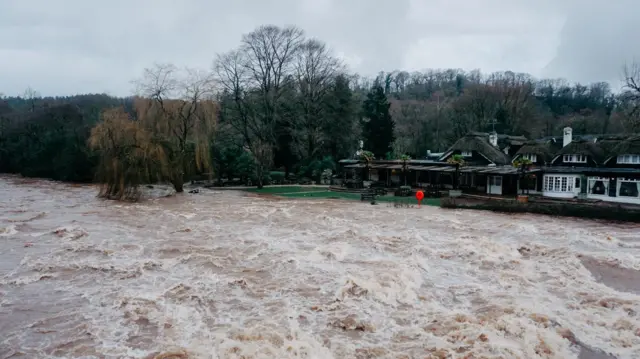
    Flooding in Bickleigh, DevonImage source, Andy P

    Rhys Roberts, from Devon, asks:

    Quote Message

    How warm is our climate going to get in the future?

    Answer:

    Hi Rhys, current predictions of how warm we will get will depend entirely on how greenhouse gas emissions evolve.

    There is a current trajectory which would suggest our climate is projected to become warmer and wetter in winters, while summers will be hotter and drier, with an increased frequency of extreme events like heatwaves, intense rainfall, and droughts.

    By 2070, summer temperatures could be as high as 5C (41F) more than they are now and winter rainfall increased by as much as 40%.

  8. Fallen tree-damaged tennis club repairs needed as 'matter of urgency'published at 19:26 GMT 19 March

    Hattie McCann
    Devon

    JJ Pickin from Exeter City Tennis

    A free community tennis club in Exeter is urging the council to fix fencing around its courts after a tree fell down and broke it.

    The large tree caused damage at Exeter City Tennis' base in Heavitree Pleasure Grounds on 23 January when strong winds hit the city a few days before Storm Chandra.

    Head coach J.J. Pickin says: "Despite the council locking the gate, people are climbing over the fence. It's a matter of urgency that these courts are repaired before someone gets injured."

    Exeter City Council, which own the courts, says it is sorry for the delay to repairs and is working to secure a supplier by the end of this week.

  9. Your Voice: Your weather questions answeredpublished at 19:23 GMT 19 March

    Longer forecasts and career ambitions

    David Braine
    Weather Forecaster

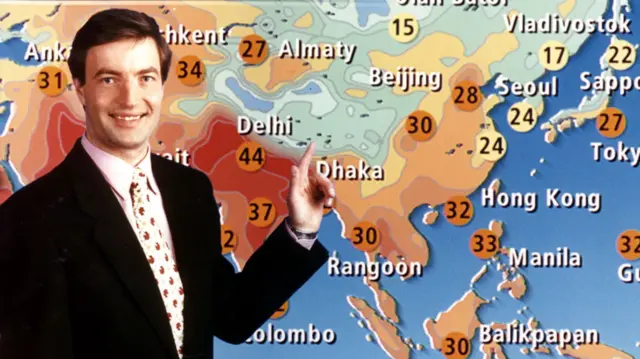
    A younger David Braine points at a weather map of Asia during a forecast

    JJ, from Devon, asks:

    Quote Message

    Why is the 10-day forecast so difficult to get right and did you always want to be a meteorologist?

    Answer:

    Hi JJ, the further away (in time) from a start point of a forecast the less accurate the forecast becomes, often the general theme of the weather in 10 days' time is identified but the timing of rain arriving or clearing and amount of cloud can vary each time the computer model runs, this happens four times a day.

    Advancements in technology and data collection have significantly improved the accuracy of weather forecasts in recent years.

    The availability of high-quality satellite data, improved weather station networks, and more advanced computer models have all contributed to enhancing forecast precision.

    And yes, from an early age I knew that I wanted to study both the sky and the sea, and was delighted to find a university course that did both since my degree is in oceanography and meteorology.

  10. Storm-hit Torcross locals say they are 'on the front line'published at 19:13 GMT 19 March

    Media caption,

    Our environment and tourism correspondent gets the latest in Torcross

  11. Your Voice: Your weather questions answeredpublished at 19:08 GMT 19 March

    Technology

    David Braine
    Weather Forecaster

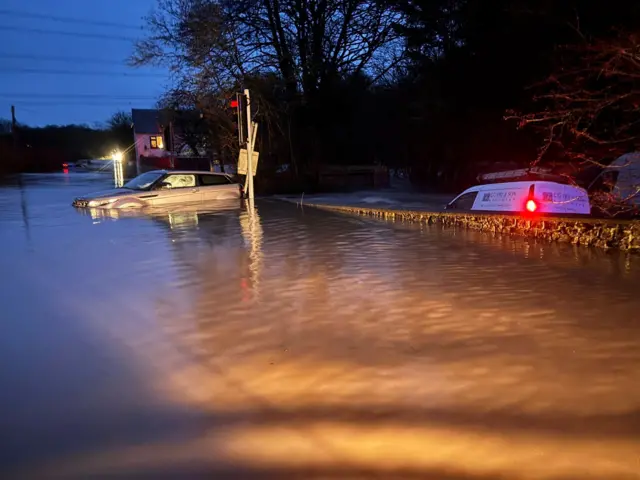
    Two vehicles - a 4x4 and a white van - are submerged in flood water along a road. A house is in the distance.Image source, Axminster Fire Station

    Penny Gerrard, from Cornwall, asks:

    Quote Message

    With the advance in technology why does the forecast keep changing so much? You can go to bed on one forecast and wake up to a completely different one.

    Answer:

    Hi Penny, with a much more frequent and more accurate computer modelling the forecast can change slightly in the short term, e.g. next 24 or 36 hours, this could be due to timing of weather fronts or a better indication of rainfall.

    In the longer term, say 5-10 days ahead, the accuracy is reduced and the model runs may pick up something that was not seen in the previous run.

    As a result you may see on the BBC Weather app a rain symbol for 10 days ahead, then in the morning for the same day that has become a shower.

    Always look at the detail within the day rather than just the one symbol, since the system is set to display the worst weather as a single icon even if it is just a bit of rain at 04:00.

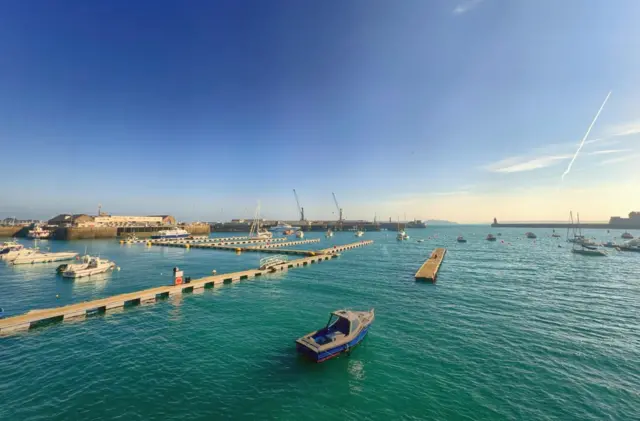
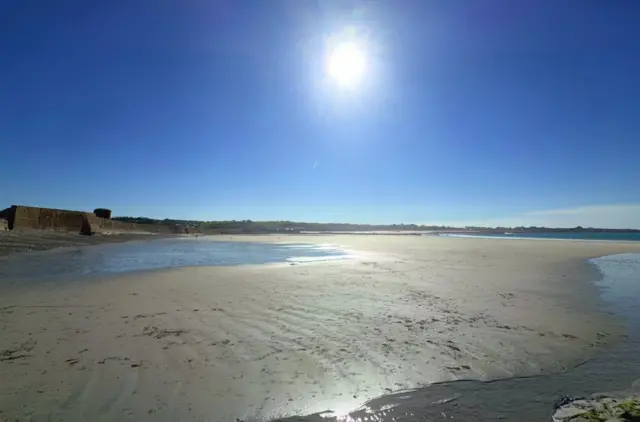
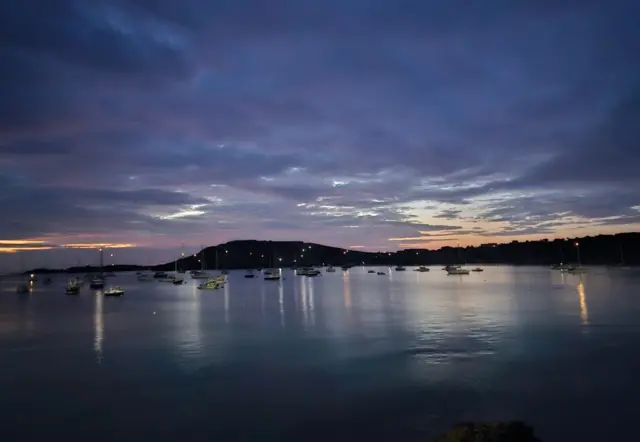
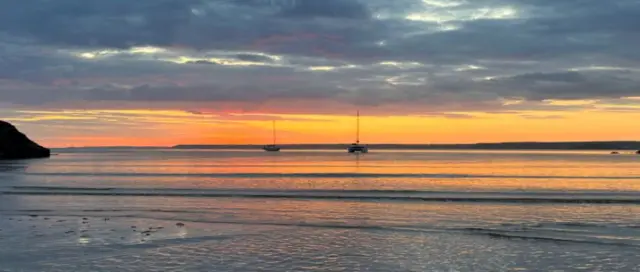
  12. Beautiful couple of days in Guernsey and Alderneypublished at 19:03 GMT 19 March

    BBC Weather Watchers have been snapping away in Guernsey and Alderney this week. Some beautiful scenes in the islands...

    St Peter PortImage source, Chris Cumulus
    GuernseyAImage source, Chris Cumulus
    AlderneyImage source, Ay Couriers
  13. Your Voice: Your weather questions answeredpublished at 18:57 GMT 19 March

    Sailing the seas

    David Braine
    Weather Forecaster

    Two yachts in the sea at Hope Cove in Devon

    Rosie Hinge, from Devon, asks:

    Quote Message

    I have a cruising yacht and it seems to me that the wind strength seems much more volatile now i.e. we see F4 gusting F6 or even F7 at times. Am I correct that this is a new normal? The winds say 10 years ago might have been F4 gusting F5 but not this wide range.

    Answer:

    Hi Rosie, one of the effects of climate change (global warming) is that the atmosphere both at the surface and higher up has more energy due to higher temperatures.

    There is therefore more vertical movement in the air and as a result stronger winds can be brought closer to the surface which is why the wind gust range is larger than perhaps 30-50 years ago.

  14. Your Voice: Your weather questions answeredpublished at 18:49 GMT 19 March

    Tourism and the weather

    David Braine
    Weather Forecaster

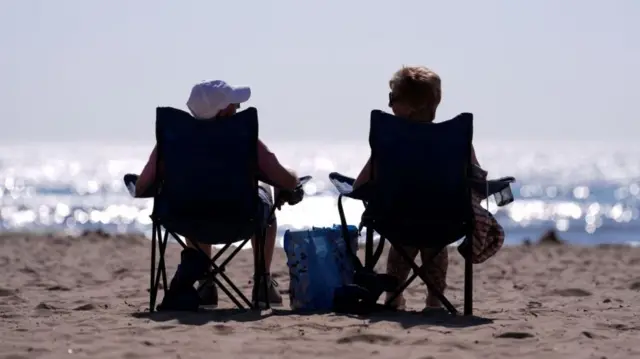
    Two people sat in fold-out camping chairs on a sandy beachImage source, PA Media

    Michael Hunt, from Devon, asks:

    Quote Message

    How much should South West tourism rely on long term forecasts to plan their business models?

    Answer:

    Hi Michael, there are medium and long range forecasts available, these can be found on the BBC Weather website and the Met Office one.

    The further ahead we look the less accurate the forecast becomes so looking one month ahead has a large amount of error, so often you will see a trend forecast without specific detail, such as turning drier or milder.

    Because of our very changeable weather the long term forecasts cannot really be relied upon for tourism, and you will find that most dependable forecast services do not routinely provide any further ahead than one month.

  15. Your weather pictures in Devonpublished at 18:44 GMT 19 March

    While named storms have dominated the early weather of 2026 in Devon, there have been a wide variety of conditions across the county since the start of the year, including snow and bright sunshine.

    Our BBC Weather Watchers have been keeping a close eye on the conditions and have sent us these pictures.

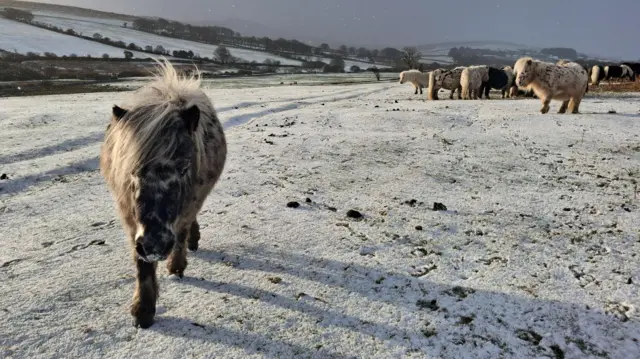
    A pony walks along snowy ground on Dartmoor near Okehampton. Other ponies are stood in the background.Image source, TreeStar/Weather Watchers
    The sun peers through a cloudy sky in Mortehoe.Image source, Letty/Weather Watchers
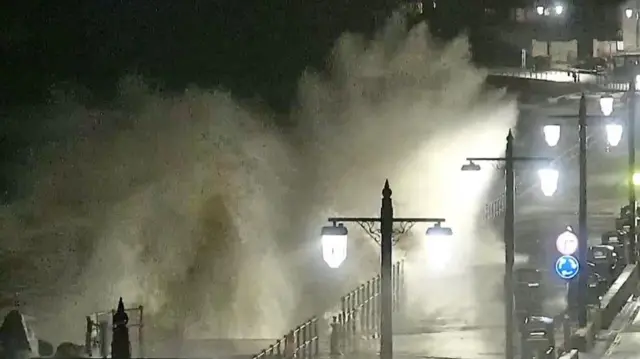
    A wave crashes into the esplanade in SidmouthImage source, Jim/Weather Watchers
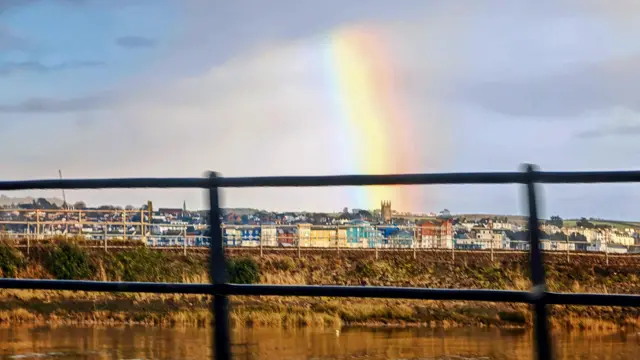
    A rainbow over StarcrossImage source, Tess C/Weather Watchers
  16. Funding of £46m to help improve flood resiliencepublished at 18:35 GMT 19 March

    The government has promised more than £46m to 70 schemes in the South West to help reduce the risk of flooding and coastal erosion.

    The Environment Agency said 49 flood defence facilities and projects in Devon were being awarded a total of just over £35.5m and 21 in Cornwall were set to share about £11m.

    It is part of the government's commitment to a three-year investment of £4.2bn, external to reduce flooding in homes, businesses and local amenities across the UK.

    The new flood funding policy is set to be implemented from 1 April and end in March 2029.

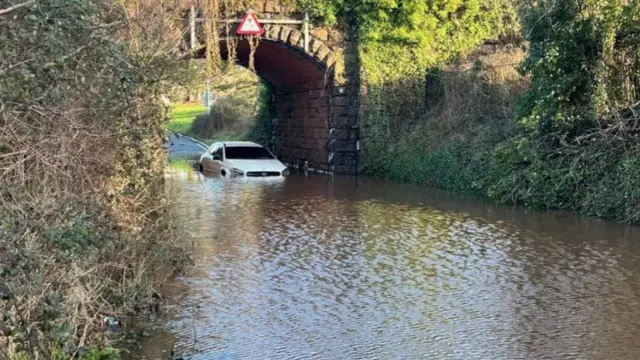
    A white car stuck in floodwater under a brick bridge, with greenery on either side
  17. Your Voice: Your weather questions answeredpublished at 18:32 GMT 19 March

    Flower power

    David Braine
    Weather Forecaster

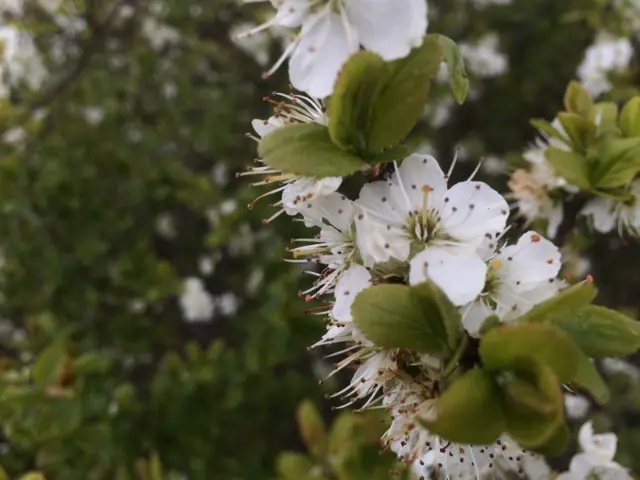
    A blackthorn plant in blossom with white leaves

    John, from Devon, asks:

    Quote Message

    What do you think of the idea that when blackthorns are in flower, we have a cold spell of weather?

    Answer:

    Hi John, there are multiple weather folklore sayings some of which have a basis in science and others do not.

    Some of the very best forecasters are those who farm or fish, out in all weathers and are tuned to the environment in which they work.

    A late uncle of mine was a farmer in Somerset all his life and more often than not he would be more accurate in the short term than most expensive computer models.

  18. Environment Agency 'throwing kitchen sink' at Torcross 'problem'published at 18:28 GMT 19 March

    Zhara Simpson
    BBC South West

    George Arnison looking to the right.

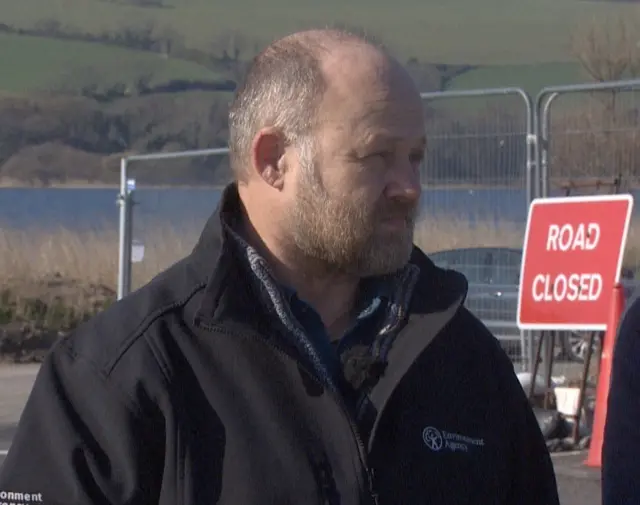
    George Arnison from the Environment Agency (EA) says the company is "throwing the kitchen sink" to fix storm damage at Torcross.

    He said the EA saw this as an emergency and that communities, authorities, and society as a whole were feeling the pressure.

    "We're throwing the kitchen sink at this problem now," he said.

    Arnison says the fundamental problem is the "very sudden and severe loss of the beach" which has left the bottom of the sea defence exposed to the waves.

    "We’re trying to do now is to mitigate from the loss of the beach and replace what used to be beach, now air, with rock armour," he said.

    "We are really trying to do that at pace - ideally before next winter’s storms and that’s a real challenge."

    Discussions are ongoing around finances, but he feels confident there will be a clearer plan soon.

    "Then we’re in a whole world of engineering challenges, how do we work here with inter-tidal conditions, the weather, we have to get rock here from far away.

    "There’s a lot of challenges, but we are doing everything we possibly can to meet that challenge."

  19. Your Voice: Your weather questions answeredpublished at 18:24 GMT 19 March

    Jet streams

    David Braine
    Weather Forecaster

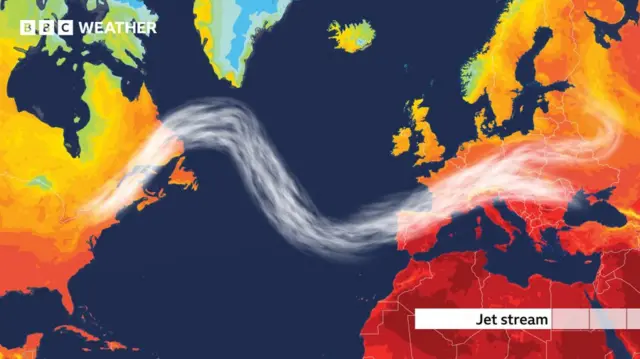
    BBC Weather image of a jet stream from the US to EuropeImage source, BBC Weather

    Peter Fitzgerald, from Cornwall, asks:

    Quote Message

    We believe that most weather watchers know the jet stream affects the UK. Please do show it on the weather map daily.

    Answer:

    Hi Peter, our TV weather broadcasts have different durations depending on when they go out. Some are pre-recorded and others are live. With durations as short as 45 secs it would not be appropriate to spend time showing and talking about the jet stream, but on longer durations we can do this but only if it helps tell the weather story.

    There will be days where the jet stream (a high-altitude ribbon of fast-moving air that significantly influences UK weather by steering low-pressure systems and storms).

    A strong jet stream brings wind and rain, while its position (north or south of the UK) determines whether the weather is mild or cold or unsettled and whether it has an impact.

  20. Storm Goretti fallout sees fallen trees at 40 propertiespublished at 18:09 GMT 19 March

    Tamsin Melville
    BBC South West

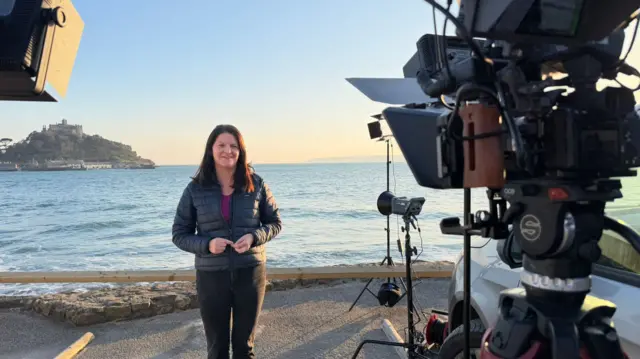
    Tamsin Melville stood in front of a camera with St Michael's Mount in the distance.

    It's been a lovely day here - quite the opposite of what it was like on Thursday 8 January when the government warning went out on people's phones that winds of upwards of 80mph (128km/h) were expected to hit Cornwall during Storm Goretti.

    St Michael's Mount lost 80% - more than 100 - of its trees during that storm.

    Since Storm Goretti tree surgeons have been clearing fallen trees from 40 properties.