Summary

Media caption,

Why are there huge protests going on in Iran?

  1. Iran leader says anti-government protesters are vandals trying to please Trumppublished at 21:20 GMT 9 January
    Jack Grey
    Live reporter

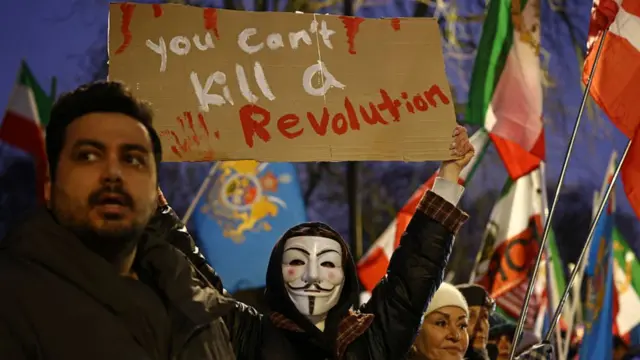
    Protesters outside the Iranian embassy in London holding placardsImage source, Getty Images
    Image caption,

    Demonstrations have been held across Europe, including outside the Iranian embassy in London

    Iran is approaching the end of its 13th day of widespread anti-government protests which have so far seen 48 protesters killed, according to two human rights groups.

    We'll be ending our live coverage shortly - but before we do, here's a quick recap of what's happened today:

    • The Iranian government confirmed that it was responsible for cutting off internet to its citizens – it has now been more than 24 hours since the country was plunged into an internet blackout
    • Earlier, Iran’s Supreme Leader Ayatollah Ali Khamenei dismissed protesters as “vandals” who were just trying "to please the president of the US", as he went on to vow that the government “will not back down”
    • US President Trump has said the US is watching the situation in Iran "carefully" and is prepared to hit Tehran “very hard” if the government “start[s] killing people"
    • Reza Pahlavi, the exiled son of Iran's late former shah, who lives in Washington DC, appealed to Trump to be “prepared to intervene” to help the people of Iran
    • Elsewhere, the UK, Germany and France issued a joint statement raising their concerns over reports of violence by Iranian security forces
    • In the UK, Iranians have been telling us about the anxiety they're experiencing after being disconnected from their loved ones inside the country due to the internet blackout

    We're ending our coverage for today, but you can stay across further updates in our main news story, or unpack the significance of these protests by watching the BBC's chief international correspondent Lyse Doucet on the Global News Podcast., external
  2. Iran is in 'big trouble', Trump says, as he warns US could order strikespublished at 21:11 GMT 9 January

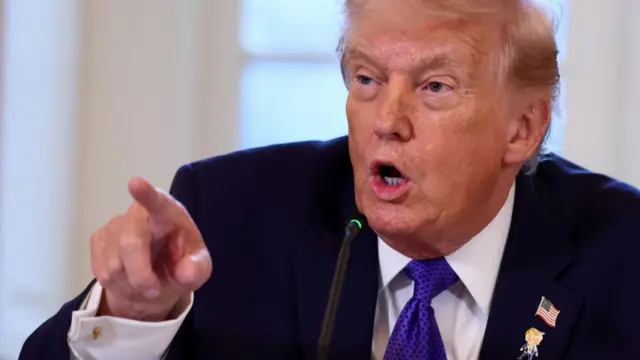
    Donald Trump points at cameras during a q and a with reporters in the Oval OfficeImage source, Reuters

    The US will get involved if Iran starts killing people, Donald Trump has just told reporters in the White House.

    "We will be hitting them very hard where it hurts," he says in a warning, adding that his administration is watching the situation in Iran carefully and that any US involvement does not mean "boots on the ground".

    "Iran's in big trouble," Trump says.

    "It looks to me that the people are taking over certain cities that nobody thought were really possible just a few weeks ago," he says.

    These remarks echo ones the US president made on Thursday, where he pledged to "hit them [Iran] very hard" if they "start killing people".

  3. UK resident hasn't heard from father in Iran for three dayspublished at 20:50 GMT 9 January

    Naomi Clarke
    BBC Newsbeat

    Sam, who grew up in Iran before moving to the UK, tells BBC Newsbeat that he hasn't heard from his father in Iran for the past three days.

    It's an especially "scary" situation, he says, because his grandmother is currently receiving critical care - amid a backdrop of widespread protests and an internet blackout.

    "I don't even know if she's getting better or what even happened to her," he says.

    He says previous protests like this one in Iran "get subdued", sometimes leads to hundreds dead.

    He says he hopes for a different outcome this time.

    “You can't really lose hope," he says. "People are putting themselves in danger for the hopes of maybe a regime change."

  4. Footage of protests emerge after total internet blackoutpublished at 20:48 GMT 9 January

    Ghoncheh Habibiazad and Emma Pengelly
    BBC Persian and BBC Verify

    Images of protests in Iran emerging following internet black out in the countryImage source, X/@AmirMiresmaeili

    In the last couple of hours, we’ve started to see more videos of protests emerging following a day of total internet outage across Iran.

    There are still severe connectivity issues, however, colleagues at BBC Persian and activists say they’re receiving some information and footage from Iranians using Starlink - Elon Musk’s project providing internet services via a network of satellites.

    It’s unclear how many have access to Starlink in Iran, but the Iranian government has officially banned its use.

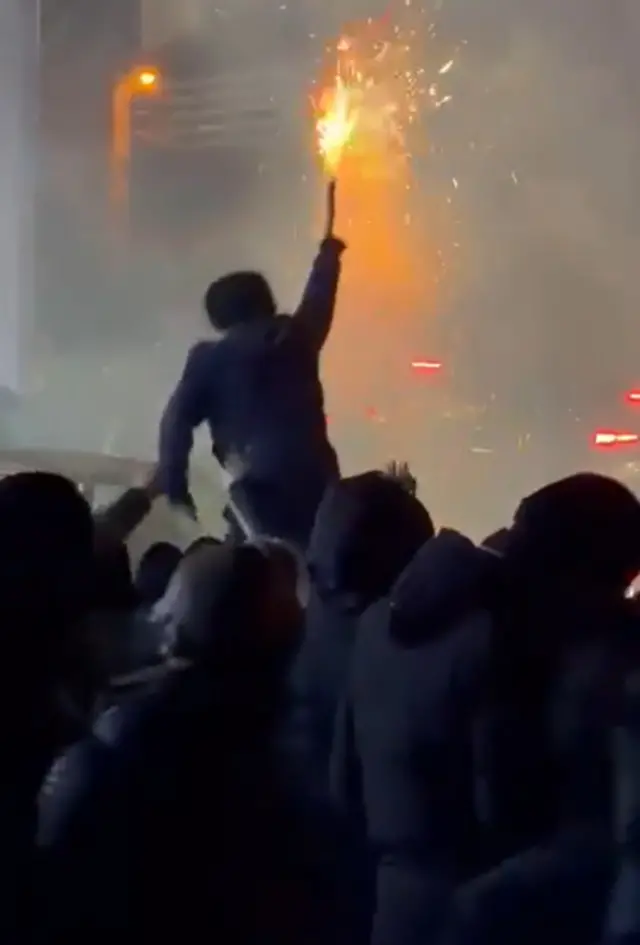
    We’ve verified videos newly circulating this evening showing protests in Tehran.

    In one clip protesters fill a street in the centre of the city while chanting and shouting in favour of pre-1979 Pahlavi monarchy. The person in the video filming says it is 9 January.

    In another, which we’ve confirmed was filmed near a large office building also in the centre of Tehran, someone lights a handheld sparkler and there are claps and cheers.

  5. Reza Pahlavi calls on Iranians around the world to aid global coverage of protestspublished at 20:27 GMT 9 January

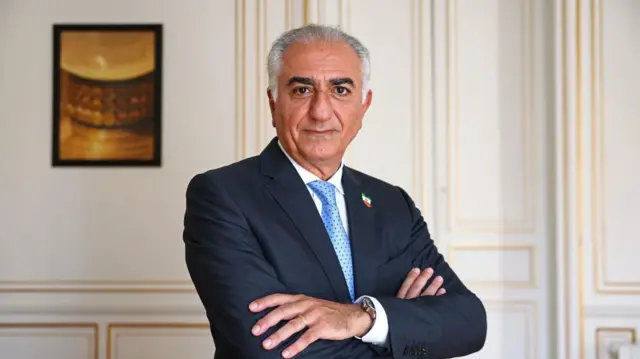
    A man with dark eyebrows and white hair wears a dark suit and fold his arms while looking at the camera.Image source, Reuters

    Reza Pahlavi, the exiled son of Iran's late former shah, is calling on the Iranian diaspora to contact governmental, political and media entities around the world and play a "critical role" in ensuring protesters inside the country aren't forgotten.

    In a video post on X, Pahlavi, who lives in the Washington DC, urges Iranians living in other countries to share information to help the continued media coverage of the protests in Iran.

    "We must not allow this voice to be silenced on the international level," he says.

    "They must know the people of Iran, despite all the limitations placed on them, with remarkable courage, are continuing to fight, and Iranians inside will see you are working alongside them and will be energised."

    Many protesters in Iran have been calling for the return of Reza Pahlavi. You can read more about him here.

  6. Iranian state media brands protesters ‘armed terrorists’published at 20:11 GMT 9 January

    Sarah Jalali
    BBC Monitoring

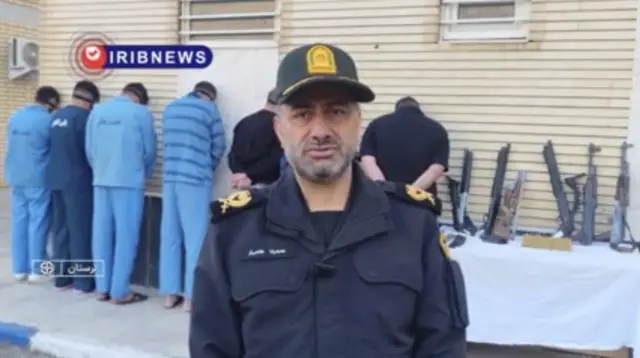
    A government official faces the camera while several blindfolded men face a wall behind him, alongside several stacked firearmsImage source, IRIB
    Image caption,

    A clip from the state broadcaster shows several people arrested and lined up against a wall

    As mass unrest continues to grip the country, Iran’s main state broadcaster appears to be hardening the tone on its Telegram channel against the protesters.

    Up until now, the broadcaster has been referring to those involved as “rioters”, but some reports today have branded them as “armed terrorists”.

    Several posts on its Telegram channel contain footage of violent armed clashes and interviews with the family members of security personnel reportedly killed. Other posts accused the “armed terrorists” of “martyring” children.

    This shift in rhetoric comes amid the second night of a nationwide internet blackout.

    However, the state broadcaster is not reporting the civilian deaths reportedly caused by security forces. According to two human rights groups, at least 48 civilians have been killed since demonstrations began on 28 December.

  7. UK, Germany and France 'strongly condemn the killing' of protesterspublished at 19:49 GMT 9 January

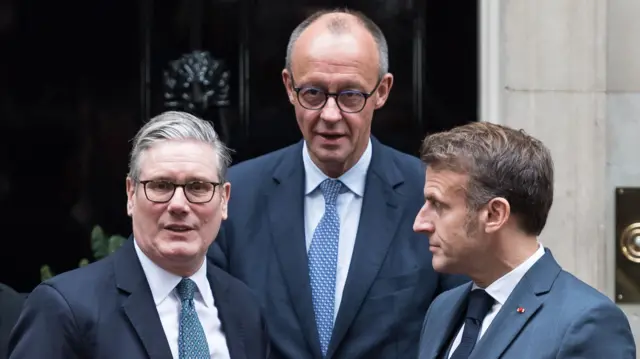
    British Prime Minister Sir Keir Starmer, President of France Emmanuel Macron and German Chancellor Friedrich Merz standing outside 10 Downing Street after a meeting in London with President of Ukraine Volodymyr ZelenskyyImage source, Getty Images

    In a joint statement, the leaders of the UK, Germany and France say they are "deeply concerned about reports of violence by Iranian security forces, and strongly condemn the killing of protestors".

    "The Iranian authorities have the responsibility to protect their own population and must allow for the freedom of expression and peaceful assembly without fear of reprisal," French President Emmanuel Macron, UK Prime Minister Keir Starmer and German Chancellor Friedrich Merz say.

    "We urge the Iranian authorities to exercise restraint, to refrain from violence, and to uphold the fundamental rights of Iran's citizens."

  8. Protests bring back memories of mother killed by regime, says Iranian that fled to UKpublished at 19:24 GMT 9 January

    Reha Kansara
    News Reporter

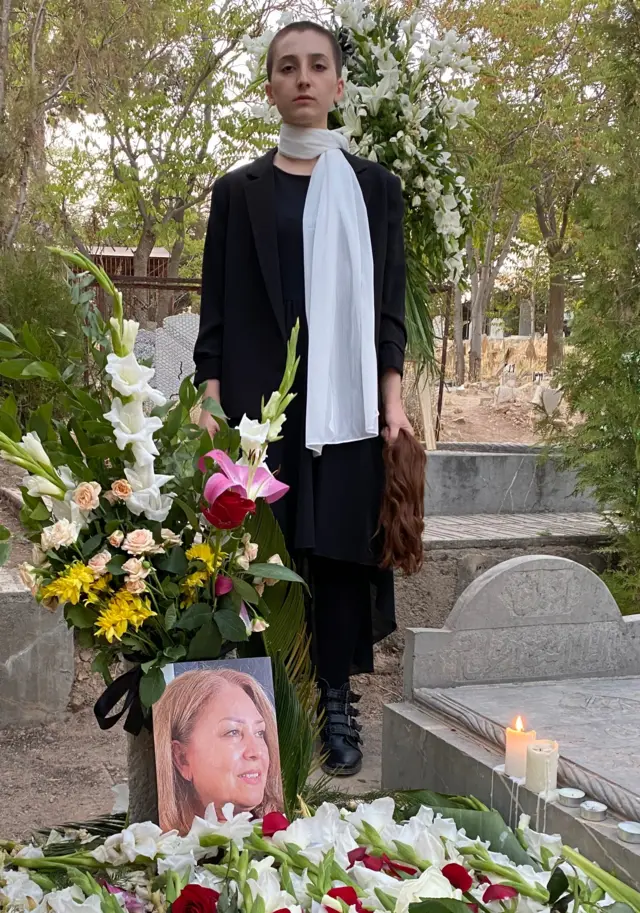
    For Roya Piraei, this wave of protests is a difficult reminder of her mother, Minoo Majidi, who she says was shot dead by the Iranian authorities during the Woman Life Freedom protests in 2022.

    Roya, 28, fled to the UK with her family after an image she posted on social media showing her standing over her mother’s grave with a shaved head went viral.

    “We are living those days again”, she tells me. But despite the grief, Roya is hopeful.

    “These uprisings are continuous, and they are attached together. We still have the same goal. We still want freedom.”

    Roya Piraei poses next to her mother's grave. She has a shaved head and wears a white shirt and black trousers. in her hand she grips what looks to be the hair she shaved off. white lilies cover the grave, and a photo of Minoo, her mother, can be seen.Image source, Roya Piraei
    Image caption,

    Roya's photo at her mother's grave went viral

  9. Eyewitnesses describe receiving text messages warning against protest attendancepublished at 18:59 GMT 9 January

    Sarah Namjoo
    BBC Persian

    We have received the first few pieces of footage from Tehran tonight. Videos show people on the streets of the capital chanting anti-government slogans.

    With the internet down, the flow of footage is more limited than last night so far.

    We have heard from people inside the country that they are receiving threatening text messages on their mobile phones from the IRGC and the police, warning them not to attend protests.

    An eyewitness at a hospital in southern Iran says that some people have been shot in the head, and that many injured protesters have been admitted for treatment.

  10. Video appears to show injured protesters in Fardis, Karajpublished at 18:38 GMT 9 January

    Farzad Seifikaran
    Senior Journalist Reporter, BBC Persian Forensic

    Based on reports and information received by BBC Persian from various cities, the level of violence during nationwide protests last night was very high.

    As a result, a large number of protesters were injured and killed after being shot by security forces. Two videos have been received by the BBC which are said to be related to last night’s protests in Fardis, Karaj.

    Both videos were filmed by the same person. The voice of the person filming can be heard saying:

    “Today is 18 Dey, Fardis. Look what they did to people. At 9pm they killed people with live ammunition.”

    Our checks show that the video has not previously been published online and relates to events from last night in Iran.

    However, at this stage, we are not able to verify all of its details. In the two videos, around eight to ten people can be seen lying on the ground with severe bleeding. The footage appears to have been filmed in an enclosed area resembling a parking lot, with several vehicles visible, including cars similar to Peugeot and Tiba models.

    It is not clear whether these individuals were injured at the same location or were taken there after being wounded. We are continuing efforts to gather more information about this incident.

    However, videos showing protests and gunfire in Fardis, Karaj, circulated last night and we have been able to verify them. Two of the videos were filmed on Shohada Boulevard in Fardis and show a large crowd.

  11. Iran's security bodies toughen warnings of ‘no leniency’published at 18:13 GMT 9 January

    Soroush Negahdari
    BBC Monitoring

    Iranian security and judicial authorities have issued a series of coordinated warnings, hardening their rhetoric and echoing an earlier message of “no leniency” by Iran’s top security body, the Supreme National Security Council (SNSC).

    Iran’s National Security Council - responsible for domestic security and not to be confused with the SNSC - said “decisive and necessary legal action will be taken” against protesters, which it described as “armed vandals” and “disruptors peace and security”.

    In a brief statement, it warned against “any form of attack on military, law-enforcement, or governmental facilities”. The intelligence arm of Iran’s Islamic Revolution Guard Corps (IRGC) similarly warned that it will not tolerate what it described as “terrorist acts”, asserting that it would continue its operations “until the complete defeat of the enemy’s plan”.

    The IRGC intelligence arm said the continuation of unrest is “unacceptable”, adding that “the blood of those who lost their lives in recent terrorist incidents lies with those who planned them”.

    Iran’s Law Enforcement Command similarly referred to a “firm decision” by the security forces to “show no leniency”. It alleged presence of “terrorist groups and armed individuals” in some areas and warned about “staged killings” - a term used by state media to deny responsibility for deaths during unrest.

    One of the strongest warnings came from Tehran’s prosecutor, Ali Salehi, who said the judiciary would charge armed protesters with death sentences.

    He asserted that those damaging public property or clashing with security forces, if carrying any cold or hot weapons, would face charges of “Moharebeh” (waging war against God) - an offence punishable by death and used in previous rounds of protests to issue death penalties for some alleged armed protesters.

  12. Iranian government confirms that it shut off nation's internetpublished at 17:58 GMT 9 January

    The Iranian government has confirmed it enacted an internet blackout following widespread anti-government protests broke out across the country.

    The government's ministry of communication says the decision was made by the "security authorities" due to the "prevailing conditions in the country".

  13. At least 48 protesters killed, human rights groups saypublished at 17:43 GMT 9 January

    The US-based Human Rights Activist News Agency (HRANA) is reporting that at least 48 protesters and 14 security personnel have been killed since the demonstrations began on 28 December.

    Separately, Norway-based NGO Iran Human Rights has counted at least 51 protesters killed, including nine children.

    Most international news organisations, including the BBC, are barred from reporting inside Iran, which means that social media is needed to verify casualties. However, the internet has been almost completely shut down since Thursday night.

    BBC Persian has so far confirmed the deaths and identities of 22 people. Iranian authorities have so far confirmed the deaths of six security personnel.

  14. Internet blackout means 'rhetoric of regime' filtering throughpublished at 17:29 GMT 9 January

    Rachel Hagan
    World Service reporter

    Speaking to the World Service’s Outside Source, BBC Persian anchor Parizad Nobakht describes an almost total information blackout inside Iran.

    “The internet is down, mobile phones are down, and we’re hearing that even normal phone lines are down,” she says, making it “extremely hard” to verify what is happening on the ground.

    As a result, she says, much of what is filtering through is “just the rhetoric of the regime”.

    Some footage is still emerging, she explains, likely because a small number of people retain access to Starlink satellite internet.

    But the challenges go far beyond technical restrictions.

    “It’s extremely complicated,” Nobakht says, explaining that many journalists abroad have families who have been directly targeted by the Iranian authorities.

    “Many of us have family members who’ve been interrogated at least once. Many people’s family members have been arrested.”

  15. Khamenei remains active on X as most Iranians unable to use internetpublished at 17:17 GMT 9 January

    Ghoncheh Habibiazad
    Senior reporter, BBC Persian

    Major social media platforms, including Telegram, X, Facebook and Instagram, are officially blocked in Iran, though many users access them via virtual private networks (VPNs).

    Despite the internet outage, the official account of Supreme Leader Ayatollah Ali Khamenei in English on X has been active today, reposting his speech in which he accused US President Donald Trump of having “Iranian blood” on his “hands”.

    Back in November, a new location feature on X revealed that many Iranian officials and media figures were accessing the banned platform without proxy servers or VPNs.

    This reignited discussions over the existence of a “tiered internet” in the country.

    Officials, a wide range of journalists and some academics appear to have been granted access to the so-called “white”, or unrestricted, internet.

    Government’s spokeswoman Fatemeh Mohajerani later confirmed this unrestricted internet access in December.

  16. Statements may indicate security forces could crack down on protesterspublished at 17:03 GMT 9 January

    Kasra Naji
    BBC Persian

    Meanwhile, the Revolutionary Guard has issued a statement saying it will not tolerate the continuation of the current situation in the country.

    Earlier, the Supreme Leader said his government would not back down from dealing with what he calls mischief-makers bent on causing destruction in the country.

    These statements may indicate that the security forces, stretched thin across the country, are planning to crack down on protesters.

    Iranian state television has been warning parents about the dangers of allowing their children to join the protests, saying terrorists may target them.

    Last night, Tehran and many towns and cities across the country were the scene of huge protests - posing the biggest challenge to the regime since its inception in the wake of the 1979 revolution.

  17. ATMs and debit cards not working due to internet blackoutpublished at 16:52 GMT 9 January

    Kasra Naji
    BBC Persian

    The cutting off of the internet in Iran has led to a near-total blackout of news about the unrest sweeping across the country.

    Only a few videos have been posted today from Zahedan in the east of the country, showing protesters facing off against security forces, with the sound of gunfire in the background. Another from Mashhad, the second biggest city in Iran shows a burnt out government building.

    One person who has been able to send a message to the BBC says he is in Shiraz, in southern Iran, where he reports a run on supermarkets by residents trying to stock up on food and other essentials, expecting worse days to come.

    The shutdown of the internet has meant that ATMs are not working, and there is no way to access cash to pay for purchases in shops where debit cards cannot be used due to the lack of internet.

  18. Iran passes 24-hour mark without internetpublished at 16:41 GMT 9 January

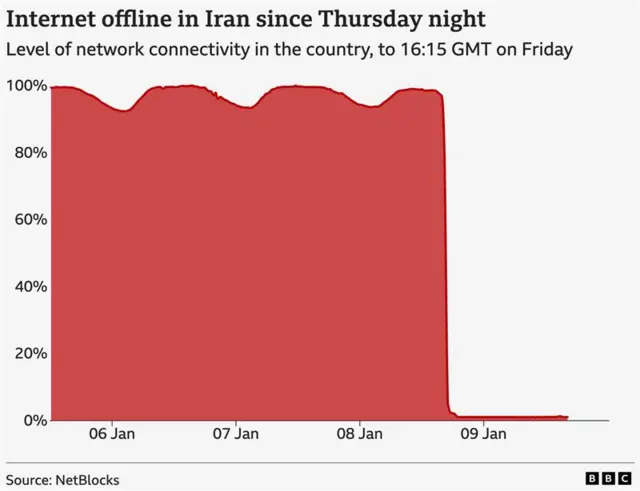
    Internet tracking agency NetBlocks says it has now been 24 hours since Iran implemented a nationwide internet shutdown.

    It says its data shows that internet connectivity across the nation has flat-lined at just 1% of usual levels.

    a graph shows near-zero internet access in Iran for 24-hours
  19. Watch: BBC Verify tracks protests across Iranpublished at 16:27 GMT 9 January

    Protests in Iran have entered their 13th day. Throughout the growing unrest, BBC Verify and BBC Persian have been working together to verify content coming out of the country.

    More than 100 videos of anti-government demonstrations in more than 50 towns and cities have been analysed by the BBC.

    As a reminder, the BBC and other international news organisations are barred from reporting inside Iran, so social media is relied upon to verify what is happening on the ground.

    Media caption,

    BBC Verify tracks protests across Iran

  20. 'I've been cut off from family in Iran since internet blackout'published at 16:14 GMT 9 January

    Reha Kansara
    News Reporter

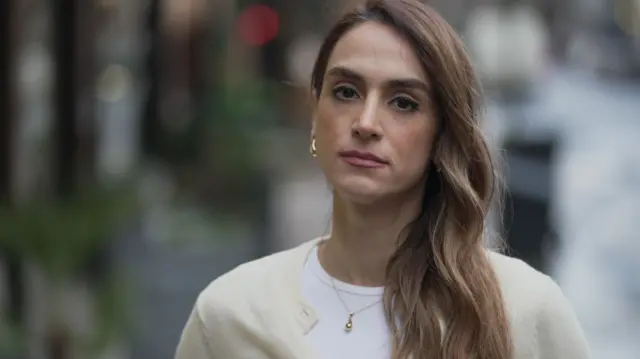
    Mahsa Alimardani on London street, with long brown hair looking into the lens of the camera

    I’ve just met with Mahsa Alimardani at an Iranian restaurant in central London.

    She tells me it’s been a “constant blackout” since she last spoke with her family in Iran yesterday evening.

    “The messages on WhatsApp still just have one check mark. They haven’t delivered yet.”

    Mahsa, who works for the human rights NGO Witness, says that when she last spoke to her family she tried to make sure they had enough medicine and food - as it was unclear if and how circumstances would intensify.

    “It’s very anxiety inducing, not having access to information, not knowing if your loved ones participated [in the protests] or if they're okay,” she says.

    “But for those of us who are outside of Iran, we are physically safe and privileged but our hearts are in Iran."