Summary

  1. AstraZeneca announces $15bn investment in Chinapublished at 10:09 GMT
    Breaking

    AstraZeneca, which is headquartered in the UK, has just announced it will invest $15bn in China until 2030.

    The pharmaceutical company says the investment will be used to expand medicines, manufacturing and research and development.

    In a press release from AstraZeneca, Prime Minister Keir Starmer says the company's "expansion and leadership in China will help the British manufacturer continue to grow - supporting thousands of UK jobs".

    We'll have more detail on this deal in the next post.
  2. China has become 'technology superpower' since UK's last visit - former diplomatpublished at 09:50 GMT

    Let's bring you some more reaction now to Starmer's visit to China.

    Kerry Brown, a former first secretary at the British Embassy in Beijing, says that China has become a "technology superpower" since 2018 - the last time a British prime minister visited the country.

    He tells BBC Radio 4's Today programme that Beijing is "way ahead" in the fields of AI, quantum computing and pharma, adding that "China is now really important" in areas that matter to the UK such as cancer treatment and environmental science.

    Brown adds that he hopes Starmer's visit "creates a framework" for the UK to "engage with that story rather than shaking our heads and saying no".

  3. Could Brits soon be travelling to China without a visa?published at 09:35 GMT

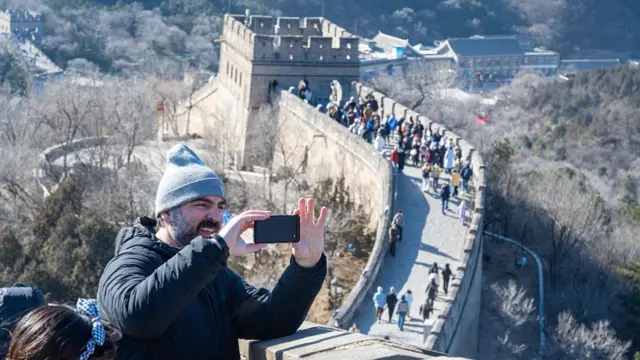
    Tourist taking picture on top of the Great Wall of ChinaImage source, Getty Images

    Currently, British passport holders need a visa to enter mainland China.

    But President Xi today announced that China would "actively consider" implementing unilateral visa-free entry for UK citizens.

    Since 2023, Beijing has dropped visa requirements for a growing number of countries including France, Germany and Spain.

    Citizens of these countries can travel to China without a visa for business or tourism for a maximum of 30 days.

    Hundreds of thousands of Brits could potentially benefit from a change to the current rules - 620,000 travelled to China in 2024, according to the Office for National Statistics.

  4. UK and China want 'open co-operation', Chinese premier sayspublished at 09:23 GMT

    Chris Mason
    Political editor, travelling with Starmer

    Chinese Premier Li Qiang and Prime Minister Keir Starmer during a welcome ceremony at the Great Hall of the People in BeijingImage source, PA Media

    Chinese Premier Li Qian said the people of the UK and China wanted “open co-operation” between their countries.

    At the start of his meeting with Keir Starmer, Li told the prime minister that his efforts to improve relations had been “widely welcomed” in both countries.

    He said this showed that “open co-operation and mutual benefit is what the people want. It also serves the shared interests of us both.”

    He added: “The more we are in a changing world, the more valuable such stability is.”

    Starmer said he wanted “to find ways to work together in a manner which is fit for these times".

    “This means being more open and frank, to deal directly with differences, and it also means recognising and respecting modern China in all its vastness and complexity, for everything it has achieved and as a power whose fortunes directly affect the United Kingdom," Starmer added.

  5. Starmer receives ceremonial welcome at Beijing's Great Hall of the Peoplepublished at 09:20 GMT

    Chris Mason
    Political editor, travelling with Starmer

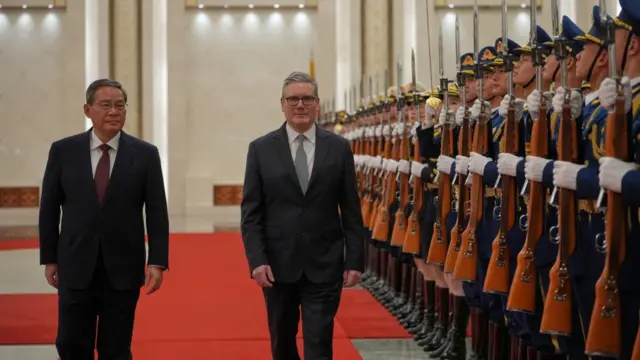
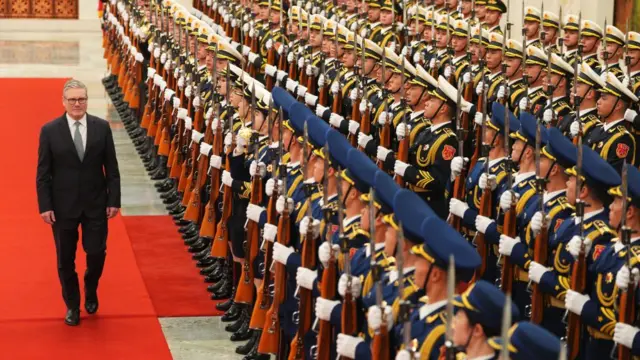
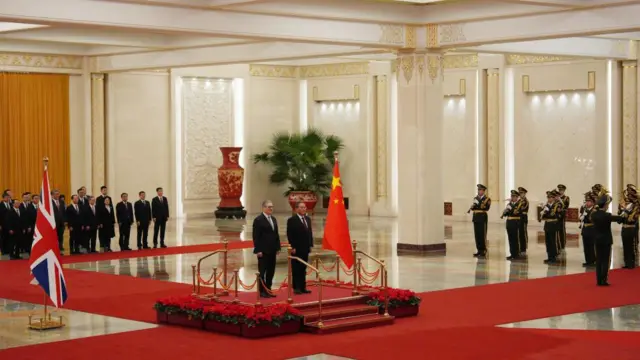
    Sir Keir Starmer has received a ceremonial welcome at Beijing’s Great Hall of the People ahead of his meeting with Chinese Premier Li Qian.

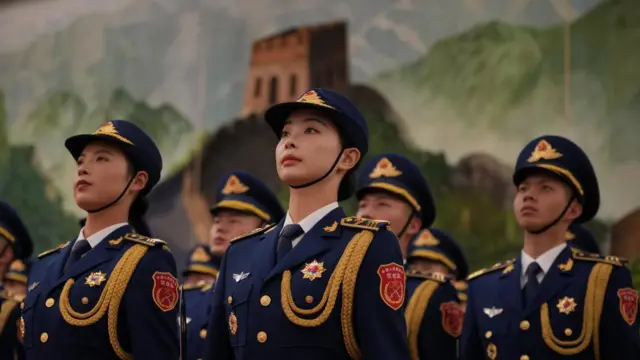
    A military band played God Save The King and the Chinese national anthem, March of the Volunteers, before the two men inspected an honour guard of around 140 troops from the Chinese army, navy and air force.

    Starmer walks past lines of uniformed soldiersImage source, PA Media
    Starmer and Qiang stand on a platform on a red carpetImage source, PA Media
    Chinese honour guard dressed in blue uniforms with gold trimmingsImage source, PA Media
  6. Prosperity at home linked to engagement with world's biggest powers - PMpublished at 09:16 GMT

    Downing Street has released its readout of the meeting between Keir Starmer and Chinese leader Xi Jinping.

    A No 10 spokesperson said the two leaders "affirmed their shared commitment to building a consistent, long-term, and strategic partnership that will benefit both countries".

    They agreed to co-operate further in areas of mutual interest "while maintaining frank and open dialogue on areas of disagreement", the spokesperson said.

    The readout adds that the prime minister raised areas of concern to the UK, but noted that Starmer hopes the visit will forge new partnerships and unlock new opportunities for British businesses.

    It quotes the prime minister as saying: "Growth and prosperity at home is directly linked to our engagement with the world’s biggest powers abroad."

  7. Shadow minister 'aghast' at PM's China remarkspublished at 08:57 GMT

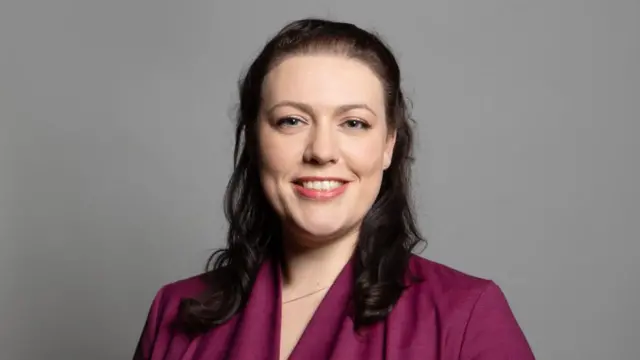
    Conservative MP Alicia Kearns, a shadow home office minister and former chair of the foreign affairs committee of MPs, tells the BBC she is "aghast" at Starmer's comments this morning and "shocked by his tone".

    Speaking to BBC 5 Live Breakfast, she lists a string of tensions between China and the UK, including cyber-threats and the case of Jimmy Lai who she says is "wrongly imprisoned".

    "He [Starmer] should not have gone to China without a precondition that Jimmy Lai would be coming home with him and the sanctions be lifted against MPs."

    For context, a number of Conservative MPs were sanctioned by Beijing in 2021 over their stance on China.

    The Conservatives have voiced scepticism over Starmer's visit and closer ties between the two countries, including concerns over the recently approved Chinese mega embassy in London.

    Starmer has insisted his visit to China is in the UK's "national interest" and will open up opportunities for British business.

    Parliamentary portrait of Alicia KearnsImage source, UK Parliament
  8. Talk of progress on travel and whisky, but no deals yetpublished at 08:40 GMT

    Chris Mason
    Political editor, travelling with Starmer

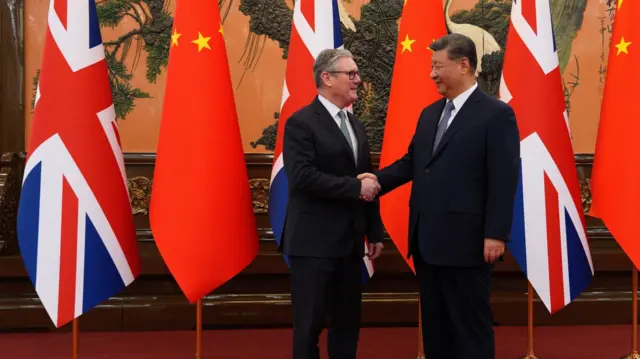
    ritain's Prime Minister Keir Starmer shakes hands with Chinese President Xi Jinping ahead of a bilateral meeting during his visit to China, in Beijing, China, January 29Image source, Reuters

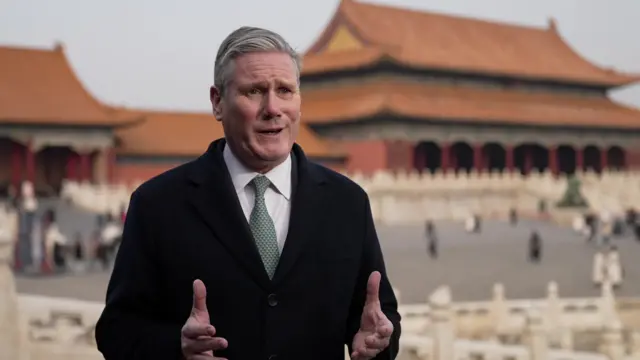
    Against the backdrop of Beijing’s Forbidden City, the prime minister reflects on his meeting - which lasted, we’re told, one hour and 20 minutes.

    Is President Xi a man you can do business with, he was asked - yes he replied.

    This visit is a three-day exercise in defrosting relations between London and Beijing.

    The language and tone of the public exchanges at the start of the meeting appeared warm.

    Xi pointedly praised Labour governments for what he saw as a history of deepening ties between the two countries.

    The prime minister says the talks brought progress on cutting whisky tariffs and the prospect of visa-free travel to China for British visitors. But note talk of progress, rather than a deal, on either.

    Xi talked of a "turbulent and fluid world" - the clear subtext, China, a beacon of stability amid President Trump’s whims, outbursts and unpredictability.

  9. A look at China's tariffs on whiskypublished at 08:31 GMT

    Emer Moreau
    BBC News

    Starmer has said progress is being made on a timeframe to reduce tariffs on whisky.

    In 2022, sales of whisky in China were valued at $2.3bn. Last year, tariffs on whisky imports increased from 5% to 10%.

    Tariffs are paid by the companies bringing in the imported goods to the government.

    Starmer said a move towards lower tariffs was an example of how he wanted a "much wider opening" for British businesses in China.

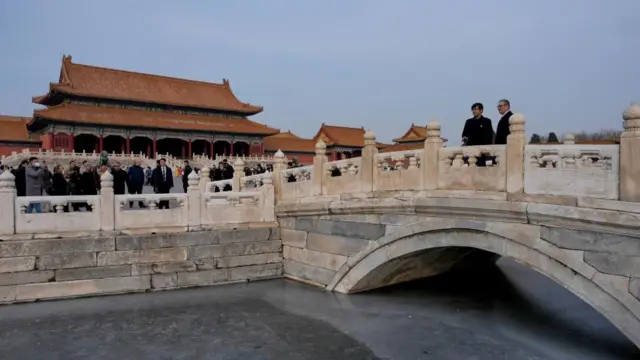
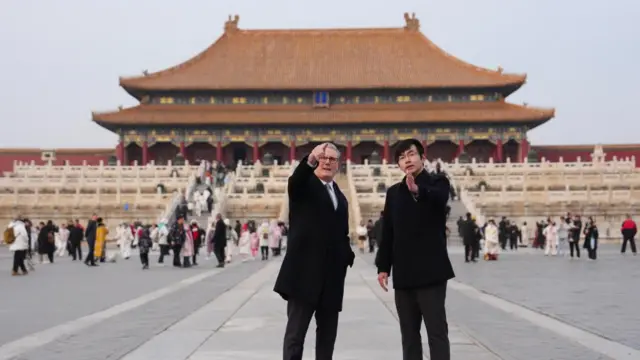
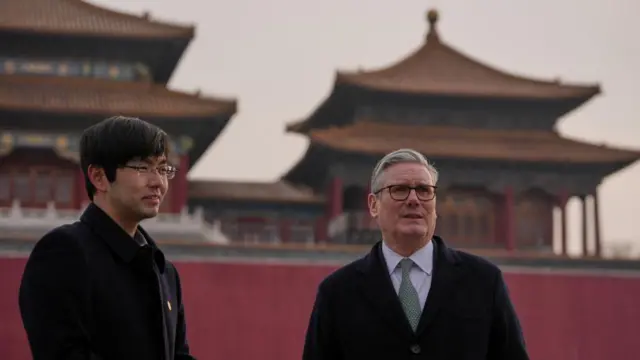
  10. Starmer's Forbidden City tour in picturespublished at 08:16 GMT

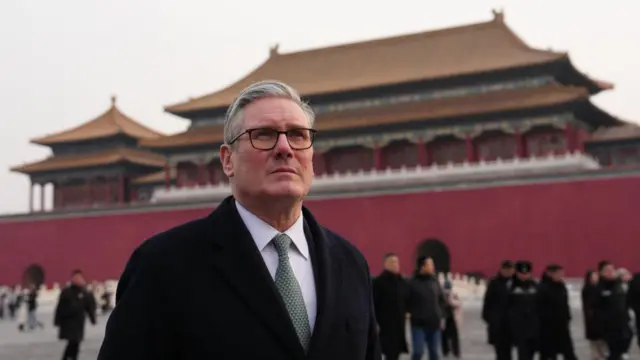
    Prime Minister Sir Keir Starmer has been given a tour of the Forbidden City - an imperial palace and Unesco World Heritage Site in Beijing.

    Prime Minister Sir Keir Starmer during a tour of the Forbidden City in BeijingImage source, PA
    Prime Minister Sir Keir Starmer (right) stands on a bridge as he's given a tour of the Forbidden City in Beijing, during his visit to ChinaImage source, PA
    Prime Minister Sir Keir Starmer (left) during a tour of the Forbidden City in BeijingImage source, PA
  11. UK wants to work with China to 'disrupt' small boat engine trade, minister sayspublished at 08:02 GMT

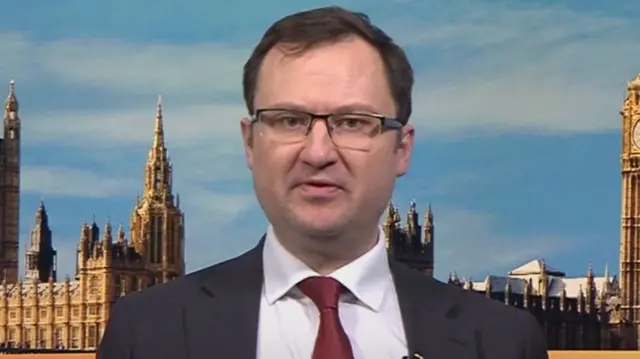
    We've just been hearing from Alex Norris, minister for border security and asylum, following Starmer's conversations in China about small boat crossings.

    A reminder, Downing Street says that 60% of the engines in small boats being used to cross the Channel last year were Chinese-made.

    Norris tells BBC Breakfast that the government wants British intelligence services to work with China "to disrupt that illicit activity, and that's what we're in the process of agreeing".

    Minister Alex Norris speaking to BBC Breakfast, he is wearing a dark suit and red tie
  12. What is the Forbidden City?published at 07:43 GMT

    A photo of Prime Minister Keir Starmer being given a tour of the Forbidden City in BeijingImage source, Reuters

    Starmer is now being taken on a tour of the Forbidden City in Beijing.

    The Forbidden City is an imperial palace, originally constructed between 1406 and 1420 as the official residence of Ming emperor Zhu Di.

    The imperial palace served as the home of Chinese emperors and was the political centre of the Chinese government for more than 500 years.

    It was repurposed as the Palace Museum in 1925 and is now a Unesco World Heritage Site.

  13. Starmer says he raised human rights issues with Xipublished at 07:32 GMT

    Starmer in Beijing

    Asked how forcefully he raised the case of Jimmy Lai and the treatment of Uyghurs, Starmer says: "We raised those issues as you would expect.

    "Part of the rationale for engagement is to make sure that we can both seize the opportunities that are available - which is what we've done - but also have a mature discussion about issues that we disagree on."

    Asked if China were listening to him, the PM adds: "Yes, we did have a respectful discussion about that."

    For context, China has been accused of committing crimes against humanity against the Uyghur population and other mostly-Muslim ethnic groups in the north-western region of Xinjiang.

  14. China visit in UK's national interest, PM insistspublished at 07:28 GMT

    Defending his visit to Beijing, Starmer says: "I always act in the national interest".

    He says seizing opportunities that closer ties with China can bring will help to ease the cost of living back in the UK.

    He adds that he and President Xi made "real progress" during their discussions.

  15. Progress on tariffs, travel and small boats, Starmer sayspublished at 07:19 GMT

    Media caption,

    'Relationship in strong place', Starmer says about meeting with Xi

    We have just heard from Keir Starmer following his meeting with President Xi.

    He describes the meeting as productive and says there were "real concrete outcomes", adding that the UK's relationship with China is in a "good, strong place".

    He says that the delegations made progress on tariffs for whisky, as well as the idea of visa-free travel to China, and on information exchange on "irregular migration" and small boats.

    As we reported earlier, more than 60% of small boat engines seized from smuggling gangs last year were found to be manufactured in China, according to Downing Street.

  16. Jimmy Lai, the pro-democracy tycoon jailed in Hong Kongpublished at 07:11 GMT

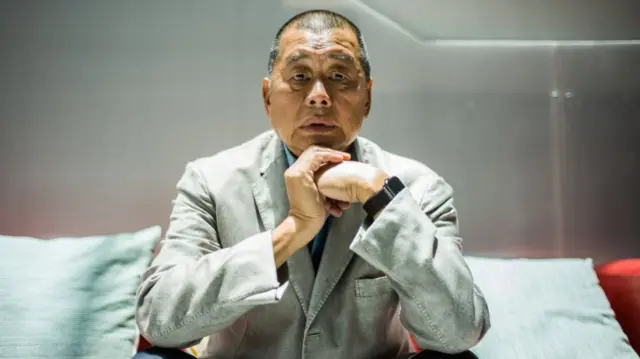
    Tycoon Jimmi Lai poses for a picture whilst sitting on a red settee, grey cushions behind him. He's in a light grey suit jacket, his chin resting on his right hand, his left hand closed in a fist covered by the right hand.Image source, AFP via Getty Images

    Starmer had earlier said he would be raising concerns over human rights during his visit to China.

    On the top of that list is likely to be the case of Jimmy Lai, a pro-democracy tycoon who's been detained since December 2020. Last month he was convicted of colluding with foreign forces under Hong Kong's controversial national security law, which was introduced in 2020 in response to massive pro-democracy protests.

    Beijing says the law is necessary to maintain stability in Hong Kong, but critics say it has effectively outlawed dissent.

    Lai, a UK citizen, is the most prominent person to be charged under the law.

    His daughter, Claire, had earlier told the BBC she fears she "may never see him again", adding that his physical condition has been deteriorating over the past year.

    A former Conservative minister Tom Tugendhat previously told the BBC that Starmer should have secured the release of Lai before heading on his trip.

  17. Lai case 'ultimate test' of UK-China relationship, son sayspublished at 07:06 GMT

    We have just heard from Sebastien Lai, son of Jimmy Lai, a pro-democracy campaigner who has been detained since 2020 in Hong Kong.

    A UK citizen, Lai was convicted of colluding with foreign forces under Hong Kong's controversial national security law (more on this in the next post).

    Sebastien Lai tells BBC Breakfast that Starmer's trip "is obviously a real test" for the relationship between the UK and China.

    "The phrase they use is a normalisation - what are we normalising here?" he asks.

    Referring to his father's imprisonment, he adds: "This is something that we will never normalise. Whether my father is freed or not is the ultimate test, it's a very visual representation of how China views our relationship.

    "We could give them the world, but if they're not giving anything back this is not a relationship."

    Media caption,

    Jimmy Lai case 'ultimate test' of UK-China relationship, says son

  18. Starmer to speak during Forbidden City visitpublished at 06:55 GMT

    Chris Mason
    Political editor, travelling with Starmer

    We will shortly hear from the prime minister for the first time since his meeting with President Xi.

    The cameras are set up and he’ll be here in the Forbidden City in Beijing in the next 15 minutes or so.

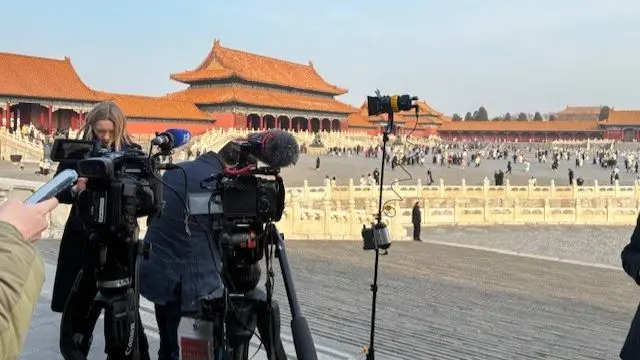
    Media at the Forbidden CityImage source, Chris Mason/BBC
  19. What else was discussed during the meeting?published at 06:33 GMT

    China has released its official readout on the bilateral meeting between Starmer and Xi - and we're now able to give you more details on what went on behind closed doors, according to the release:

    • China dismissed suggestions it posed a threat: "No matter how much China develops and grows stronger, it will not pose a threat to other countries"
    • The two leaders discussed cooperation across a range of sectors, from education to healthcare, finance, artificial intelligence and new energy, among others
    • China will "actively consider" implementing unilateral visa-free entry for UK citizens, said President Xi
    • The subject of Taiwan and Hong Kong came up in the meeting, but the readout offered brief details. The UK's policy on Taiwan – it does not recognise the island as a state nor maintain formal diplomatic relations with it – remains unchanged, according to the readout, adding that the UK welcomes Hong Kong as a "unique and important bridge" between the UK and China
    • Xi also called on the two countries to advocate for "genuine multilateralism" and a "more just and reasonable governance system", noting that unilateralism and "power politics" have severely impacted the international order
  20. A landmark meeting for both economiespublished at 06:18 GMT

    Suranjana Tewari
    Asia Business Correspondent

    Keir Starmer’s visit to China is as much about economic outcomes as it is about diplomacy.

    For the UK, the visit comes at a time of weak growth and a push to attract more overseas investment. China remains one of the world’s largest consumer markets and a major source of foreign investment, in manufacturing, clean energy and infrastructure.

    British officials see an opportunity for sectors where the UK is competitive like in financial services, pharmaceuticals and education.

    Starmer is facing scrutiny for engaging with Beijing at home, but by taking a large business delegation, it allows him to project the image of a prime minister focused on growth, investment and jobs at a time when the UK economy remains fragile.

    China is also facing a drop in domestic demand and growth, fragile investor confidence and rising trade friction with the US. Strengthening ties with the UK - Europe’s second-largest economy - would be a boost for Beijing and signal that it remains open for business with Western partners.