Summary

  • Plans for a huge Chinese embassy in London have been approved by the government after years of debate over security risks

  • The decision is "now final unless it is successfully challenged in court", Housing Secretary Steve Reed says

  • "National security is our first concern," the government says, adding that intelligence agencies "have been involved throughout the process"

  • Shadow communities secretary James Cleverly calls the move "a disgraceful act of cowardice", while the Liberal Democrats say it's Keir Starmer's "biggest mistake yet"

  • China bought the site of the proposed new embassy, at Royal Mint Court, near the Tower of London, for £255m in 2018

  • The decision on whether to approve the new embassy was under close scrutiny due to concerns about the security implications of the plan, including the location, size and design of the building

  1. UK approves Chinese mega-embassy in Londonpublished at 13:21 GMT

    The UK has approved plans for a new Chinese mega-embassy in central London, despite opponents warning it could be used as a base for spying and pose security risks.

    Beijing bought the site at Royal Mint Court near the Tower of London in 2018 for £225m, and at 20,000 square metres, it would be the biggest embassy of its kind in Europe.

    The Conservatives have called the decision an "act of cowardice", and a "shameful super embassy surrender", while the Liberal Democrats say this is Keir Starmer's "biggest mistake yet". Reform UK says it would "never have approved" the embassy, calling it a security threat.

    The head of MI5 says in a letter that the national security threat cannot be wholly eliminated, but he adds the assessment to mitigate risk has been "expert, professional and proportionate".

    A government spokesman says intelligence agencies had been involved throughout, with an "extensive range of measures" to "manage any risks".

    The decision, which has been repeatedly delayed, was always going to be met with criticism when it was delivered, and the embassy's approval lays the ground for engagement with China, says the BBC's Damian Grammaticas.

    We're now bringing our live coverage to a close, but you can continue to follow the latest in our main news story.

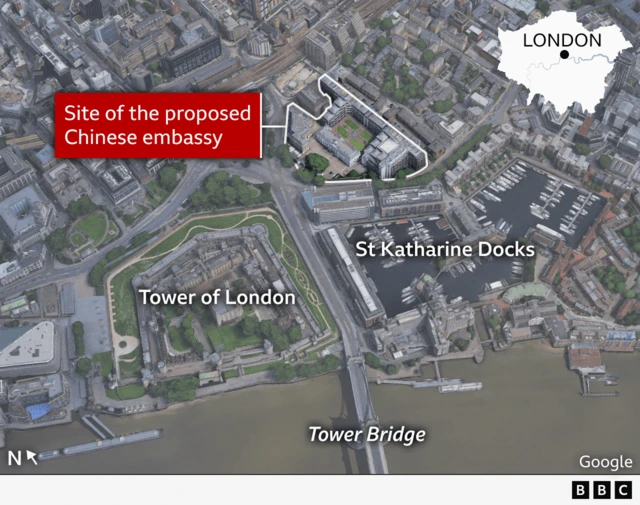
    Picture showing the location of the proposed Chinese embassy in London, near the Tower of London, Tower Bridge and St Katharine Docks.
  2. Analysis

    Hugely sensitive decision that was bound to be met with criticismpublished at 13:08 GMT

    Damian Grammaticas
    Political correspondent

    This decision is a hugely sensitive one. Whenever it was delivered it was always going to be met with criticism from all sides, and accusations that the government was bending too far to accommodate China.

    A final decision was delayed several times last year, ostensibly because the government was seeking more information.

    But, at the time controversies over Chinese spying in the UK and targeting of dissidents had already raised the political temperature, so delaying was also politically expedient.

    For China securing permission was its top priority in relations with the UK. Having a huge and prominent embassy in a key location would be a symbol of China's diplomatic heft.

    From the UK's perspective, with Sir Keir Starmer expected to visit Beijing in the near future, the approval lays the groundwork for engagement China on a whole range of issues, from trade to security and human rights.

    The government's view is that does not mean the UK is "soft" on China in any way, but dealing, pragmatically with a major power that cannot be ignored. The security risks have been considered and deemed not serious enough to veto the plan.

    As for how it may be taken by the US. So far it's been voices in Congress, critics of China, who have voiced opposition to the mega embassy.

    Downing Street may be waiting to see if President Trump feels the need to weigh in on this.

  3. Ministers: Establishing embassies 'normal part of international relations'published at 13:07 GMT

    The government is defending its decision to grant permission for the new Chinese embassy, saying that the building of new embassies is a "normal part of international relations".

    Referring to concerns around national security, a spokesperson says that is the government's "first duty."

    "Intelligence agencies have been involved throughout the process and an extensive range of measures have been developed to manage any risks," they added.

  4. Reform UK 'would never have approved this'published at 13:06 GMT

    A spokesperson for Reform UK says the decision to approve the building of the embassy "so close to some of the UK's most sensitive communications cables represents a serious threat to national security".

    They describe the decision as a "desperate attempt by the Labour Government to cosy up to the Chinese Communist Party.

    "A Reform government would never have approved this in the first place."

  5. UK must take 'principled stand' says group opposed to embassypublished at 12:49 GMT

    A group of local residents, campaigners and cross-party parliamentarians say they are united in their opposition to the embassy plans.

    In the statement, Baroness Kennedy, a Labour member of the House of Lords, says that the UK "must take a principled stand", and cannot "reinforce the dangerous notion that Britain will continue to make concessions - such as granting a mega-embassy - without reciprocity or regard for the rule of law".

    Conservative MP Iain Duncan Smith says granting permission for the embassy is a "terrible decision" that "ignores the brutality of the Chinese Communist Party".

    He says it gives China a "major strategic foothold in the heart of London".

    "At a time when the Chinese Communist Party is intensifying its intimidation of Britain, this decision sends entirely the wrong message," Smith says.

    The group says it will be holding a news conference this afternoon.

  6. Possible risk of terror attack no reason to reject embassy - reportpublished at 12:45 GMT

    Today's report from the planning inspector – which led to the government approving the new Chinese Embassy – says a risk of terrorist attacks is no reason to reject an embassy.

    "There is no evidence to substantiate the argument that an embassy use in London is likely to attract terrorist attacks," the report states.

    "There is certainly no evidence to suggest that local people are more at risk from having an embassy near them than other uses.

    "In terms of the proposals being for a Chinese Embassy – it is the same position.

    "The current Chinese Embassy in Portland Place has been the PRC’s Embassy for decades; there have been no terrorist attacks...

    "It is not possible to say that embassies in general or the embassy for any specific nation could never be a target, but the same could be said for any use, and certainly for any place where large numbers of people gather or are passing through."

  7. MI5: Risks to national security can't be wholly eliminatedpublished at 12:33 GMT

    The director of MI5 says national security risks linked to the new embassy can't be wholly eliminated.

    In a joint letter to the home and foreign secretaries from him and the director of GCHQ - the government's intelligence, cyber and security agency, Sir Ken McCallum writes: "It would be irrational to drive 'embassy generated risk' down to zero when numerous other threat vectors are so central to the national security risks we face in the present era."

    The letter goes on to say that the collective work across the UK to formulate a package of security mitigation has been "expert, professional and proportionate".

  8. 'Facing the might of the People's Republic of China'published at 12:24 GMT

    Aurelia Foster
    BBC London

    Man with a beard and wearing a cap in standing in front of a blurred building
    Image caption,

    Mark Nygate said he and other leaseholders are worried they will lose their homes

    Royal Mint Court resident Mark Nygate said the decision to build the embassy next to his home could transform his life.

    "The worst case scenario is that we might end up being moved off.

    "And if they just move us off and there's no compensation, what do I do?

    "I'm 65. I can't afford to live in London without any money."

    China bought the land in 2018 and had been seeking approval for a new embassy there since 2019.

    "We're 100 flats, 200 people, facing the might and the wealth of the People's Republic of China," Mark said.

  9. Wrong embassy, wrong place, wrong time, says London Labour Grouppublished at 12:21 GMT

    Jess Warren
    BBC London

    London's Labour group, the regional part of the party in Greater London says the decision raises "serious questions about security and how the area will be impacted".

    Unmesh Desai, Labour London Assembly Member for City and East says: "This is the wrong embassy in the wrong place at the wrong time."

    "Londoners deserve clear answers on why this site was chosen, how the decision was made and how risks will be managed," he adds.

  10. Watch: See where China plans to put its controversial mega-embassypublished at 12:13 GMT

    Last year, the BBC's Damian Grammaticas visited the site of the embassy - watch below as he explains the controversy that surrounded plans:

  11. The bigger the embassy, the more espionage, says dissidentpublished at 12:04 GMT

    Aurelia Foster
    BBC London

    Woman speaking to somebody off camera

    Chung Ching Kwong, who works for the Inter-Parliamentary Alliance on China, fears Hong Kong dissidents like her will be at risk when the new embassy is built.

    Chung Ching says she is in "self-imposed exile" from Hong Kong due to her pro-democracy work.

    The bigger the embassy, the more "oppression and espionage activities" there will be, she says.

    "For our community to know that this is going to be the biggest embassy, there's going to be a few hundred more staff on the ground in the UK is a very scary thought because we fled the country to try to escape oppression, surveillance and the long arm of the state," she continues.

    "China needs a new embassy, the current one is not functioning, but this is not the right place or a safe place for it to be."

  12. Some opponents fear site could be used to infiltrate financial systempublished at 12:01 GMT

    Meghan Owen
    Work & Money correspondent, BBC London

    A spokesperson for the City of London Corporation said: "We note the approval of a new Chinese embassy in the borough of Tower Hamlets. This decision is a matter for the government."

    While the governing body for the Square Mile – the historic and financial heart of London – hasn't been drawn into detail, some opponents fear the Royal Mint Court site could be used by China to infiltrate the UK's financial system by accessing fibre-optic cables carrying sensitive data for City of London firms.

    The site previously housed a trading floor that was wired directly into the UK's financial infrastructure. For more than four decades, a nearby tunnel has carried fibre-optic cables under the Thames, serving City firms.

    The Chinese embassy previously said: "Anti-China forces are using security risks as an excuse to interfere with the British government's consideration over this planning application. This is a despicable move that is unpopular and will not succeed."

  13. This is the wrong decision for the UK, says campaign grouppublished at 11:59 GMT

    A group involved in the campaign opposing the embassy plans has called today's approval the "wrong decision for the UK".

    Luke de Pulford, a co-founder of the Inter-Parliamentary Alliance on China, says: "This is the wrong decision for the UK, sending all the wrong signals.

    "Wrong for dissidents, wrong for UK national security. Our three Cs China policy is less compete, challenge and co-operate, more cover-up, cave in, and cash out."

  14. 'This will amplify China's surveillance efforts,' Lib Dems saypublished at 11:53 GMT

    The Liberal Democrats' foreign affairs spokesman Calum Miller calls today's decision Keir Starmer's "biggest mistake yet".

    "The prime minister knows his decision today will amplify China's surveillance efforts here in the UK and endanger the security of our data - not to speak of the safety of the brave Hong Kongers on British soil," he says.

    "It's categorically wrong that he's embraced these threats to further his flirtation with China. This government should be ashamed of its decision to allow the super spy embassy to go ahead today."

  15. Tories call decision an 'act of cowardice'published at 11:40 GMT

    James Cleverly, the shadow communities secretary, calls today's decision "a disgraceful act of cowardice from a Labour government and prime minister utterly devoid of backbone".

    "The first duty of any government is to keep the country safe. But Keir Starmer has relegated that most critical priority beneath his desperate desire for Beijing's approval," he says.

    Meanwhile his fellow Tory MP Priti Patel, the shadow foreign secretary, says: "Keir Starmer has sold off our national security to the Chinese Communist Party with his shameful super embassy surrender.

    "Throughout his dismal premiership to date, the PM has kowtowed to Beijing at every opportunity, including over Chagos. And now, once again, he is giving Xi Jinping what he wants - a colossal spy hub in the heart of our capital."

  16. 'Intelligence agencies have been involved throughout' - UK governmentpublished at 11:32 GMT

    We now have reaction from the UK government:

    "This planning decision has been taken independently by the secretary of state for housing," it says.

    "This follows a process that began in 2018 when the then foreign secretary provided formal diplomatic consent for the site.

    "More broadly, countries establishing embassies in other countries' capitals is a normal part of international relations.

    "National security is our first duty. Intelligence agencies have been involved throughout the process and an extensive range of measures have been developed to manage any risks.

    "Following extensive negotiations in recent months, the Chinese government has agreed to consolidate its seven current sites in London into one site, bringing clear security advantages."

  17. Embassy decisions should be 'nation-neutral', says inspectorpublished at 11:26 GMT

    The planning inspector's report, released today, twice refers to decisions on embassies being "nation-neutral".

    "It is not possible to discriminate against a use on the basis of the anticipated user," the report says on page 31. , external

    "Otherwise that could give rise to an untenable situation of the embassy of one nation being permitted but another nations embassy being refused."

    Later, the report says: "In this regard, any ethical or similar objection to the provision of an embassy for a specific country cannot be a material planning consideration.

    "It would not be lawful to refuse permission simply because it would be for a Chinese Embassy (my emphasis).

    "The same would hold for any other specific country seeking an embassy use through the planning system."

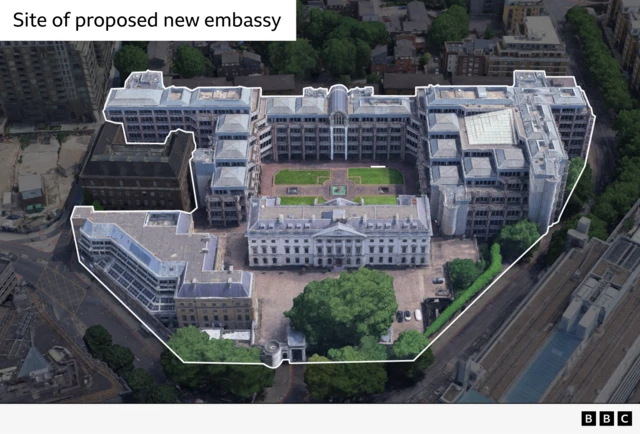
    A close-up satellite image of the site of the proposed new Chinese embassy in London, highlighting the boundaries of the site. The site features an older central building next to a courtyard, which is surrounded by several taller, more modern buildings.
  18. Decision is final unless challenged in court - ministerpublished at 11:17 GMT

    We now have a written statement from Steve Reed, Secretary of State for Housing, Communities and Local Government.

    "This statement follows the decision I made today to grant planning permission and listed building consent for a new Embassy in London," it begins, before setting out details of the decision.

    "All material considerations were taken into account when making this decision," it concludes. "The decision is now final unless it is successfully challenged in court."

  19. Critics had voiced opposition over security concernspublished at 11:10 GMT

    China bought the site of the proposed new embassy, at Royal Mint Court, near the Tower of London, for £255m in 2018.

    At 20,000 square metres, the complex would be the biggest embassy in Europe if built.

    The decision on whether to approve the new embassy was under close scrutiny because of concerns about the security implications of the plan, including the location, size and design of the building.

    The site is close to fibre optic cables carrying communications to and from financial institutions in the City of London.

    Concerns have been raised that Chinese operatives could use the site to tap into the cables and eavesdrop.

    Further questions were raised last year about the nature of the threat posed by Beijing, following the collapse of the case against two men accused of spying for China.

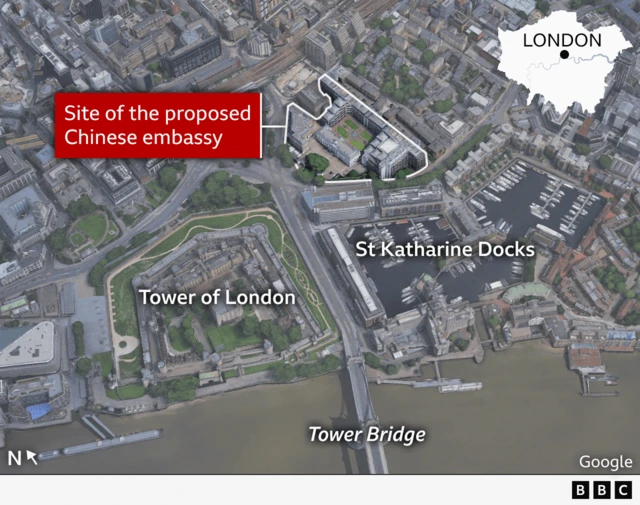
    Picture showing the location of the proposed Chinese embassy in London, near the Tower of London, Tower Bridge and St Katharine Docks.
  20. 'I conclude... planning permission should be granted'published at 11:08 GMT

    The inspector's planning report, which led to the housing secretary approving the application, concludes:

    "To conclude, I am of the clear view that the proposal complies with the development plan when taken as a whole. There are no other material considerations which would warrant a conclusion other than that planning permission and listed building consent should be granted.

    "For the reasons set out above, I conclude that the applications for planning permission and listed building consent should be granted, subject to the attached conditions in Annex D and the relevant obligations under the s106 planning obligation."

    We're going through the decision now and will bring you more shortly.