Summary

  1. Trump nominates Warsh to lead Federal Reserve - What you need to knowpublished at 15:36 GMT

    Tara Mewawalla
    Live reporter

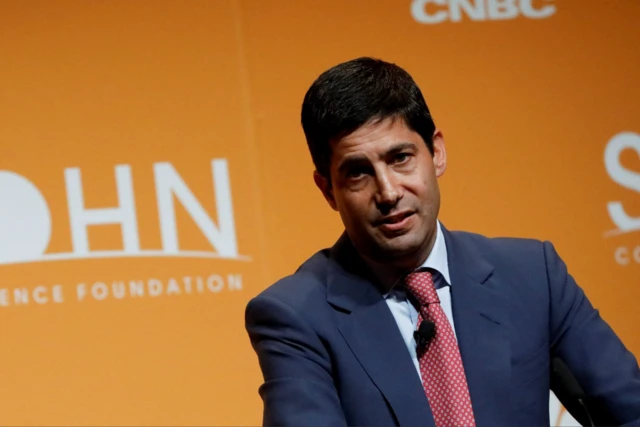
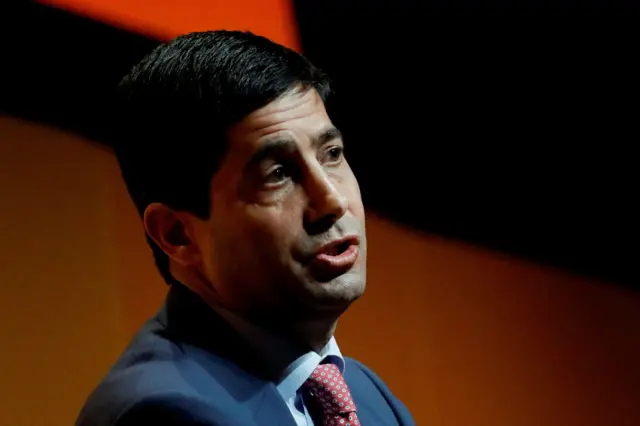
    Fed chair nominee Kevin Warsh mid-speech, he's in a dark blue suit, white shirt and white polka dots red tie. Behind him an orange wall with writings in whiteImage source, Reuters

    US President Donald Trump has nominated Federal Reserve critic Kevin Warsh to run the institution. Here's what you need to know:

    What is the Federal Reserve?

    It is the US central bank which operates independently from government, with goals of maximum employment and stable prices. The Fed uses interest rate hikes or cuts to achieve this.

    Who is Kevin Warsh?

    A former Federal Reserve governor and Wall Street veteran, Kevin Warsh has been outspoken in his calls for "regime change" at the central bank.

    In a speech last year, he said US fiscal policy was on a "dangerous trajectory" and that there had been a rise in "irresponsible spending". He is seen as a voice that would support lower interest rates in the near term.

    Who is he replacing?

    Current Fed head Jerome Powell was selected for the role by Trump in 2018, with his term set to end in May. Due to his resistance to pressure from the president to cut interest rates more rapidly, he found himself under fire and often lambasted on social media. He is currently under investigation by federal prosecutors.

    What happens now?

    Warsh will now undergo a Senate confirmation, although there is some resistance to appointing a new chair while an investigation into the present chair is ongoing - this could mean lengthy delays going forward.

    Our New York business reporter Natalie Sherman has taken a look at why Warsh's nomination matters.

    We will be closing this page shortly but you can keep up with more developments in our story
  2. Warsh is an 'inside the box' choice, former Treasury official tells BBCpublished at 15:20 GMT

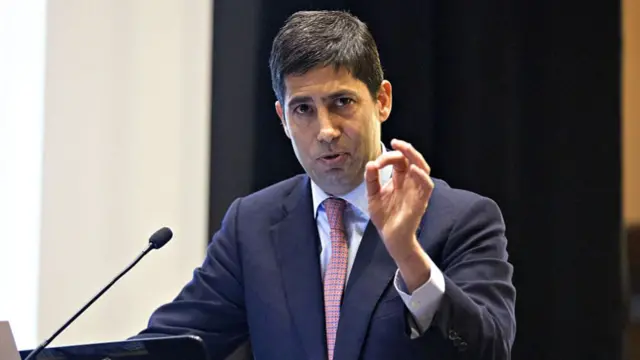
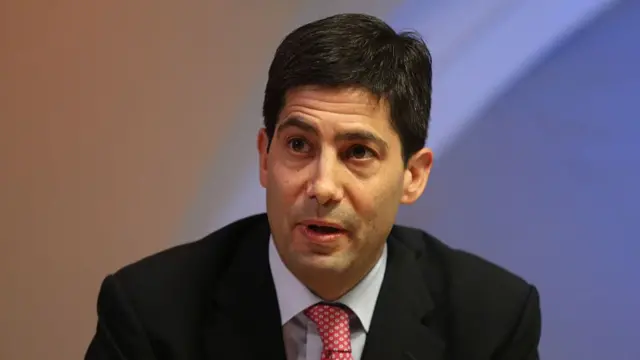
    Close up of former Fed governor Kevin Warsh mid speechImage source, Reuters

    A former US Treasury official who worked with Fed nominee Kevin Warsh tells BBC Newshour he approves of the choice.

    “It’s a very ‘inside the box’ standard choice… a very fine and reasonable choice," says Aaron Klein, who worked with Warsh during the Bush administration and is now a senior fellow at the Brookings Institution.

    "In the World of Trump, things that make sense are ‘wins’," he adds.

    Klein says Warsh has been "relatively hawkish" for most of his career - a word which means an economist favours keeping interest rates high to curtail inflation. By contrast, Donald Trump has been putting pressure on the Fed to cut interest rates more quickly.

    But Klein says what Warsh does in the role is the "big open question".

    He believes Warsh is committed to the Fed's independence, but whether he will be able to resist pressure from the White House is "the million dollar question", in his view.

  3. How the Fed chair gets confirmedpublished at 15:09 GMT

    Donald Trump has nominated Kevin Warsh to be the next chair of the Federal Reserve. But before he's allowed to take on the role, he will need to be vetted and confirmed by the Senate - meaning he could face lengthy delays.

    The committee that will consider Warsh's nomination is the Banking Committee chaired by Republican Senator Tim Scott - who's already said he possesses "essential knowledge" needed to lead the institution.

    However, committee ranking member Sen Elizabeth Warren says that "no Republican purporting to care about Fed independence should agree to move forward with this nomination" until an investigation into the current Fed chair, Jerome Powell, is dropped.

  4. Analysis

    Why does the choice of Fed chair matter to Americans, and around the world?published at 14:41 GMT

    Natalie Sherman
    New York business reporter

    The Fed's official charge from Congress is to keep prices and employment stable, creating a kind of Goldlilocks economy - running not too hot and not too cold, but just right.

    That may sound pretty abstract. But the primary way it pursues that goal is more mundane: it decides what interest rate to charge banks to borrow, a decision that then ripples out to influence borrowing costs across the economy.

    In other words – the monthly payments Americans owe on mortgages, car loans and credit card debts are all shaped by the Fed.

    And because of the important role of the US dollar and Treasury bonds in financial markets, what it does often has consequences for borrowing costs in other countries as well.

    How much Warsh himself will matter is going to be hotly debated in the months. Trump wants lower interest rates but the bank sets policy by committee – and Warsh, assuming he is confirmed, will be just one voice.

    What’s more, since the terms of people on the committee run for 14 years, Trump's opportunities to install allies sympathetic to his call for lower interest rates are limited.

    Let's not overstate the Fed's powers either. Its tool is blunt and the final rates faced consumers are influenced by many other factors too.

  5. An outspoken critic of the Federal Reserve - what Warsh has saidpublished at 14:25 GMT

    Jemma Crew
    Business reporter

    Kevin Warsh.Image source, Daniel Acker/Bloomberg via Getty Images

    In a speech last April, Kevin Warsh said US fiscal policy was on a "dangerous trajectory". He said there had been a rise in "irresponsible spending", especially after Covid.

    Fed leaders encouraged government spending when times were tough, he said, but "didn’t call for financial discipline at the time of sustained growth and full employment".

    Warsh - who was on the Fed's board from 2006-2011 - also criticised the central bank for getting involved in what he called "politically charged issues" such as climate change and inclusion.

    "The more the Fed opines on matters outside its remit, the more it jeopardises its ability to ensure stable prices and full employment," he said.

    In an interview with CNBC in July, Warsh called for "regime change" at the central bank which he said was facing a "credibility crisis".

    "It’s not just about a person, it’s about an approach to economics… I’m troubled when I see them moving the goal posts," he said.

    The Fed has "done a very good job of blaming others for its mistakes", and its choices about inflation were made "poorly", he added.

  6. 'A qualified nominee': Republicans react to Warsh's nominationpublished at 14:17 GMT

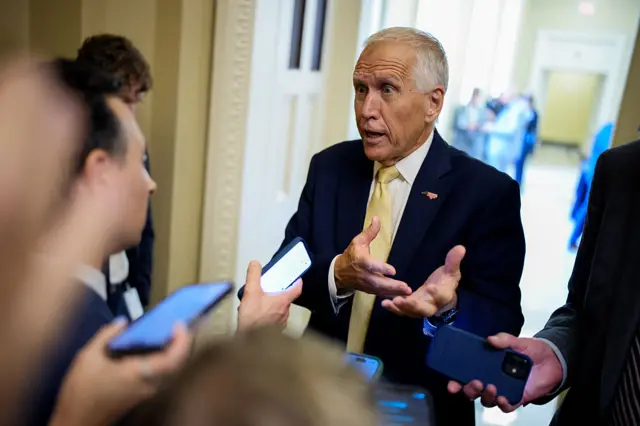
    Sen. Thom Tillis, a white man with white hair speaking to reporters, he is wearing a blue suit with white shirt and yellow tie.Image source, Andrew Harnik/Getty Images
    Image caption,

    Sen. Thom Tillis warns he will oppose any confirmation until an investigation into current Fed chair Jerome Powell is concluded

    In announcing Warsh's nomination for the top job at the Federal Reserve, President Trump said he's expecting his pick to "go down as one of the GREAT Fed Chairmen" in history, "maybe the best".

    His vision is being shared by Banking Committee head, Republican Senator Tim Scott, who says Warsh has "essential knowledge" that will help him bring "accountability and credibility" back to the institution.

    "Federal Reserve independence remains paramount, and I am confident Kevin will work to instil confidence and credibility in the Fed’s monetary policy," he writes on X, adding he's looking forward to "leading a thoughtful and timely confirmation process".

    But Scott's colleague, Sen. Thom Tillis, warns he will oppose any confirmation until an investigation into current Fed chair Jerome Powell is concluded.

    While he agrees Warsh is "a qualified nominee", Tillis says "protecting the independence of the Federal Reserve from political interference or legal intimidation is non-negotiable".

    • For context: On 11 January, Powell disclosed that the US Department of Justice (DoJ) served the agency with subpoenas and threatened a criminal indictment over testimony he gave to a Senate committee about renovations to Federal Reserve buildings.
  7. Analysis

    Trump's fight over interest rates - is the Fed his scapegoat?published at 13:58 GMT

    Natalie Sherman
    New York business reporter

    Trump has made the US central bank one of the key bogeymen of his term in office, accusing the current Federal Reserve chairman, Jerome Powell, of hurting the economy by keeping interest rates too high.

    So it’s worth remembering: the Fed cut interest rates three times last year, leaving its key lending rate hovering around 3.6% - lower than where it stood for much of its pre-2008 financial crisis history.

    What's more, most analysts are expecting it to cut again this year – totally independent of Fed pressure.

    That creates a path for Warsh to lead the bank in lowering borrowing costs while keeping his credibility as an independent economist intact.

    Whether that will resolve Trump’s fight with the Fed, however, is another question. For one thing, he may decide having the Fed to scapegoat for economic problems is too convenient to give up.

  8. The Trump-Powell row - explainedpublished at 13:49 GMT

    Jemma Crew
    Business reporter

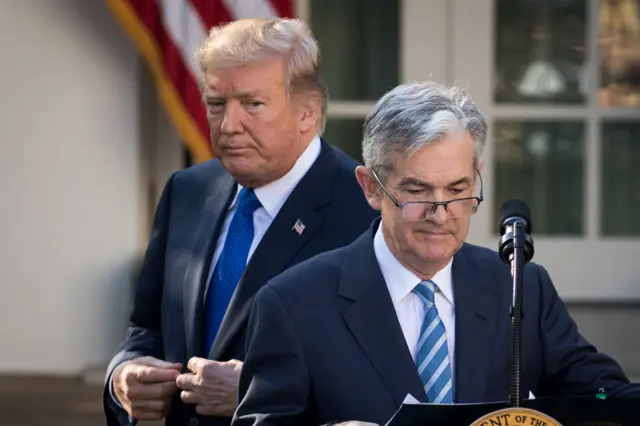
    Donald Trump stood behind Jerome Powell who is speaking into a microphone behind a podium.Image source, Drew Angerer/Getty Images
    Image caption,

    Jerome Powell giving a speech as Trump's nominee for Fed chair back in 2017

    Trump and the current Federal Reserve chair, Jerome Powell, have been embroiled in a long-running spat that hit the headlines in recent weeks.

    The central bank has been under repeated political pressure from the White House about how it sets interest rates, with Trump wanting Powell to cut them quicker.

    As well as criticising Powell's decisions on interest rates, the US president has made personal comments, calling the world's top central banker a "major loser" and a "numbskull".

    Earlier this month, Powell revealed he was the subject of a criminal investigation, linked to testimony he gave to a Senate committee about renovations to Fed buildings.

    He called the investigation "unprecedented", and said he believed it was opened due to Trump's anger over the Fed's refusal to cut rates. Trump said he didn't know anything about it.

    Powell, who steps down in May, also warned the independence of the bank was at stake, saying it was about whether the Fed would "be able to continue to set interest rates based on evidence and economic conditions, or whether instead monetary policy will be directed by political pressure or intimidation".

  9. Democratic Senator Warren says Trump's pick shows he is trying to seize Fed controlpublished at 13:42 GMT

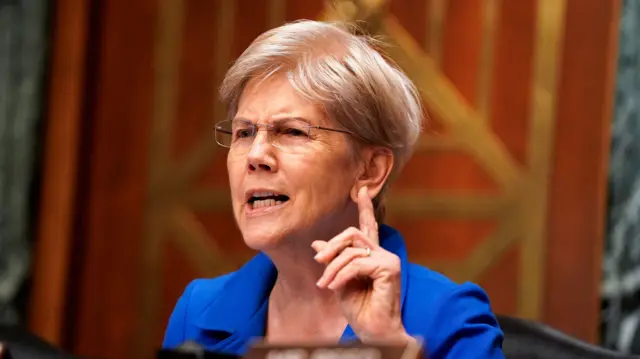
    Democratic Senator Elizabeth Warren with her finger pointing upwards and her mouth partly open. She is speaking at a Senate Banking, Housing and Urban Affairs Committee nomination hearing on Capitol Hill in WashingtonImage source, Reuters

    Democratic Senator Elizabeth Warren says President Donald Trump's pick for Fed chair is his latest attempt to seize control of the US central bank.

    She adds that no Republican should agree to move forward until Trump stops his criminal investigation into current federal reserve chair Jerome Powell.

    Other senators have previously criticised the Trump administration for its probe - we'll have more on this in our next post.

  10. The loyalist Trump says is doing 'an outstanding job': Who is Kevin Hassett?published at 13:30 GMT

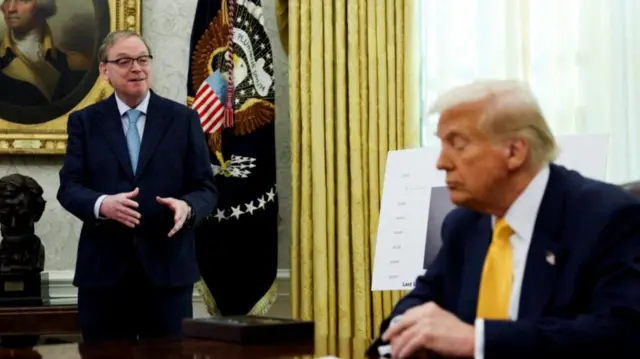
    White House economic adviser Kevin Hassett speaks next to US President Donald Trump in the Oval Office of the White House in Washington DC, US, 7 March 2025.Image source, Reuters

    "I think the two Kevins are great," Trump told the Wall Street Journal in December as rumours whirled around who would be nominated to run the US central bank.

    He was referring to Kevin Warsh - who has today been nominated - and Kevin Hassett.

    As we've just reported, Trump says Hassett is doing an "outstanding job" in the White House and he "didn't want to lose him".

    But, who is Hassett?

    A Trump loyalist, Hassett, 63, served as chair of the White House Council of Economic Advisers during Trump's first term and now leads the National Economic Council.

    Hassett has been a stalwart defender of Trump's economic policies, downplaying data showing signs of weakness in the US economy and repeating allegations of bias at the Bureau of Labor Statistics.

  11. 'I just didn't want to let him go': Trump's reasoning for not nominating Hassettpublished at 13:13 GMT

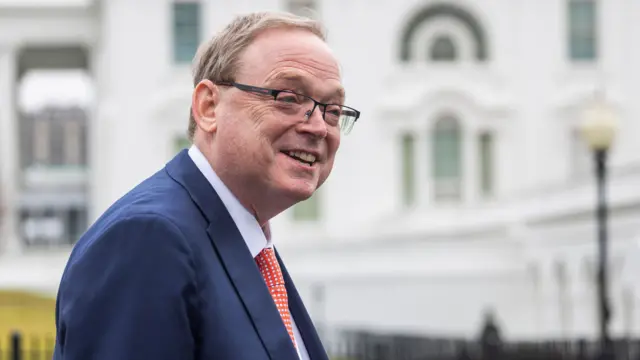
    US Director of the National Economic Council Kevin Hassett walks into the West Wing of the White House in Washington, DC, USA, 9 January 2026.Image source, JIM LO SCALZO/EPA/Shutterstock

    US President Donald Trump says Kevin Hassett, who had been seen as a frontrunner for the Fed role, would have made "a great Chairman" but that he couldn't afford to spare him.

    Hassett is a long-time conservative economist and key Trump economic adviser.

    Taking to Truth Social in the last few minutes, Trump says Hassett is "highly respected" and "is doing such an outstanding job".

    "I just didn’t want to let him go. Kevin is indescribably good so, as the expression goes, “if you can’t do better, don’t try to fix it!”

    In our next post, we'll bring you more on who Kevin Hassett is.

  12. Analysis

    What would Warsh's appointment mean for interest rates?published at 13:04 GMT

    Natalie Sherman
    New York business reporter

    Kevin Warsh has been at the top of Trump’s list of favourites to lead the Federal Reserve since the president's first term in office.

    The fact it took Trump this long to name him is down to one problem: that Warsh has for years been seen as a voice for higher interest rates.

    That’s at odds with Trump – a self-described "low interest rate guy" of longstanding, who has put unprecedented public pressure on the Fed to slash borrowing costs.

    Since Trump’s election, Warsh has taken steps to shed his reputation in media appearances and opinion columns.

    But Trump has remained uneasy, openly worrying about whether candidates would say one thing while jockeying for the job but do another once it was secured.

    But he also needs his pick to pass muster in Congress and on Wall Street, where the potential for an independent streak is seen as a plus.

    For now, Warsh seems to have satisfied the president's concerns.

    But Trump’s swift turn on his last pick for Fed chair – Powell – should serve as a cautionary tale for anyone taking the job.

  13. How are the gold markets reacting - and what does that tell us?published at 12:58 GMT

    Ben King
    Business reporter

    Trump said Kevin Warsh was from "central casting" - and in many ways he is a fairly typical central banker, as a former Federal Reserve governor and adviser to the Bank of England.

    Hence the markets' reaction to rumours of his appointment.

    Gold prices had been soaring to record highs.

    This was partly driven by fears that Trump would choose a Fed chairman who would cave in to his demands to cut interest rates, leading to a falling dollar and rising inflation.

    Buying gold is a strategy to protect against those things.

    Compared to other candidates, Warsh is seen as a "relatively safe choice", in the words of Capital Economics' analyst Stephen Brown, and less likely to "morph into a full-blown Trump stooge".

    Gold slumped as reports of his impending appointment emerged, even falling below $5000 an ounce at one stage this morning.

  14. Analysis

    Warsh is a rare candidate who appears to appease both the president and investorspublished at 12:47 GMT

    Dharshini David
    Deputy economics editor

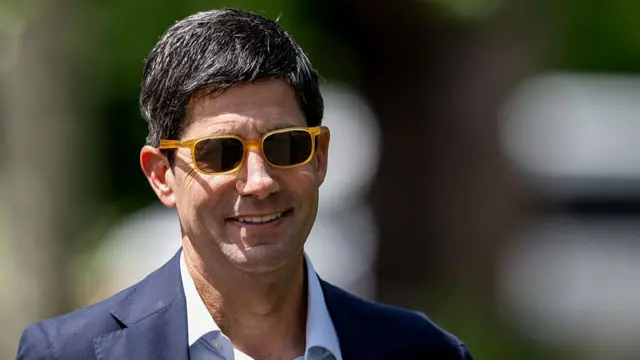
    Kevin Warsh in sunglasses and a suitImage source, Getty Images

    Kevin Warsh, a Wall Street veteran and a former Federal Reserve member, faces one of the world’s most coveted policymaking jobs - but perhaps also one of the trickiest.

    This selection process has not just been about who gets to be the world’s most powerful banker - but also the future of the central bank's independence.

    Kevin Warsh is a rare candidate who appears to appease both the president and investors.

    Warsh believes that rates should be lower and that the AI revolution can help contain inflationary pressures - aligning with the president.

    Meanwhile, some investors believe Warsh's track record on taking a tough line on inflation during his previous stint as Fed Chair hints at a pragmatic approach.

    He now undergoes a Senate confirmation, where there is resistance to appointing a new chair while an investigation into the present chair is ongoing.

    And then, once in post, he will need to prove his credibility to markets, coping with political pressure to cut rates amid a weakening jobs market - while also trying to balance the need to curb inflation.

    President Trump has acknowledged that however amenable candidates may appear beforehand, they tend to pick their own path once in post.

    Economists suggest Warsh may choose not to push for rate cuts immediately, to underscore that independence at America’s central bank has been maintained.

  15. What is the Federal Reserve?published at 12:41 GMT

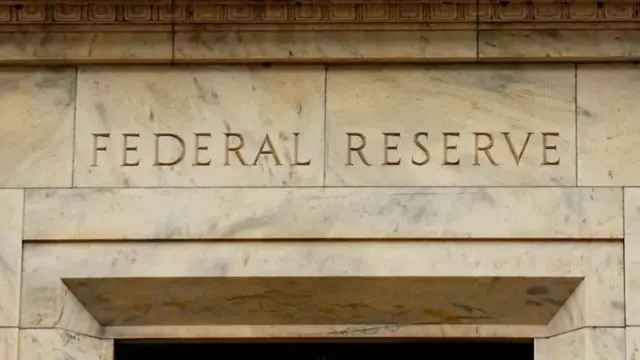
    Federal Reserve building.Image source, Reuters

    Put simply, the Federal Reserve (Fed) is the US central bank.

    It operates independently from government and one of its roles is to support a strong economy through its monetary policy.

    This policy has two key goals, often referred to as the Fed's "dual mandate", they are:

    • To support stable prices (i.e. keeping inflation at a target rate of 2%)
    • To support maximum employment (defined as the highest or lowest level of employment the economy can sustain while still keeping prices stable)

    The Fed uses interest rates as a tool for achieving these goals. Putting interest rates up - or keeping them high - can help control inflation.

    But it can also have a negative impact on the economy over time, making it more expensive for households and businesses to repay the interest on debts.

    A long period of high interest rates can put the brakes on economic growth and slow the jobs market.

    For now, the Fed seems to think the economy is showing signs of resilience. After holding interest rates at 3.5% to 3.75% this week, Powell said economic activity and business investment had expanded, while consumer spending had shown "resilience".

  16. Trump outlines Warsh's credentials for Fed rolepublished at 12:28 GMT

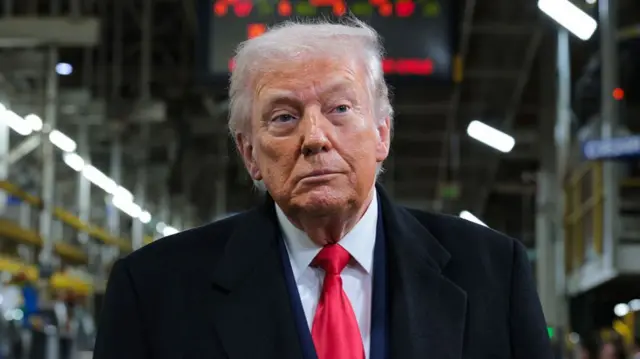
    US President Donald Trump.Image source, Anna Moneymaker/Getty Images

    We can now bring you more of what US President Donald Trump has said about Kevin Warsh, who he has nominated as the new chair of the Federal Reserve.

    In his post on Truth Social announcing Warsh's nomination, Trump outlines the reasons why Warsh's past experience will equip him to be a "GREAT" chairman.

    "He has conducted extensive research in the field of Economics and Finance," Trump says, as he credits Warsh for issuing an independent report to the Bank of England "proposing reforms in the conduct of Monetary Policy in the United Kingdom".

    "Parliament adopted the Report's recommendations," Trump adds.

    He also outlines Warsh's previous tenure in the Federal Reserve, last time as a member of the Fed's board of governors between 2006 and 2011. In this role, Trump adds, Warsh represented the Fed at the G20 group of nations.

  17. Fed held interest rates this week - as current chair stressed important of 'credibility'published at 12:14 GMT

    Media caption,

    Watch: Jerome Powell explains why Federal Reserve left interest rates unchanged

    Trump's nomination comes days after the Federal Reserve voted to hold interest rates - with its current chair, Jerome Powell, defending the importance of the central bank's independence.

    On Wednesday, the Fed said it would keep its key lending rate between 3.5% to 3.75%.

    Donald Trump has frequently criticised Powell for not cutting rates quickly enough.

    Federal prosecutors recently opened a criminal investigation over testimony Powell gave to the Senate about renovations to Fed buildings.

    Powell declined to comment on the probe as he spoke on Wednesday, but said that if a central bank lost its independence "it would be hard to restore the credibility of the institution".

    Powell previously said he believed the federal investigation stemmed from Trump's anger at the pace of interest rate cuts.

  18. What do we know about Kevin Warsh?published at 12:05 GMT

    Kevin Warsh, a white man with dark hair wearing a suit.Image source, Getty Images

    Kevin Warsh, who served as a Fed governor from 2006 to 2011, has been an outspoken Fed critic, lambasting everything from the central bank's heavy reliance on data to its use of assets on its balance sheet.

    The 55-year-old economist, a fellow at the right-leaning Hoover Institution who serves on the board of UPS, had also been considered for Fed chair during Trump's first term.

    He briefly overtook Trump loyalist Kevin Hassett in prediction markets last month before falling back to second place.

    Warsh had a relatively "hawkish" reputation in his first stint as Fed governor, meaning that he tended to favour higher interest rates and focused on concerns about inflation.

    But he is now seen as a voice that would support lower rates in the near term.

    "He thinks you have to lower interest rates," Trump told the Wall Street Journal in December. "And so does everybody else that I've talked to."

    Warsh also has close family connections to Trump's orbit. His father-in-law, billionaire businessman Ronald Lauder, is a long-time Trump donor and ally.

  19. Trump says Warsh 'will never let you down' as he confirms nominationpublished at 12:03 GMT

    Announcing his nomination on Truth Social, Donald Trump writes: "I have known Kevin for a long period of time, and have no doubt that he will go down as one of the GREAT Fed Chairmen, maybe the best.

    "On top of everything else, he is 'central casting,' and he will never let you down."

    We'll bring you more on Warsh's background in the next post.

  20. Trump nominates Kevin Warsh as new chair of Federal Reservepublished at 12:00 GMT
    Breaking

    Donald Trump has just announced his nomination for the new chair of the Federal Reserve.

    He's nominating Kevin Warsh, who served as a Fed governor from 2006 to 2011.

    The central bank has been under political pressure from the White House about how it sets interest rates.

    We'll bring you more on this story in the next few moments.