Summary

  1. Tehran 'lashing out' at Gulf countries is not a surprise, Iranians tell BBCpublished at 12:53 GMT

    Azadeh Moshiri
    South Asia Correspondent in Dubai
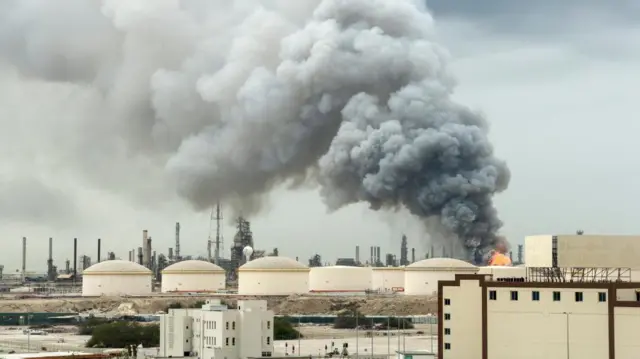
    Smoke rises following a strike on the Bapco Oil Refinery, amid the U.S.-Israeli conflict with Iran, on Sitra Island Bahrain, March 9.Image source, Reuters
    Image caption,

    Iranian strikes on the Gulf region continue, this image shows smoke rising from an oil refinery on Sitra Island in Bahrain last week

    Countries in the Gulf are still dealing with attacks in a war they feel they've been unjustly pulled into.

    In Iran, residents I've spoken to are not surprised that Iran is lashing out at the region.

    One man in northern Iran tells us "it was predictable since the regime has no way of putting pressure other than threatening the world economy".

    Iran's Foreign Minister Abbas Araghchi has told Fars News Agency, which is linked to Iran's Revolutionary Guard Corps, that Iran is not targeting civilian or residential areas.

    Here in Dubai, images of debris striking the airport, a residential building, and a luxury hotel have circulated widely online, as the United Arab Emirates continues to intercept attacks.

    There are fears in Iran of how Gulf countries will approach their relationship with Tehran, should the regime stay intact.

    Oman, and at times the United Arab Emirates, have played mediating roles during periods when the West would impose sanctions on Iran.

    "The relationship is very important if the regime survives this," a resident tells us. "I foresee a huge breakdown for the regime but also for normal people like us."
  2. Operations resume at one of the largest oil facilities in the Middle East after fire - reportspublished at 12:45 GMT

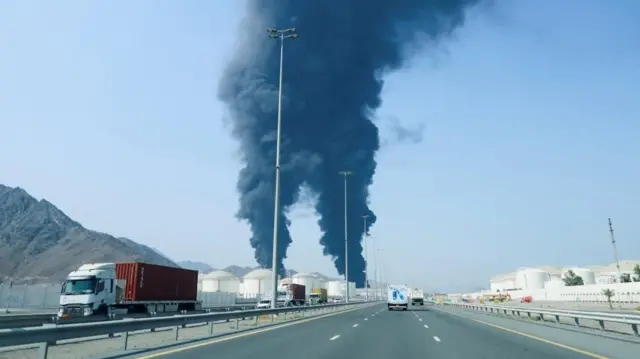
    Two columns of black smoke rise high into the sky above a motorwayImage source, Reuters
    Image caption,

    Thick smoke was seen in the Fujairah oil industry zone on Saturday

    Operations at one of the largest oil facilities in the Middle East have restarted after it was targeted by a drone strike, reports say.

    Thick plumes of smoke were seen at the port of Fujairah in the United Arab Emirates on Saturday and Fujairah officals said a fire was caused by "falling debris following the successful interception of a drone by air defenses".

    Bloomberg reports that oil loading operations at the port have now resumed, quoting several people who are familiar with the situation.

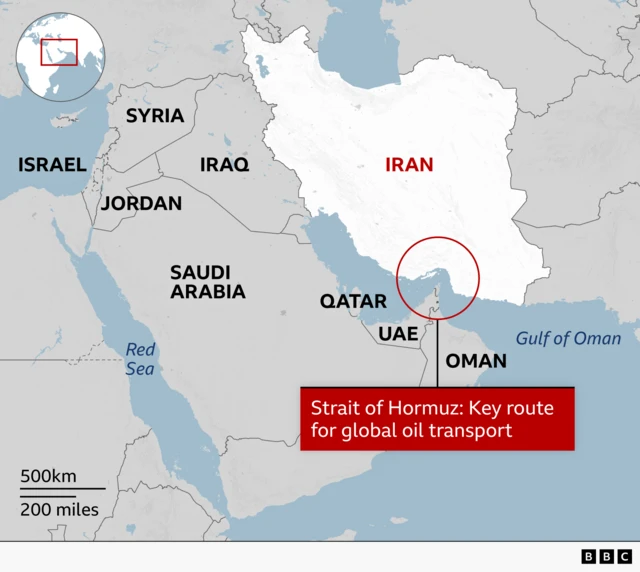
    The port is a key location for fuelling ships as it sits 70 miles from the Strait of Hormuz - meaning vessels do not need to navigate through the key oil route that has been practically cut off.

    Map showing where the Strait of Hormuz is in the Gulf of Oman, a key route for global oil transport. The strait lies between Iran and the peninsula of the United Arab Emirates and Oman. The map also shows countries in the wider Middle East region including Saudi Arabia, Iraq, Jordan and Israel
  3. Five arrested in Bahrain accused of passing information to Iranpublished at 12:43 GMT

    Officials in Bahrain say five people have been arrested for their involvement in collecting and passing on "precise and sensitive information" to the Iranian Revolution Guard Corps (IRGC).

    Bahrain's Ministry of the Interior says the arrests were also for "recruiting terrorist elements" to carry out terror plots against Bahrain.

    The ministry says a sixth individual is also on the run abroad.

  4. UAE downs further Iran missiles, says six killed in attacks since conflict beganpublished at 12:39 GMT

    We're now turning our attention briefly to some of the updates we're seeing from the Gulf nations.

    The United Arab Emirates says it has intercepted four further ballistic missiles and six drones fired from Iran.

    It also lists the total number of attacks it has intercepted since the conflict began: 298 ballistic missiles, 15 cruise missiles, and 1,606 drones.

    These attacks have resulted in six deaths and 142 "minor and moderate injuries", the ministry of defence says.

  5. Analysis

    US weapons in UK illustrate air supremacy over parts of Iranpublished at 12:27 GMT

    Chris Partridge
    BBC News weapons analyst

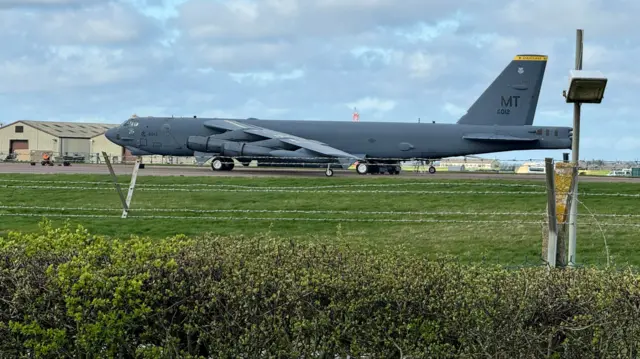
    A b-52 plane is seen behind barbed wire and a hedge at RAF FairfordImage source, Chris Partridge/BBC

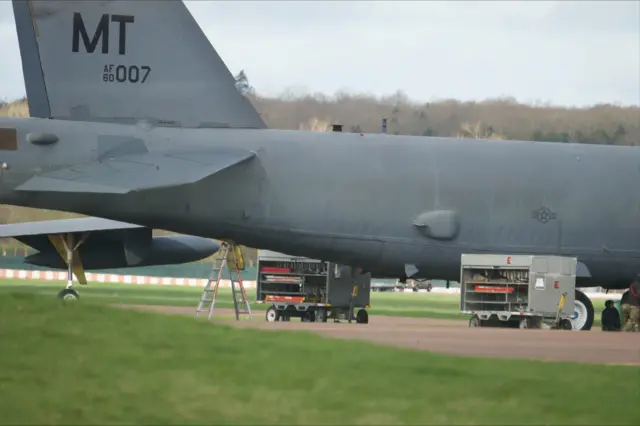
    I'm at RAF Fairford in Gloucestershire, UK, where I can see racks of GBU-31(v)3 JDAM bunker busters at the rear of one of several USAF B-52 bombers.

    These point to Secretary of Defense Pete Hegseth's comments on Friday that the US are using 99% stand-in weapons over targets now - which also illustrates a greater level of air supremacy over parts of Iran.

    These precision-guided weapons have a thickened outer casing of steel allowing them to penetrate hardened and buried targets. A delay fuse means they can detonate at various depths depending on what intelligence is advising.

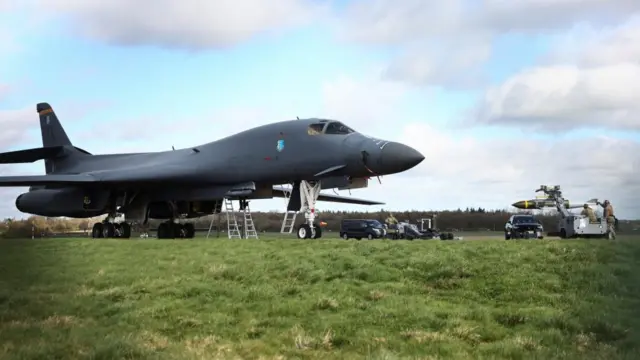
    Also here are the heavy B-1 Lancer bombers which have been carrying out frequent strikes - again using mainly GBU-31 bunker busters.

    It seems stand-off cruise missiles are still in use against Iran. I spotted a B-52 at the RAF base loaded up with AGM-158 JASSM/JASSM-ER munitions - three to a pylon on each wing.

    With a range of up to 500 miles, these missiles are used against heavily defended or high value targets where getting closer using free-fall precision guided bombs would be deemed too dangerous.

    Bombs are seen on racks towards the back of a USAF B-52 bomberImage source, Chris Partridge/BBC
    Image caption,

    Bombs are seen on racks towards the back of a USAF B-52 bomber

    A USAF B1 B bomber stands on the grass at an RAF base. A number of workers stand near a large missile nearbyImage source, Reuters
    Image caption,

    Ground crew work to remove munitions from a USAF B1 B bomber, at RAF Fairford airbase

  6. Fires burning, people running: BBC at the scene of Iranian strike in Israelpublished at 12:16 GMT

    Jon Donnison
    Reporting from Tel Aviv

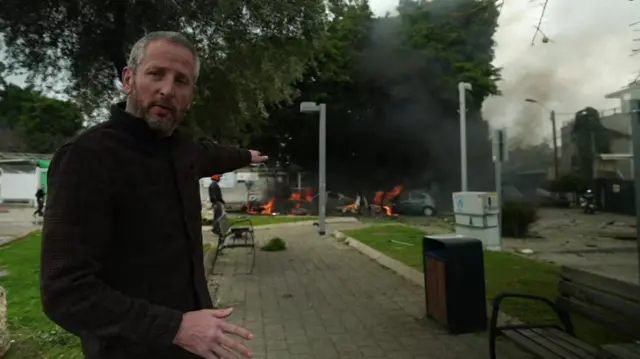
    BBC reporter Jon Donnison at scene of Israeli strike in Tel Aviv

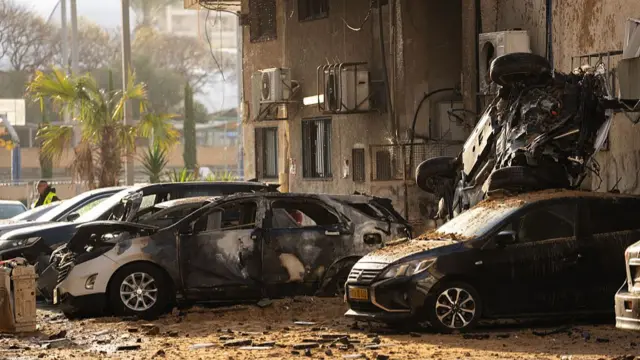
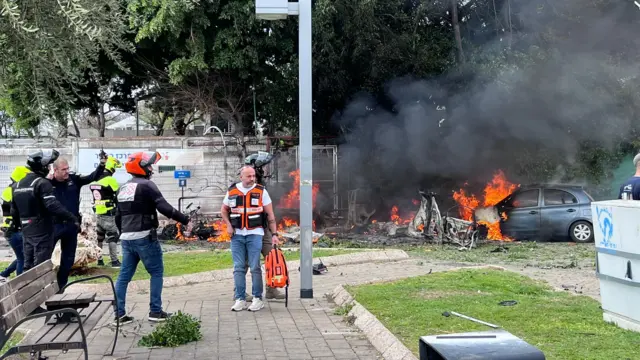
    We’re just on the outskirts of Tel Aviv where, just as we were driving in, the sirens went off.

    In front of us we can see the impact, a couple of cars have been completely destroyed, fires are burning and there’s bit of a sense of panic amongst the people here.

    There’s a lot of people running towards the area, presumably to try to find out if anyone they knew has been hurt. It’s a pretty built up residential neighbourhood.

    Most of these Iranian missiles are being shot down, but some are getting through.

    Some of these missiles break up in the sky and form these smaller cluster bombs that don’t do as much damage when they fall, but are still potentially deadly.

  7. Saudi Arabia's Prince Sultan Air Base a target for Iran's attackspublished at 12:07 GMT

    Frank Gardner
    Security correspondent, reporting from Riyadh

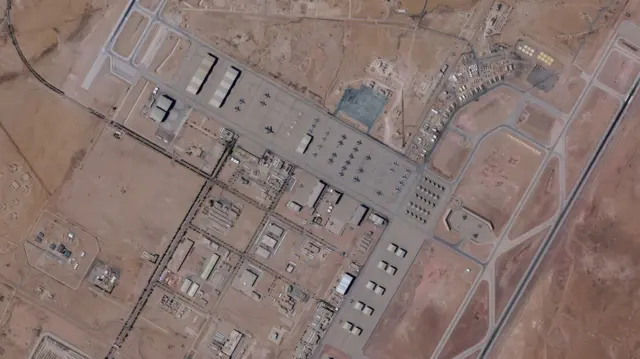
    A satellite image shows planes at Prince Sultan Air Base in Saudi Arabia February 21, 2026Image source, Reuters

    Saudi Arabia’s Prince Sultan Air Base (PSAB) at Al-Kharj, near the capital of Riyadh, has come under repeated missile and drone attack from Iran.

    The air base is home to a number of US warplanes, with the Saudi defence ministry saying it has intercepted at least 10 drones in the Riyadh and Eastern Province regions.

    Iran’s Fars news agency says it has fired a salvo missiles at the base.

  8. 'At this pace we will end up with a ruined Iran': BBC hears from Iranians after US attackpublished at 11:57 GMT

    Ghoncheh Habibiazad
    Senior reporter, BBC Persian

    Iranians have told BBC Persian they are worried that it could take years to rebuild energy facilities and Iran could become "ruined" if attacks continue at pace.

    One man describes how Kharg Island, where the US says it struck more than 90 military targets on Saturday, is a "very small island with kind people" but had not progressed much.

    "It is the Islamic Republic's fault that they were neglected," he adds.

    A man in his 20s who is not being named, from Tehran, says he strongly disagrees with the attacks and tells the BBC "at this pace we will end up with a ruined Iran".

    Another man in his 20s, from Keraj, adds: "I just hope energy facilities are not attacked.

    "It’s unclear how many years it would take to rebuild them - but I really don't care about military sites."

    BBC Persian is the Persian language service of BBC News, used by 24 million people around the world - the majority in Iran - despite being blocked and routinely jammed by Iranian authorities.

  9. Iran's late supreme leader was wary of his son taking power, sources tell CBSpublished at 11:53 GMT

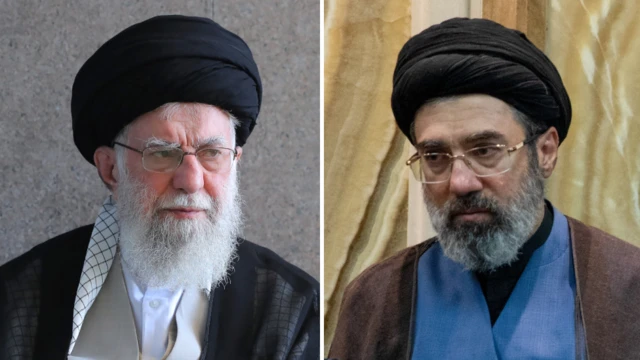
    A composite image of Ayatollah Khamenei and his son, Mojtaba KhameneiImage source, Getty Images | Reuters

    US intelligence shows that Iran's late supreme leader Ayatollah Ali Khamenei was wary of his son, Mojtaba Khamenei, taking power, sources tell the BBC's US partner CBS News., external

    The sources report that the elder Khamenei was wary of his son ever taking power because he was perceived as not very bright, and was viewed as unqualified to be leader.

    The intelligence also indicated that the father was aware that his son had issues in his personal life.

    Mojtaba Khamenei has not been seen publicly since he was elected supreme leader on 8 March, but on Sunday Iran's foreign minister said he was "in good health" and "fully controlling the situation".

  10. Israeli FM dismisses reports of missile defence shortage and Lebanon peace talkspublished at 11:38 GMT

    Israeli Foreign Minister Gideon Saar attends the inaugural Board of Peace meeting at the U.S. Institute of Peace in Washington, D.C., U.S., February 19, 2026Image source, Reuters

    Israel's Foreign Minister Gideon Saar has dismissed reports from US media outlet Semafor that Israel told the US it is running "critically low" on missile interceptors.

    "The answer is no," Saar tells reporters on a visit to a site in northern Israel damaged by an Iranian missile attack.

    He also denies reports that Israel could soon hold direct peace talks with Lebanon, claims which were reported over the weekend by Israeli newspaper Haaretz.

    He adds that Israel sees "eye-to-eye" with the US and that their objective is to "remove the existential threats from Iran for the long term".

    "We don't want to go every year to another war."

  11. More missiles fired at Israel, IDF sayspublished at 11:27 GMT
    Breaking

    A few minutes ago, the Israel Defense Forces (IDF) said it had detected another wave of Iranian missiles being fired at Israel.

    It comes less than two hours after the previous wave was reported.

  12. Charred buildings after strikes on Beirut's southern suburbspublished at 11:15 GMT

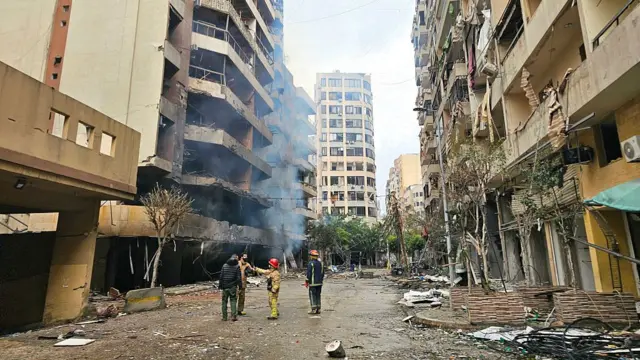
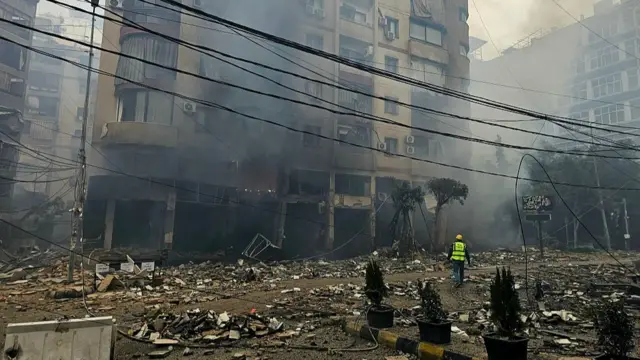
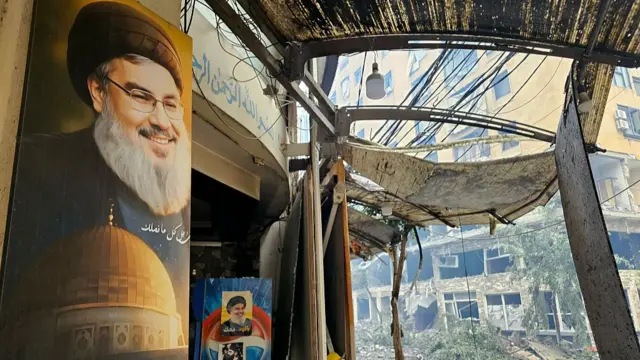
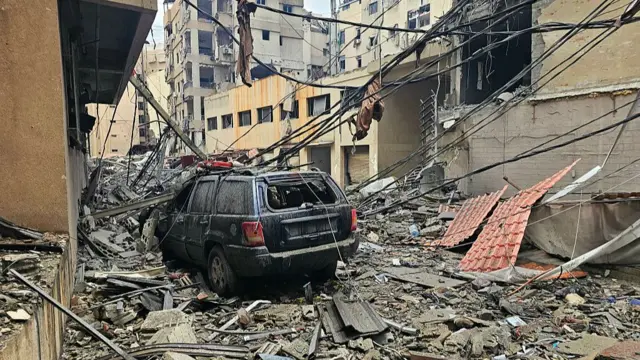
    New images show the damage caused by Israeli strikes on Haret Hreik, an area in Beirut's southern suburbs.

    Smoke rises from a charred residential block, and debris litters the street. A car has been crushed and its windows smashed.

    The neighbourhood is one of several that the IDF told people to evacuate earlier today. Strikes are aimed at Hezbollah targets in the region, the IDF says.

    Firefighters and rescuers assess the site of an Israeli airstrike on a residential blocks in Beirut's southern suburb of Haret Hreik on 15 March 2026.Image source, Getty Images
    A rescuer arrives at the site of an Israeli airstrike on a residential blocks in Beirut's southern suburb of Haret Hreik on 15 March 2026.Image source, Getty Images
    A portrait of Hassan Nasrallah, the assassinated leader of the Lebanese Shia movement Hezbollah, hangs outside a store damaged in an Israeli airstrike in Beirut's southern suburb of Haret Hreik on 15 March 2026.Image source, Getty Images
    Debris is strewn along a street and vehicles after a residential apartment block was struck in an Israeli airstrike in Beirut's southern suburb of Haret Hreik on 15 March 2026.Image source, Getty Images
  13. One person killed, three children injured in Israeli strike in Lebanon - reportspublished at 11:05 GMT

    An Israeli strike on a Lebanese town south of Beirut has killed one person and left three children injured, according to the state-run National News Agency (NNA).

    The strike occurred in Sharhabil, in the Sidon district, about 20 miles (32km) south of Beirut, NNA reports, citing the Lebanese health ministry,

  14. Strikes continue, as Trump rejects deal with Iranpublished at 10:51 GMT

    Debris is scattered around a crater and damaged cars after a projectile impact on March 15, 2026 in Holon, Israel.Image source, Getty Images
    Image caption,

    Aftermath of an Iranian drone strike in Holon, Israel

    It's now day 16 of the ongoing conflict in the Middle East. Here's what you need to know this morning:

    Strikes continue: Israel and Iran continued to exchange strikes overnight. Pictures from the Israeli city of Holon show an overturned car and a hole in the side of a residential building. Two people suffered minor injuries, according to emergency services. New strikes in the last hour also set fire to a car, and injured two men in their 50s.

    Meanwhile, the Israel Defence Forces (IDF) says it has launched further strikes on western Iran. And in Lebanon, the IDF has issued new evacuation orders for those in the southern suburbs of Beirut.

    Gulf states intercept missiles: Gulf nations reported intercepting more missiles overnight. Saudi Arabia said it had taken down 26 Iranian drones, while Kuwait said it had downed five over the previous 24 hours. Meanwhile, sirens sounded in Bahrain.

    No deal, Trump says: In a telephone interview with NBC News published late last night, US President Donald Trump said Iran wanted a deal but he was not ready for one, "because the terms are not good enough yet". He also said the US had "totally demolished" Iran's oil hub, Kharg Island, but that the US "may hit it a few more times just for fun".

    Strait of Hormuz: This morning, British Energy Secretary Ed Miliband said "any options" to get the Strait of Hormuz reopened are "being looked at". It comes after Trump called for a host of nations, including the UK, to send warships to the region. Here's how others have responded.

  15. Two treated for minor injuries after Iran's latest strike on Israelpublished at 10:37 GMT

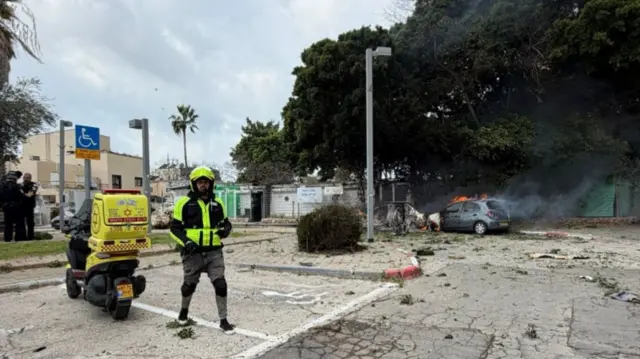
    An emergency services worker stands next to a motorbike in front of a burning carImage source, Magen David Adom

    In an update from Magen David Adom, Israel's emergency services, it says that it has now treated two men in their 50s for "minor injuries" following Iran's latest strikes.

    It previously said no casualties were reported, but that its teams were still working in the affected areas.

  16. South Korea 'monitoring' situation after Trump's call to send warships to Gulfpublished at 10:29 GMT

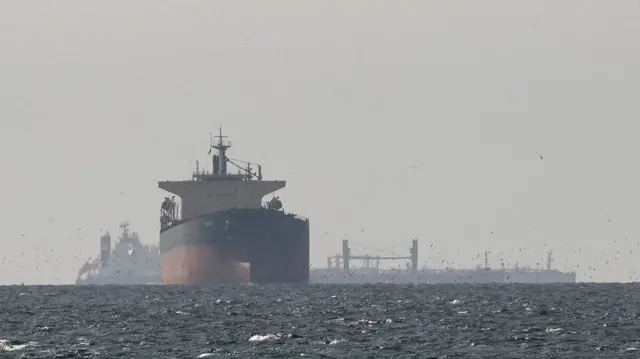
    Tankers sail in the Gulf, near the Strait of Hormuz, as seen from northern Ras al-Khaimah, near the border with Oman’s Musandam governance, amid the U.S.-Israeli conflict with Iran, in United Arab Emirates, March 11, 2026Image source, Reuters
    Image caption,

    Trump has urged several nations to send warships to the Strait of Hormuz so that it can "no longer be a threat" by Iran

    South Korea says it is "closely monitoring developments" related to the conflict in the Middle East after US President Trump called on the nation, among others, to deploy warships to the region.

    Trump yesterday urged China, France, Japan, the UK and South Korea to send ships to "get the Hormuz Strait OPEN, SAFE, and FREE!".

    A spokesperson for the South Korean Foreign Ministry says Seoul is "paying close attention" to the US president's statements and is continuing to "communicate closely" with the US.

    It says it is "exploring various measures" to protect Korean national and "ensure the safety of energy transportation routes".

  17. Car on fire and thick smoke rising after latest round of Iranian strikespublished at 10:15 GMT

    Colleagues from Jerusalem have sent us this image from the outskirts of Tel Aviv, which shows the aftermath of the latest round of Iranian strikes.

    As we said in the previous post, Israel's emergency services have said there have been no reported casualties following the attack.

    Emergency services respond at scene of fire following latest Iranian strikes on Israel. A car is seem burning and smoke is rising.Image source, Eleanor Smallwood/BBC
  18. No reported casualties in Israel after latest Iranian strikespublished at 10:07 GMT

    Israel's emergency services say there have been no reported casualties following the latest wave of strikes from Iran.

    Authorities add that search and rescue teams are continuing to work in areas where reports of strikes have been received.

  19. Another wave of Iranian missiles fired at Israel - IDFpublished at 09:50 GMT
    Breaking

    The Israel Defence Forces (IDF) has issued a new warning, saying it had detected missiles being fired from Iran.

    It is the fifth wave in the space of nine hours.

    The IDF is encouraging people in affected areas to shelter.

  20. US accuses Iran of making false claims about aircraft carrierpublished at 09:46 GMT

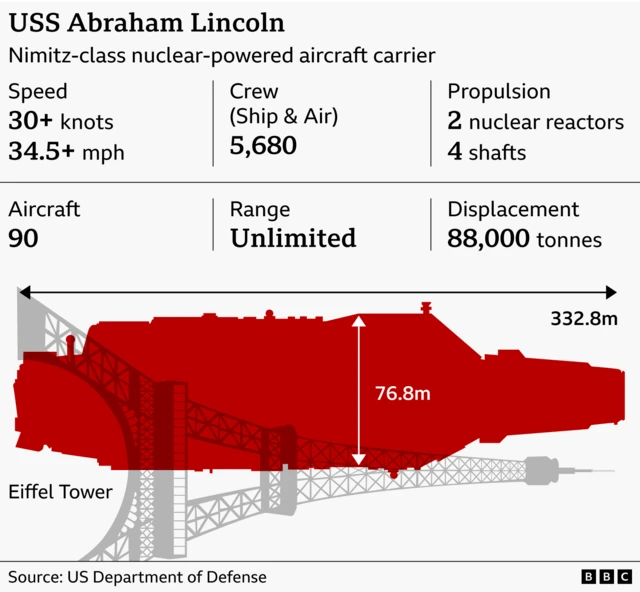
    US Central Command (Centcom) has accused the Islamic Revolutionary Guard Corps (IRGC) of spreading false claims about the aircraft carrier USS Abraham Lincoln.

    On its Farsi page on X, Centcom writes that the IRCG has "once again" claimed to have "disabled" the warship.

    "Let us be clear: the Abraham Lincoln carrier strike group continues to maintain complete dominance over Iran's airspace from the expanse of the sea," it says.

    The US began building up its military presence in the Middle East in the lead-up to the conflict. As well as the Lincoln, the US Navy's largest aircraft carrier, the USS Gerald Ford, is also operating in the region.

    It has also been widely reported in US media that the US is sending additional forces to the Gulf, including what’s known as an amphibious ready group (ARG), with up to 5,000 Marines and sailors.

    The amphibious assault ship USS Tripoli is expected to join the existing armada.

    USS Abraham Lincoln, Nimitz-class nuclear-powered aircraft carrier graphic showing speed 30+ knots 34.5pmh crew (ship & air) 5,680, propulsion 2 nuclear reactors 4 shafts aircraft 90 range unlimited displacement 88,000 tonnes and comparison in size with Eiffel Tower