Summary

  • US President Donald Trump arrives in Switzerland to meet world leaders at a summit in Davos

  • It comes as US Treasury Secretary Scott Bessent says the UK is "letting us down" by handing over sovereignty of the Chagos Islands to Mauritius

  • UK Prime Minister Keir Starmer tells his MPs he will not "yield" to pressure from Trump

  • Earlier in Davos, UK Chancellor Rachel Reeves said she "would never rule anything out" when asked if the UK would impose retaliatory tariffs on the US

  • It comes after Trump says he will add a 10% tariff to goods imported from eight European countries that oppose his plan to take over Greenland

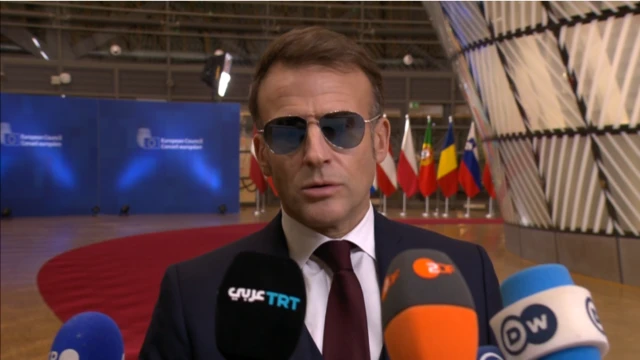
  • On Tuesday, French President Macron said the EU could consider a series of retaliatory options including a "trade bazooka"

  1. Watch: Trump's arrival in Switzerlandpublished at 12:26 GMT

  2. 'I will not yield to Trump's pressure on Greenland' - Starmerpublished at 12:23 GMT

    Starmer in the House of Commons.Image source, UK PARLIAMENT

    We can bring you some comments now from Keir Starmer on both Greenland and the Chagos deal.

    Speaking at Prime Minister's Questions in the House of Commons, Starmer vows: "I will not yield. Britain will not yield on our principles and values about the future of Greenland under threats of tariffs."

    Starmer reiterates his stance on the future of Greenland and says Trump's threats to impose tariffs on countries that oppose him are "completely wrong".

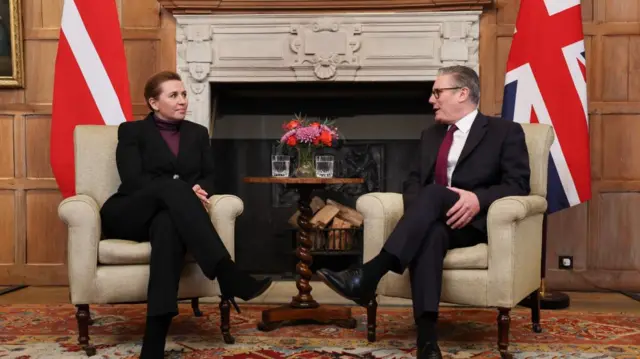
    He also says the prime minister of Denmark is coming to the UK tomorrow for bilateral talks.

    It comes after US Treasury Secretary Scott Bessent said the UK is "letting us down" by handing over sovereignty of the Chagos Islands to Mauritius.

  3. Analysis

    Will it be showdown or climbdown in Davos?published at 12:17 GMT

    Nick Beake
    Europe correspondent

    Europe is about to find out which Donald Trump has barrelled into the Swiss Alps.

    Will it be a continuation of the explosive social media persona - or a more conciliatory figure

    Before flying to Switzerland, the president teased he has a plan for Greenland that everyone will be happy with, without giving any details.

    It's hard to see how he can solve so neatly a crisis of his own making.

    Particularly one in which he insists he absolutely must take over a territory belonging to an EU and Nato member - for global security – and at a time when the White House is refusing to take off the table the threat of military force to achieve that aim.

    Trump departing Air Force One.Image source, Reuters
  4. Trump's team also arrive in Switzerlandpublished at 12:15 GMT

    Disembarking just before the US president were some members of his inner team, who he's brought with him to Davos.

    So far we've seen Chief of Staff Susie Wiles, US Secretary of State Marco Rubio, and Press Secretary Karoline Leavitt walking off the plane.

    Here's a reminder of who the White House said would be accompanying Trump.

    Three members of the teamImage source, Reuters
  5. Trump boards helicopter on way to Davospublished at 12:11 GMT

    Trump walking towards helicopter.Image source, US POOL

    We've just seen Donald Trump leave Air Force One at Zurich Airport and make his way to the helicopter that will transfer him to Davos.

    He briefly stopped on the tarmac as reporters shouted questions at him.

    Trump on tarmac.Image source, Getty Images
  6. Trump disembarks Air Force One - watch livepublished at 12:06 GMT
    Breaking

    TrumpImage source, US POOL

    We've just seen US President Donald Trump disembark from Air Force One.

    You can watch live above - stay with us.

  7. Trump set to leave Air Force One - watch livepublished at 11:59 GMT

    Door of Air Force One plane.Image source, EBU

    We're waiting for US President Donald Trump to leave Air Force One before continuing his journey to Davos to meet world leaders.

    It's not clear whether he'll make any comments before he departs, but we'll be listening across.

    Stay with us for the latest.

  8. US treasury secretary says UK is 'letting us down' with Chagos dealpublished at 11:41 GMT
    Breaking

    Jack Fenwick
    Political correspondent

    While we wait for President Trump to get off his plane, and then head to Davos, here are some new comments from his Treasury Secretary Scott Bessent.

    He says the UK is "letting us down" by handing sovereignty of the Chagos Islands to Mauritius.

    Yesterday, Downing Street said it still believed the US supported the deal, despite President Trump's social media post calling it an "act of great stupidity".

    Bessent says: "President Trump has made it clear that we will not outsource our national security or our hemispheric security to any other countries.

    "Our partner the UK is letting us down with the base on Diego Garcia [where the US-UK military base is], which we had shared together for many, many years and they want to turn it over to Mauritius.

    "So President Trump is serious here."

    • As a reminder, the UK government said on Tuesday "the base on Diego Garcia was under threat after court decisions undermined our position... this deal secures the operations of the joint US-UK base on Diego Garcia for generations". As part pf the deal to hand over the Chagos Islands, the UK will pay to lease the base there for 99 years, with an option to extend for another 40 years.
  9. Trump lands in Switzerland for World Economic Forumpublished at 11:36 GMT
    Breaking

    A plane landed on tarmac that says United States of America on the side.Image source, DC POOL

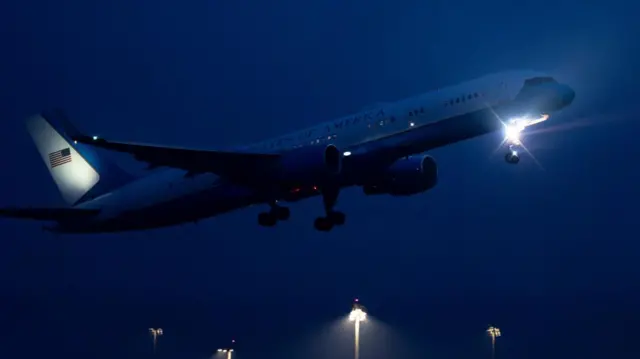
    The US presidential plane Air Force One has just touched down on the tarmac in Zurich, Switzerland.

    First on the day's agenda for President Trump is a reception with business leaders, before he makes a speech to the World Economic Forum later.

  10. Trump expected to land in Switzerland - watch livepublished at 11:25 GMT

    A runway with planes parked in a rowImage source, Reuters

    We're waiting for the arrival of US President Donald Trump in Switzerland, which is expected shortly.

    Trump's journey to Switzerland was delayed earlier, after Air Force One was forced to turn back to an air base in Maryland following a "minor electrical issue".

    You'll be able to watch his arrival live at the top of the page, and we'll bring you all the key moments here.

  11. Analysis

    Tariff threats can work both ways, but success not guaranteedpublished at 11:18 GMT

    Jonathan Josephs
    Business reporter

    It's clear from President Trump's words that he thinks trade and tariffs give him influence when it comes to Greenland.

    But that can work both ways.

    The EU-US trade deal that's been in the works since July is being suspended, and later today we're expecting a news conference from the chair of the European Parliament's international trade committee Bernd Lange about that.

    Without parliamentary backing or another suspension from EU member states, tariffs on €93bn worth of goods that America sells to the EU will come into force next month, everything from livestock to aircraft parts to whiskey.

    That will disappoint US exporters who were hoping the deal would increase their sales in Europe.

    With mid-term elections in the US later this year they could push the president to tone down his use of tariffs.

    Whether they're successful is another question.

  12. UK chancellor 'not ruling out' retaliatory tariffs on USpublished at 10:58 GMT
    Breaking

    Faisal Islam
    Economics editor, in Davos

    Reeves smiling in front of 'World Economic Forum' advertisingImage source, Reuters

    Chancellor Rachel Reeves says "we would never rule anything out" about retaliatory tariff measures, following growing concerns over Trump's threats to raise tariffs over Greenland.

    Speaking to the BBC at the World Economic Forum in Davos, she says the UK "would not be buffeted around" and would be acting in the national interest when dealing with the US on trade which means "bringing down trade barriers with countries around the world".

    It was only in May 2025 that the UK secured an agreement with the US on trade measures following global tariffs announced on "liberation day".

    Then, this weekend, President Trump threatened to add a 10% tariff to "any and all goods" imported from eight European countries from 1 February, including the UK, if those countries oppose his proposed takeover of Greenland.

    French President Emmanuel Macron says the EU could consider a series of retaliatory options, but the UK chancellor tells the BBC she's had assurances from the US commerce secretary that the "US-UK trade deal will stand".

  13. We can't drop the ball on Ukraine, says Nato secretary generalpublished at 10:57 GMT

    Mark RutteImage source, Reuters

    "The main issue is not Greenland now, the main issue is Ukraine", says Nato Secretary General Mark Rutte in Davos.

    Speaking on a panel at the World Economic Forum, Rutte says he is "a little bit worried that we might drop the ball focusing so much on these other issues".

    Despite losses in the tens of thousands in December, Russia is still increasing its attacks on Ukraine, he says.

    Rutte adds that progress on peace talks and a newly-agreed €90bn loan to Ukraine from the EU commission shouldn't give Europe's Nato members the idea that they can "forget about the defence of Ukraine".

    "They need our support now, tomorrow, and the day after", he says. "I need European allies to keep focus on this issue."

  14. Analysis

    Suspicion and anxiety in Ukraine over shaky security guaranteespublished at 10:49 GMT

    Laura Gozzi
    Europe reporter, in Kyiv

    At any other time, Ukraine could have been at the centre of the discussions at Davos - especially after the diplomatic momentum of the last few months.

    But this time, Donald Trump's escalating rhetoric over Greenland means that the ongoing war in Ukraine may be overlooked.

    Last week, President Zelensky said he was going to travel to the forum in the hope of signing documents on security guarantees to put off Russia from invading again in the future.

    But the developments of the last few days have made some seriously question whether Ukraine could still consider security guarantees from the US as rock solid.

    Many Ukrainians are convinced that, even if the fighting stopped, Moscow would always demand more of their country. "We have been fighting the Russians for hundreds of years, and we always will" is a common sentiment here in Kyiv.

    Shaky security guarantees from a partner who can row back on them at any point will be viewed with extreme suspicion and anxiety in Ukraine.

    Now it seems Zelensky is not going to Davos at all. Some Ukrainians will welcome the decision, which will spare him the embarrassment of being relegated to the sidelines.

    But it also means more space for the Russian delegation - whose head, Kirill Dmitriev, gleefully stated that "more and more people are recognising the correctness of Russia's position" after meeting with US envoy Steve Witkoff.

  15. Analysis

    Cautious Europe facing up to new realitypublished at 10:43 GMT

    Paul Kirby
    Europe digital editor

    Ursula von der Leyen, a white lady with blonde hair, wearing a green jacket and white shirt standing behind microphones.Image source, Reuters
    Image caption,

    "We are at a crossroads," Ursula von der Leyen told the European Parliament on Tuesday

    For all Europeans, not just Danes and Greenlanders, President Trump's intense focus on taking control of Greenland has called into question security and the US alliance they have taken for granted for so long.

    The head of the EU's executive Commission, Ursula von der Leyen, sought to capture the mood in Strasbourg this morning when she said Europe needed to "speed up its push for independence".

    The cold reality for Europeans is that they now feel they can no longer take the US for granted to help protect them from outside threats. That may well be true for the wider Nato alliance, as much as it is for the EU.

    "We are at a crossroads," she told the European Parliament. "We need our own strategic approach."

    One of the problems the EU always has to overcome is that it's made up of 27 democracies that don't always agree - which makes for a response to events that is often slow and often cautious.

    Take last year when EU leaders appeared to dither for weeks as Ukraine's financial needs became increasingly urgent with the loss of US financial support under Trump.

    In the end a €90bn support package was agreed last month, but Ukraine remains the EU's biggest security issue and there is no sign that Russia is ready to end almost four years of full-scale war.

    "We will need a departure from Europe's traditional approach of caution," von der Leyen warned. There is widespread agreement on this, but no clear path for it to happen.

    In our next couple of posts, we'll take a closer look at how Ukraine fits into the wider anxieties across Europe as Trump doubles down on his plan to own Greenland.

  16. Time has come to stand up to Trump, says former Nato chiefpublished at 10:36 GMT

    Anders Foh Rasmussen speaking into a webcam

    The former secretary-general of Nato, Anders Fogh Rasmussen, says the time of flattering President Trump "has ended" and we can now expect a "more firm response" from Europe.

    Rasmussen, who is also the former Danish prime minister, tells the BBC that if Trump carries out the extra tariffs on eight European countries, retaliatory tariffs should be introduced, as "Trump only respects force and strength".

    He tells the BBC that Nato wouldn't survive if Trump carried out his threat to take over Greenland.

    "Time has come to stand up against Trump," he adds.

  17. What sort of welcome will Trump get at Davos?published at 10:23 GMT

    Media caption,

    Will Trump get friendly welcome as world leaders meet in Davos?

    The World Economic Forum has been dominated by Trump's ambition to take control of Greenland, even before he has arrived in Switzerland.

    The BBC's economics editor Faisal Islam explains whether Trump can expect to receive the warm reception he's used to in Davos.

  18. With Trump's focus on Greenland, Zelensky skips Davospublished at 10:05 GMT

    Wyre Davies
    Reporting from Kyiv

    Volodymyr Zelensky speaking behind a podium with microphones on it, wearing black.Image source, EPA/Shutterstock

    In his recent New Year address and then after the “Coalition of Willing” summit in Paris, Volodymyr Zelensky was upbeat about hopes for a ceasefire – saying he thought an agreement to end the war with Russia was "90% ready".

    The Ukrainian leader and his European allies expected that agreement, which would include post-war security guarantees for Ukraine and a multi-billion-dollar "Prosperity Plan" would be ready for signing or, at the least, there would be further discussions at Davos.

    But Zelensky is not going to Switzerland – officially because of the severe energy crisis across Ukraine after intense Russian bombing of the country’s power infrastructure.

    But the Ukrainian leader has also admitted, that with Donald Trump's attention focused elsewhere, there is nothing to sign and he was "choosing Ukraine over an economic forum".

  19. Analysis

    The EU's 'trade bazooka' - what you need to knowpublished at 09:44 GMT

    Hugh Schofield
    Paris Correspondent

    The "Anti-Coercion Instrument" (ACI) which President Macron has spoken of was approved by Brussels in 2023 in order to deter attempts by outside powers to force policy changes on the EU or member states.

    At the time the main threat was seen as coming from China, which had recently "punished" Lithuania for its links with Taiwan by putting restrictions on bilateral trade.

    Today there would appear to be a clear-cut case of another outside power - the United States - using commercial muscle to change European policy on Greenland.

    In these circumstances, the "anti-coercion instrument" is an added weapon in the EU trade arsenal.

    If there is agreement that coercion has been attempted by an outside power, and if negotiations to resolve the conflict fail, then the EU has enhanced powers to retaliate "within international law".

    According to the EU, "The ACI permits import and export restrictions to be placed on goods and services, but also on intellectual property rights and foreign direct investment.

    "Additionally, the ACI enables the imposition of various restrictions on access to the EU market, notably to public procurement, as well as the placement on the market of products under chemical and sanitary rules."

    The ACI has never been used. Last year, during the negotiations over tariffs between the US and the EU, there was talk of the EU invoking it but it never happened.

  20. Trump's strong words on Greenland and Natopublished at 09:30 GMT

    Trump grips on to the podium while delivering his briefing in the White House press roomImage source, Reuters

    On Tuesday, President Trump attended the White House media briefing - a rare appearance - to mark the one-year anniversary of his second inauguration.

    Here's a recap of what we heard about Greenland and Nato:

    "You'll have to find out," Trump said when asked how far he is willing to go to acquire Greenland.

    He said there is "no going back" on his plan, claiming: "Greenland is imperative for national and world security."

    When asked whether the possible break up of Nato was a price he was willing to pay for Greenland, Trump responded: "Nobody has done more for Nato than I have, in every way. Nato is going to be happy and we are going to be happy..."

    But he earlierquestioned if Nato would come to aid of the US. "I know we'll come to [Nato's] rescue, but I just really do question whether or not they'll come to ours," he told reporters