Summary

  1. That's a wrap for COP30published at 20:20 GMT 22 November 2025

    Georgina Rannard
    Climate and science correspondent in Belém

    Exhausted delegates are trickling out to catch planes home and another tropical storm is battering the roof. The man sitting next to me gave me a parting gift - a chocolate bar reading “last chance for our rainforests”.

    Here are the key takeaways from the closing day of the summit:

    • After a bitter row over fossil fuels (by far the largest contributor to climate change) a deal passed that contained no direct reference to them
    • Brazilian President Luiz Inácio Lula da Silva and more than 80 countries including the UK and EU lost a battle to advance commitments made two years ago to move away from fossil fuels
    • But some parties, such as oil-producing nations, are happy about the outcome, saying they have the right to decide on how to tackle climate change at their own pace
    • Rich countries committed to triple finance for poor countries to help them adapt to climate change - roughly $120bn of the $300bn climate finance goal will now be dedicated to adaptation measures in the most vulnerable countries
    • Some progress was made on tackling deforestation, including the establishment of a fund called Tropical Forest Forever Facility, which has raised $6.6bn
    • This was a challenging summit, with many countries saying opinions are more divided now than for a long time, as global leaders including US President Donald Trump challenge the global consensus on tackling climate change

    Personally, I’ve found it fascinating going to a climate meeting in the Amazon. The astonishing ecosystem is at terrible risk from ongoing climate change but it is also the source of many solutions - which have been on display during this two-week meeting.

    I will take away from this COP that despite the difficulties in getting everyone to agree on how to tackle climate change, real-world solutions are being implemented at speed almost everywhere.

    We're now closing our live coverage for today - thanks for joining us.

  2. What was the impact of the US absence?published at 19:55 GMT 22 November 2025

    Mark Poynting
    Climate reporter

    Official delegations from more than 190 countries were at COP30 – but not the US.

    Under the Trump administration, the US will withdraw from the Paris climate agreement, which underpins global efforts to tackle rising temperatures.

    While the UN would have undoubtedly preferred to have the US engaged in the process, some observers were relieved they would not be there to obstruct efforts to secure a deal – as happened in the global shipping negotiations in October.

    “The US only scored an own goal with its absence. It disabled its own ability to engage on critical climate and energy issues with other major countries,” says David Waskow, international climate action director at the World Resources Institute.

    “If they don't want to be part of the electro-tech revolution, God bless… it’s their loss,” adds Christiana Figueres, former UN climate chief.

    But the concern for those who want to see more ambitious climate action is that the US climate rollbacks have emboldened other nations to do the same – making global agreements more challenging.

    “With shifts in US climate leadership, we’re likely to see climate action increasingly driven by coalitions of willing nations and industries rather than unified global frameworks,” says Dr Jesse Abrams of the University of Exeter.

  3. This year's COP took place in 'stormy political waters', says UN climate chiefpublished at 19:44 GMT 22 November 2025

    Esme Stallard
    Climate reporter

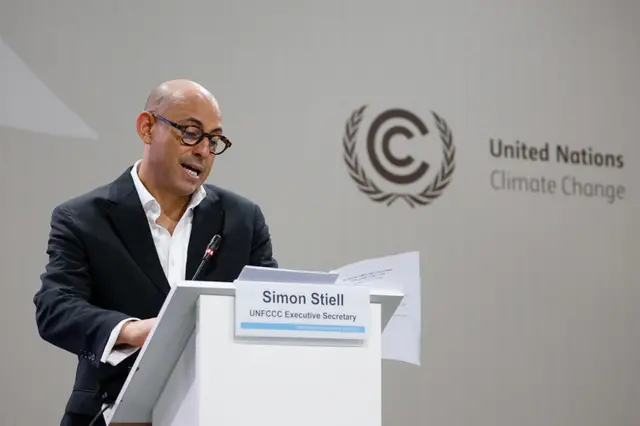
    A man in a black suit with a white shit wearing brown framed glasses stands in front of a lecturn with his name "Simon Stiell UNFCCC Executive Secretary" across the front. In the background is a white wall and the words "United Nations Climate Change" in brown with the UNFCCC logo on the left.Image source, UN Climate Change/Zô Guimarães

    The UN's climate chief Simon Stiell has praised the efforts of countries in turning up in Brazil and continuing to discuss the issue of climate change. He says the conference showed that "climate cooperation is alive and kicking, keeping humanity in the fight for a liveable planet."

    But he acknowledges the challenges that countries have faced in getting a deal.

    "We knew this COP would take place in stormy political waters. Denial, division and geopolitics has dealt international cooperation some heavy blows this year," he says. "This year there has been a lot of attention on one country stepping back."

    Stiell did not name the US specifically, but the absence of the US from the talks and recent decisions by President Donald Trump to rollback on the country's climate commitments has hung heavy over the talks.

    Since taking office Trump has pulled the US out of the Paris Agreement and just days before the end of the COP30 talks said he was opening up new areas off the coast of the country for oil and gas drilling to secure economic progress.

    The overwhelming consensus from scientists is that burning fossil fuels is the primary driver of global temperature rise and changes to extreme weather.

  4. UN Gender Action Plan approvedpublished at 19:25 GMT 22 November 2025

    Georgina Rannard
    Science correspondent

    The meeting has just passed a new "Gender Action Plan".

    It instructs countries to improve the representation of women at the talks and to make sure their climate policies addressed how women and girls are impacted.

    Representatives for Argentina, Paraguay, Russia and the Holy See made speeches on the floor criticising the plan. They objected to the term gender equality, and instead said it should refer to the biological sexes men and women.

    Bridget Burns, executive director of the Women's Environment & Development Organization (WEDO), based in the US, says the plan has "significant wins... a mandate to protect and safeguard women environmental defenders...and opportunities to the link between climate and care work, health and violence against women."

    Women and girls are disproportionately affected by climate change, according to the UN.

    Women make up 35% of delegates at COP30, according to the WEDO.

  5. Did this Amazon COP do anything for forests?published at 19:13 GMT 22 November 2025

    Esme Stallard
    Climate reporter

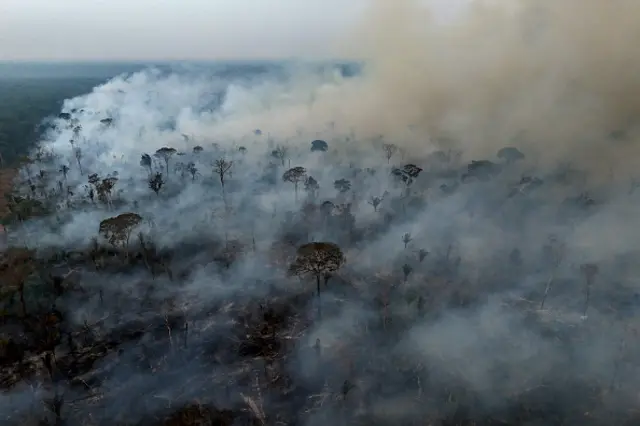
    Amazon rainforest with a fire and smoke risingImage source, AFP

    As my colleague Matt in Belém has written, hopes that this COP's setting on the edge of the Amazon would focus diplomats' attention on deforestation have fallen short.

    But COP30 did see some commitments to protecting forests at a regional level and by individual countries.

    • Brazil launched its flagship forest fund (TFFF), which has seen close to $6bn (£4.59bn) pledged for communities working to protect rainforests
    • France, along with other EU members, launched a $2.5bn conservation scheme for the Congo Basin - the second largest tropical forest globally - to combat forest loss from agriculture
    • There was also recognition of four new indigenous territories in Brazil
    • The governor of the state of Pará, where Belém is located, committed to tagging all 20 million cattle in the region to more easily track deforestation

    Toerris Jaeger, Executive Director of Rainforest Foundation Norway, praised President Lula's efforts in making forests the focus of this COP and said it had "summoned both money and political will."

  6. The fight is over - and the meeting turns to technical detailspublished at 19:02 GMT 22 November 2025

    Georgina Rannard
    Climate and science correspondent in Belém

    The COP president do Lago has now managed to calm the assembled delegates and find a solution to the angry objections raised by Colombia and several other countries.

    He has promised them that the issue of stronger language on moving away from fossil fuels can be raised again in six months time at an interrim COP meeting.

    As the Amazonian rain drips onto my laptop and the delegates in front of me, do Lago goes through the other texts dealing with other issues in the UN talks.

  7. No signs that this row is going awaypublished at 19:00 GMT 22 November 2025

    Georgina Rannard
    Climate and science correspondent in Belém

    The COP president has promised a solution to countries objecting that they could not register their concerns over the fossil fuel content of the deal.

    He said that they can raise it at a future meeting in six months time.

    But Saudi Arabia has now challenged that offer and asked for clarity. Negotiators say that Saudi Arabia blocked a stronger deal on fossil fuels during these two weeks of talks.

    Saudi Arabia's representative says she wants to ensure this is not "establishing a precedent whereby those did not get what they want beforehand, negotiate that in plenary."

    This is all quite technical - but we are following it to understand how it could affect the overall outcome of this meeting.

    We should find out very soon.

  8. COP president apologises as meeting restartspublished at 18:37 GMT 22 November 2025

    Georgina Rannard
    Climate and science correspondent in Belém, Brazil

    COP president do Lago has now re-opened the plenary.

    He says he is tired, and apologises for missing the objections raised by Colombia and other countries, including Uruguay and Chile.

    He blames his "advanced age", which gets a chuckle in the room.

    He says he has consulted lawyers, who say the deal that was passed cannot be re-opened to add in stronger language about fossil fuels.

    But Colombia is determined to have something stronger on moving away from fossil fuels - and will be consulting its own lawyers.

  9. How unusual is this backlash?published at 18:15 GMT 22 November 2025

    Mark Poynting
    Climate reporter

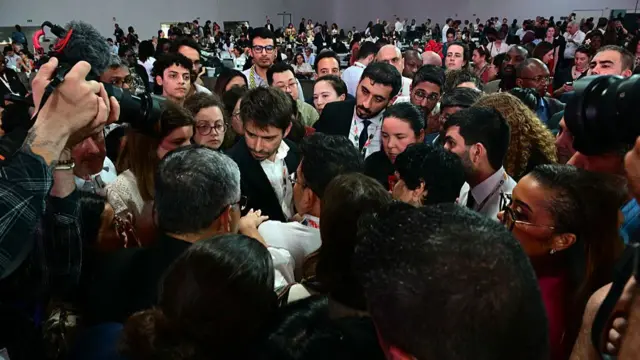
    Several people stand in a huddle in deep discussionImage source, TOM INGHAM / BBC
    Image caption,

    Delegates discuss next steps during the delay

    As my colleague Georgina in Belém has just explained, the headline deal has been passed.

    But the delay, prompted by angry objections by Colombia and others, is unusual.

    The assumption was that once the main deal had been passed, things would run relatively smoothly until everything else on the agenda had been gavelled through.

    It's common for countries to voice their opinion about a deal - to say that it wasn't perfect but they accepted it anyway.

    Usually, the presidency notes these concerns in their report, but carries on anyway.

    It appears, however, that Colombia and others aren't accepting this as a solution - so what happens next isn't clear.

  10. The skies open as presidency tries to work out what to dopublished at 18:09 GMT 22 November 2025

    Georgina Rannard
    Climate and science correspondent in Belém, Brazil

    COP30 sceneImage source, AFP/Getty Images
    Image caption,

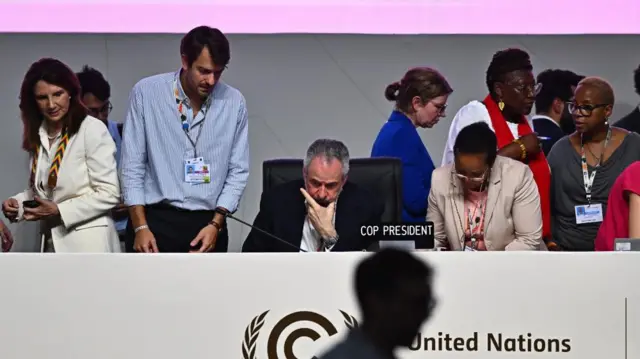
    Negotiators from various countries speak to representatives of the COP30 presidency after the plenary session was interrupted

    This COP is in the Amazon, so we’ve got Amazonian weather.

    Torrential rain is pounding down on the tent roof above us, threatening to drown out voices in the room.

    I can see the COP president on stage, his head leaning on his hand, apparently contemplating what to do next after Colombia and other countries raised strong objections over the deal passed in the last hour.

    I’m finding out what options the president has now - more on that shortly.

  11. Analysis

    What exactly does this 'deal' mean?published at 17:53 GMT 22 November 2025

    Matt McGrath
    Environment correspondent in Belém

    So what has actually happened here in Belém?

    After two weeks of tough talking, negotiators have approved a key agreement by consensus, despite it being massively disappointing for at least half the countries at this COP.

    The deal that’s been done, though, is mainly a re-iteration of stuff that’s already been agreed at previous meetings.

    There is nothing clear or obvious about a move away from fossil fuels. There is nothing much about stopping deforestation. There is some commitment of money for poorer countries to cope with climate impacts, but it’s the equivalent of “the cheque’s in the post.”

    The president of the COP did announce two “roadmaps” on deforestation and one on transitioning away from fossil fuels, but these are mostly a sop to the audience here who desperately wanted those issues mentioned in the main text but couldn’t overcome the objections of others including Saudi Arabia, Russia and India.

    These “roadmaps” have no legal standing and are little more than a crumb of comfort.

    As one observer said – they’d never seen so many people so underwhelmed by so little progress at a COP.

    Of course, not all countries will be disappointed in the outcome tonight. Those who are large producers of fossil fuels or whose economies are dependent on them will welcome the pause in ambition.

    It's been a complicated COP with a complicated outcome and it's emblematic of a wider world where there's increasingly less consensus on what to do about global warming.

  12. What is happening now at the COP30 final meeting?published at 17:41 GMT 22 November 2025

    Georgina Rannard
    Climate and science correspondent in Belém, Brazil

    COP30 closing meeting venueImage source, COP30

    That's the question we're asking ourselves. There's a real sense of chaos and confusion in here.

    The final meeting has been suspended.

    The COP30 president is on stage with the UN climate chief Simon Stiell - they're likely discussing what to do about Colombia's angry objection.

    A huge crowd of country delegates and media are huddled around Colombia's representative as she explains why she made an objection.

    She says the COP procedures weren't followed, and their point of view wasn't allowed to be heard.

    Once a deal has been passed here, it can't be undone.

    But the COP president may be trying to see if Colombia's point of view can be included in other smaller deals yet to be passed.

  13. Analysis

    Brazil will make its own 'roadmaps' - but these will carry less weightpublished at 17:39 GMT 22 November 2025

    Mark Poynting
    Climate reporter

    As we've reported, Brazil has announced plans for "roadmaps" to move away from fossil fuels and halt and reverse deforestation.

    The idea is to set out a clearer path for how countries intend to meet these pledges, which were agreed at previous conferences.

    The plan for roadmaps had support from dozens of countries - but also faced strong opposition. In the end, the opposition won.

    The deal agreed doesn't include any reference to those roadmaps - so there's no new ambition on fossil fuels or deforestation.

    As a compromise, the Brazilian hosts will start their own initiatives, which willing countries can sign up to.

    But this will carry much less weight than if it had been part of the main deal, which would have had the backing of all countries.

  14. Which countries are the barriers to a fossil fuel deal?published at 17:33 GMT 22 November 2025

    Mark Poynting
    Climate reporter

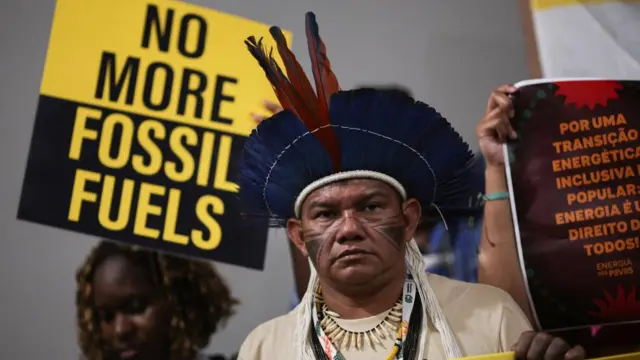
    Indigenous people protest against fossil fuels during COP30Image source, Reuters

    As we've mentioned, dozens of countries have supported Brazil’s call for a fossil fuel "roadmap" - a plan for how to move away from coal, oil and gas, the main causes of climate change.

    But the idea has strong opposition, particularly from major fossil fuel producers.

    French Environment Minister Monique Barbut said yesterday that the deal was being blocked by "oil-producing countries - Russia, India, Saudi Arabia, but joined by many emerging countries".

    The reasons are obvious. These countries either have huge reserves of fossil fuels or rely heavily on them to power their economies.

    Some developing countries argue they should be allowed to exploit their reserves as other countries have done in the past.

    And they have often argued for the focus to be on reducing emissions, rather than fossil fuels.

    But without technologies to capture the emissions from fossil fuels – which are not widely available – burning more coal, oil and gas means more warming.

    And that would mean climate change continuing to get worse.

  15. More than 80 countries have called for plan to quit fossil fuelspublished at 17:21 GMT 22 November 2025

    The UK is among a group of countries that has rejected the new deal that omitted any mention of fossil fuels, by far the largest contributor to climate change.

    More than 80 countries have called on a plan to quit fossil fuels altogether.

    An earlier text of the agreement included three possible routes to achieve a phase-out, but that language has been dropped after opposition from oil-producing nations.

    A letter co-signed by the UK reads: "We express deep concern regarding the current proposal under consideration for a take it or leave it."

    In 2023, at COP28 in Dubai, world leaders agreed to transition away from burning planet-warming fossil fuels. It was the first time climate talks addressed fossil fuels head-on. But a roadmap to make that happen still hasn't materialised.

  16. President suspended meeting after Colombia's angry speechpublished at 17:18 GMT 22 November 2025
    Breaking

    Georgina Rannard
    Climate and science correspondent in Belem

    COP30 President André Corrêa do Lago has just suspended the talks after Colombia's angry intervention.

    He says he'll now consult with countries.

    It's a sign this might not be over after all.

    "What do you expect when you don't listen?" an observer sitting next to me from an NGO called Plant for the Planet said.

  17. 'You are leaving us with no other choice but to object'published at 17:17 GMT 22 November 2025

    Georgina Rannard
    Climate and science correspondent in Belém, Brazil

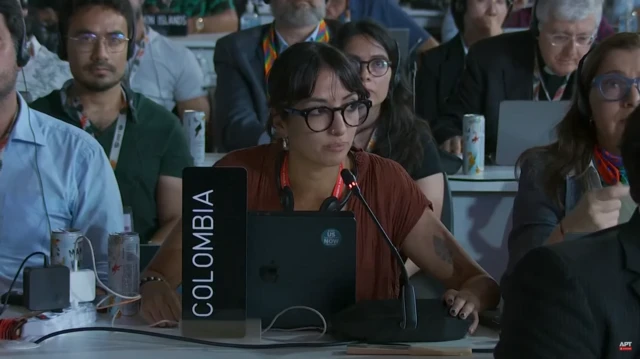
    Delegate for Colombia mid-speech. She's a young woman with black hair pulled back in a ponytail and thick rimmed glassesImage source, UN Climate Change

    More from Colombia now.

    The country’s representative is telling the plenary that Colombia objects to what it calls a weak deal on fossil fuels.

    She says they raised a point of order earlier but were ignored.

    "You are leaving us with no other choice but to object," she says.

    She offers alternative language that mentions fossil fuels.

    "This is the COP of truth and trust. You are leaving us with no other option after the procedural issues seen in this plenary," she says.

    A round of applause breaks out when she finishes.

    Colombia is one of the global leaders in reducing the use of fossil fuels and has led the charge at this COP.

  18. Deal 'falls far short' of addressing challenges faced by vulnerable countries - Colombiapublished at 17:07 GMT 22 November 2025

    We're now hearing Colombia's response to the COP30 deal - and it's one of disappointment.

    "This was meant to be the COP of adaptation," the representative says, yet the outcome "falls far short of reflecting the magnitude of the challenges that parties - especially the most vulnerable - are confronting on the ground."

    She says the views of parties were "not meaningfully reflected", despite the "long hours" spent in debate during the conference.

    The Colombia representative adds the final text "does not capture the full breadth of positions expressed throughout the negotiations".

  19. 'Science prevailed, multilateralism won' - Brazil's presidentpublished at 17:03 GMT 22 November 2025

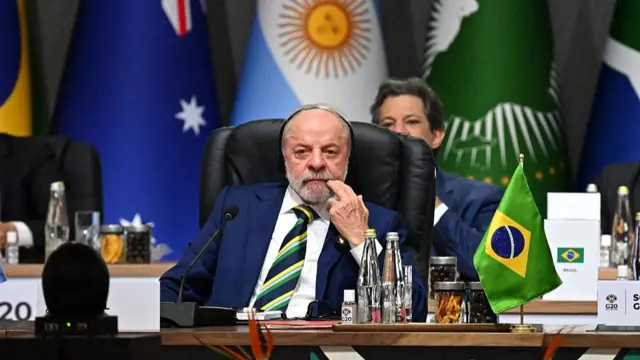
    Brazil's President Luiz Inácio Lula da Silva during the opening plenary session at the G20 Summit on 22 November 2025 in Johannesburg, South Africa ahead of the G20 SummitImage source, Getty Images

    Brazilian President Luiz Inácio Lula da Silva has praised the COP30 deal, saying "science prevailed, multilateralism won".

    Speaking from the G20 summit in South Africa before the final meeting begins, he says: "In the year when the planet surpassed for the first time - and perhaps permanently - the limit of 1.5C above pre-industrial levels, the international community faced a choice: to continue or to give up.

    "We chose the first option."

    In his statement, he also refers to COP30 as "the COP of truth".

  20. COP30 deal 'takes many steps forward', says UK's Ed Milibandpublished at 16:57 GMT 22 November 2025

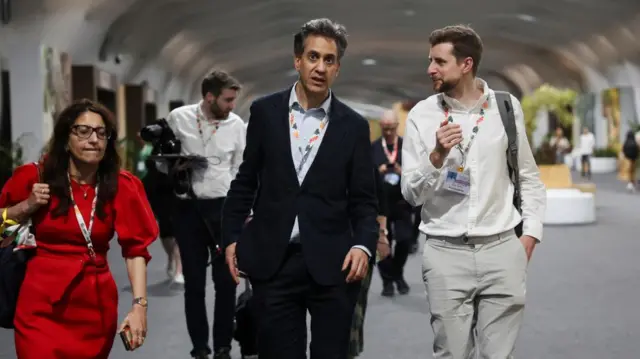
    UK Energy Secretary Ed MilibandImage source, Reuters

    UK Energy Secretary Ed Miliband has welcomed COP30's decision to approve the new deal on climate, saying the 193 countries behind the agreement "fought hard for this outcome".

    However, he admits the deal "does not have all the ambition we would have wanted", but adds that it commits to keeping the 1.5C target alive, triggers the launch of a roadmap on the transition away from fossil fuels, and takes other steps forward on issues from forests to adaptation.