That's all - for nowpublished at 21:41 GMT 17 March
That brings to an end our live coverage of tonight's televised debate in Wrexham, thanks for joining us.
For a full round-up of tonight's events and all the reaction, you can click here.
Labour, Conservatives, Plaid Cymru, Reform, Liberal Democrats and the Greens set out their visions for the country at the Your Voice live debate in Wrexham
Questions range from how to "fix our broken NHS?" to the cost of a bigger Welsh Parliament and help for young people at university
Wrexham's Hollywood owners Ryan Reynolds and Rob Mac are credited with doing more for the north Wales economy than politicians
The debate comes less than seven weeks before the election for the Welsh Parliament
That brings to an end our live coverage of tonight's televised debate in Wrexham, thanks for joining us.
For a full round-up of tonight's events and all the reaction, you can click here.
David Deans
Wales political reporter
At the end of the debate Labour's cabinet secretary for transport says he thinks the cost of going to university would have put him off if he was still looking at whether to study now.
Ken Skates said he was "the first person ever in the history of my family to have gone to university".
But adds: "I wouldn’t have gone there had I been in education today looking at whether I should go to university or take an apprenticeship because of the cost."
 Gareth Lewis
Wales political editor
Some eye-catching pledges on reducing the debt burden for Welsh students.
The Conservatives would refund some tuition fees, the Lib Dems think a free university education is a "right" and Plaid says it would look to abolish tuition fees "in the long term".
The question revolves around money.
But none of the three parties mentioned above say how much their plans would cost or how they'd pay for them.
David Deans
Wales political reporter
Carrie Harper says her son has just finished a degree and is incredibly worried about the debt he will face.
"Our long-term vision in Plaid Cymru would be to abolish tuition fees," she says, but she adds universities are in "crisis" in terms of funding.
The funding structure needs to be reviewed urgently, she says.
The party says students studying outside of Wales could lose a £1,000 grant - Harper says "we need to make sure we are retaining the best talent we can here in Wales".
Ken Skates says students in Wales should be congratulated wherever they go to university.
"You shouldn't use debt as a hook to bring people back," he says.
He accepts it's incredibly challenging for students today.
"We have the most generous maintenance package in the UK."
Reform’s James Evans says it is important to support young people "whatever route they decide to take".
He says there is "no easy answers" to student debt.
"We do need to look at how we fund our universities across Wales, we need to look at tuition fees, but it has to be done in a fiscally responsible way," he said.
He says it isn't the job of politicians to tell people where to continue their education.
Lee Lavery says university "is a great leveller" adding that he met a broad range of people from all walks of life when he went but points out that finances are a huge issue.
David Deans
Wales political reporter
The fourth and final question is about how young people will be funded to go through university?
Sam Rowlands says students should not be burdened "for the rest of your life" with a student loan.
He says the Tories would refund those who train in Wales as a doctor, dentist or a nurse if they commit to Wales for five years after they have been trained.
Tim Sly of the Welsh Liberal Democrats says he is not here to defend Nick Clegg's tuition fee policies.
"We are where we are in terms of tuition fees today." he says.
He adds student debt hangs over you for your whole working life and that his party would "significantly increase the threshold at which you start the repayment".
Gareth Lewis
Wales political editor
Some clarity on Reform’s position regarding the expansion of the Senedd.
Panelist James Evans says the party does'’t want money spent on more politicians.
But would the party try to scrap the expansion if it runs the next welsh government?
A party spokesperson confirms it is against the expansion and says: "We don't think it's realistic to say we will reverse the increase because we'd need a super majority to do it and the polling doesn't suggest that we will have a super majority.
"It would undermine trust for us to campaign for a reversal while knowing we can't deliver it."
David Deans
Wales political reporter
Sam Rowlands agrees with Sid - £120m on more politicians "is not the right way to spend taxpayers money".
He says a Conservative budget understands that you "have to watch your pennies".
Tim Sly says the Lib Dems "are not talking about unfunded promises" about backing major projects.
"We are being honest and realistic about what it is going to take."
Meanwhile Ken Skates denied that Cardiff Airport had been a "financial blackhole", as it is suggested to him.
David Deans
Wales political reporter
The third question of the evening goes to Sid Robbins who asks if money is tight is expanding the Senedd a good idea?
James Evans says Reform does not want to see more money spent on expanding the Senedd chamber and nor does the public.
He says he would have preferred the cash used to expand the Senedd on doctors and nurses.
Asked if he would reduce the number of councils in Wales, he says "everything should be on the table".
Lee Lavery says a lot of the issues seen in health, transport and education is down to a lack of adequate governance.
He says his party will not talk about independence for the next Senedd but wants Wales to be "more confidence".
Carrie Harper says the Senedd was "always too small" and a lot of power had been devolved since 1999.
She says more politicians is necessary "if we want a fit for purpose democracy".
Meanwhile, she says Plaid would not look at increasing income tax.
Antonia Matthews
BBC Wales
One audience member quips "three men have done more for the economy in north Wales than anybody, from my view, in the Welsh Senedd, and that's a gentleman called Thomas Telford, Ryan Reynolds and Rob Mac".
His comments are applauded by other members of the audience who cheer at the names of the Wrexham AFC co-owners Rob Mac and Ryan Reynolds.
 Image source, Getty Images
David Deans
Wales political reporter
Ken Skates says two big road schemes in north Wales will go ahead in Wrexham and Deeside.
He agrees with David and says he got into politics because he was concerned "the north was losing out".
Skates promises the first new station in north Wales by the end of next year.
Lee Lavery complains that Wales is not benefiting from HS2 funding over the border, while Tim Sly says Wales has been short-changed by “arbitrary decisions”.
James Evans says certain parts of south Wales had been neglected too.
He says when you look at funding other issues like health should be considered too.
In north Wales, Reform want to see upgrades to the A55, he says, and a bigger drive for tourism.
Gareth Lewis
Wales political editor
First fireworks on the night, no surprise, comes on the NHS.
Plaid's Carrie Harper accuses Reform of planning to introduce an insurance-based health service.
This is something sources told BBC Wales last summer would be unlikely to happen because of potential legal difficulties.
Reform's James Evans retorted that the party would keep the NHS free at the point of use, but did not directly answer the accusation about insurance.
David Deans
Wales political reporter
The next question comes from David Sumner, who says North Wales seems to be the “poor relation in terms of investment.” What will the parties do?
Sam Rowlands says he agrees and says north Wales gets overlooked compared to south Wales. “Investment in infrastructure is absolutely fundamental,” he says, saying the region needs rail and road investment. He says the proposed investment in nuclear reactors is welcome but more like that is needed.
Carrie Harper says David “makes a fair point”. She complains of austerity from the previous UK government and "managed decline” under Labour. “The real scandal is in Westminster,” she says, complaining of how it funds the Welsh government.
Gareth Lewis
Wales political editor
A pointed opening first question from Toni, who used the term "broken" to describe the Welsh NHS.
It's a term that's also been used by opposition parties in their criticism of the ruling Labour party.
It is something that Labour's Ken Skates did not push back on directly tonight, highlighting instead "record investment".
David Deans
Wales political reporter
Carrie Harper accuses Reform of wanting to bring in an insurance-based health care system, which the party denies.
She says Plaid has a "concrete plan" to introduce 10 new surgical hubs and would invest in tackling corridor care.
Harper says the party has already published detailed plans on the NHS based on recommendations by experts.
Lee Lavery from the Greens says it isn't the time for "finger pointing" and says there needs to be strong governance.
"Lets look responsible for actually doing these things and who has not been picking them up on that," he said.
David Deans
Wales political reporter
Tim Sly of the Welsh Liberal Democrats says there is care in corridors and ambulances that can’t discharge because many people who are medicaly fit "are stuck in hospital because there’s nobody to care for them at home”.
He says the Lib Dems would "fix social care" with a £380m investment.
James Evans of Reform says there needs to be a "never event" declared on corridor care.
"We've got too many people stranded on hospital wards, adding "step down" care in community hospitals are needed.
He says he believes there are too many health boards - and says there is too much duplication. The current structure "is fundamentally broken and doesn't work".
Antonia Matthews
BBC Wales
An audience member said she had worked in the NHS since 1968.
She said: "I'm retired. We've experienced corridor care twice now and it's horrific.
"And, it's so sad. I think the horrendous thing is we saw the same people quite a few months apart, but [they] were coming back and we need a sort of acute mental health service because not many of the people in A&E were casualties."
David Deans
Wales political reporter
The first question is from Toni Wood, who asks about the NHS and the "epidemic of corridor care". How will our panellists “fix our broken NHS?"
Ken Skates' party has run the Welsh NHS since 1999. He tells the programme Welsh Labour is "utterly committed" to the service, but said that for "far too long" there was a lack of investment from the previous Conservative UK government.
He says the "taps have been turned on" from Labour in Westminster and as a result waiting lists have dropped for seven months.
Sam Rowlands for the Conservatives says the NHS is a "disaster" in Wales - not the fault of doctors and nurses but the fault of Labour's government.
"Under Labour 20% of beds have been removed in the last 25 years," adding that the Tories would declare a health emergency.
Gareth Lewis
Wales political editor
As the candidates prepare for the debate and Wales gears up for the election, it does not mean that work in the Welsh Parliament has stopped.
There are another two working weeks of Senedd business left, before parliament breaks for Easter recess and is officially dissolved next month.
Tonight is a significant one with a law likely to be passed that would ban greyhound racing and another that would require you to register if you rent out accommodation to visitors on platforms such as Airbnb.
Also likely to go through is legislation that would make it illegal for politicians to lie during future Senedd election campaigns.
Its supporters have described it as “pioneering”, some of its opponents fear that it would stifle free speech.
It will be up to the next Welsh government - after the election this May - to introduce and define a criminal offence of deception.
Cemlyn Davies
Wales political correspondent
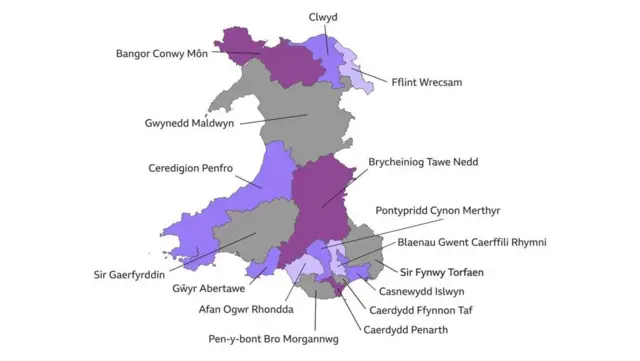
A brand new set of constituencies has been created for this election as part of wider changes to the way the Senedd is elected.
Here's a brief guide to the new electoral map.
Cemlyn Davies
Wales political correspondent
On 7 May voters will head to the polls for the next Senedd election.
It promises to be the most consequential election to Cardiff Bay since the National Assembly for Wales, as it used to be called, was established in 1999.
That is largely because of major reforms to the way the Senedd is elected.
At the moment the Welsh Parliament, or Senedd Cymru, is made up of 60 politicians.
Forty of those represent an individual constituency, who are elected via the first-past-the-post system, where the candidate with the most votes wins the seat.
The remaining 20 Members of the Senedd (MSs) are regional politicians, with five regions represented by four regional MSs each.
These members are elected via a proportional system with the number of politicians elected from each party based on the proportion of votes each party gets.
At the next election the 40 constituencies and five regions will disappear and Wales will be divided into 16 large constituencies.
Each one will be represented by six MSs as the total number of politicians in Cardiff Bay increases from 60 to 96.
