Summary

  1. Trump issues 48-hour deadline to Tehranpublished at 03:50 GMT

    Donald Trump gestures as he steps from Air Force One upon his arrival in West Palm Beach.Image source, Reuters

    US President Donald Trump has issued Iran with a new 48-hour deadline to re-open the Strait of Hormuz, after which he says the US will "obliterate" Iranian power plants.

    Iran has said that if its fuel and energy infrastructure is struck, it will retaliate by targeting US-linked energy infrastructure across the region, according to state media.

    In the past few hours, we've also received reports of a military helicopter crash in Qatar, and an "incident" involving a projectile on a vessel off the coast on the UAE.

    That followed Iranian strikes on southern Israel, with more than 120 people reported injured across the towns of Dimona and Arad.

    We are wrapping up our coverage here, but for all the latest developments on the conflict in the Middle East, head over to our new live page.
  2. UAE intercepts Iranian missile and drone strikepublished at 03:24 GMT

    Missile and drone attacks launched from Iran are being intercepted by the UAE, the country's Ministry of Defence says.

    "The sounds heard are the result of the air defence systems intercepting missiles and drones," it said in a post on X early on Sunday.

  3. 'Nothing worse than being forced from home', Iranians tell BBCpublished at 02:47 GMT

    Iranians inside the country have been speaking with BBC Persian about their experiences during the war.

    One woman in Tehran has said that, in her view, "nothing is worse than being forced to leave your home". She says that she hasn't had to leave for now, but "I am still afraid, I won’t pretend I’m not, but at least I have my own belongings around me".

    She says her thoughts are with those who had to leave: "For those who have lost their homes and become displaced, that is terrible. ... Honestly, I hope everyone who has been forced from their homes anywhere in the world can one day return. Losing your home is worse than the war itself."

    • BBC Persian is the Persian language service of BBC News, used by 24 million people around the world - the majority in Iran - despite being blocked and routinely jammed by Iranian authorities.
  4. Military helicopter crashes into waters off Qatar, defence ministry sayspublished at 02:12 GMT

    Qatar's defence ministry says one of its helicopters crashed into the country's territorial waters after suffering a "technical malfunction".

    Authorities launched a search and rescue operation for the helicopter's crew and passengers, Qatar's Ministry of Defence said in a statement published by state media.

    It was carrying out a "routine duty" when it crashed, officials said.

  5. Iran to target US-linked energy sites if power plants attacked - state mediapublished at 01:41 GMT

    Iranian state media says that the country's military would target US-linked energy infrastructure across the Gulf region, if Iran's own fuel and energy facilities were hit.

    The warning came following a fresh ultimatum issued by President Donald Trump, who said that the US would "obliterate" Iranian power plants if Tehran failed to re-open the Strait of Hormuz within 48 hours.

  6. In-person classes cancelled across Israel - education ministerpublished at 01:14 GMT

    All in-person classes in Israel scheduled for Sunday and Monday have been cancelled, the Israeli education minister says.

    Writing on X, Yoav Kisch says that in light of the missile strikes in Dimona and Arad on Saturday evening, "no frontal learning" will take place for the next two days, including special education classes.

    Kisch adds that a new situation assessment will be carried out before Tuesday to decide whether in-person schooling can resume.

  7. Netanyahu pledges to strengthen defences after Arad strikepublished at 00:52 GMT

    The Israeli prime minister says he's spoken with the mayor of Arad after what he describes as a "very difficult evening" for the city.

    Emergency services in Israel say 88 people have been taken to hospital after an Iranian strike on the southern Israeli city.

    Netanyahu writes on X that he will bolster emergency and rescue forces "operating in the field right now" as he urges people across the country to abide by security instructions.

    "We are determined to continue to strike our enemies on all fronts," he adds.

  8. Incident involving vessel off coast of UAE, maritime body confirmspublished at 00:44 GMT

    The United Kingdom Maritime Trade Operations (UKMTO) says that it has received a report of an incident on a vessel 15 nautical miles (27km) north of Sharjah, a city in the United Arab Emirates.

    It said that the captain of a ship reported an explosion from an unknown projectile in "close proximity" to the vessel.

    All crew have been reported safe, the UKMTO confirmed.

  9. Trump's new deadline - how much time does Iran have?published at 00:34 GMT

    President Donald Trump has just issued Iran with a fresh deadline to re-open the Strait of Hormuz, after which he says the US will "obliterate" Iranian power plants.

    The president was clear in his post to Truth Social. Iran has 48 hours "from this exact point in time" to open the waterway fully and "without threat".

    Trump posted at 23:44 GMT on 21 March. That means Iran has until 23:44 GMT on 23 March (03:14 in Tehran on 24 March), to open the Strait.

  10. Strait of Hormuz - why is it significant?published at 00:19 GMT

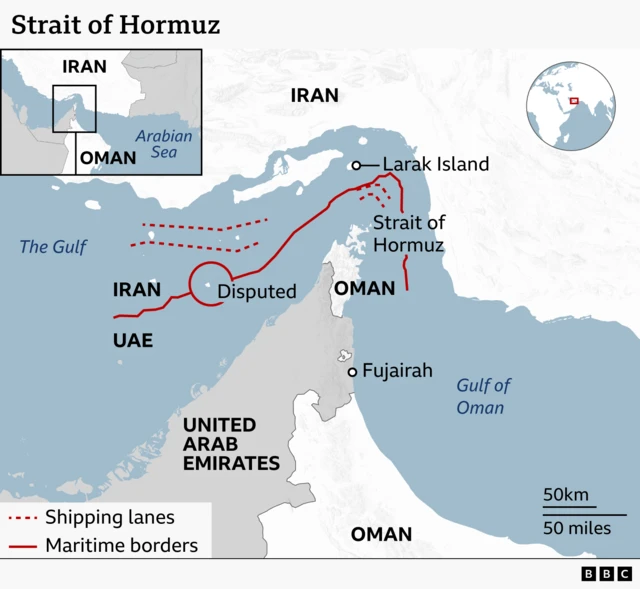
    The Strait of Hormuz, a narrow shipping route in the Gulf region, is one of the world's most important shipping routes. Bounded to the north by Iran and to the south by Oman and the United Arab Emirates (UAE), the Strait of Hormuz connects the Gulf with the Arabian Sea. The strait is deep enough for the world's biggest crude oil tankers, and is used by the major oil and gas producers in the Middle East - and their customers.

    As a reminder, Iran has effectively blocked the Strait of Hormuz, one of the world's busiest oil shipping channels, since the US and Israel attacked the country on 28 February.

    Bounded to the north by Iran and to the south by Oman and the United Arab Emirates (UAE), the waterway - only about 50km (31 miles) wide at its entrance and exit, and about 33km wide at its narrowest point - connects the Gulf with the Arabian Sea.

    About 20% of the world's oil and liquefied natural gas (LNG) usually passes through the strait, with oil coming not only from Iran but other Gulf states such as Iraq, Kuwait, Qatar, Saudi Arabia and the UAE.

    What is the impact of closing the strait?

    About 3,000 ships usually sail through the strait each month but this has dramatically decreased recently, with Iran threatening to attack tankers and other ships.

    At least 21 vessels have been hit or targeted, or have reported attacks, since the start of the war, according to an AFP news agency tally on 18 March.

    Global fuel prices have soared in the wake of the war. Crude oil has risen above $100 a barrel - up almost 70% this year and nearly 50% from a year ago.

    You can read more about why the Strait of Hormuz matters so much here.

  11. Trump gives Iran 48-hour deadline to open the Strait of Hormuzpublished at 23:52 GMT 21 March
    Breaking

    The US president has just posted again on Truth Social, saying that the US will "obliterate" Iran's power plants if the country doesn't open the Strait of Hormuz "without threat" within 48 hours.

    Here is the post in full:

    If Iran doesn’t FULLY OPEN, WITHOUT THREAT, the Strait of Hormuz, within 48 HOURS from this exact point in time, the United States of America will hit and obliterate their various POWER PLANTS, STARTING WITH THE BIGGEST ONE FIRST!

  12. Emergency services say 88 people taken to hospital following Arad strikepublished at 23:48 GMT 21 March

    Israel's Magen David Adom emergency service has issued another update on this evening's missile strike in Arad, reporting 88 people have been injured and taken to hospital as of 01:20 local time (23:20 GMT).

    Of the 88 people receiving treatment, 10 are severely injured, 19 are moderately injured, and 55 have minor injuries.

  13. Iranian strike causes heavy damage in Aradpublished at 23:20 GMT 21 March

    We're now starting to get some pictures from the earlier strike on the southern Israeli city of Arad.

    Emergency services say 10 people were severely injured in the attack.

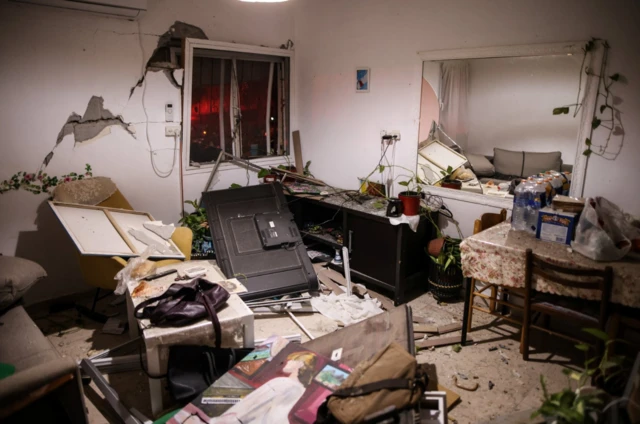
    The inside of what appears to be a living room in an apartment bloc in Arad following a missile strike. There's exposed parts of concrete walls without missing chunks of plaster, windows with no glass and furniture overturned on the floor. Debris, including pieces of wood and glass litter the floorImage source, Reuters
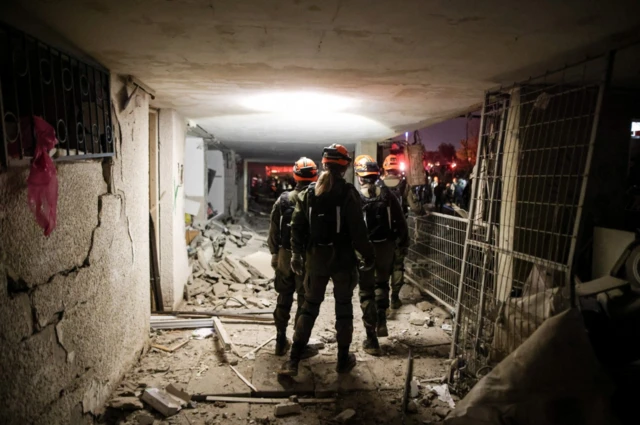
    Emergency respondents in heavy duty gear walk along the entrance corridor of an apartment bloc, debris and pieces of wall littering the ground, red lights shining in the distanceImage source, Reuters
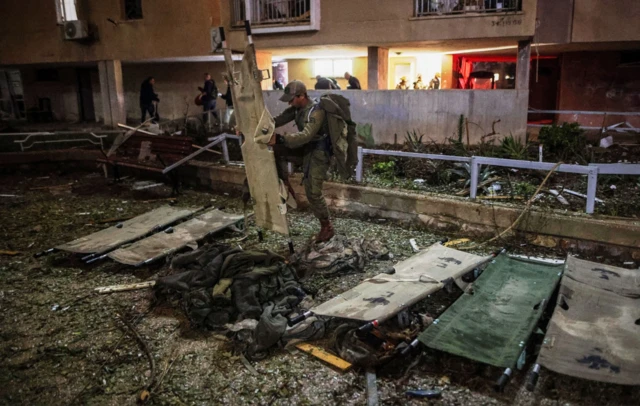
    An Israeli soldier prepares stretchers at the impact site after Iranian missile barrages struck residential buildings in AradImage source, Reuters
  14. 'Iran wants to make a deal. I don't,' says President Trumppublished at 22:47 GMT 21 March
    Breaking

    In the last few minutes, US President Donald Trump has shared some fresh comments on Iran on his social media platform, Truth Social.

    Trump says the US has "blown Iran off the map" as he addresses recent analysis from the New York Times about his war record.

    He dismisses suggestions that he has failed to achieve his goals in Iran, saying: "Yes I have, and weeks ahead of schedule.

    "Their leadership is gone, their navy and air force are dead, they have absolutely no defense and they want to make a deal. I don't."

  15. Ten severely injured in southern Israel strike - emergency servicespublished at 22:32 GMT 21 March
    Breaking

    The Magen David Adom ambulance service has issued a further update on this evening's missile strike in Arad.

    MDA says that, as of 00:11 local time (22:11 GMT), 75 people are receiving treatment - including ten who are severely injured.

    Another 13 are presenting with moderate injuries while 48 have minor ones, the service adds as it notes the injured are being evacuated to local hospitals via "MDA intensive care vehicles, and MDA and Air Force helicopters".

  16. Analysis

    There's important caveats to consider when discussing Iranian missile capabilitiespublished at 22:20 GMT 21 March

    Joe Inwood
    World news correspondent

    The suggestion that Iranian missiles could - theoretically - reach European capitals will no doubt cause concern for the continent.

    “It complicates the job of missile defence across that area,” says Justin Crump of intelligence company Sibylline. “It certainly focuses thinking of European capitals.”

    There are, however, important caveats.

    Iran will have a very limited stock of these missiles. Launching them takes time, making them vulnerable to US and Israeli strikes.

    On top of that, Crump says they are incredibly inaccurate at the sort of range needed to target Europe.

    For him, the key lesson from the attempted strike on Diego Garcia may not be about the capability of the missiles, but of the forces firing them.

    “Iran is still able to surprise the US and Israel after three weeks of bombing. Their forces may be degraded, but they are not on the ropes."

  17. Iran entering 'new phase' of war - Iran's parliamentary speakerpublished at 22:04 GMT 21 March

    Ghoncheh Habibiazad
    Senior reporter, BBC Persian

    Iranian Parliament Speaker Mohammad Bagheri Ghalibaf has posted on his account on X that “it appears that the time has come to implement the next pre-planned strategies” about the war with Israel and the US.

    “If Israel is unable to intercept missiles in the heavily protected Dimona area, it is, operationally, a sign of entering a new phase of the conflict. Israel’s skies are defenceless,” Ghalibaf says.

  18. MDA has taken 64 to hospital in Aradpublished at 21:46 GMT 21 March

    In an update on Telegram, the Magen David Adom emergency service says it has transported 64 injured people to hospital after an Iranian strike on Arad.

    The MDA has used ambulances and helicopters to transport the injured. Seven people are in serious condition, 15 people are moderately injured, and 42 people have light injuries, it says.

  19. Photos show crews working at site of Dimona missile strikepublished at 21:22 GMT 21 March

    We're starting to see some photos of the site of a missile strike by Iran on the Israeli city of Dimona.

    Crews can be seen working at a residential area - the remains of a family home can be seen, as can a damaged apartment building.

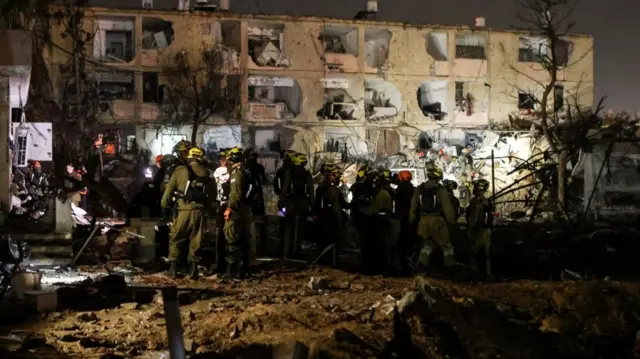
    Emergency crews gather in front of an apartment building. The windows of the building are blown out. The area is lit by flood lamps.Image source, Reuters
    Image caption,

    Workers assess the damage of an apartment building

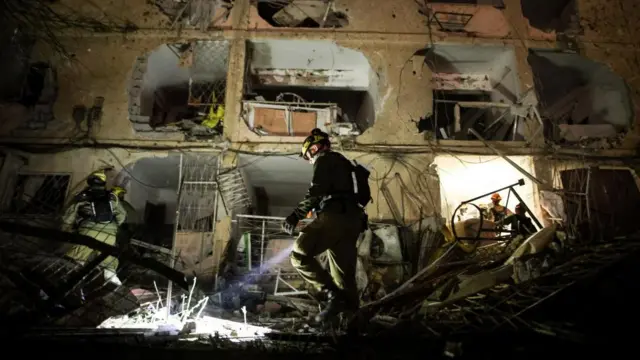
    An Israeli soldier uses a torch to inspect the damageImage source, Reuters
    Image caption,

    An Israeli soldier uses a torch to inspect the damage

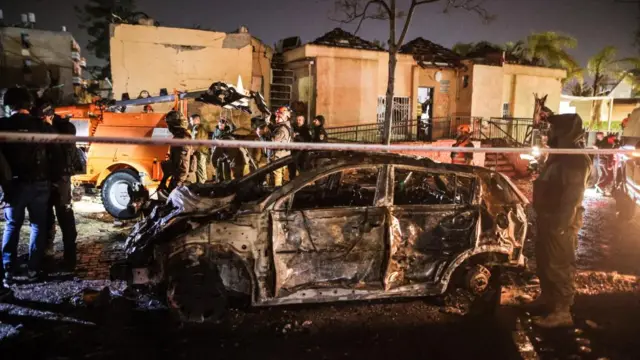
    The burnt out shell of a car is shown, with emergency tape in the foreground. workers can be seen inspecting damage and congregate around the car. a house is in the background.Image source, Reuters
    Image caption,

    The remains of a car can be seen near the site of the strike

  20. More than 30 people in hospital after Arad strike - MDApublished at 21:02 GMT 21 March
    Breaking

    We can bring you a further update from Arad, southern Israel, where the Israeli emergency service is responding to a new Iranian strike.

    Magen David Adom says 33 people have been taken to hospital, including four who are seriously injured, 12 who are moderately injured and 17 who are lightly injured.

    It says its teams will continue to "scan for additional injured people".