Summary

Media caption,

Rwanda and DR of Congo leaders sign peace deal in Washington

  1. 'Even-handed' Trump praised as Rwanda and DR Congo leaders commit to peacepublished at 19:33 GMT 4 December 2025
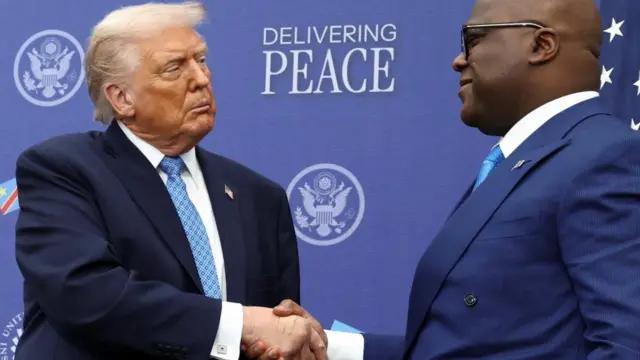
    Donald Trump shakes hands with Democratic Republic of Congo President Felix Tshisekedi.Image source, Reuters

    US President Donald Trump has met Rwandan President Paul Kagame and Democratic Republic of Congo President Felix Tshisekedi for the signing of a peace agreement between both African countries.

    The peace deal seeks to end decades of conflict in the region by establishing a permanent ceasefire, the disarmament of rebel groups, provisions for refugees to return home, and a new framework for economic prosperity, Trump said during the ceremony.

    "I have a lot of confidence in both leaders," Trump said. "We'll keep these commitments."

    Both Kagame and Tshisekedi said they will honour the deal, with Kagame praising Trump as a "pragmatic" and "even-handed" leader who seized on an opportunity to contribute to peace.

    But while experts who spoke to the BBC said the formal signing of the agreement was a positive step, they said fresh fighting raging in DR Congo and conflict spreading across the region meant lasting peace was still a long way off.

    We're ending our live coverage now, but you can stay across the news in our story here.
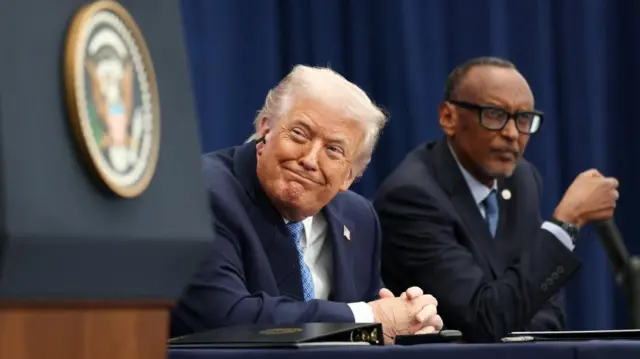
    A smiling Donald Trump sitting next to Rwandan President Paul KagameImage source, Reuters
  2. Leaders put pen to paperpublished at 19:03 GMT 4 December 2025

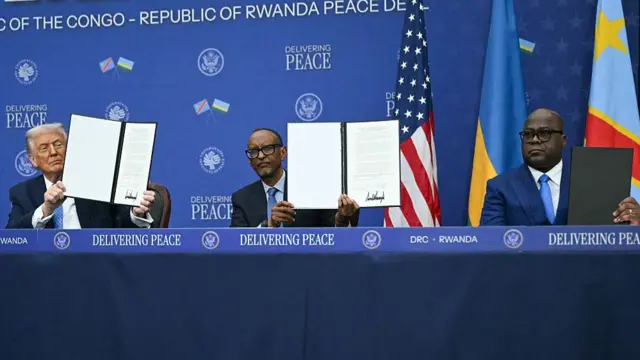
    Trump, Kagame, and Tshisekedi hold up their signed papersImage source, AFP via Getty Images

    Trump, Kagame, and Tshisekedi have each just physically signed the deals for peace and mineral sharing that were discussed today.

    The formality follows representatives of both nations agreeing to the peace terms in June.

  3. Ending a conflict between 'brothers' - African leaders praise dealpublished at 19:01 GMT 4 December 2025

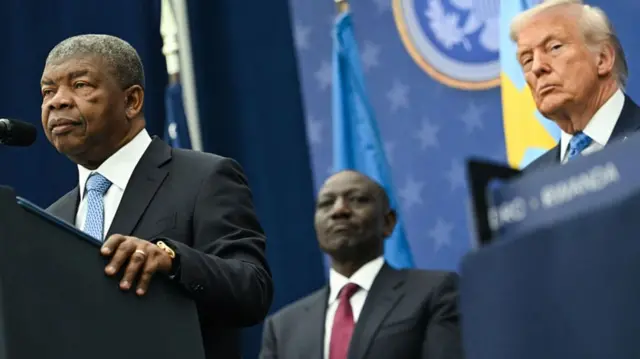
    Angola President standing at podium as Trump and another leader look onImage source, AFP via Getty Images
    Image caption,

    João Lourenço (left) speaks at the peace agreement signing as Kenyan President William Ruto (center) and Trump (right) look on

    Various African leaders have been invited forward to address the conference.

    African Union Chair and Angolan President João Lourenço, who has also brokered talks in the past between DR Congo and Rwanda, lamented the conflict between "brother" nations that has lasted 30 years.

    But he continued with more hopeful words about the huge wealth and potential of the Great Lakes region.

    Kenya's leader William Ruto said peace could unlock Africa's vast resources, while extolling the regional economic framework that has been launched as part of the deal.

    He praised Trump's "historic" achievement with the peace talks, saying "his bold leadership has been instrumental".

  4. Deal gives 'clear hope' - Tshisekedipublished at 18:42 GMT 4 December 2025

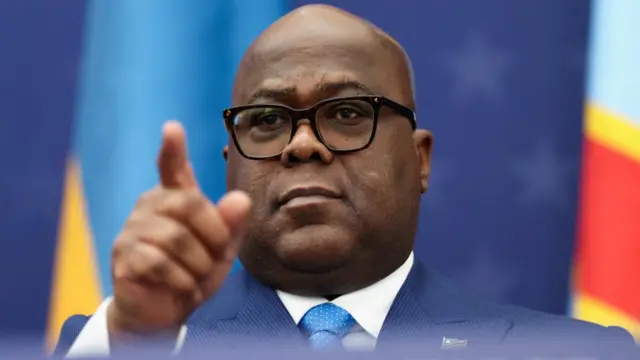
    Congolese President Felix Tshisekedi pointingImage source, Reuters

    Congolese President Felix Tshisekedi has expressed "deep gratitude and clear hope" while addressing those assembled during the signing ceremony.

    He has vowed to uphold his side of the agreement, and said he hoped Rwanda will "respect the letter and spirit of the deal".

    He also spoke of a "joint struggle" against armed groups.

  5. Kagame praises Trump's negotiating skillspublished at 18:38 GMT 4 December 2025

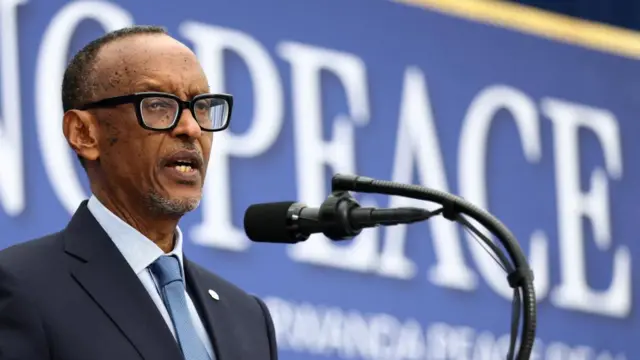
    Rwandan President Paul Kagame speaks at a lectern.Image source, Reuters

    Rwandan President Paul Kagame has praised Donald Trump as an "even-handed" leader who is "never taking sides".

    He said that while the region "is far from the headlines", Trump saw an opportunity to contribute to peace and "immediately took it".

    "More importantly, President Trump's approach is pragmatic," Kagame told the signing ceremony.

    "As a result, we have the clearest and most viable path forward that we have ever had."

    Kagame continues, saying that the future success of the peace deal lies upon the shoulders of African leaders, not on Trump.

  6. US to acquire rare minerals from African countriespublished at 18:33 GMT 4 December 2025

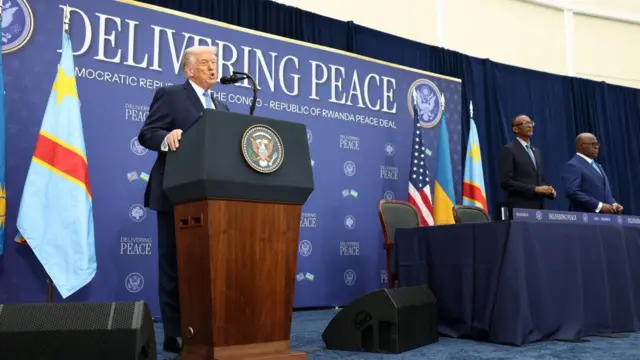
    Trump also says the US is signing its own mineral deals today with both DR Congo and Rwanda that will "unlock new opportunities for the United States to access critical minerals and provide economic benefits for everybody".

    Trump adds that the US will be sending some of its "biggest and greatest companies" to both countries to extract some of the rare earth minerals.

    "Everybody is going to make a lot of money," Trump says.

    Donald Trump speaks at a lectern with Rwandan President Paul Kagame and DR Congo President Felix Tshisekedi off to one side.Image source, Reuters
  7. Trump says leaders will keep to agreementpublished at 18:27 GMT 4 December 2025

    Trump says the agreement being signed today formalises the terms agreed to in June.

    Trump says that includes:

    • a permanent ceasefire
    • the disarmament of non-state forces
    • provisions for refugees to return to their homes
    • justice and accountability for those who have committed "illegal atrocities"
    • a new framework for economic prosperity

    "I have a lot of confidence in both leaders," Trump says. "We'll keep these commitments. I know they're going to keep them and follow through on the agreement and create a much brighter future for the people of their countries and they're heroes within their countries."

  8. Trump greets foreign guests present at the signing ceremonypublished at 18:24 GMT 4 December 2025

    Trump is now welcoming other foreign leaders who are present at the deal signing.

    That includes the presidents of Kenya, Angola, Burundi, Togo, and the vice-president of Uganda.

    He also welcomes the foreign ministers of Qatar and the United Arab Emirates, chairman of the African Union Commission, US Secretary of State Marco Rubio, and several US lawmakers.

  9. 'A great day,' Trump says as leaders enter stagepublished at 18:15 GMT 4 December 2025

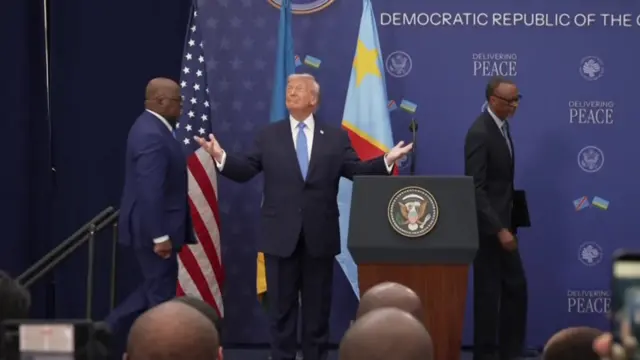
    Donald Trump with his arms out, with the Rwandan and DR Congo presidents walking onstage behind him.

    US President Donald Trump, Rwandan President Paul Kagame, and DR Congo President Felix Tshisekedi have just walked on stage for the peace deal signing at the newly renamed Donald J Trump US Institute for Peace.

    Trump greets the crowd, saying "It's an amazing day, great day for Africa, great day for the world and for these two countries, and they have so much to be proud of".

  10. Trump hopes peace will provide access to vital minerals for mobile phonespublished at 17:58 GMT 4 December 2025

    Donald Trump is hoping that the peace deal will provide access to minerals in eastern DRC.

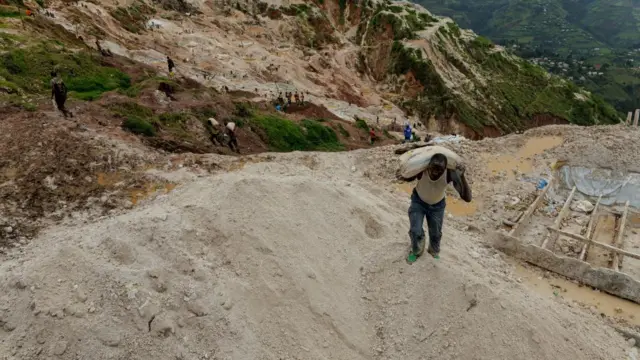
    The BBC was recently given access by the M23 rebels to a huge mining site in the region that is vital to the production of the world’s mobile phones.

    Thousands of miners dotted the landscape covered with pits and tunnels.

    Many were deep underground digging up ore with shovels while others hoisted sacks of extracted rock containing coltan, a key ingredient in making mobile phones.

    At least 40% of the mineral's global supply comes from DR Congo and some of the key mining areas are now under the control of the M23.

    A labourer carries a sack up a steep sand bank at a mineImage source, Reuters
    Image caption,

    A labourer carries a sack of ore at the Rubaya coltan mine in the eastern DRC

  11. Kagame and Tshisekedi depart White Housepublished at 17:33 GMT 4 December 2025
    Breaking

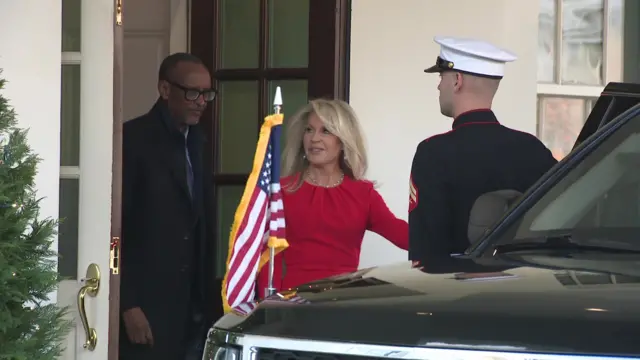
    Paula Kagame leaves the White HouseImage source, Reuters

    Rwandan President Paul Kagame and Democratic Republic of the Congo President Felix Tshisekedi have now left the White House after their meeting with US President Donald Trump.

    They didn't stop to address the press before driving off in two black SUVs.

  12. Progress being made, but a long way to go - experts on peace dealpublished at 17:30 GMT 4 December 2025

    Farouk Chothia
    BBC News

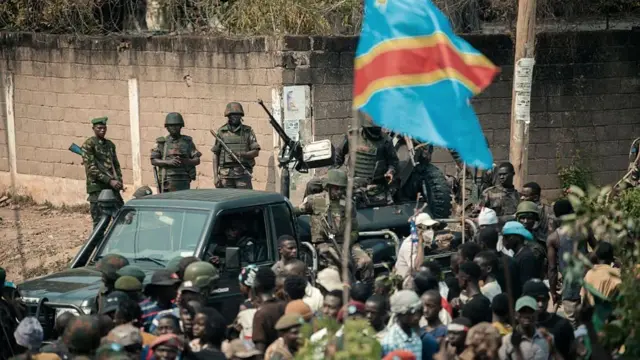
    armed guards standing beside truck in front of group of protestersImage source, AFP via Getty Images

    Bram Verelst, a DR Congo researcher with the South Africa-based Institute for Security Studies think-tank, describes the deal as significant from a diplomatic perspective.

    But he adds: "There is currently no ceasefire in place, and the M23 rebellion continues to expand and consolidate its control."

    The conflict is spreading across the region and increasingly impacts and involves Burundi, which remains outside all peace initiatives.

    "The signing ceremony is unlikely to alter this situation, though there is some small hope it could increase accountability on Congolese and Rwandan leaders to honour their commitments," he says.

    "The inclusion of Burundi (and Kenya) as a guarantor is also a welcome step towards more regional inclusivity. But much more needs to be done for a more inclusive peace process. Labelling war as peace will not change the reality and suffering on the ground."

    Still, the "signing shows that progress is being made, and both sides are still interested in talks", Prof Jason Stearns, a Canada-based political scientist who specialises in the region, tells the BBC.

    “It does not actually address or make much progress in terms of the substance of the peace deal. Most of the substance will be addressed in what they call the protocols, which are supposed to be negotiated after this signing.”

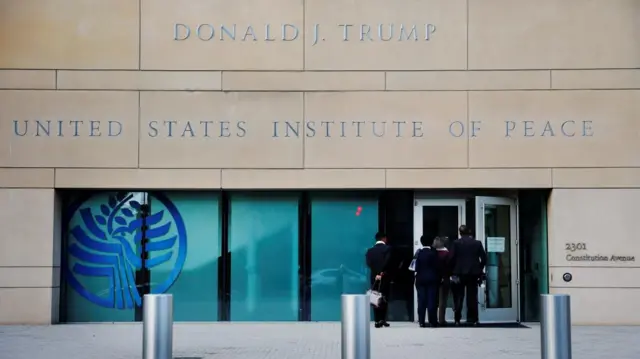
  13. Deal to be signed in newly named Donald J. Trump Institute of Peacepublished at 17:13 GMT 4 December 2025

    The peace agreement between DR Congo and Rwanda will be signed today not at the White House, but at the freshly named Donald J. Trump Institute of Peace.

    The president’s name was added in large block capitals to the building yesterday ahead of the signing ceremony.

    The Department of State announced the renaming was "to reflect the greatest dealmaker in our nation's history".

    The institute was founded as an independent, non-profit think tank funded by Congress, but question marks remain around its future.

    A legal battle has broken out after the Trump administration tried to exert control by cutting the institute's staff and budgets.

    A sign reads 'Donald J. Trump' on a stone building. The words 'United States Institute of Peace' are in block capitals underneath and several people can be seen entering the buildingImage source, Reuters
    Image caption,

    A sign reads 'Donald J. Trump' on the building of the United States Institute of Peace

  14. US-brokered deal one of two peace processespublished at 17:03 GMT 4 December 2025

    Farouk Chothia
    BBC News

    The US-brokered deal being signed in Washington today is not the only peace process in the works, with mediation efforts also being led by Qatar.

    Prof Jason Stearns, a Canada-based political scientist who specialises in the region, says Qatar, like other oil-rich Gulf states, is expanding into Africa "to project power, influence, but also to seek economic opportunities".

    He adds that Qatar became involved in mediation efforts at the request of Rwanda, which perceived the US as being in favour of DR Congo - which Washington denies.

    Prof Stearns says Qatar has "massive" economic interests in Rwanda, pointing out that the Gulf state is building a new multi-billion dollar airport in Kigali and was in talks to acquire a 49% stake in the national airline.

    He explains that it is important for the two processes to be "tightly tied to each other".

    "You don't want to end up in a situation where there is a peace deal between DR Congo and Rwanda, but Rwanda then says 'We don't control the M23', and the M23 continues escalating [the conflict] in eastern DR Congo".

    You can read more of his views here.

  15. Fresh fighting rages in DR Congo despite Washington meetingpublished at 16:49 GMT 4 December 2025

    Samba Cyuzuzo
    BBC Great Lakes

    While we wait to hear more from the White House, let's bring you some reports of what is happening in the Democratic Republic of Congo.

    Residents near the city of Uvira have told the BBC that clashes have broken out.

    Unconfirmed reports suggest people may have been displaced from their homes in the Katogota and Kamaniola areas.

    On Thursday's awaited peace deal, Fiston Misona, the leader of civil society in Walikale - a territory hit by violence in recent weeks - said people there were "happy" with developments in Washington but "suspicious" of the outcomes.

    "If Rwanda commits [to this deal], be honest and use logic, we are hopeful to a lasting peace in our country and the Great Lakes region," he added.

    Rwanda has recently accused DR Congo of violating earlier deals, but Foreign Minister Olivier Nduhungirehe has told reporters Kigali still has hope.

  16. Little movement at the White House as leaders meetpublished at 16:43 GMT 4 December 2025

    Bernd Debusmann Jr
    Reporting from the White House

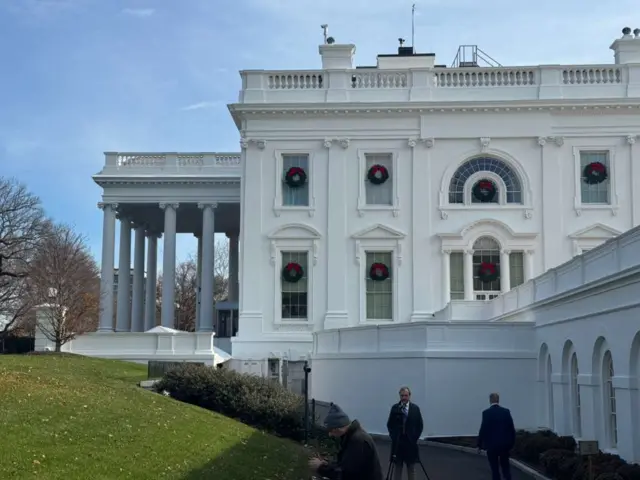
    Exterior of the White House

    Foreign leader visits to the White House are usually accompanied by considerable fanfare, with troops lining up along the driveway for the president to greet them by the West Wing.

    That's not the case today. The leaders are now in the White House, but we caught no glimpse of them going inside.

    I did, however, see black SUVs bearing the flag of the Democratic Republic of Congo drive away from a side entrance after dropping off President Tshisekedi, away from the eyes of the media.

    It's otherwise very quiet here, with only a handful of media outlets present. Most were just outside watching staff lower US flags to half-staff in honour of Sarah Beckstrom, the West Virginia National Guard soldier shot and killed nearby last week.

    As of now, there are no plans for their Oval Office encounter to be open to the press.

    Unless that happens, the first we will see them is later at the newly-renamed Donald J Trump Institute of Peace - more on that shortly.

  17. Presidents arrive at the White Housepublished at 16:38 GMT 4 December 2025
    Breaking

    Bernd Debusmann Jr
    Reporting from the White House

    Rwandan President Paul Kagame and Congolese President Felix Tshisekedi have arrived at the White House to meet Donald Trump ahead of their peace agreement ceremony later this afternoon.

    So far, we're not expecting any press appearances from the three presidents ahead of that ceremony, but I'm here at the White House and will let you know what I hear about their West Wing meeting.

  18. US marine stands guard at White Housepublished at 16:33 GMT 4 December 2025

    We may not get the chance to see Rwandan President Paul Kagame and Congolese President Felix Tshisekedi arrive at the White House.

    Their greeting with US President Donald Trump is currently listed as closed to the press, but it may still open up.

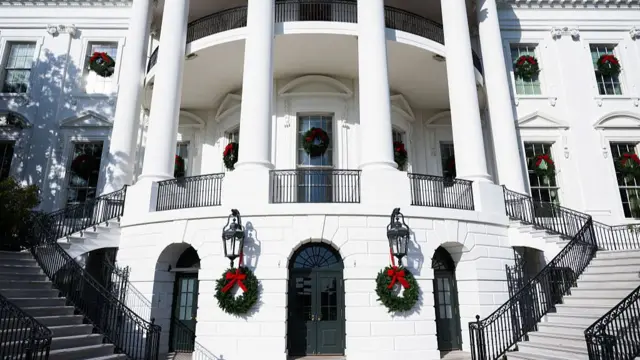
    For now, a US marine is standing guard beside the White House entrance, next to two Christmas trees.

    White House with wreaths hanging by the back entrance. Pic taken on 1 DecemberImage source, Getty Images
    Image caption,

    The White House has been getting a Christmas glow-up in recent days - here's the South Lawn entrance decorated with wreaths

  19. Roots of conflict traced back to Rwandan genocidepublished at 16:22 GMT 4 December 2025

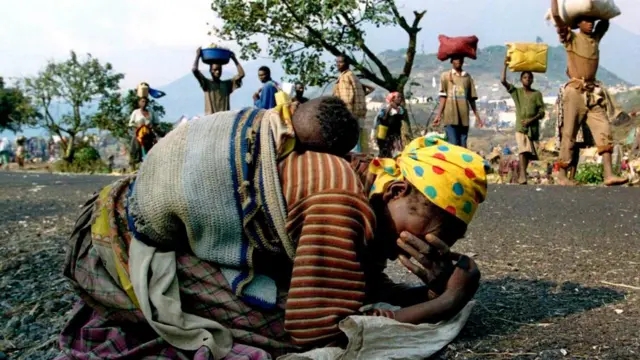
    The origin of the current fighting can be traced back to the genocide in Rwanda in 1994 when about 800,000 people – mostly from the Tutsi community - were slaughtered by ethnic Hutu extremists.

    The genocide ended with the advance of a force of Tutsi-led rebels commanded by Paul Kagame, who is now president of Rwanda.

    Fearing reprisals, an estimated one million Hutus then fled across the border to what is now DR Congo. This stoked ethnic tensions as a marginalised Tutsi group in the east – the Banyamulenge - felt increasingly under threat.

    Rwanda's army twice invaded DR Congo, saying it was going after some of those responsible for the genocide, and worked with members of the Banyamulenge and other armed groups.

    After 30 years of conflict, one of the Hutu groups, the Democratic Forces for the Liberation of Rwanda (FDLR), which includes some of those responsible for the Rwandan genocide, is still active in eastern DR Congo. Rwanda describes the FDLR as a "genocidal militia" and says its continued existence in the DR Congo's east threatens its own territory.

    In February, Rwandan government spokesperson Yolande Makolo told the BBC the FDLR wanted to return to Rwanda to "finish the job", and this is why Rwanda had to defend its territory.

    Rwanda accuses the Congolese authorities of working with the FDLR. DR Congo denies this, but in the recent peace deal, both sides agreed to ending "state support" for the FDLR. The agreement also says the group should be neutralised and Rwanda should row back on its "defensive measure".

    A Rwandan woman collapses with a child on her back alongside the road connecting Kibumba refugee camp and Goma in 1994. Several people carry supplies on their heads in the background.Image source, Reuters
  20. A brief history of the M23 rebelspublished at 16:12 GMT 4 December 2025

    The M23 is a rebel group led by ethnic Tutsis, who say they needed to take up arms to protect the rights of the minority group. In a rapid advance, they’ve captured a number of key cities and towns in the Democratic Republic of Congo.

    They say that several previous deals to end decades of fighting in the region have not been respected - and they take their name from a peace agreement that was signed with a previous Tutsi-led rebel group on 23 March 2009.

    Shortly after its creation in 2012, the M23 rapidly gained territory and seized the vital trading hub of Goma - acts that were met with international opprobrium and accusations of war crimes and human rights violations.

    It was forced to withdraw from Goma, and then suffered a series of heavy defeats at the hands of the Congolese army along with a UN force that saw it expelled from the country.

    M23 fighters then agreed to be integrated into the army in return for promises that Tutsis would be protected. But, in 2021, the group took up arms again, saying the promises had been broken.

    Fighting between the M23 and the Congolese army and allied militia has continued in the region as the rebels attempt to expand their territory.