Summary

  1. Important High Court ruling on Palestine Action doesn't end the storypublished at 14:06 GMT

    Thomas Mackintosh
    Live reporter

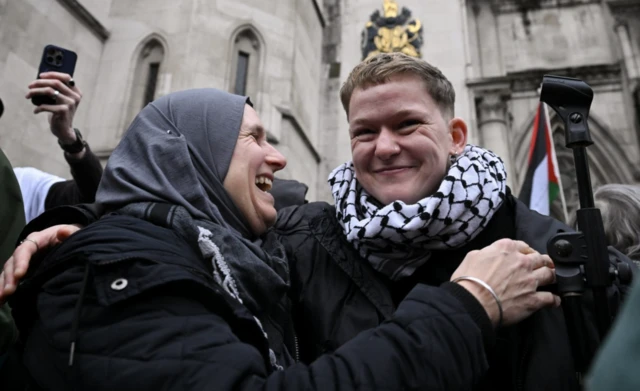
    People react outside the High CourtImage source, Reuters

    We will shortly be closing our coverage following the High Court ruling that the government's decision to proscribe Palestine Action as a terror group was unlawful.

    In a 46-page judgement read out this morning, the High Court judges described the ban as "disproportionate" and ruled that the then Home Secretary Yvette Cooper had not followed her own policies when bringing in the ban last summer.

    The ruling has triggered mixed reaction. The government has signalled an intention to appeal the decision. The Green Party and Liberal Democrats welcomed today's decision while the Tories said it "welcomed the Home Office's appeal to this ruling".

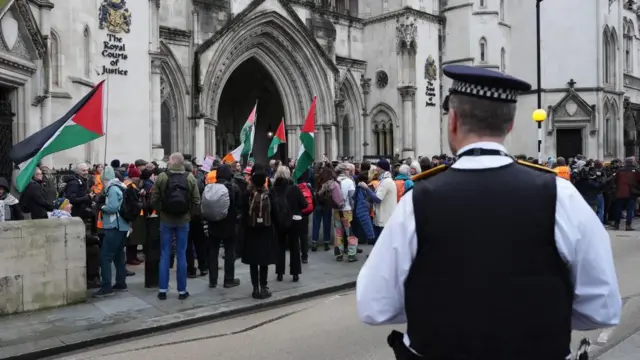
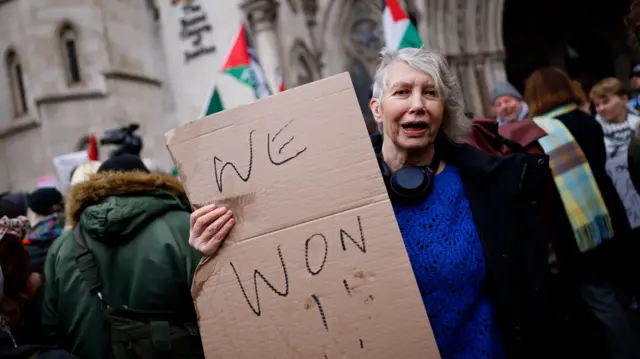
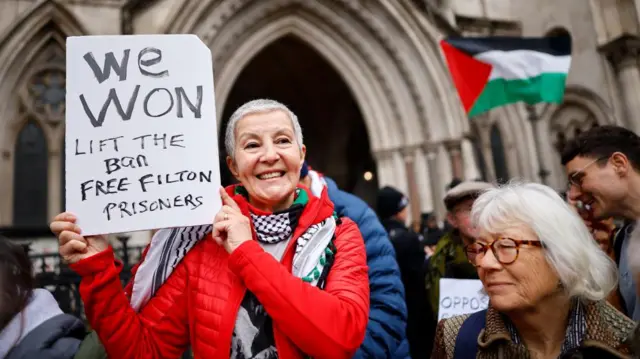
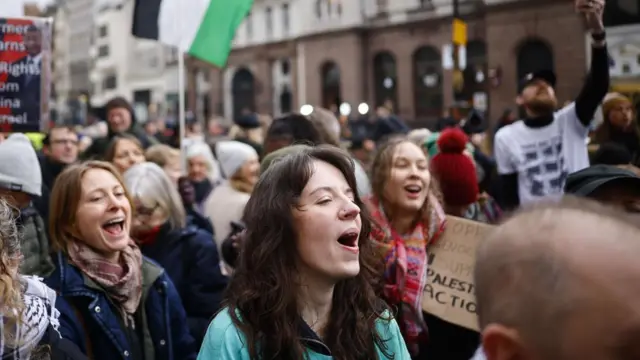
    Outside the High Court, supporters of Palestine Action celebrated; while co-founder Huda Ammori said the ruling was a "monumental victory".

    Despite the ruling, supporting the group remains a criminal offence for the time being – until another hearing on 20 February which will determine what happens next.

    Until then, the Metropolitan Police says the ruling places the force in an "unusual" position – saying that officers will now focus on gathering evidence of potential offences where support for Palestine Action is expressed "rather than making arrests".

    There are still plenty of moving parts. My colleague Dominic Casciani writes - explaining here - in our main news article - that today's judgement is really important but it does not end the story.

  2. 'This matters for everyone,' says rights group Amnestypublished at 13:55 GMT

    Amnesty UK – the UK branch of Amnesty International – says the ruling "matters for everyone" as "the right to protest has been under sustained and deliberate attack".

    "Thousands of people have been arrested for something that should have never been a crime," the group says in a post on X.

    Amnesty says the government must now "protect protest rights and make sure counter-terror laws are not misused".

  3. Hundreds charged with terrorism offence since Palestine Action banpublished at 13:49 GMT

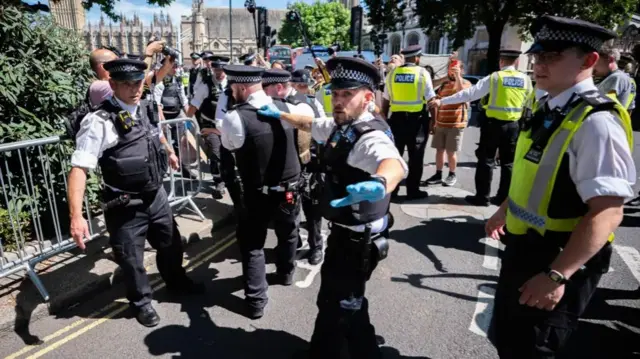
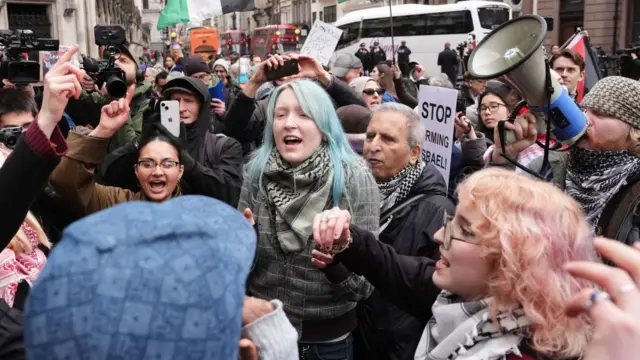
    Officers are at a protest in the streetImage source, PA Media

    As we've been reporting, the High Court has ruled that the decision to proscribe Palestine Action was "disproportionate" and should be overturned.

    It still currently remains a criminal offence to express support for the group, punishable by up to 14 years in prison.

    The protest group Defend Our Juries says more than 2,700 people have been arrested for holding up signs supporting Palestine Action since the ban came into force last July.

    Nearly 700 people have been charged with a terrorism offence and faced preliminary court proceedings, although no-one has yet been convicted.

  4. Conservatives welcome appeal against High Court rulingpublished at 13:27 GMT

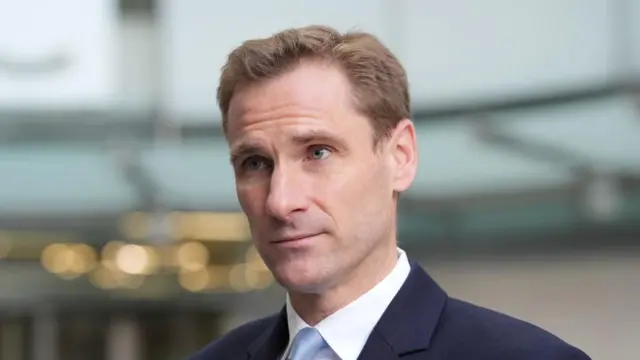
    Chris Philp stands outside BBC Broadcasting HouseImage source, Lucy North/PA Wire

    Shadow home secretary Chris Philp says Palestine Action has engaged in "organised political violence and cannot be tolerated".

    Following today's high court ruling, Philp says the group's campaign is "built on intimidation, destruction and violence".

    He adds: "Conservatives welcome the Home Office's appeal to this ruling. There can be no hesitation when public safety and national security are at stake."

  5. Jewish groups 'deeply concerned' at Palestine Action rulingpublished at 13:09 GMT

    Two Jewish groups have said they are "deeply concerned" at today's ruling, and have welcomed the government's intention to appeal.

    In a joint statement, the Board of Deputies of British Jews and the Jewish Leadership Council say: "We recognise the vital importance of judicial oversight in matters of national security and civil liberties.

    "However, the practical impact of Palestine Action's activities on Jewish communal life has been significant and deeply unsettling."

    They say they are seeking "clarity" from officials to "ensure that communities are protected from intimidation and criminality".

  6. 'Fantastic news' and 'disappointed': MPs react to Palestine Action judgementpublished at 12:52 GMT

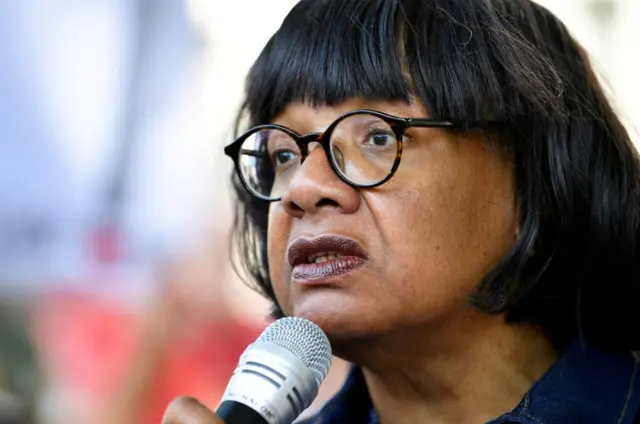
    Diane Abbott speaks into a microphoneImage source, Reuters
    Image caption,

    Diane Abbott, an independent MP, says it was a "democratic outrage" that Palestine Action was ever banned in the first place

    MPs have been reacting to the High Court judgement on Palestine Action, which ruled that banning the group was unlawful:

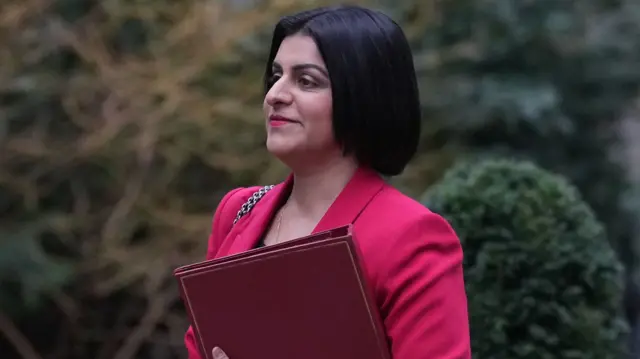
    • Home Secretary Shabana Mahmood says she is "disappointed" and that the government will "fight the judgement"
    • But Labour MP John McDonnell says the ruling is "fantastic news", calling the group's proscription "an assault on our civil liberties"
    • And former Labour MP Diane Abbott, now an independent, says it was a "democratic outrage" that the group was ever banned in the first place, adding that the government will bring itself "into further disrepute by pursuing an appeal"
    • Meanwhile, Liberal Democrat MP Max Wilkinson calls the ban a "grave misuse of terrorism laws", but adds that anyone accused of "vandalism" or "violent disorder" should still be investigated and prosecuted accordingly

    Earlier, we brought you some reaction from Green Party leader Zack Polanski. We'll bring you further statements from across the political spectrum as they come in.

  7. This is an important judgement - but what happens now?published at 12:34 GMT

    Dominic Casciani
    Home and legal correspondent, reporting from the High Court

    A police officer observes protesters gathered outside the High CourtImage source, PA Media
    Image caption,

    A police officer observes protesters gathered outside the High Court

    There's a lot of moving parts around Palestine Action.

    We're all back in court about likely re-trials in relation to the first major prosecution of its members for breaking into an arms firm - that happens on 18 February.

    And we know Home Secretary Shabana Mahmood is going to appeal today's decision.

    On 20 February, there's what's known as a consequential hearing. The home secretary will have to set out what she expects from an appeal. Meanwhile, I suspect Palestine Action will seek for the ban to be immediately quashed - and for the group to become lawful again.

    As the ban remains in place, it will be interesting to see what happens this afternoon.

    But as we just learned, the Met now says it won't arrest anyone for the time being for holding signs that declare support for Palestine Action, as they have done on previous occasions.

    This is a really important judgement, but it doesn't end the story.

  8. Recap: Palestine Action wins challenge, but group still proscribed for nowpublished at 12:20 GMT

    Supporters of Palestine Action hold placarss outside Royal Courts of Justice as they celebrate winning a legal challenge against the decision to proscribe the group under anti-terrorism lawsImage source, EPA

    The High Court has ruled that banning Palestine Action under terrorism legislation is unlawful, but it will remain a proscribed group for now. Here's a recap if you're just joining us:

    • Judges called the ban "disproportionate", adding that former Home Secretary Yvette Cooper had not fully followed her own policies when introducing the ban last summer. She also failed to account for the impact it would have on the right to protest, they said
    • It's a blow to the Home Office, which has said it will appeal the decision. Home Secretary Shabana Mahmood says she is "disappointed", adding that the government's proscription followed a "rigorous" process
    • Palestine Action co-founder Huda Ammori calls the ruling a "monumental victory", adding that the ban will be remembered as "one of the most extreme attacks on free speech in recent British history"
    • However, supporting the group is still a criminal offence for the time being. The ban will remain in place until another hearing on 20 February, which will determine what happens next
    • So, what does it mean in terms of law enforcement? The Met Police says it will continue to identify potential offences, but will now focus on "gathering evidence" for "enforcement at a later date", rather than making immediate arrests
  9. Police won't arrest people for holding Palestine Action signs for now, the Met sayspublished at 12:09 GMT

    The Metropolitan Police has just issued a statement in response to today's High Court ruling, saying that expressing support for Palestine Action remains a criminal offence.

    The High Court ruled earlier that proscribing the group under terrorism legislation was unlawful, but it added that the ban would remain in place to allow further arguments.

    "The group remains proscribed pending the outcome of any government appeal," the Met says, adding that they "recognise these are unusual circumstances".

    Police officers will focus on "gathering evidence" of those expressing support for the group "to provide opportunities for enforcement at a later date".

    But they won't arrest those committing the offence at the time, the statement explains.

  10. Green leader welcomes High Court decisionpublished at 12:00 GMT

    Nick Eardley
    Political correspondent

    Green Party leader Zack PolanskiImage source, PA Media

    Green Party leader Zack Polanski has welcomed the High Court's ruling that the government's proscription of Palestine Action was unlawful.

    In a statement, he urges the government to take action and "stop criminalising" people who demonstrate in support of Palestine Action.

    "Over 2,700 people have so far been arrested for holding a sign opposing genocide and the proscription of Palestine Action," Polanski says.

    "Those already charged should have those charges dropped, and the Crown Prosecution should discontinue action against all those arrested."

  11. What is a proscribed terror group?published at 11:30 GMT

    Palestine Action was proscribed a terror group by the UK government last July.

    By law, the government can proscribe an organisation if it commits, prepares for, promotes, encourages or is “otherwise concerned” in terrorism.

    There are currently 84 organisations proscribed under the Terrorism Act 2000.

    This list includes al-Qaeda, an Islamic group previously led by Osama Bin Laden, neo-Nazi group National Action and private Russian military company the Wagner Group.

  12. Former home secretary did not follow her own policies, High Court toldpublished at 11:19 GMT

    Dominic Casciani
    Home and legal correspondent

    Yvette Cooper is seen up closeImage source, PA Media

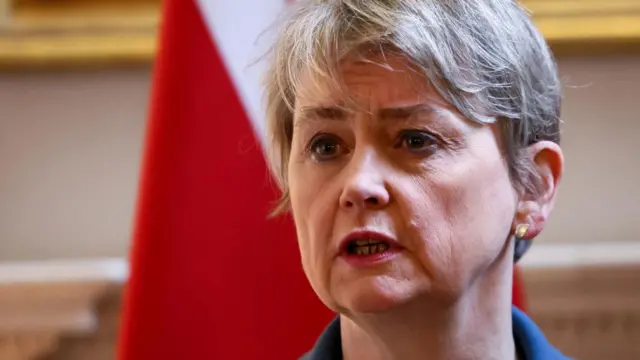
    The High Court said that when the former Home Secretary Yvette Cooper decided to ban the organisation last June, she had failed to first take into account what impact that decision would have on the right to protest.

    They also said she had not fully followed her own policies regarding the test for when an organisation should be proscribed under the Terrorism Act.

    Prior to the ban, the group’s volunteers had been breaking into arms firms linked to Israel, leading to charges of criminal damage.

    Terrorism legislation permits ministers to ban a group which causes serious damage to property in order to further their cause.

    The High Court ruled that the organisation had no human rights defence to those incidents.

    But the judge said that a critical issue in the case was whether the ban was impacting the rights of others to protest in support of Palestinian issues.

    “We accept that the fact of proscription and the heavy penalties for [terrorism offences] will mean that it is reasonable to expect people to be risk averse, to adjust their behaviour and to avoid doing things that run any significant risk that they might commit any of those criminal offences,” Dame Victoria Sharp said.

    The judges said that while “a very small number” of Palestine Action’s activities met the legal test for acts of terrorism, the standard criminal law could be used to confront the group.

  13. Supporters of Palestine Action celebrate outside courtpublished at 11:00 GMT

    We can now bring you some images from outside the High Court, where judges have just read out their ruling which said the decision to ban Palestine Action was "unlawful".

    Though the High Court said the ban is "disproportionate", it currently remains a criminal offence to be a member of, or support, Palestine Action.

    Supporters of Palestine Action hold banners outside Royal Courts of Justice as they celebrate winning a legal challenge against the decision to proscribe the group under anti-terrorism laws, in London, Britain, 13 February 2026. PalestinImage source, EPA
    Supporters of Palestine Action hold banners outside Royal Courts of Justice as they celebrate winning a legal challenge against the decision to proscribe the group under anti-terrorism laws, in LondonImage source, EPA
  14. Judges say Palestine Action ban is 'disproportionate'published at 10:51 GMT

    As we continue to bring you reaction to the High Court's ruling, here's a quick look at the summary of their decision.

    Dame Victoria Sharp said while reading out the 46-page judgement that the court considered the proscription of Palestine Action "disproportionate".

    "A very small number of Palestine Action's activities amounted to acts of terrorism within the definition of section 1 of the 2000 Act," she said.

    "For these, and for Palestine Action's other criminal activities, the general criminal law remains available.

    "The nature and scale of Palestine Action's activities falling within the definition of terrorism had not yet reached the level, scale and persistence to warrant proscription."

  15. Why was Palestine Action proscribed as a terror group?published at 10:42 GMT

    Supporting Palestine Action became illegal in July 2025 after the government voted to proscribe it under anti-terror law.

    It meant that membership or expressing support for the group became punishable by up to 14 years in prison.

    The move came weeks after Palestine Action activists broke in to an RAF base and spray-painted two military aircraft, resulting in £7m of damage.

    At the time, the government said the group met the criteria for terrorism, which is the use or threat of violence or damage to property designed to influence a government or intimidate the public to advance an ideological cause.

    As a reminder: The group has successfully challenged the ban, but expressing support for Palestine Action or taking part in its activities remains a serious criminal offence.

  16. 'A monumental victory,' says Palestine Action's co-founderpublished at 10:40 GMT

    Protesters celebrate outside the High Court, central London, where Dame Victoria Sharp, Mr Justice Swift and Mrs Justice Steyn have ruled in favour of Palestine Action's co-founder Huda Ammori's challenge over the ban of the organisation as a terror group. The Government will appeal against the High Court's decisionImage source, PA Media
    Image caption,

    Protesters celebrate outside the High Court after it ruled in favour of Palestine Action's challenge over the ban of the organisation as a terror group

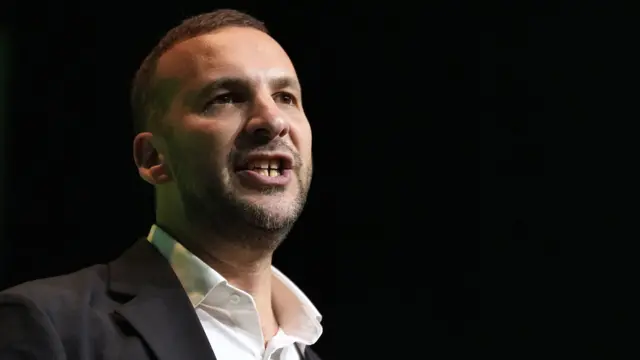
    Palestine Action's co-founder, Huda Ammori, calls the High Court ruling a "monumental victory for both our fundamental freedoms in Britain and in the struggle for freedom for the Palestinian people".

    Ammori says the group's ban under terrorism legislation will be remembered as "one of the most extreme attacks on free speech in recent British history".

    Responding to the government's intention to appeal the High Court ruling, Ammori says it would be "profoundly unjust" for the thousands of people who have been arrested since the group was proscribed last July.

  17. I'm disappointed by High Court's decision - home secretarypublished at 10:31 GMT
    Breaking

    Home Secretary Shabana MahmoodImage source, PA Media

    We can now bring you more from the home secretary, who says she's "disappointed" by the High Court's decision.

    “For those reasons, I am disappointed by the Court’s decision and disagree with the notion that banning this terrorist organisation is disproportionate.

    She adds that the government's proscription “followed a rigorous and evidence-based decision-making process, endorsed by Parliament".

  18. Government says it will appeal court's decisionpublished at 10:29 GMT
    Breaking

    The government will appeal against the High Court's decision that the ban on Palestine Action is unlawful, Home Secretary Shabana Mahmood says.

    We'll bring you more comments from Mahmood in the next few moments.

  19. Palestine Action ban ruled unlawful but group remains proscribedpublished at 10:19 GMT
    Breaking

    Dominic Casciani
    Home and legal correspondent

    The High Court has ruled that the ban of Palestine Action under terrorism legislation is unlawful - but it remains in place for now.

    In a massive blow to the Home Office, three senior judges said that while Palestine Action use criminality to promote its aims its activities had not crossed the very high bar to make it a terrorist organisation.

    The judges however ruled the ban must remain in place until a further hearing later in February as to what should happen next - including the possibility of a government appeal.

    The decision means that while the group has successfully challenged the ban, expressing support for Palestine Action or taking part in its activities remains a serious criminal offence.

    This is a developing story. We’ll bring you more information in just a moment.