Summary

  1. Recap: Trump says US will leave Iran in two or three weekspublished at 02:01 BST
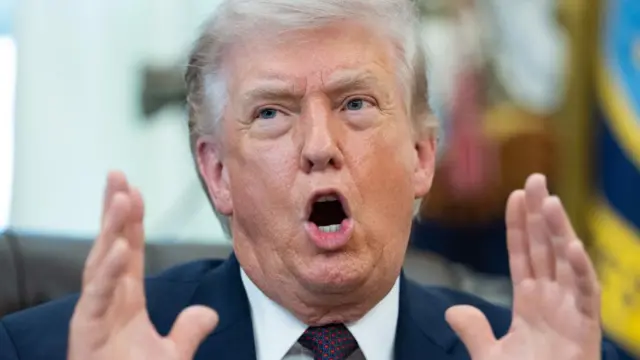
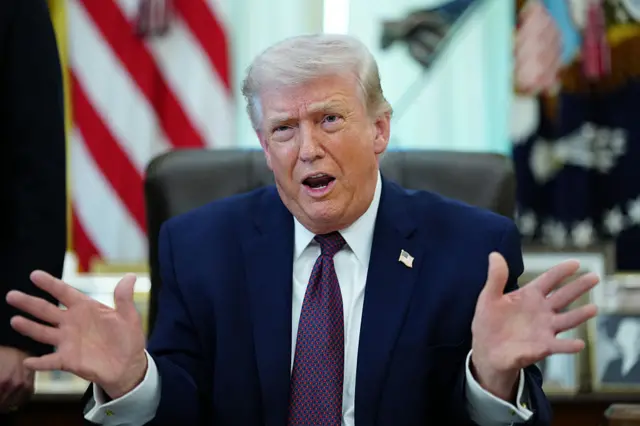
    Donald Trump gestures with both hands in the Oval OfficeImage source, EPA

    Donald Trump had said the United States could end its military attacks on Iran within two to three weeks and that Tehran does not have to make a deal as a condition for the war ending.

    "We'll be leaving very soon," Trump said at the White House on Tuesday, adding the exit could take place "within two weeks, maybe two weeks, maybe three".

    Asked if successful diplomacy with Iran was required to bring the conflict to an end, Trump said it was not. "Iran doesn't have to make a deal, no. No, they don't have to make a deal with me."

    The US president earlier lashed out at European allies, saying on Truth Social that countries "like the United Kingdom" who can't get jet fuel because of the restrictions around the Strait of Hormuz should “build up some delayed courage, go to the Strait, and just TAKE IT".

    Meanwhile, the fighting continues in the Middle East. Lebanon's capital Beirut has been hit by heavy airstrikes, with Israel's military saying it was targeting a Hezbollah commander and another senior figure.

    And just a short while ago, the White House announced that Trump will address the nation on Wednesday evening. We'll be covering that live as it happens.

    We're closing our live coverage here now. You can follow all the latest developments on our new page here.
  2. Trump to give 'important update on Iran' in Wednesday night national addresspublished at 01:08 BST
    Breaking

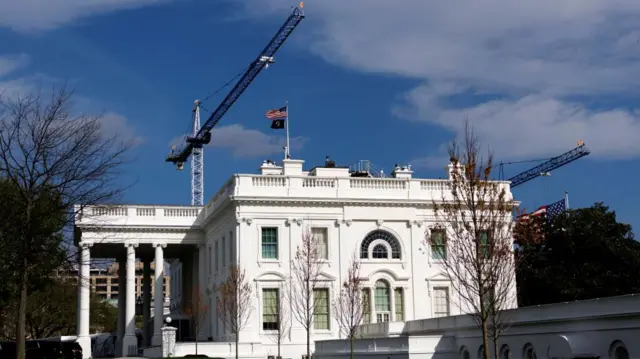
    A crane behind the White House in Washington, DC, USAImage source, EPA

    President Trump will deliver an address to the nation about Iran on Wednesday evening.

    White House Press Secretary Karoline Leavitt says the president will "provide an important update on Iran."

    The speech will be at 21:00 ET (02:00 BST, 01:00 GMT).

  3. Petrol prices on track to hit record high in USpublished at 00:44 BST 1 April

    Media caption,

    'Something needs to be done' - Americans struggle as fuel prices surge

    Now that the Iran war is one month on, US consumers are beginning to feel the pain of of higher petrol prices.

    With the Strait of Hormuz - one of the world's busiest shipping channels - effectively cut off by Iran, the average price of petrol at the pump has topped $4 (£3.02) in the US for the first time in nearly four years.

    Oil prices are on track for the biggest one-month rise on record, with the global Brent crude benchmark trading near $120 (£90) a barrel.

    Read more about the rise in petrol prices here.

  4. Beirut rocked by 'heavy' strikes as IDF hits Hezbollah figurespublished at 00:19 BST 1 April

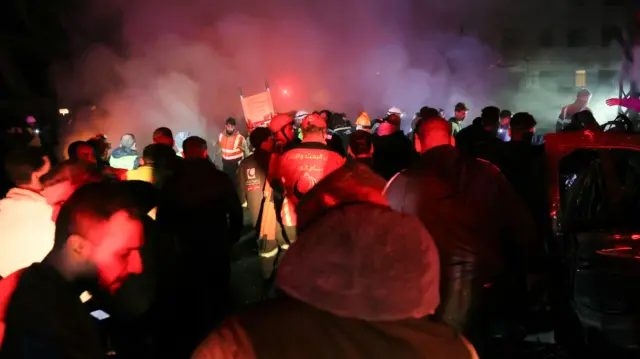
    Reports indicate Lebanon's capital Beirut was hit by heavy airstrikes overnight, where Israel's military says it struck a Hezbollah commander and another senior figure.

    The IDF says it conducted "two separate attacks" across Beirut but did not provide further details.

    Smoke columns were seen rising from the Jnah neighbourhood on the outskirts of southern Beirut, while multiple "heavy" explosions shook parts of the city, according to security officials speaking to Reuters.

    A car travelling south of Beirut was hit by multiple missiles launched by an Israeli drone, Lebanese state media reported.

    Earlier on Tuesday, Lebanon's Ministry of Health said eight people had been killed by Israeli strikes in the country's south, including a paramedic.

    First responders rush to the site of a series of Israeli strikes in JnahImage source, AFP
    Image caption,

    First responders rush to the site of a series of Israeli strikes in Jnah

  5. Israel says it was not responsible for blast that killed two UN peacekeeperspublished at 00:01 BST 1 April

    Israel says it was not responsible for a blast that killed two UN peacekeepers in southern Lebanon on Monday.

    The United Nations Interim Force in Lebanon (Unifil)'s initial findings suggest a "roadside blast" struck a convoy near Bani Haiyyan, killing the two Indonesian peacekeepers and injuring a further two.

    The Israel Defense Forces (IDF) says this incident "was not caused by IDF activity".

    "A comprehensive operational examination indicates that no explosive device was placed in the area by IDF troops, and that no IDF troops were present in the area at all," it says in a statement.

    It adds that it is targeting Hezbollah sites in the region, not Unifil, and urged Unifil to "avoid presence in combat zones" in which the IDF has issued evacuation orders.

  6. What we learned from Trump's Oval Office remarkspublished at 23:45 BST 31 March

    Kwasi Gyamfi Asiedu
    Live reporter

    We have just heard from President Donald Trump at the White House where he says the US campaign in Iran will come to a conclusion soon.

    Here is a round up of what he said:

    • Trump told reporters the US "will be leaving [Iran] very soon" and says US military action could end as soon as "two or three weeks"
    • He says the US has achieved the goals set before airstrikes against Iran began late last month in conjunction with Israel. He says the primary goal of curtailing Iran's ability to obtain a nuclear weapon has been reached and the US was now "finishing the job"
    • Trump claims the US now dominates Iranian skies and has also achieved regime change following the killings of many senior political and military leaders. He described the new leaders in Tehran as "much less radicalised" and "more rational" compared to their predecessors
    • Trump also says Iranian leaders are "begging to make a deal" with the US to end the war, a claim that has previously been denied by Iran. He adds that the war could end without a deal brokered between both sides
    • On the war's impact on rising fuel prices, the president says they will come down as soon as the US ends its military actions
  7. Iran 'begging to make a deal', Trump claimspublished at 23:19 BST 31 March

    After several questions on other topics, Trump returns to talk of Iran, saying that the US is "totally unchecked" and "everything's been bombed out".

    He says the regime no longer has anti-aircraft protection either.

    "They're not putting up a fight. They're not even shooting at us," he claims, noting that's because "their equipment's been totally decimated" and there's "nothing to shoot".

    He reiterates that they no longer have a navy or military too.

    "They're losing. They admit they're losing. They're begging to make a deal," he says.

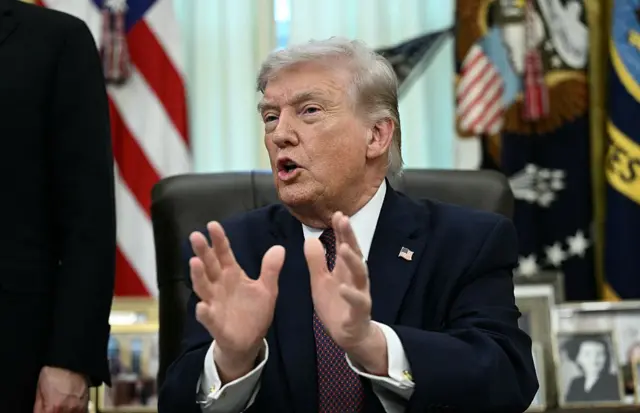
    Donald Trump, with hands splayed out, sits behind his desk in the Oval OfficeImage source, Getty Images
  8. Trump says a deal with Iran is not neededpublished at 23:09 BST 31 March

    "Iran doesn't have to make a deal, no," Trump says in response to a question from a journalist in the Oval Office.

    Trump says the US will leave Iran when they are certain the regime can not build a nuclear weapon "for years".

    "They cannot have a nuclear weapon."

    He says a deal is "irrelevant" to when the US leaves Iran.

    Trump is then asked about recent Iranian threats to US technology companies, which Trump brushes off. He questions what Iran could do, saying will they use "bb guns".

  9. US will 'leave' in 'two or three weeks', Trump claimspublished at 23:06 BST 31 March

    Trump suggests the US will "leave" Iran in "two or three weeks".

    He says he had "one goal" - that Iran can have no nuclear weapons, and says that has been attained.

    "We're finishing the job," he says adding the US will leave "within maybe two weeks, maybe a couple days longer to do the job".

    "We want to knock out every single thing they have - now it's possible we make a deal before that."

    He also says they may get a deal, but "it doesn't matter" if they "come to the table".

    US President Donald Trump gesticulates while sitting behind his desk in the Oval OfficeImage source, Getty Images
  10. Trump asked about rising gas prices, says US leaving Iran 'very soon'published at 23:01 BST 31 March

    Trump has been speaking in the Oval Office on various topics, and has just been asked by a journalist about rising gas prices at home and what his plan is to bring them back down.

    "All I have to do is to leave Iran and we will be doing that very soon," Trump says. "We will be leaving very soon."

    Trump says there has been regime change in Iran saying the new crop of Iranian leaders are "much less radicalised" and more "rational".

    He says if France or another country wants oil they can go up the strait of Hormuz and "fend for themselves." He says the US will have nothing to do with that.

  11. Trump is speaking now in the Oval Officepublished at 22:36 BST 31 March

    US President Donald Trump is now holding an executive order signing event in the Oval Office of the White House concerning mail-in voter fraud.

    In his opening remarks, Trump said he would take a few questions. We'll be listening for any news on the war against Iran.

    You can watch live at the link above.

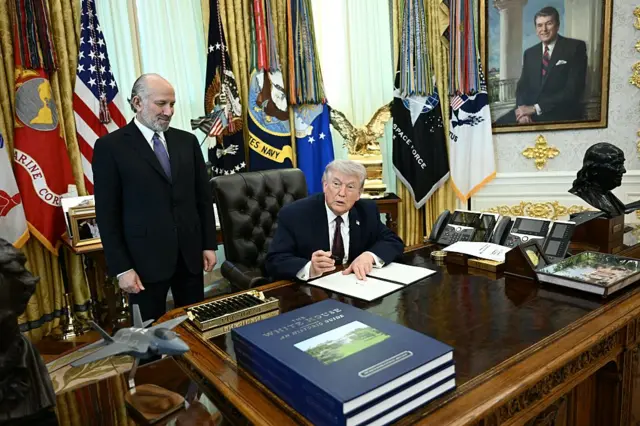
    US President Donald Trump sits behind his desk in the Oval Office with Commerce Secretary Howard Lutnick standing next to himImage source, Getty Images
  12. What we know about the kidnapping of a US journalist in Iraqpublished at 22:28 BST 31 March

    Tom Bateman
    US State Department correspondent

    Shelly Kittleson is an American journalist who has freelanced extensively from Iraq, Syria and Afghanistan, working for several outlets including the news website Al Monitor.

    The outlet said she was abducted by unidentified individuals in Baghdad and called for her immediate and safe release.

    Iraqi officials confirmed a foreign journalist had been kidnapped, saying security forces pursued a vehicle belonging to one of the kidnappers, which overturned as they attempted to flee.

    One suspect was arrested and officials said efforts were ongoing to track down the remaining perpetrators and secure the release of the kidnapped journalist.

    An emergency contact of Kittleson told CBS News the journalist had been warned by the US government about a specific threat to her from the Iran-backed armed group Kataib Hezbollah.

    Since the start of the war, the US embassy in Baghdad has warned of kidnapping risks and urged citizens in the country to leave.

    The US State Department said it was closely tracking the reports but due to privacy considerations had nothing further to share.

  13. US aware of reported kidnapping of American journalist in Iraq - State Departmentpublished at 22:09 BST 31 March

    Another story we are following out of Iraq that President Donald Trump may refer to in his remarks this afternoon is the kidnapping of an American journalist in Baghdad as confirmed by the US State Department.

    Dylan Johnson, assistant US secretary of state for global public affairs, writes on X that the State Department had previously "warned this individual of threats against them".

    He adds that an "individual with ties to the Iranian-aligned militia group Kataib Hizballah believed to be involved in the kidnapping has been taken into custody by Iraqi authorities".

    He adds that the department will "continue to coordinate with the FBI" to ensure the release of the journalist "as quickly as possible".

  14. Trump to speak at White Housepublished at 22:02 BST 31 March

    US President Donald Trump is about to speak at the White House where he will be signing an executive order.

    According to a post on X by White House Press Secretary Karoline Leavitt, the order concerns a "crack down on mail-in voting".

    The president may also make comments on the war with Iran and take questions from reporters in the room and we will bring you any developments.

  15. Pezeshkian says Iran has 'necessary will' to see war ended but there are heavy caveatspublished at 22:00 BST 31 March

    John Sudworth
    Senior News Correspondent

    Iran’s President Masoud Pezeshkian's comments that Iran has the “necessary will” to see the war ended have boosted financial markets in the US.

    However, the post of president in Iran is a subordinate one in a system long run by hard-line clerics, and the claim there is a “will” to end the war anyway came with heavy caveats, namely that guarantees are put in place that there will not be a return to conflict.

    On the face of it, that doesn’t appear to change much as calls for non-aggression guarantees had already been included in Iran’s reported response last week to America’s 15-point peace plan.

    And the powerful Islamic Revolutionary Guard Corps are certainly not offering olive branches with a new threat to widen the retaliation to include US tech companies.

  16. Iran has the 'necessary will' to bring war to end, with conditions - Iranian presidentpublished at 21:41 BST 31 March

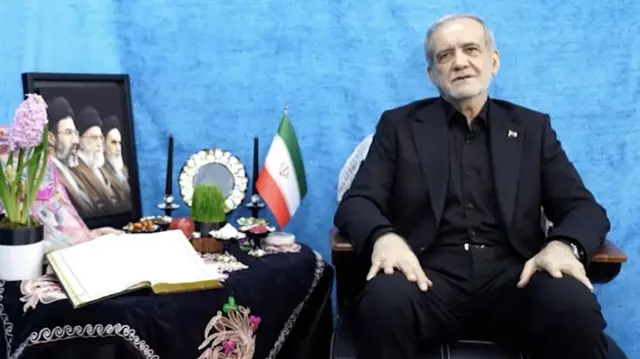
    A screen grab shows of the Iranian President Masoud Pezeshkian's video message regarding Nowruz on March 20, 2026 in Iran.Image source, Getty Images

    Iranian President Masoud Pezeshkian says Iran has the "necessary will" to put an end to the war with the US and Israel, as long as certain requirements are met.

    The comments came in a phone call between Pezeshkian and European Council President Antonio Costa, of which details have been reported by Iran's state-run IRNA news agency.

    These requirement, Pezeshkian says, include "mandatory guarantees" to prevent the recurrence of any future aggression.

    "At no point have we sought tension or war," he says, adding "the solution to normalising the situation is the cessation of their aggressive attacks".

  17. US has 'successfully started' first overland B-52 missions in Iran - top military adviserpublished at 21:24 BST 31 March

    Chris Partridge
    BBC News weapons analyst

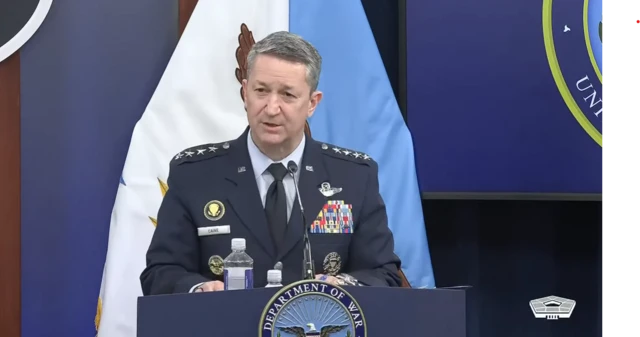
    Gen Dan Caine, Chairman of the Joint Chiefs of Staff

    US Air Force B-52s have been a key part of the strategic heavy bomber strike force against Iran since the start of this war.

    Taking off from RAF Fairford in Gloucestershire, early in the campaign we saw them armed with AGM-158 JASSM/-ER cruise missiles.

    These missiles would have been launched perhaps hundreds of miles away from targets because it would have been deemed too risky for the big, slow B-52s - with huge radar signatures - to get any closer at the time.

    Today General Dan Caine, Chairman of the Joint Chiefs of Staff, showed how gaining greater control of the skies meant that the B-52s have been able to fly over targets in Iran, dropping free-fall GBU-31 2,000lb bunker buster munitions.

    “Given the increase in air superiority, we have successfully started to conduct the first overland B-52 missions which allow us to continue to get on top of the enemy,” said Gen Caine.

    This was actually apparent last week when aircraft were taking off from Fairford loaded up with JDAMs.

    Gen Caine also signalled the move to more “dynamic targeting” - where aircraft in flight are given new targets - or find themselves new targets - to strike.

    These might well be mobile surface-to-air missile systems, missile launchers or Shahed-type drones fired from trucks. Such mission types were carried out in Desert Storm in 1991 - commonly known as Scud-hunting.

  18. Iran threatens US-linked tech firmspublished at 21:05 BST 31 March

    Ghoncheh Habibiazad
    Senior reporter, BBC Persian

    Iran’s Islamic Revolutionary Guard Corps (IRGC) has issued a one kilometre evacuation order for the Middle East operation sites of 18 companies it has threatened to target from 20:00 Tehran time (17:30 BST) on Wednesday.

    The IRGC has accused American tech companies of being the "primary elements of designing and tracking assassination targets".

    The companies listed include tech giants – and some of the valuable companies on the earth - Microsoft, Apple, Google, Meta, Tesla and Nvidia.

    Also included in the IRGC’s list are Cisco, Hewlett Packard, Intel, Oracle, IBM, Dell, Palantir, JP Morgan, General Electric, Spire Solutions, G42 and Boeing.

    "We advise the staff of these institutions to immediately evacuate their workplace to protect their lives,” the statement says.

    "Those residents living near these terrorist organisations in all countries in the region should also evacuate within a one-kilometre radius of their location and move to a safe area."

  19. Syrian president says country won't join the war unless it is targetedpublished at 20:39 BST 31 March

    Paul Adams
    Diplomatic correspondent

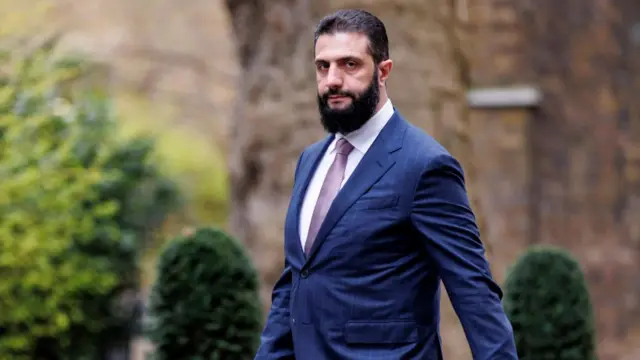
    Syrian president in blue suit walks along Downing StreetImage source, EPA
    Image caption,

    The Syrian president also met Sir Keir Starmer on his visit to London

    The Syrian president, Ahmed al-Sharaa, says that Syria is determined to stay neutral in the war with Iran, unless it is targeted.

    Speaking to an audience at London’s Chatham House think tank, the president said Iran’s interventions in Syria had helped the former Assad regime to displace Syrians.

    “We don’t have any problem with Iran in Tehran,” he said, “but we have a problem with Iran in Damascus.”

    He added there had been no contact with Iran since the outbreak of the war. The two countries do not have diplomatic relations.

    Al-Sharaa said Syria preferred a negotiated settlement with Iran, rather than continued conflict and that Syria would avoid being dragged into the conflict.

    He admitted that the situation in the region was so volatile that it was “a possibility” Syria could be targeted.

    “We’re not ready for another war,” he said, adding that his government’s priorities were to reconstruct and transform Syria and welcome back Syrian refugees.

  20. 'People are still going to the beach,' says Tel Aviv resident as Iranian attacks continuepublished at 20:18 BST 31 March

    Gabriela Pomeroy
    Live reporter

    Shimon RosenImage source, Shimon Rosen
    Image caption,

    Shimon Rosen says debris from a missile crashed onto the house next door to him

    Tel Aviv residents have been telling the BBC about frequent trips to bomb shelters as Iran continues to fire missiles at Israel.

    Shimon Rosen says he has been to a shelter more than 100 times this month.

    Debris from a missile interception crashed into the roof of the building next door to him several days ago.

    “The whole top floor crumbled,” he says. “I look out of my window, and I see a brick wall was blown off.

    “But people are still going to the beach, bars and parties,” he says.

    A month of sirens waking their children in the middle of the night has left many parents "destroyed," says one woman I spoke to who didn't want to be named.

    She recently ended up in the basement car park of a shopping centre during a missile siren, and found several tents pitched there. People have been sleeping there every night so they don't have to get up when the sirens sound, she says.

    An hour’s drive away in Jerusalem, teacher Shoshana Cohen says the war brings a real sense of "darkness".

    But during one of the many recent missile alerts, she smiled when she met a woman in a bomb shelter with her hair covered in silver foils, as the sirens had interrupted her hair salon colouring appointment.